The Louvre in Paris began as a medieval fortress, became a royal palace and opened as a public museum during the French Revolution. Twenty pictures cover very little of its collections. The famous names are here, Leonardo, Vermeer, Rembrandt and David among them. So are pictures that are easy to walk past on the way to them: Cimabue's Virgin on a gold background, a fragment by Bosch, a kitchen still life by Chardin, and Hubert Robert's view of the Louvre's own Grande Galerie imagined in ruins.
Raphael, Rembrandt, David and Delacroix each recur in the list, so you can compare an artist with himself as well as with his neighbours. Rembrandt, for instance, appears once telling a biblical story and once as his own sitter at the easel. The scale varies as much as the subject matter. Vermeer's Lacemaker could almost be held in two hands, while Veronese's Wedding at Cana spreads a banquet across a vast canvas.
Artline chose these works from documented museum holdings, independently of the museum. A picture in the collection is not necessarily on the wall, because it may be on loan or off display. Dates and attributions keep the qualifications given in the linked records.
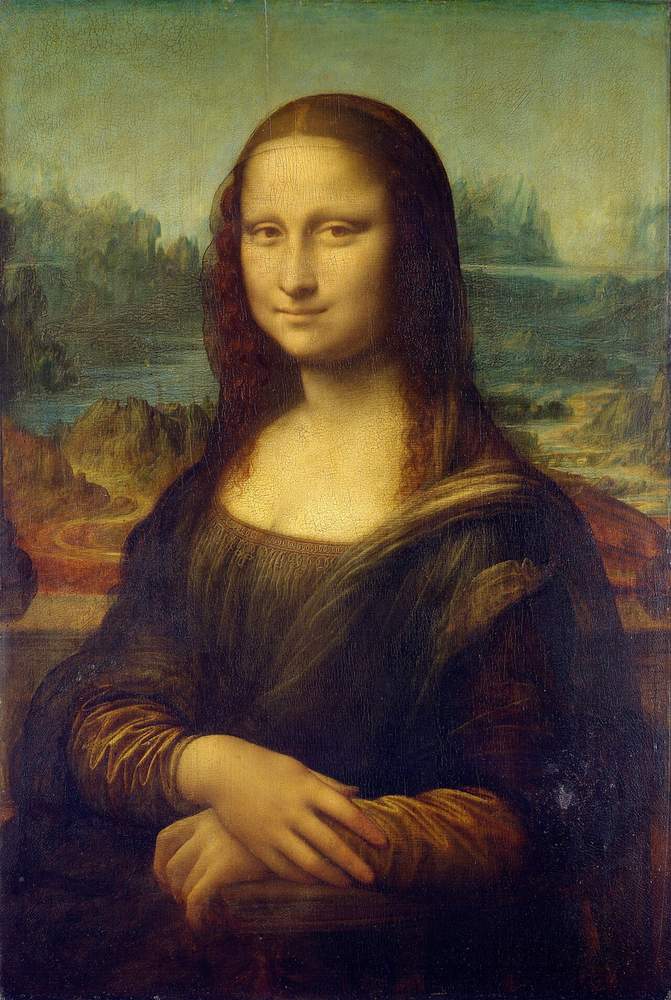
The steadiest part of Leonardo's portrait of Lisa Gherardini is her hands, folded calmly in front of her. Her face is less definite. Around the eyes and mouth the outlines seem to dissolve into shadow, and this goes some way to explaining why her expression is so hard to pin down. The technique is called sfumato: tones are blended without a hard boundary between them. Behind her, a winding landscape grows hazier as it recedes.
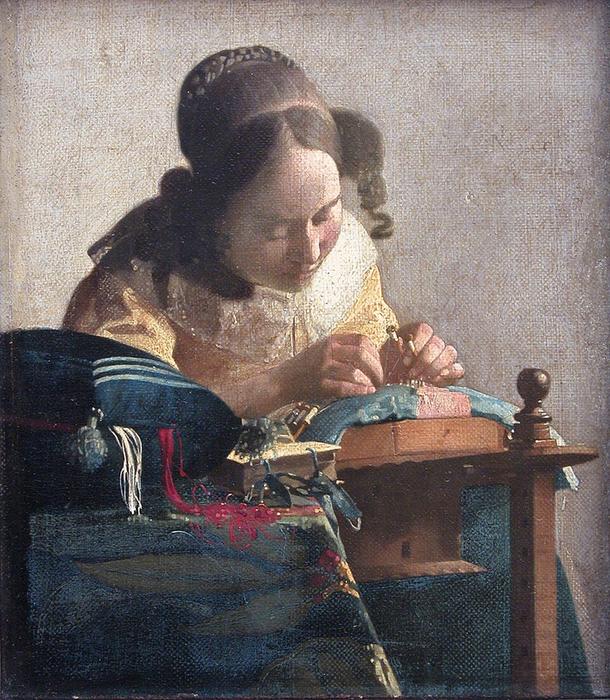
c. 1669–1670 · Oil on canvas mounted on wood · Musée du Louvre
Vermeer's Lacemaker measures only about 24 by 21 centimetres. A young woman bends over her work, and her attention seems to have narrowed to her fingers and the threads. In a picture this concentrated, it is surprising how loosely Vermeer paints the threads nearest the viewer. She may not be quite what the title suggests, either. The Louvre describes her as a woman of comfortable means rather than a professional lacemaker.
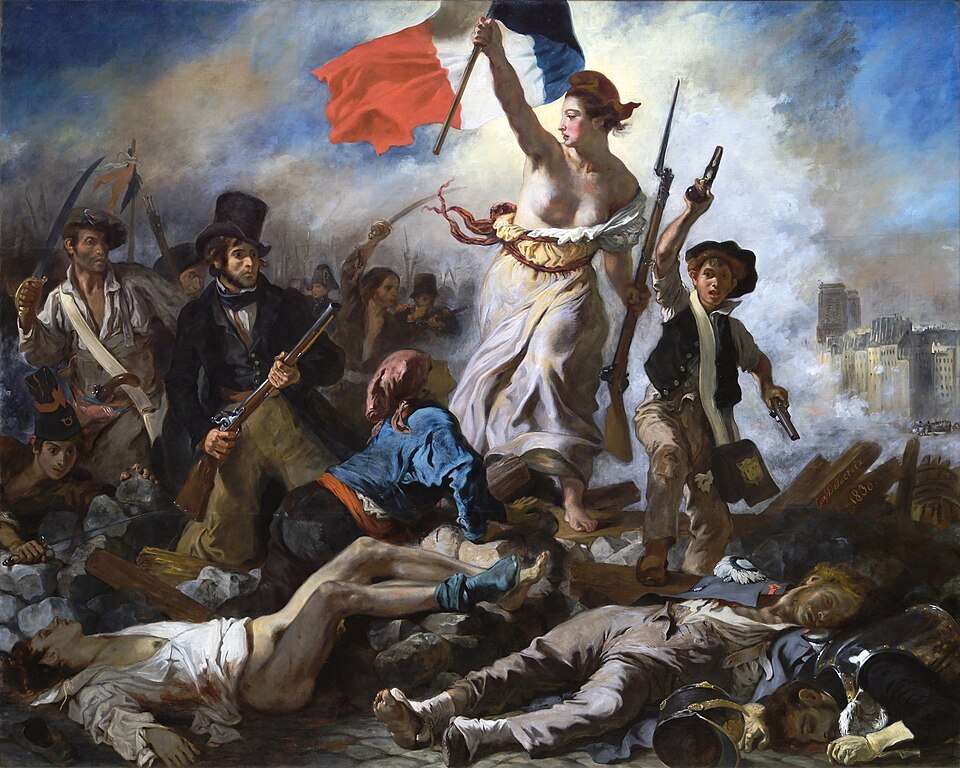
The fighting here belongs to the July Revolution of 1830, not the French Revolution of 1789. Into this street battle Delacroix puts an allegorical figure. Liberty carries a real weapon and steps over corpses that look real, but her bare breast, raised flag and greater scale set her apart from the people around her. In the foreground, the dead lie across the path the living have to take.
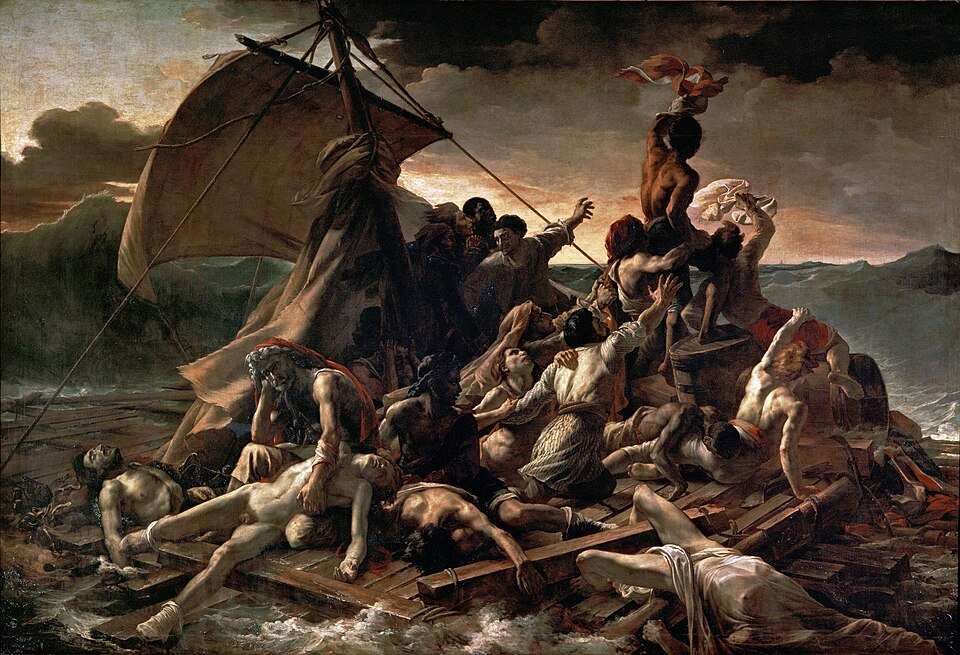
The wreck of the Medusa happened in 1816 and became a public scandal. Géricault gave this recent disaster the scale normally reserved for grand historical subjects.
The survivors' effort builds upwards, from the dead and exhausted at the front to the raised cloth at the far end of the raft. They are signalling to a ship on the horizon, and the ship is so small that their gestures towards it look almost useless.
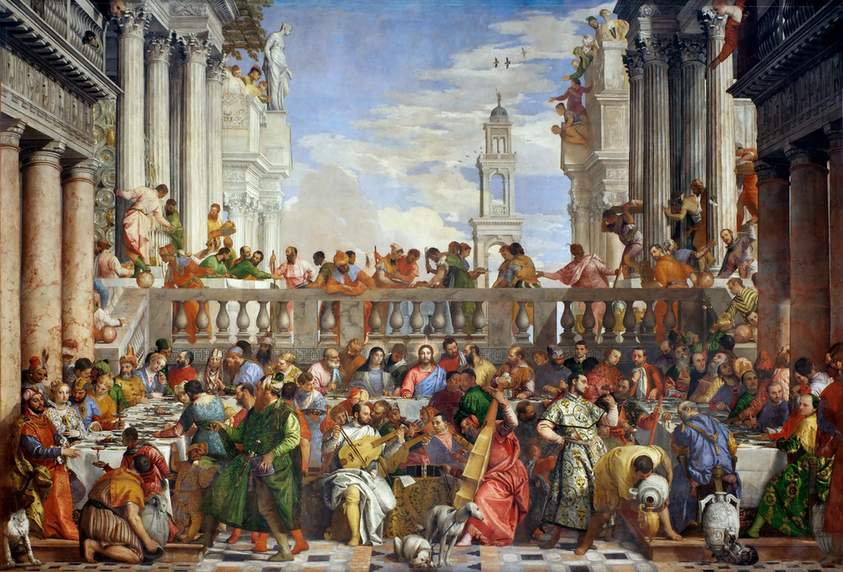
Christ sits near the centre, below the activity on the terrace, but he has a great deal of competition. Musicians, servants and guests fill almost ten metres of canvas, and the miracle of water turned into wine is surrounded by the business of a lavish meal.
Veronese painted the picture for the Benedictine refectory of San Giorgio Maggiore in Venice, so it originally faced people who were eating too. Its architecture and long tables suit that setting.
The woman in white is Hersilia. She steps into the space where the weapons are about to meet, between her Roman husband and her Sabine father. The women have family on both sides of the conflict, and the children at their feet make that impossible to ignore. Outstretched arms hold the centre, and the armed men around them hesitate.
David had painted a divided family before. In The Oath of the Horatii, also in this selection, the grieving women are kept to one side while the men swear their oath. Here a woman takes the centre, and her interruption becomes the decisive action.
The title names the card to watch for, and the cheating is visible before the game itself makes sense. At the left, a player reaches behind his back for a card. The richly dressed young man opposite is studying his own hand. Between them, a glance and a pointing finger suggest that the others know more than he does.
Almost nothing moves. The viewer is let in on the deception with no way of stopping it, while the young man, apparently the only one at the table still in the dark, has not yet worked out what is happening.
The woman's back runs from shoulder to hip for longer than ordinary anatomy would allow. The line flows so smoothly into the turn of her head and the fabric around her that the distortion may not register at first.
A peacock fan, a turban and luxurious textiles set her in an imagined harem. It is a European fantasy and a poor guide to Ottoman life. The polished surface lays everything out for inspection, though the look she returns is harder to read.
Castiglione was a writer and diplomat. Raphael dresses him in grey fur, a black cap and a pale shirt, so that little competes with his face. His blue eyes meet the viewer's and his hands rest low in the frame. He makes no emphatic gesture, which seems apt for a diplomat.
The ease is carefully arranged. The shoulder turns one way and the face another, and the broad shapes of the clothes hold the figure together.
The title keeps both of the figure's names: the picture was formerly called Gilles. Pierrot wears the costume of a comic performer but has very little to perform. He faces straight out with his arms hanging, and his white clothes stand out against the landscape. His companions appear lower in the picture, as if they belong to an action he has drifted away from.
It is tempting to call him sad, but his still face gives away less than that.
Nicolas Rolin, chancellor to the duke of Burgundy, kneels opposite the Virgin and Child as though they shared an unusually well-furnished room. His patterned robe, clasped hands and intent face are painted with as much care as the sacred figures. An angel holds a crown above Mary. Through the arches, a river runs past a crowded town, and even its small buildings are painted in detail.
The painting gives Rolin's devotion a public form, placing him for good at a meeting no ordinary visitor could attend.
Three brothers stretch their arms towards the swords their father holds, and their bodies repeat the same braced movement. At the right, the seated women bend and fold towards one another. Resolve and grief occupy separate parts of the picture.
The brothers are swearing to fight for Rome. Their families are bound to the enemy as well, and the women carry the cost of the oath at home. The picture was a royal commission, finished before the French Revolution, so this call to sacrifice for the state was first painted for the crown.
In the story Delacroix depicts, a defeated ruler orders the destruction of the people, animals and possessions that have served him. Sardanapalus watches from the top of a red bed while the killing spreads through the room below. Around him there is struggle and resistance, and against that his stillness is chilling. Delacroix's later Liberty Leading the People also has the dead at its feet, but there a figure steps over them on her way forward.
The scene is hard to sort out. Limbs, weapons and fabrics overlap, and the diagonal of the bed leads the eye through the confusion. The luxury offers no relief, since it is among the things being destroyed.
Robert's subject is the building that now holds the picture. Daylight falls through a broken vault in the Louvre's Grande Galerie, plants grow from the masonry and people move among fallen fragments. The long perspective survives, so the gallery is still recognisable without its roof.
The picture was a companion to a painted proposal for improving the same gallery, so the pair set a future for the museum's displays beside a vision of the building's decay.
Cimabue's panel is more than four metres high, and its design had to read across a church. The repeated figures and clear hierarchy suit that distance. The Virgin, the Child and six angels are set against gold, in a space defined by their sacred importance, yet the throne gives Mary a solid seat. The angels rise in balanced groups on either side, and their turning heads and the folds of their robes give the bodies some weight.
Mary looks down at the standing Christ child, while the young John the Baptist kneels with his cross. The three figures fit into a broad triangle, but their hands and the glances they exchange keep the group from hardening into a diagram. Behind them a landscape stretches out, and the sacred encounter looks like an intimate meeting in the countryside. Only John's cross brings the children's future into the scene.
A white cap catches the light above Rembrandt's face. The Louvre notes that technical examination revealed an earlier, darker head covering, so that patch of light was a revision. His tools and the edge of the easel identify his trade, but most of the picture's attention goes to his unevenly lit features.
King David does not appear. His power enters the room through the letter Bathsheba holds while an attendant tends to her foot, and Rembrandt keeps the scene on the woman who has to receive it. Broad light falls across her body.
Her head is lowered and her hand is at rest, which slows the story down. The biblical situation is clearer than her thoughts: her expression could be read as guilt, consent or sorrow.
For his reception piece at the Royal Academy, Chardin submitted a kitchen. A gutted ray hangs above the table with its pale underside exposed, an awkward and even unpleasant centrepiece. On the left a cat picks its way among the seafood; on the right the vessels stand more quietly. A folded white cloth links the two sides without tidying them. Wet flesh, rough skin, cloth and glazed surfaces gave him plenty to paint without any heroic story.
The passengers eat, drink and reach for food on a boat that seems to have lost any practical purpose. A tree serves as its mast. Clerical dress gives no protection against folly, and the crowd is too taken up with its appetites to notice where it is heading.
This narrow panel is a fragment of a triptych that was later taken apart, and the other parts once helped frame its moral argument. Even its present edges are partly the result of later cutting and may not be where Bosch meant them to be.
See the selected works alongside books and events from their period, or compare when the artists lived. The books and events provide context, not evidence of direct influence. Works without confirmed dates remain in this guide.
Continue in Artline
The combined timeline places the selected works beside books and events. The artist timeline shows something else: whose lives overlapped.
Before your visit
The entries follow no route through the building. To find locations, use the museum's current collection records and visitor information.
Read further
For dates, materials and bibliography, start with the object records linked with these entries. Leonardo's Treatise on Painting is a different kind of reading: a painter writing about his own craft, not a scholar writing about these pictures.
Leonardo da Vinci; translated by John Francis Rigaud Read free · English
Leonardo's notes on painting, compiled from his writings and translated into English by John Francis Rigaud. They cover observation, proportion, the body, light and perspective, and the practical decisions a painter makes.
 Art, literature & history