The Museo del Prado grew out of the Spanish royal collections and opened to the public in Madrid in 1819. It is particularly rich in Velázquez, Goya and El Greco. The Habsburg monarchs also collected works from Italy and the Netherlands, which helps explain why Titian, Bosch and Rubens are found in the same museum.
More than half of the twenty paintings chosen here are by Velázquez or Goya. Between them they take in royal portraiture, mythology, war, the crucified Christ and the horror of Goya's Saturn. The others are El Greco's Trinity and Adoration of the Shepherds, and one picture each by Bosch, Rogier van der Weyden, Bruegel, Titian, Raphael, Caravaggio and Dürer. Their subjects run from mourners crowded at the cross to an emperor on horseback and a painter's portrait of himself.
The paintings come from the museum's holdings, but the selection was made independently of the Prado. Inclusion here does not mean a painting is on view, because works may be on loan or off display. Dates and attributions follow the museum's records and keep their qualifications.
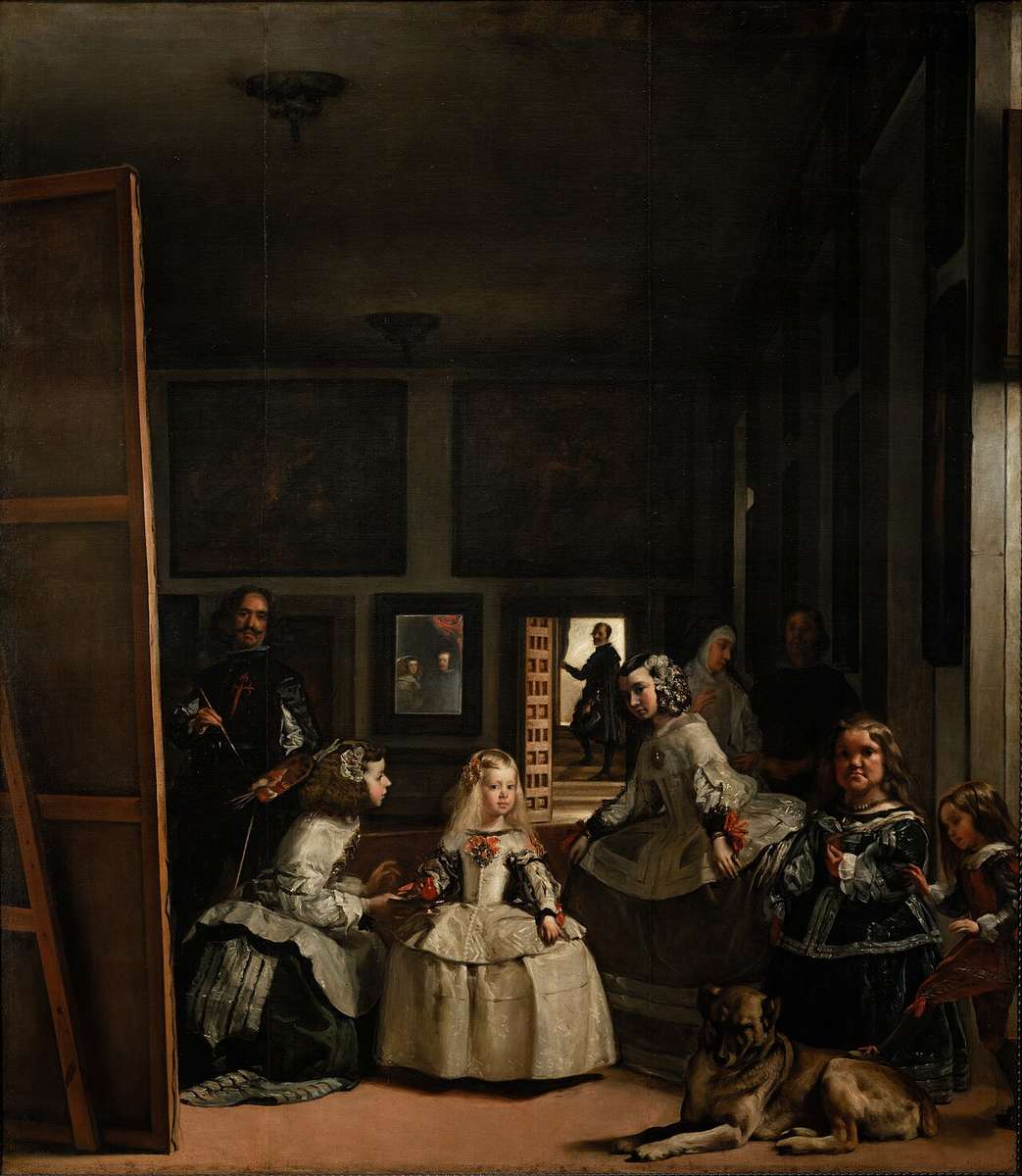
Velázquez painted himself at work in a room of the palace, alongside the young Infanta and her attendants. He stands beside a large canvas, but from where we stand its painted side is hidden. On the back wall a mirror reflects the king and queen, and an open doorway leads further into the palace.
These few details make the room hard to work out, and the picture has prompted many interpretations. If the king and queen appear in the mirror, where are they standing? Perhaps roughly where the viewer stands, in which case the hidden canvas might be their portrait, but nothing in the painting confirms either guess. Nor is it settled who the picture is really about: the Infanta and her attendants, the royal couple seen only in reflection, or the painter who has placed himself among them.
1490–1500 · Oil on wood panel · Museo Nacional del Prado
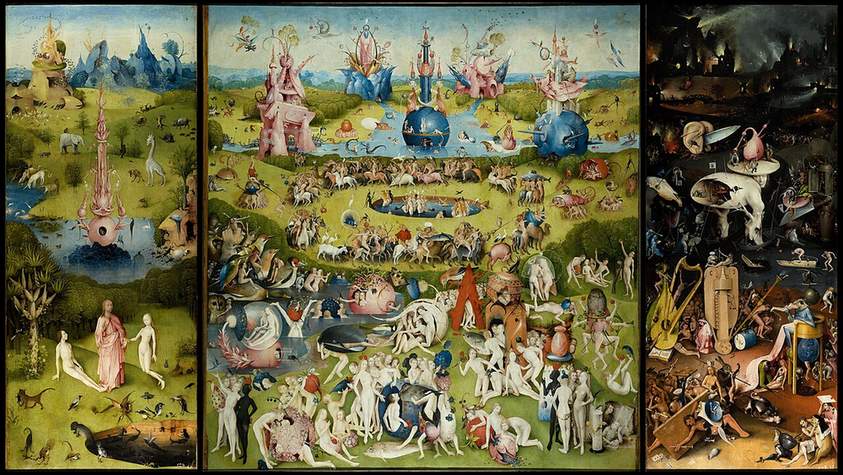
Bosch's panels move from open landscape to crowded pleasure, and then to darkness and punishment, with the hinges marking where one stage gives way to the next. Bodies are present throughout. What changes is the world around them and what is done to them. In the central panel they crowd among fruit and hybrid creatures. On the right they meet punishment in the dark.
Read from left to right, the sequence looks like cause and effect, with pleasure followed by its price. The trouble is the centre. It is so packed with small incidents and strange details that it is hard to read as a single lesson about either innocence or sin.
Before 1443 · Oil on wood panel · Museo Nacional del Prado
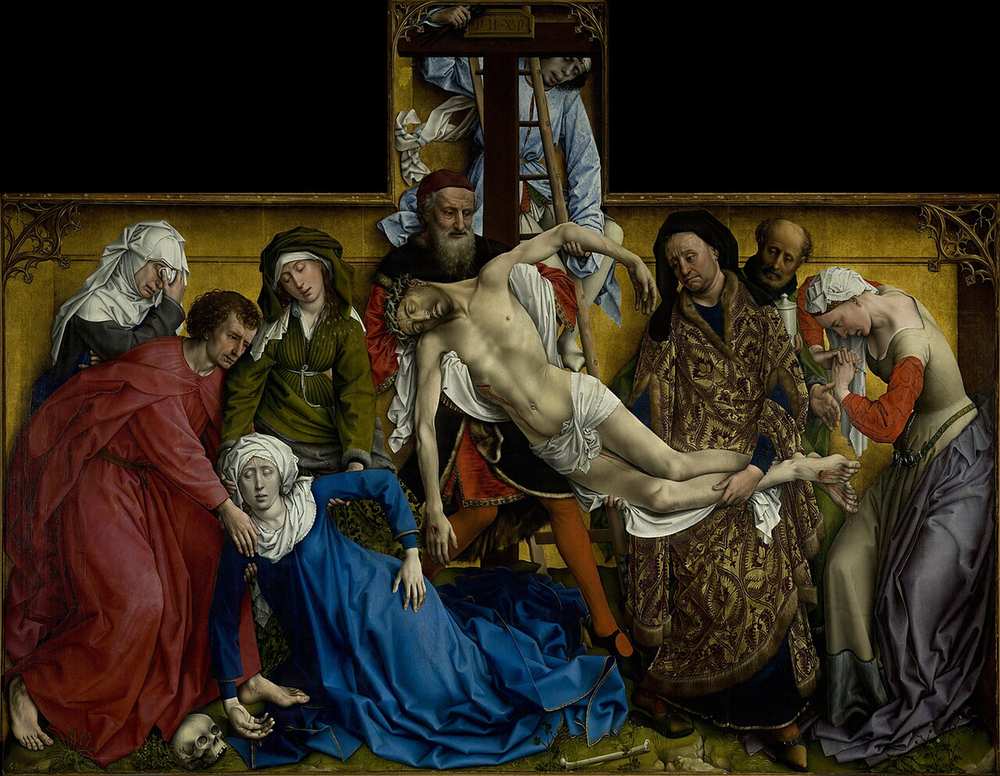
Mary has fainted, and her body slants at the same angle as Christ's as he is lowered from the cross, so the mother's collapse repeats the line of her son's body. Around them the other mourners support, bend forward and wipe away tears. The shallow golden enclosure leaves them almost no room and presses gestures and robes together, almost like a carved relief. Even so, each pair of hands keeps its own distinct grip.
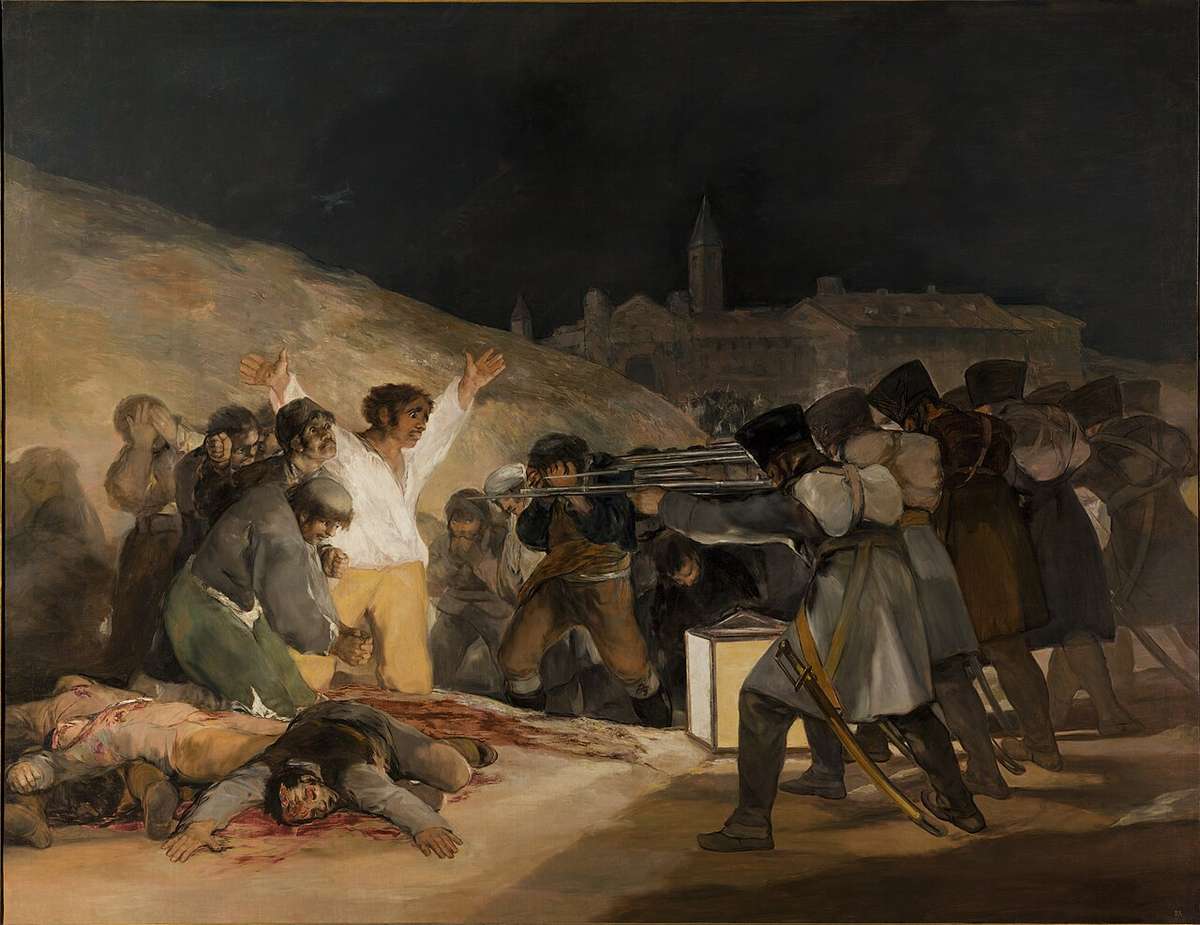
Goya painted these executions six years after the events named in the title. A lantern lights the condemned men, above all the figure in white with his arms raised. The soldiers have their backs to us and are little more than uniforms and rifles. We never see the killers' faces, while the light falls full on their victims.
The picture can also be read as a sequence in time. Behind the man in white, other prisoners wait their turn. In front of him, bodies already lie on the ground.
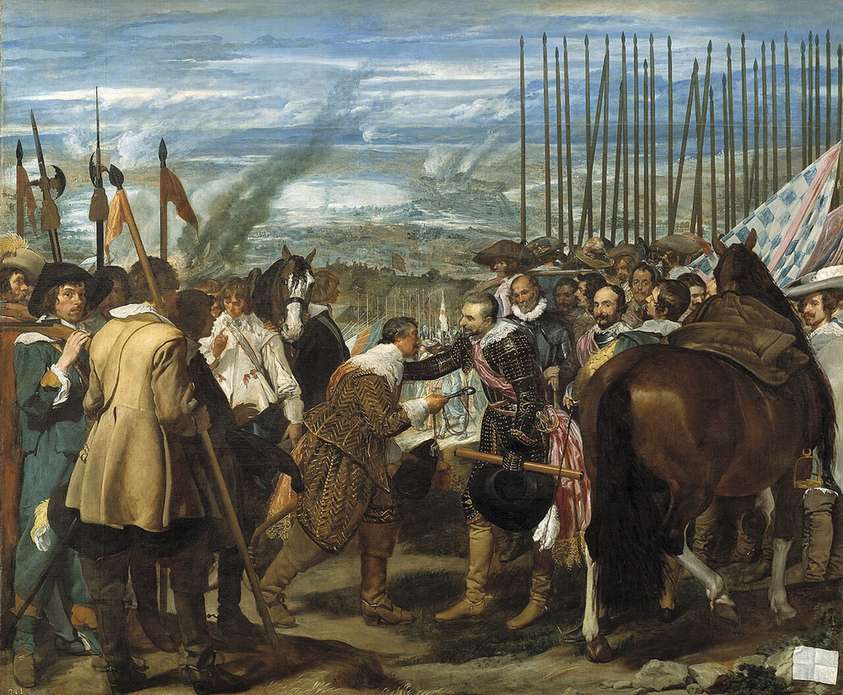
Ca. 1635 · Oil on canvas · Museo Nacional del Prado
Everything here turns on a small key passing between the two commanders. Spears, soldiers and a scarred landscape are enough to establish the scale of the event, but Velázquez keeps the exchange itself restrained and formal. In this picture, the victor's treatment of the defeated man counts for as much as the capture of the town.
1655–1660 · Oil on canvas · Museo Nacional del Prado
The double title offers a choice, and the picture contains both subjects. In the dim foreground, workers are busy at a spinning wheel. Behind them, in brighter light, a raised space opens onto the fable of Arachne and a finished tapestry. The labour of making thread is nearest to us, while the story that finished cloth can carry is set further back and better lit. Cloth appears here twice over: as a material handled with practical skill, and as a surface for an elaborate story.
Titian painted the emperor alone. There are no fighting troops and no confusion of battle, only Charles V on horseback in full armour, lance in hand, with red cloth running from rider to horse against a glowing sky. The mounted figure takes up almost the whole canvas, so the victory has to be read in his armour, his lance and his command of the horse.
1510–1511 · Oil on wood panel · Museo Nacional del Prado
The title gives an office rather than a name, and the red robes of that office fill most of the panel. Against the red, the pale face and the white sleeve stand out sharply, so even slight shifts of position register. He holds himself upright and still and looks straight at the viewer. Raphael conveys his authority through that direct gaze and a controlled turn of the body.
1498 · Oil on wood panel · Museo Nacional del Prado
Dürer presents himself as a distinguished sitter, and he is carefully dressed for the role. His gloved hands are composed, and the curled hair and clothes are painted with close attention. A window opens a view beyond the figure. The pose is turned and socially formal, quite unlike his later self-portrait in Munich, where he faces the viewer directly.
The tall format pushes the gathering upwards. Elongated figures bend towards the infant Christ and stretch into the space above him, and light picks out faces and robes across the scene. Anyone trying to work out exactly where each figure stands will get little help from the painting. Colour and light hold the crowded group together, and they keep the child clear at its centre.
1820–1823 · Mixed technique on a wall, transferred to canvas · Museo Nacional del Prado
Goya painted this in mixed technique on a wall. It was only later transferred to canvas. The god fills a dark space with no setting and no other witness, gripping a mutilated body and pressing it to his mouth. Nothing stands between the act and the viewer.
The face is harder to read than the act. Frenzy is the obvious reading of the wide, staring eyes, but they could equally suggest terror, and the picture becomes more disturbing still if the god seems horrified by what he is doing.
1795–1800 · Oil on canvas · Museo Nacional del Prado
She reclines on white pillows, hands behind her head, looking straight out at the viewer. The pillows continue the long horizontal of her body against the dark background. The setting, the pose and the direct gaze stay almost the same in The Clothed Maja.
1800–1807 · Oil on canvas · Museo Nacional del Prado
This version is dated later than The Naked Maja. White fabric covers the body, so folds and seams take the place of bare skin, and a darker jacket breaks up the long horizontal line. The clothes change the composition as well as the painted surface. The gaze, though, is as direct as before, and it is hard to see that covering the figure makes the picture much less confrontational. If anything, with the body hidden, the face has more work to do.
Apollo's entrance interrupts the men in the forge while they are still at work, and the surprise is carried by bodies caught mid-movement. One head turns sharply, a hand stops short, another man stares. No gesture is repeated, and none is theatrical.
Caravaggio shows the aftermath of the victory. David bends over Goliath's severed head with his face turned downward, and the light falls on his arms and on the task still in his hands. The dark setting leaves no room for a crowd or a public celebration, and the awkward physical business that follows the fight is kept close to the front of the picture.
1562–1563 · Oil on wood panel · Museo Nacional del Prado
There is no single focus here. Bruegel spreads the action across different settings and social ranks, and any attempted escape you follow leads only to another disaster. Fires and ruined buildings carry the destruction into the far distance. If the picture has a protagonist, it is the one named in the title, and it reaches every part of the crowded scene.
The royal family appears in full ceremonial dress and is presented as a dynasty, yet each face is distinct and individually characterised. Goya painted himself in shadow at one side and left the breadth of the canvas to the royal group. Characterisation of this kind is not, on its own, evidence of hidden caricature.
1628–1629 · Oil on canvas · Museo Nacional del Prado
Bacchus is pale and half-naked, which sets him apart from the men around him in their everyday clothes. Even so, he shares their space and seems to belong to the same drinking party. A wreath adds a ceremonial note, but the god has no separate heavenly zone. Velázquez handles myth in a similar way in Apollo in the Forge of Vulcan, where a god likewise appears among working men.
c. 1632 · Oil on canvas · Museo Nacional del Prado
Christ hangs alone on the cross against a dark background, with almost nothing of the surrounding story. The bowed head and carefully balanced limbs convey the weight of the body. Light falls on that body and on nothing else, so the eye always returns to it, and the picture reads as an image for contemplation.
1577–1579 · Oil on canvas · Museo Nacional del Prado
God the Father holds the dead Christ, whose body slants heavily downward across the canvas. Even within this heavenly gathering, the weight of the body is plain. Angels and billowing cloth lead the eye upward towards the dove of the Holy Spirit, but the body keeps pulling it back down.
See the selected works alongside books and events from their period, or compare when the artists lived. The books and events provide context, not evidence of direct influence. Works without confirmed dates remain in this guide.
Pictures to compare
Two paintings, or a small group, can be enough to shape a visit. Las Meninas and The Family of Charles IV both bring the painter into a royal group: Velázquez is at work beside his canvas, among the Infanta and her attendants, while Goya keeps to the shadows and leaves the stage to the family. Goya's two Majas differ mainly in what covers the body. War takes very different forms across the selection. At Breda it is the restrained handover of a key. Titian shows an armoured emperor riding alone. In The Third of May, soldiers seen only from behind fire on their prisoners. Christ's death is just as varied. Rogier van der Weyden presses his mourners into a shallow golden space, Velázquez sets a single lit figure against the dark, and El Greco shows the dead body held by the Father among angels.
A short illustrated study of Velázquez, published in English in 1907. It gives an earlier generation's view of the painter. For dates and attributions, the Prado's current entries take precedence.
Leonardo da Vinci; translated by John Francis Rigaud Read free · English
Leonardo's notes on technique, observation and proportion, in an older English translation by John Francis Rigaud. It does not discuss the Prado, but it offers a painter's own account of the practical problems of painting.
 Art, literature & history