A wood-panelled room from Anastasios G. Leventis's Paris apartment was rebuilt in Nicosia for the Leventis Gallery. His European paintings had once been kept in that home. The gallery opened in 2014 and also houses Greek and Cypriot collections. These twenty works come from all three.
Artline selected these works from documented museum holdings. The selection is independent of the museum, and individual works may be on loan or off display. Dates and attributions retain the qualifications in the linked records.
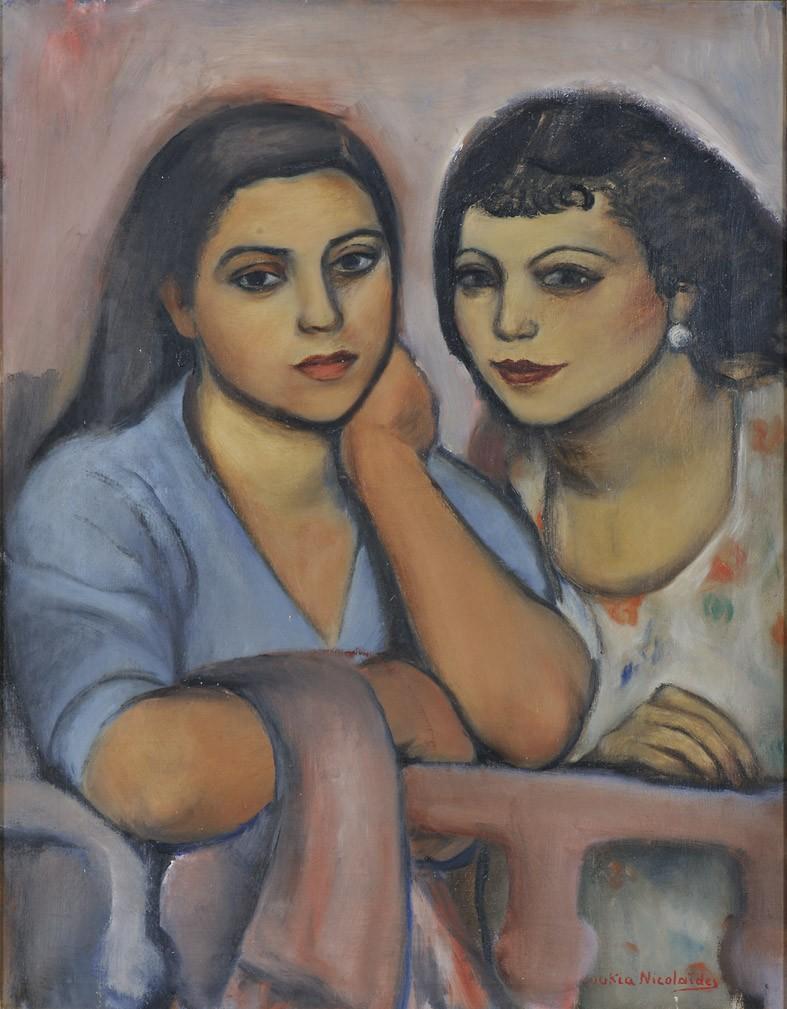
1933–1936 · Oil on canvas · A. G. Leventis Gallery
Nicolaides-Vassiliou returned to Cyprus in 1933 after studying art in Paris. Here she paints a dressmaker beside a customer, both women she knew. The dressmaker holds cloth; the customer, a friend of the painter, wears jewellery. Dressmakers went to their customers' homes and were paid by the day.
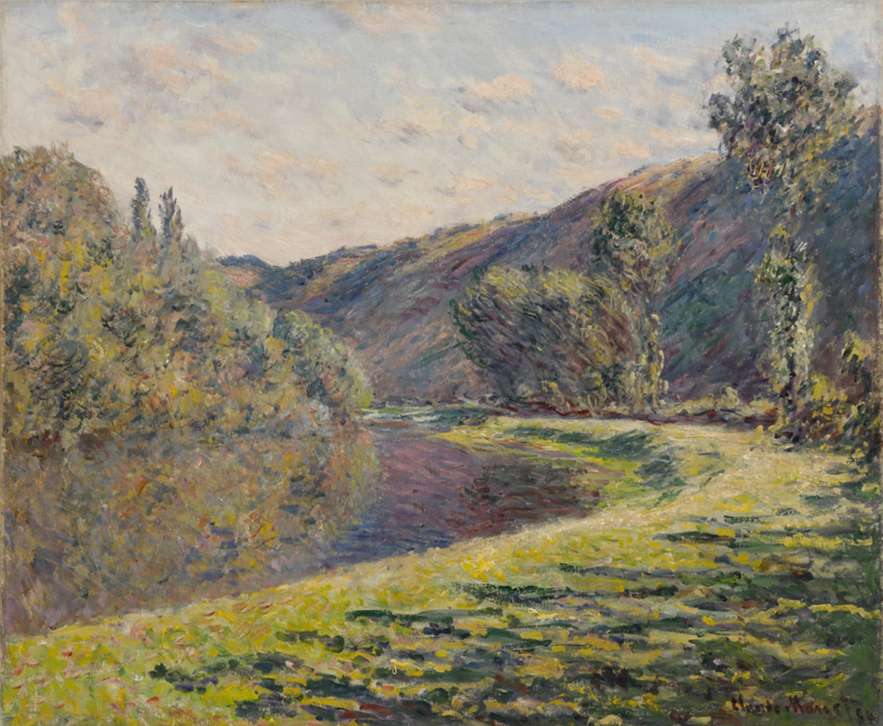
Paul Durand-Ruel bought this canvas from Monet in November 1884. Monet had painted it from a towpath at Jeufosse, looking upstream towards two islands, not far from his home at Giverny. The Seine picks up the green of the leaves; in places it is hard to tell bank from water.
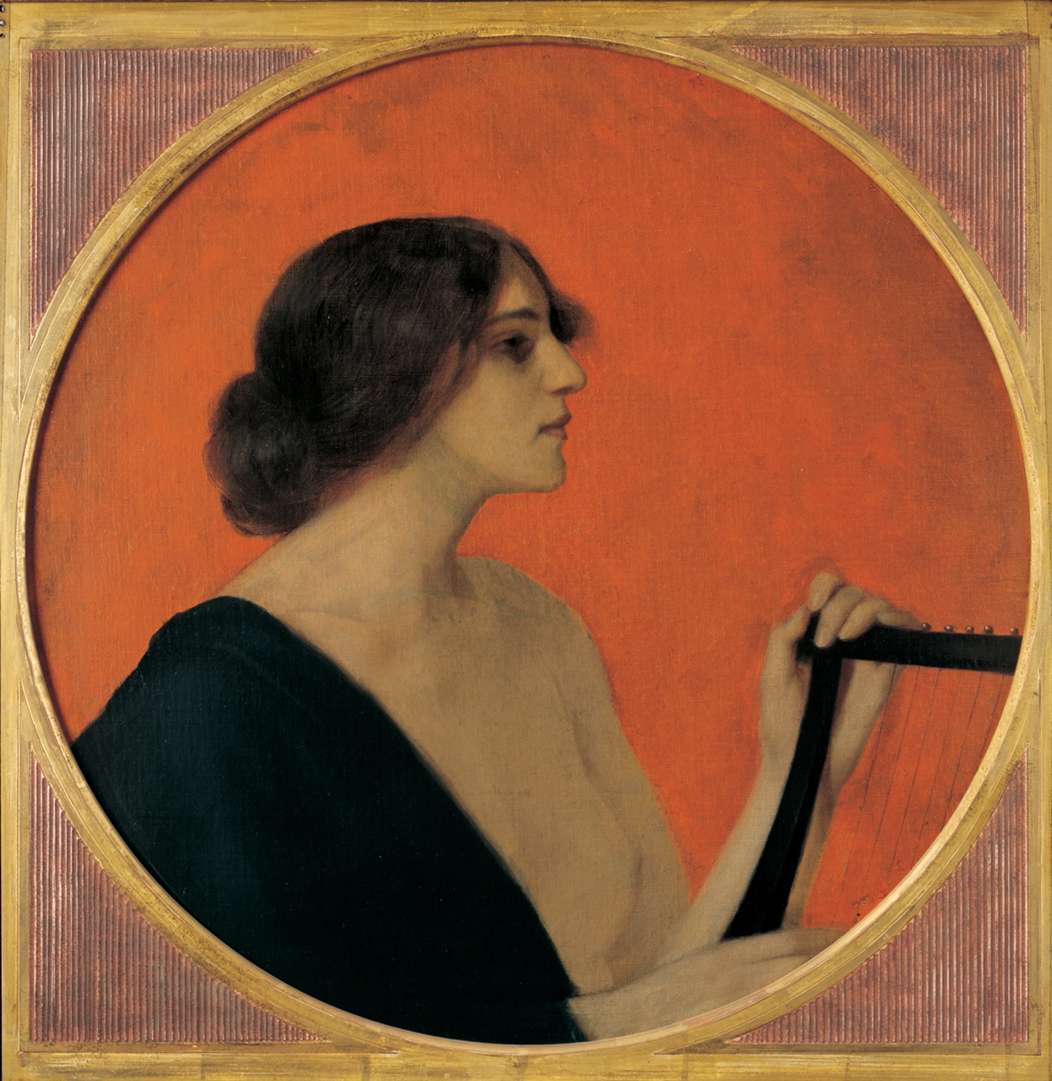
1893 · Oil on canvas mounted on wood · A. G. Leventis Gallery
A figure holds a lyre against a circle of light. This ancient Greek instrument stands at the centre of Harmony, the painting with which Gyzis won a competition organised by the German piano maker Rud. Ibach Sohn. The firm's centenary was in 1894; the painting was finished a year earlier.
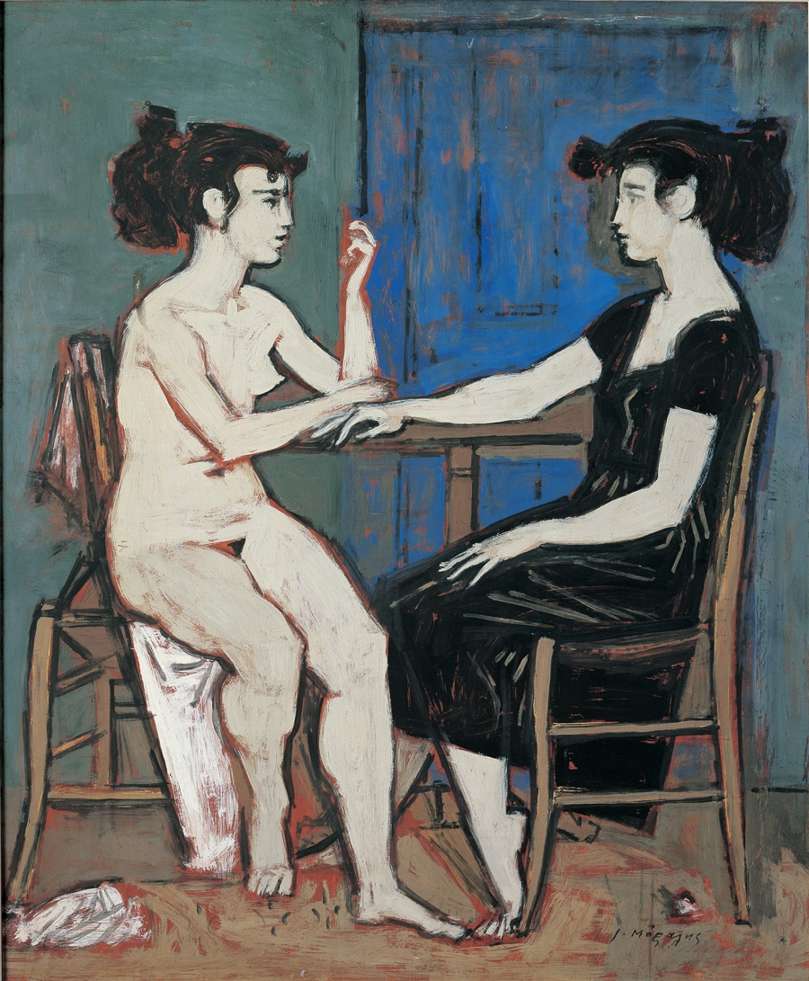
1954 · Egg tempera and oil on hardboard · A. G. Leventis Gallery
Moralis paints the two seated women in egg tempera and oil on hardboard. One is nude and the other dressed in black; they face each other with their hands resting on the table between them. The gallery compares this pose with ancient Greek funerary reliefs.
c. 1954–1955 · Oil on wood panel · A. G. Leventis Gallery
Some of the shadows look nearly as solid as the wooden trellis. Leaves cross its lines, adding to the tangle. Ghika had long worked with the angles of Greek streets and buildings.
Georghiou had painted the monastery of St Spyridon at Tremetousia around 1949. In this version, dated 30 July 1955, the stairs and balconies seem to lean in several directions while remaining recognisable as parts of the building. A related design was later printed as a lithograph in the Netherlands.
For many Cypriot families after the Second World War, emigration happened in stages. The men went abroad to find work. Their families could follow once there was enough money for them to go. Michaeledes paints the waiting part of that history: women and children remain on shore as the ship leaves.
The painting dates from 1950. Five years later, the catalogue of his exhibition identified the vessel as the Proteus, bound for Australia.
Frangoulides made elaborate religious images as well as landscapes, earning his living through painting and icon-making. Sunrise is pared down to water and a pale band of sky, with a slight change in tone between them. Corot's morning landscape in this selection includes goats, trees and a valley; Frangoulides gives the morning a much sparer setting.
before 1936 · Oil on plywood · A. G. Leventis Gallery
The gallery's 2017 exhibition Solomos Frangoulides: The Artist, The Art Critic considered both sides of his work. He contributed criticism to Cypriot newspapers and magazines as well as painting. Chatting, in oil on plywood, takes a domestic conversation as its subject.
before 1954 · Oil on wood panel · A. G. Leventis Gallery
A narrow panel contains Georghiou's elongated figure, with the small blue pillow providing a familiar scale beside her body. He takes liberties with architectural forms too: the monastery in Tremetiousia leans in several directions. Female nudes formed a small part of his work, and many remained in private hands.
Look for the two walkers among the orchard trees. They occupy very little of a canvas measuring 31 by 27 centimetres; most of it is given to the orchard. Pissarro had been painting rural paths and fields for decades by the time he signed this work in 1901, at the bottom left.
Pieter van der Velde bought this picture directly from Boudin on 31 October 1889. It shows the view from a pier above the mouth of the Touques, between Trouville and Deauville.
Sky stretches across most of the unusually wide canvas. Along the strip of sand below, some holidaymakers are hardly larger than their parasols. A trace of smoke from around Le Havre is visible on the horizon.
c. 1905 · Oil on board mounted on a cradled panel · A. G. Leventis Gallery
Bonnard keeps The Outing indoors. The woman is apparently preparing to leave, while furniture and patterns occupy almost as much space as she does. A mirror offers a second view of the room.
Goats graze under trees while morning light reaches the open ground beyond. Around ten years earlier, Corot had painted another morning scene with goats, now part of The Four Times of Day at London's National Gallery.
1916–1922 · Oil on cardboard · A. G. Leventis Gallery
The Bois de Boulogne was a fashionable place to ride, though the clothes in this sketch are difficult to make out. Van Dongen gives the horses and riders a few quick blue strokes on cardboard. Further marks indicate branches and the ground beneath them.
1912–1913 · Oil on canvas · A. G. Leventis Gallery
Look at the spaces between the boats: the green of the Channel helps to define their shapes. The sails are packed close together, with flags breaking up the gaps. Dufy builds the regatta out of these areas of colour.
date uncertain · Black chalk and brown wash on laid paper · A. G. Leventis Gallery
A young woman asks for alms beneath an arch. Fragonard sketches the space around her with a few strokes of ink and wash.
Her name may connect the drawing with La Reine de Golconde, published by Stanislas de Boufflers in 1761. In that story, Aline falls into poverty before her fortunes change. Several drawings by Fragonard have been associated with it. The connection would explain this subject, but the dates and original purpose of those drawings remain uncertain.
1746–1755 · Oil on canvas · A. G. Leventis Gallery
Lightning damaged St Mark's campanile on 23 April 1745. The repair platform in Canaletto's view hangs high beside the tower, above the people crossing the Piazzetta.
The picture was catalogued as a work by Canaletto's nephew Bernardo Bellotto at a Christie's sale in London in 1917. The gallery now attributes it to Canaletto.
1660–1675 · Pen and brown ink with brown wash on brown-toned paper · A. G. Leventis Gallery
Murillo places Mary above a small group of angels, using brown ink and wash to suggest the folds of her robes. Areas of bare paper separate the figures. The title refers to the Catholic teaching that Mary was free from original sin from the beginning of her own life.
With his feet planted on the floor and both elbows raised, the boy tips his head back to drink from a large jug. Pantazis painted the scene on wood while still in his early twenties. After many years in private Belgian collections, it entered the Leventis Gallery in 2021.
See the selected works alongside books and events from their period, or compare when the artists lived. The books and events provide context, not evidence of direct influence. Works without confirmed dates remain in this guide.
Before your visit
Check the gallery's visitor information for opening times, exhibitions and access. Works on paper may rotate. The collection pages and publications linked here contain more information about individual objects.
A. G. Leventis Foundation; editorial advisor Myrto Hatzaki Publisher listing · English
The gallery's English-language catalogue of the Paris Collection, published in 2013. It is the most directly relevant book for the European works selected here. The link opens the publisher's listing.
Duret's early account of Manet and his work, in French. It gives some background to the reception of modern French painting represented in the Paris Collection. Its dates and attributions should be checked against current museum records.
 Art, literature & history