 Art, literature & history
How geometry becomes ornament
Islamic geometric patterns use simple shapes, such as circles, squares and stars, to decorate buildings and objects. An eight-point star can begin as two overlapping squares. Repeat it across a surface and the gaps become shapes too. The same drawing can guide a tile mosaic or the pieces of a wooden door.
Make your own patternStart with a star, see what changes in wood and stone, then try a design of your own.
The Metropolitan Museum of Art. Public Domain. Object record [1]
What is the pattern doing?
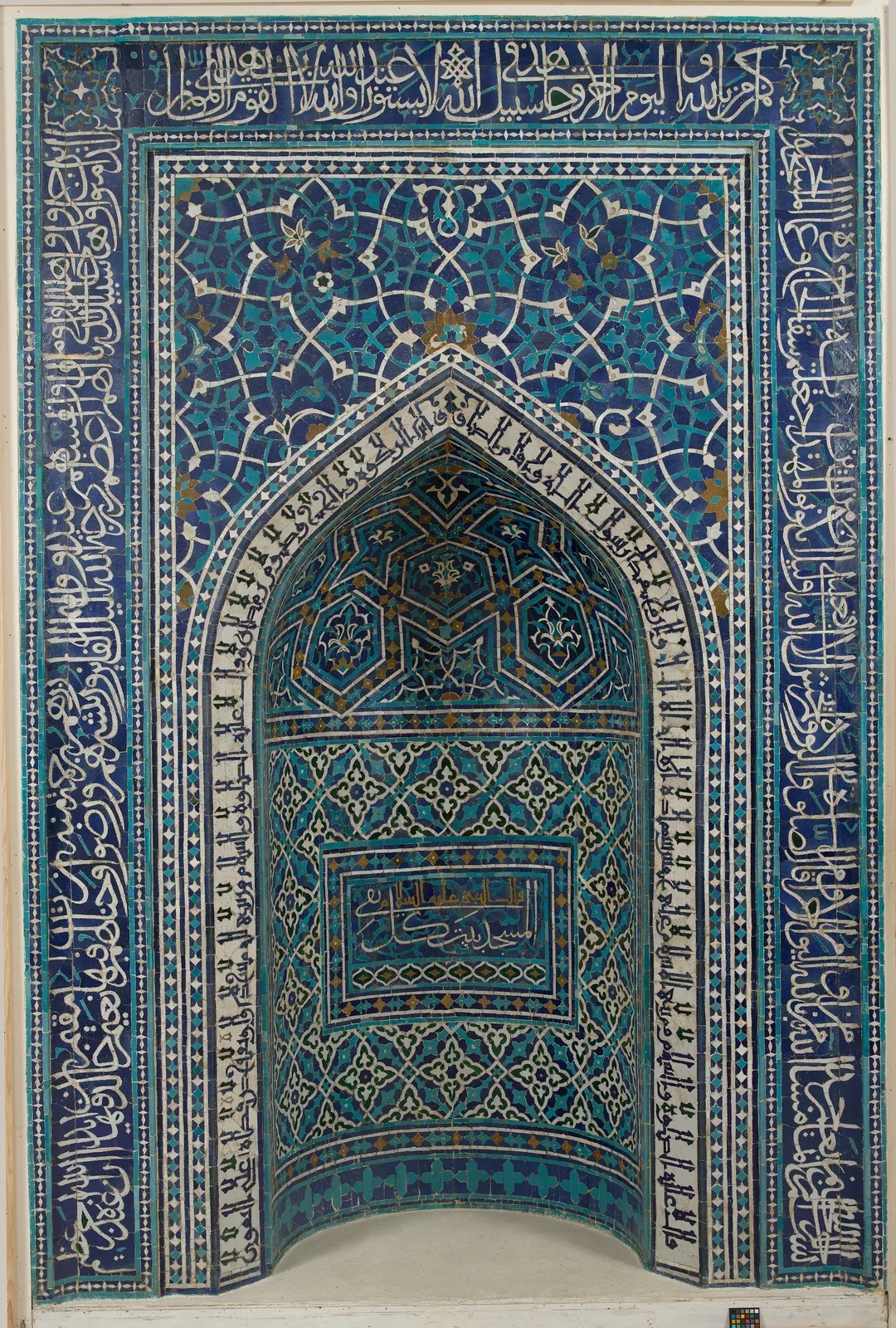
Ornament means decoration. On the prayer niche above, it divides a large surface, more than three metres high, into smaller areas. Pale lettering follows the blue outer frame. Curling stems fill the space above the pointed arch, while stars and polygons, or straight-sided shapes, fill the upper part of the recess.
A mihrab, or prayer niche, marks the direction of Mecca. This one comes from the Madrasa Imami, a religious school in Isfahan, and is dated 1354–55. Its makers set small pieces of glazed ceramic into mortar, so what looks like a drawn line is often the boundary between two pieces.
The geometric pattern sits alongside calligraphy, or decorative writing, and plant ornament. All three became prominent in Islamic religious architecture, where human and animal figures were generally avoided. Figures appear widely in manuscripts, ceramics and other secular arts; we will meet them later in the paintings. A mosque’s decoration is only one part of this broader artistic tradition. The Met on figures in Islamic art [2]
To see how a pattern works, begin with a single shape. A star keeps the same angles when you make it larger or smaller, but its spacing, colour and material change how it looks. The drawings below let you separate those choices before returning to the objects.
From drawing to pattern
Each exercise follows a star from its first construction lines to a finished pattern. The shape picked out from those lines is the motif; arranging it makes the pattern. These are modern teaching examples, not reconstructions of a particular workshop’s methods. When a star matches itself several times during a full turn, it has rotational symmetry. Fivefold means five matches.
1. Construction — Divide the circle
Mark eight equally spaced points on a circle, 45° apart. Join alternate points to draw two squares, one rotated 45° relative to the other.
8 divisions · 45° at the centre
The circle only locates the points; it can be erased from the finished motif.
From drawing to pattern · Construction
Eight-point star
1. Construction — Divide the circle
Mark eight equally spaced points on a circle, 45° apart. Join alternate points to draw two squares, one rotated 45° relative to the other.
8 divisions · 45° at the centre
2. Motif — Keep the outer line
Trace the outer boundary of the two overlapping squares. Where their edges cross, the outline turns inwards; these crossing points become the star’s inward corners.
2 squares · 8 outer points
3. Arrangement — Place the stars on a grid
Repeat the star in horizontal rows and vertical columns so that the centres sit on a square grid. The spaces left between the stars become part of the pattern.
Square grid · 4 nearest neighbours
The circle only locates the points; it can be erased from the finished motif.
Six-point star
1. Construction — Divide the circle into six
Mark six equally spaced points on a circle. Join alternate points to draw two equilateral triangles.
6 divisions · 60° at the centre
2. Motif — Keep the outer line
Trace the outer boundary of the two overlapping triangles. The points where their edges cross become the star’s six inward corners.
2 triangles · 6 outer points
3. Arrangement — Stagger the rows
Set the stars in rows, then shift every other row sideways by half the distance between two centres. The centres now form a triangular grid.
Triangular grid · 6 nearest neighbours
With the compass still set to the circle’s radius, step around the edge: the radius marks off six equal divisions.
Pentagonal medallion
1. Construction — Join every second point
Place five points around the circle, 72° apart. Join every second point to draw a pentagram.
5 divisions · 72° at the centre
2. Motif — Follow the star’s outline
Trace the star’s outline, passing through its outer points and the intersections between them. A smaller pentagon is left at the centre.
1 pentagram · 5 outer points
3. Arrangement — Repeat towards the centre
Draw another pentagram inside the central pentagon, then repeat. Each new star is rotated 36° and has about 38.2% of the previous star’s radius.
One shared centre · nested stars
The result is a finite medallion, which grows inwards around a shared centre instead of repeating across a surface. Designs with fivefold symmetry can also cover a surface by combining different shapes.
Twelve-point star
1. Construction — Divide the circle into twelve
Mark twelve equally spaced points on a circle, 30° apart. Join every third point to draw a square. Repeat from the next two starting points to make three overlapping squares.
12 divisions · 30° at the centre
2. Motif — Keep the outer line
Trace the outer boundary of the three overlapping squares. The intersections along this boundary form the star’s twelve inward corners.
3 squares · 12 outer points
3. Arrangement — Stagger the rows
Stagger the rows so that the stars sit on a triangular grid. How far apart they are set determines the shapes of the gaps between them.
Triangular grid · 6 nearest neighbours
The star and its arrangement have different symmetries: the star has twelve points around its centre, while each position on the grid has six nearest neighbours.
How the shapes fit together
Once you repeat a star, its neighbours matter. Turn an eight-point star by 45° and it matches its starting outline. Put stars on a square grid, and the whole arrangement needs a 90° turn to match again. Try turning the drawings below, then turn them again to see when both match.
Does it still match?
Turn both drawings by 45°. Dashed lines mark their starting positions.
The gaps matter too. Our stars leave spaces between them; to cover a surface without gaps or overlaps, those spaces need shapes of their own. This kind of covering is called a tessellation. Circles and polygons such as squares can help you draw more complex patterns. The Met on geometric ornament [3]
Regular pentagons have equal sides and angles. Put three together with a corner of each meeting at the same spot. Their inside angles of 108° leave a gap too small for another pentagon. That is why regular pentagons alone cannot cover a flat surface. Designs with fivefold symmetry can combine different shapes, or grow around a shared centre, like the medallion above.
A wooden window shutter in Istanbul’s Süleymaniye Mosque shows how much further this can go. In her study, Serap Ekizler Sönmez examines different ten-point stars at the shutter’s centre and corners. Turning parts of the design, or reversing them as in a mirror, makes new compositions. How the shapes fit together determines how the pattern can extend. Read the illustrated study (PDF, pp. 533–538) [4]
From a drawing to wood and stone
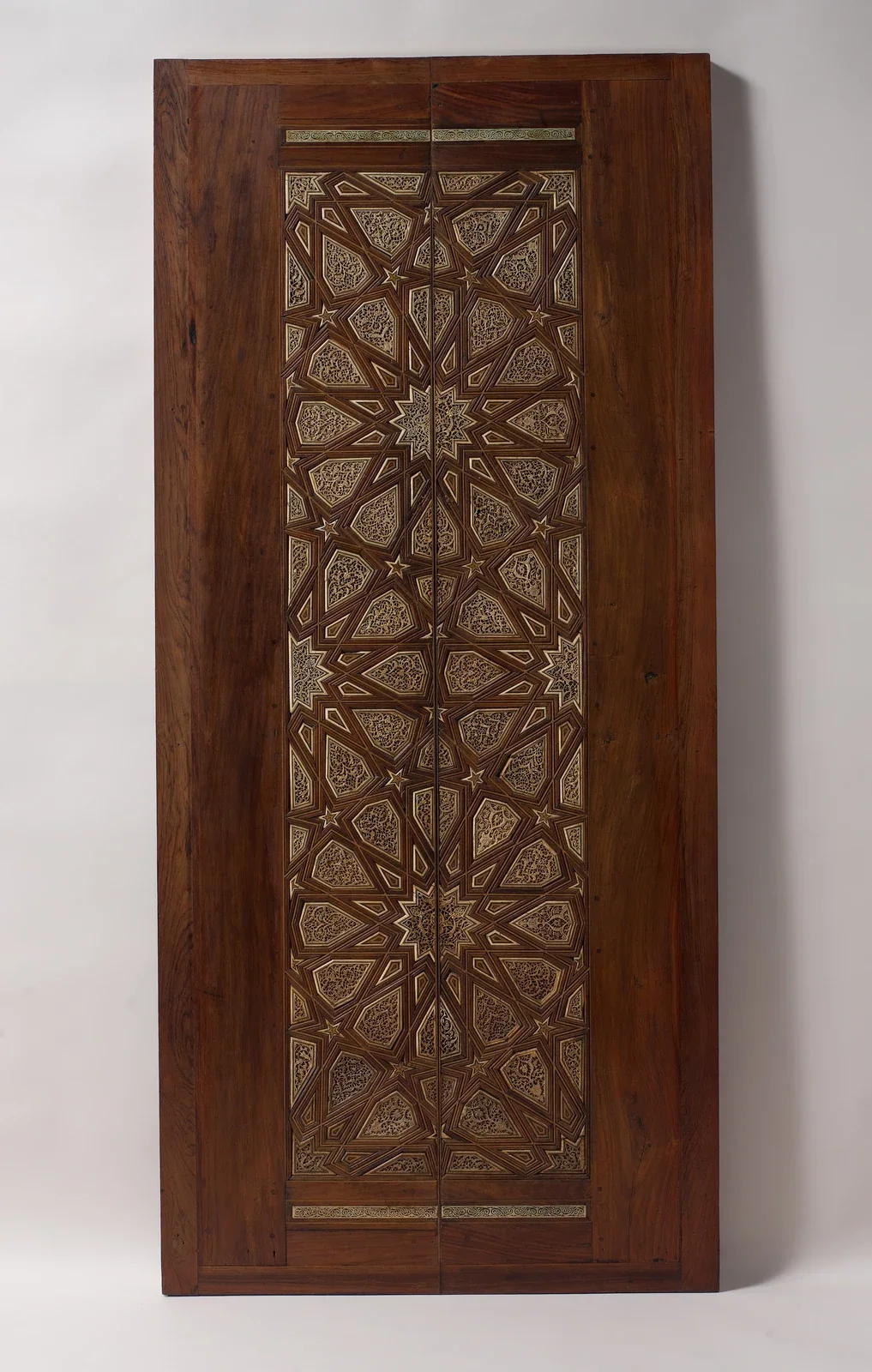
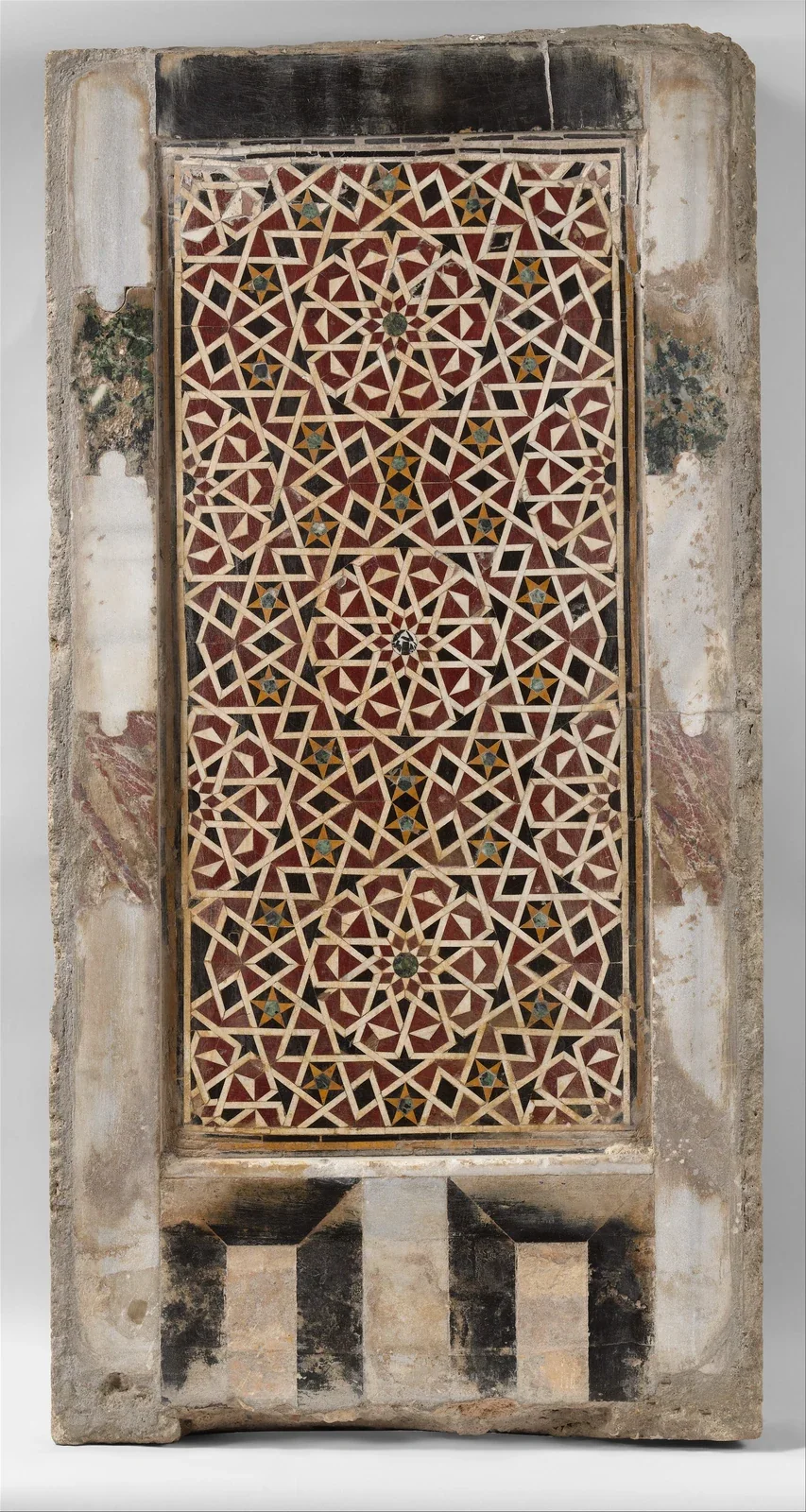
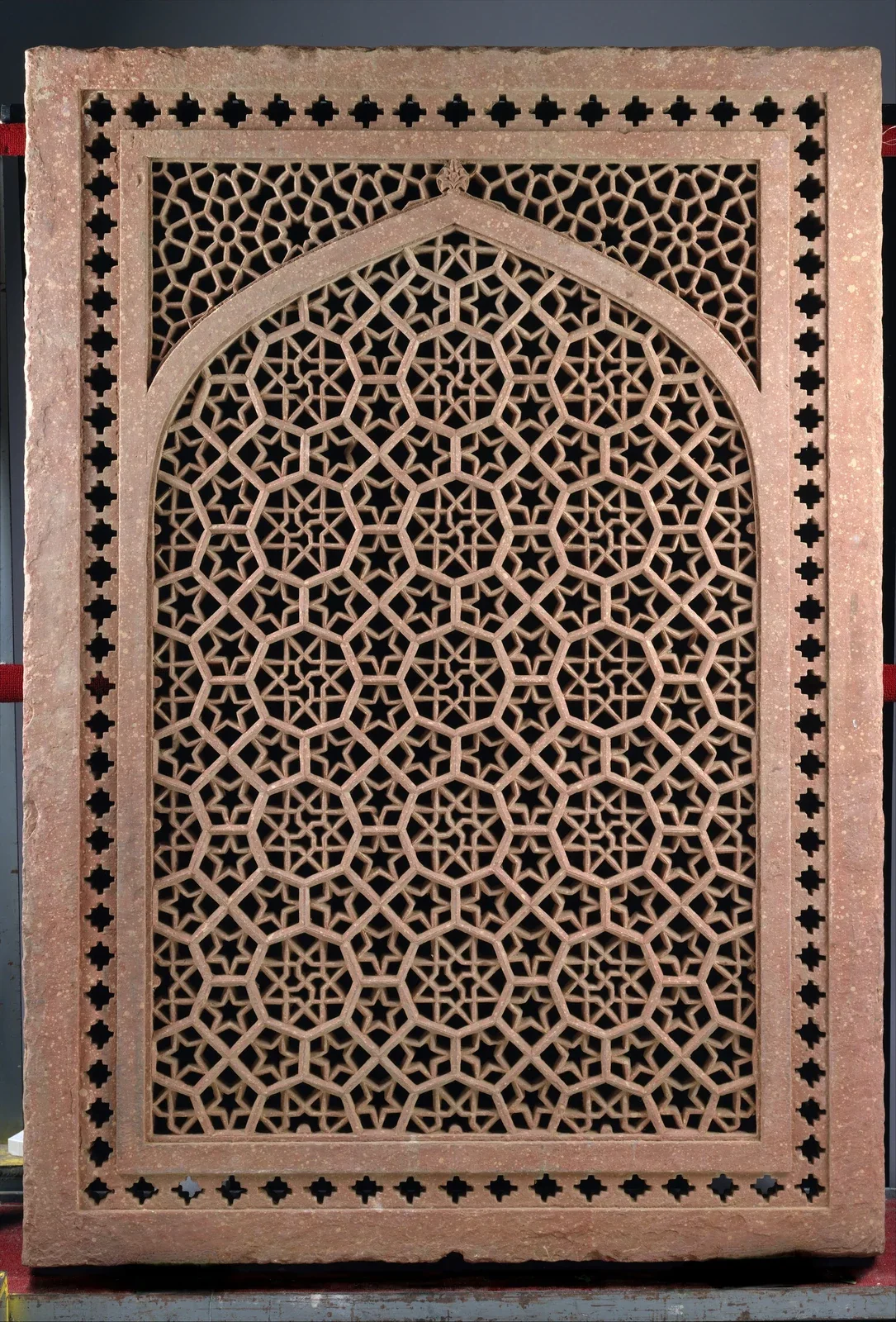
Follow a line in the mihrab and you often follow a join between tiles. The doors below use fitted pieces of wood instead. Their joints have to hold the doors together while letting the material expand and contract. Stone presents different choices: fit separate coloured pieces, as in the marble panel, or carve openings through a solid screen.
Wood: pieces that lock together
The Metropolitan Museum of Art. Public Domain. Object record [5]
A vertical seam divides the doors, but the stars continue across it. Pale inlay picks out small shapes against the brown wood, and carved ornament fills many of the compartments; through all this finer detail, the main geometric divisions stay clear.
The doors once formed the entrance to a minbar, the pulpit used for the Friday sermon. Mecka Baumeister, a conservator at the Met, explains how the fitted pieces and interlocking joints hold together without nails or glue, and how those joints allow the wood and ivory to expand and contract. Construction and conservation [5]
Marble: colour separates the strands
The Metropolitan Museum of Art. Public Domain. Object record [6]
Three large starbursts run down this narrow panel, linked by pale strips that pass through a dense network of small polygons. Red and dark stone pick out the spaces between the strips. Where the strips appear to cross, the crossing is made from separate pieces fitted together.
The panel is attributed to fifteenth-century Cairo; the building it came from is unknown. The Met suggests that it was set in the lower part of a wall, where the pattern would have been seen at close range. Its broad border gives a firm edge to an interlace that might otherwise seem to continue beyond the panel. The museum’s account [6]
Sandstone: openings for light
The Metropolitan Museum of Art. Public Domain. Object record [7]
In this jali, or pierced screen, from India, the dark shapes in the photograph are openings. The stone left between them forms a continuous network of narrow strips. A broad pointed arch interrupts that network, separating the main field from the smaller areas above it.
The screen is about 1.85 metres high. According to the Met, weathering on one side suggests that it once formed part of an exterior window. There, its openings would have admitted light and cast a changing pattern into the room. The screen’s architectural setting [7]
Pattern inside a painting
Patterns also help painters describe a room. These two sixteenth-century manuscript paintings bring decorated walls and floors onto a page: a change in pattern shows where one surface ends and another begins. Select a detail to see the geometric shapes, fine meshes and curling stems at closer range.
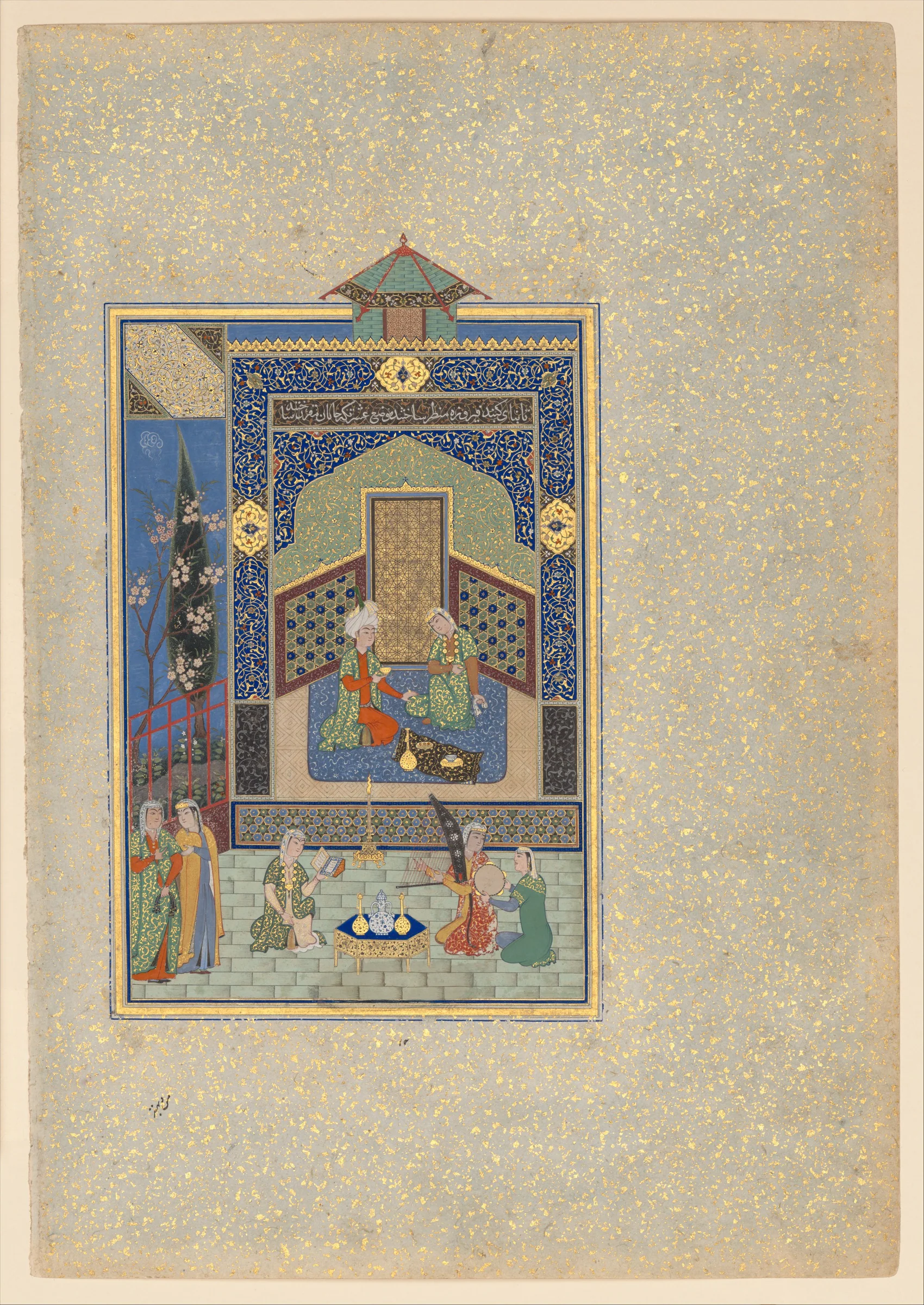

Folio 216 from a Khamsa of Nizami. Herat, dated 931 AH / 1524–25 CE. Ink, opaque watercolour, silver and gold on paper. Page: 32.2 × 22.2 cm.
Collection record and image source [8] · View in Artline
The Metropolitan Museum of Art. Gift of Alexander Smith Cochran, 1913; 13.228.7.10. Public Domain.
Two figures sit in a raised room above the musicians. Blue geometric panels flank the pair, and a narrow patterned band divides their room from the paving below.
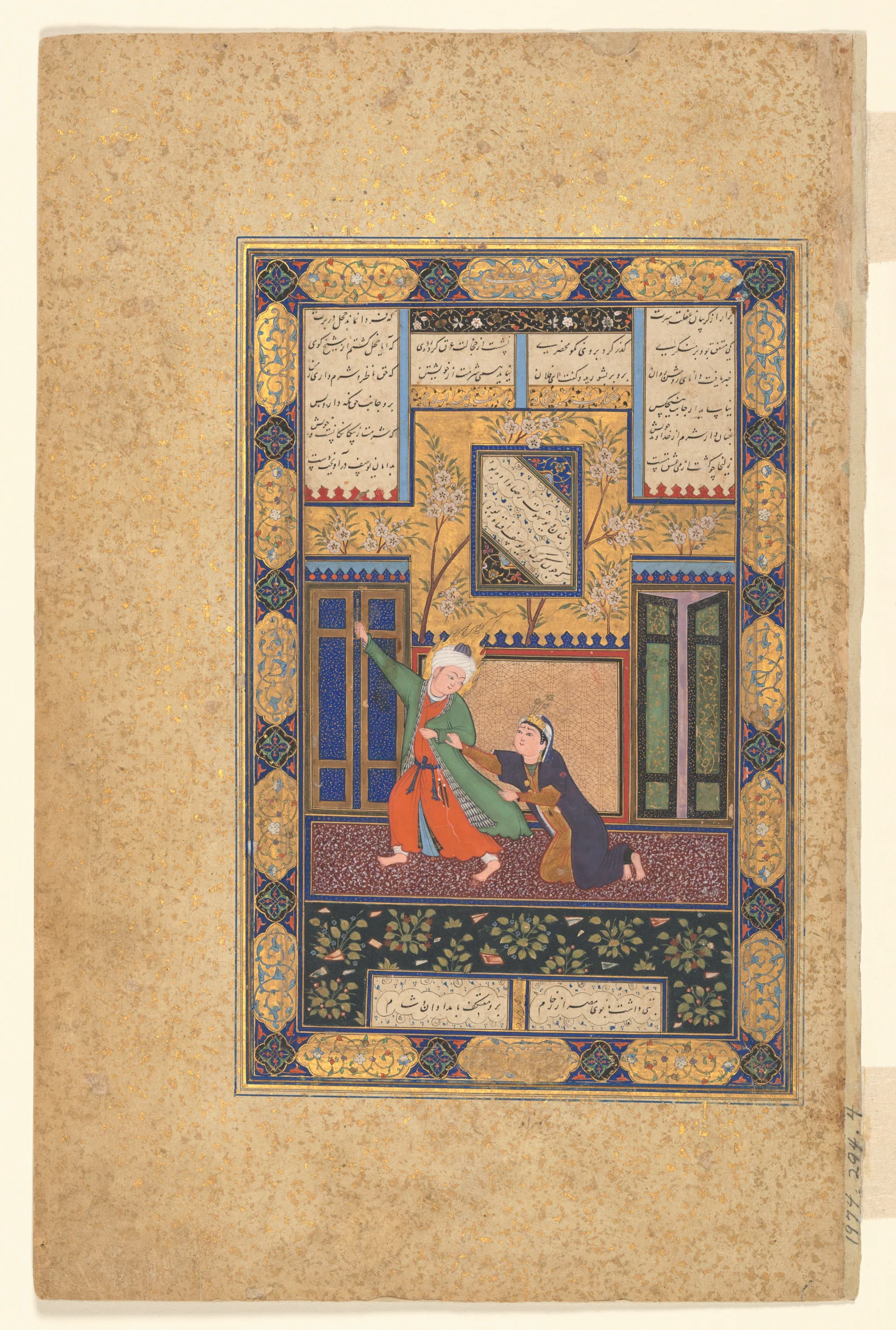

Folio 51r from a Bustan of Sa’di. Bukhara, about 1525–35. Ink, opaque watercolour and gold on paper. Page: 27.9 × 18.4 cm.
Collection record and image source [9] · View in Artline
The Metropolitan Museum of Art. Purchase, Louis V. Bell Fund and The Vincent Astor Foundation Gift, 1974; 1974.294.4. Public Domain.
Behind the figures, a fine geometric mesh fills a pale wall panel. Flowering branches spread across the gold wall above, and smaller plants fill the dark band below.
Here, human figures share the page with geometry, writing and plant ornament.
What colour changes
Pale lettering stands out against the dark blue of the Isfahan mihrab. Turquoise, yellow and green divide the surrounding decoration into smaller forms. Following one colour helps you pick out a shape among the crowded lines. The mihrab’s colours and inscriptions [10]
You can test this without drawing new lines. In the two patterns below, swap the colours of the stars and the background. Which shapes do you notice first? Then remove the fills to see the same design as a network of outlines.
Change the colours, keep the lines
Star and background colours swapped: The shapes and their spacing are unchanged; the stars and the background have simply exchanged colours.
In the photograph of the sandstone screen, the openings look dark. In a window they would let light through, casting the pattern into the room.
Make your own pattern
The studio below lets you change the scale, colours and outlines of a design. Click or tap a piece to recolour it. Try making the spaces between the stars stand out.
Stars and crosses
Eight-point stars and cross-shaped pieces fill the surface between them. Try using colour to bring out just one of the two motifs.
Click or tap a piece to change its colour
Use Tab to focus a piece, then the arrow keys to move between pieces. Press Enter or Space to change its colour.
A PNG is convenient for sharing; an SVG can be resized without losing sharpness.
These are original geometric compositions, with palettes inspired by tile, wood and stone. Six patterns repeat across a grid; two medallions grow around a single centre.
Further reading
If you would like to draw patterns on paper, begin with Eric Broug’s practical guide. The other books take you further into the buildings, objects and history behind the designs.
Eric Broug · Revised edition, 2019
Islamic Geometric Patterns
Step-by-step instructions for drawing 23 patterns by hand, with brief introductions to the buildings and objects they come from. Use it with a pencil, ruler and compass.
Eric Broug · 2013
Islamic Geometric Design
Photographs and construction drawings group patterns into fourfold, fivefold, sixfold and combined systems, making it easier to compare families. It serves as an architectural companion to Broug’s practical guide.
Jay Bonner · 2017
Islamic Geometric Patterns: Their Historical Development and Traditional Methods of Construction
A substantial study of historical development, pattern classification and polygonal design, with detailed construction methods. The chapter on computer algorithms is co-authored with Craig S. Kaplan.
Daud Sutton · Wooden Books
Islamic Design: A Genius for Geometry
A compact illustrated introduction to geometric patterns and how to draw them. Sutton’s discussion also takes in spiritual interpretations of geometry.
Keith Critchlow · Thames & Hudson
Islamic Patterns: An Analytical and Cosmological Approach
Critchlow combines geometric analysis with a cosmological reading of the patterns. His account of their symbolism may differ from what the historical makers intended.
Jules Bourgoin · Dover edition
Arabic Geometrical Pattern and Design
A collection of geometric pattern drawings, useful as a repertoire to compare with your own. It is best used alongside a guide that explains the construction process.
Gülru Necipoğlu · 1995
The Topkapi Scroll: Geometry and Ornament in Islamic Architecture
Necipoğlu examines a surviving architectural design scroll, together with the ideas and working practices behind its ornament. Getty provides a free PDF edition.
Serap Ekizler Sönmez · 2016 · In Turkish
Mimar Sinan Cami Minberlerinde Beşgen Geometrik Desenler
A specialised study, in Turkish, of pentagon-based patterns on the minbars of Sinan’s mosques. Sönmez’s shorter illustrated study of a window shutter is linked in the geometry section above.
Sources and image credits
All six reproductions are public-domain images from The Metropolitan Museum of Art. Each caption links to the work’s collection record, which gives its date, materials, dimensions and accession number. In the interactive article, select any image to enlarge it. The painting viewers label cropped details, and “Whole page” returns to the full reproduction.
The historical and technical descriptions are based on these collection records, on the Met’s essays on geometric ornament [3] and figural representation [2], and on Serap Ekizler Sönmez’s “The Whispers of a Window Wing in Istanbul” [4] (Bridges 2020, pp. 533–538). The book notes rely on publishers’ descriptions and available tables of contents.
- www.metmuseum.org — 449537
- www.metmuseum.org — figural-representation-in-islamic-art
- www.metmuseum.org — geometric-patterns-in-islamic-art
- archive.bridgesmathart.org — bridges2020-533.pdf
- www.metmuseum.org — 444812
- www.metmuseum.org — 452203
- www.metmuseum.org — 453344
- www.metmuseum.org — 446606
- www.metmuseum.org — 452672
- www.metmuseum.org — image-4
- www.thamesandhudsonusa.com — islamic-geometric-patterns-softcover-1
- www.thamesandhudson.com — islamic-geometric-design
- link.springer.com — 978-1-4419-0217-7
- redwheelweiser.com — islamic-design-9781952178054
- www.thamesandhudson.com — islamic-patterns
- store.doverpublications.com — 9780486155319
- www.getty.edu — 9780892363353.pdf
- istanbultasarimmerkezi.org — mimar-sinan-cami-minberlerinde-besgen-geometrik-desenler_B1.html