Artemisia Gentileschi trained in the workshop of her father, Orazio, worked in several Italian cities and spent time at the English court. She is often introduced today through Judith Beheading Holofernes. That painting is here, together with a second, quieter Judith in which the killing is already over.
The rest of the selection widens the view. It includes self-portraits in different guises: as Painting itself, as Saint Catherine and as a lute player. There is also a portrait of a gonfaloniere, and a ceiling figure painted for Casa Buonarroti's tribute to Michelangelo. Judith, Jael, Esther, Bathsheba and Susanna share the list with Lucretia, Aurora, Venus, Clio and a satyr outwitted by a trick. Several of the pictures settle on a moment of choice: a raised hammer, a dagger held but not yet used, Esther faltering before a king who has only begun to respond. The entries describe what Artemisia painted and do not treat the pictures as clues to her private life.
Twenty editorial choices, made independently. This is not a complete catalogue, and it is not a ranking by any museum.
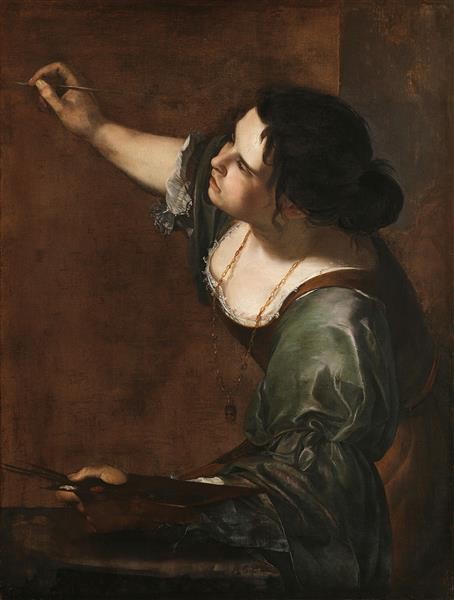
A painter is caught at work, her brush raised towards a canvas outside the picture. The body is turned at an angle unusual in portraiture, so the emphasis falls on the activity, not on a conventional pose. The title makes a larger claim. The picture has often been discussed both as a self-portrait and as an image of Painting itself. Because the personification is female, Artemisia could take both parts at once: the allegory of her art, and a woman busy with the practical labour of making a picture.
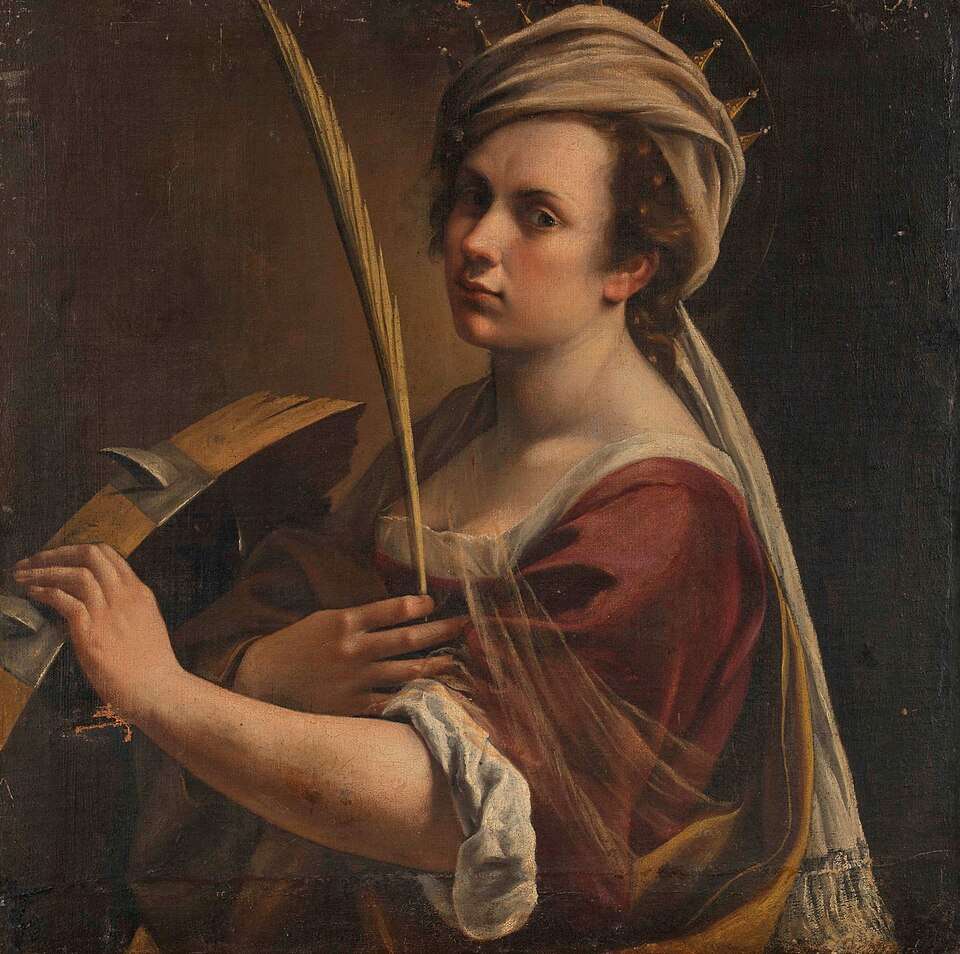
The wheel beside her, its spikes broken, is enough to identify Catherine, and the palm across her chest marks her as a martyr. She looks out of the picture, composed. Artemisia gives the saint her own face, but the attributes cast the sitter in a role, so this is not an ordinary likeness.
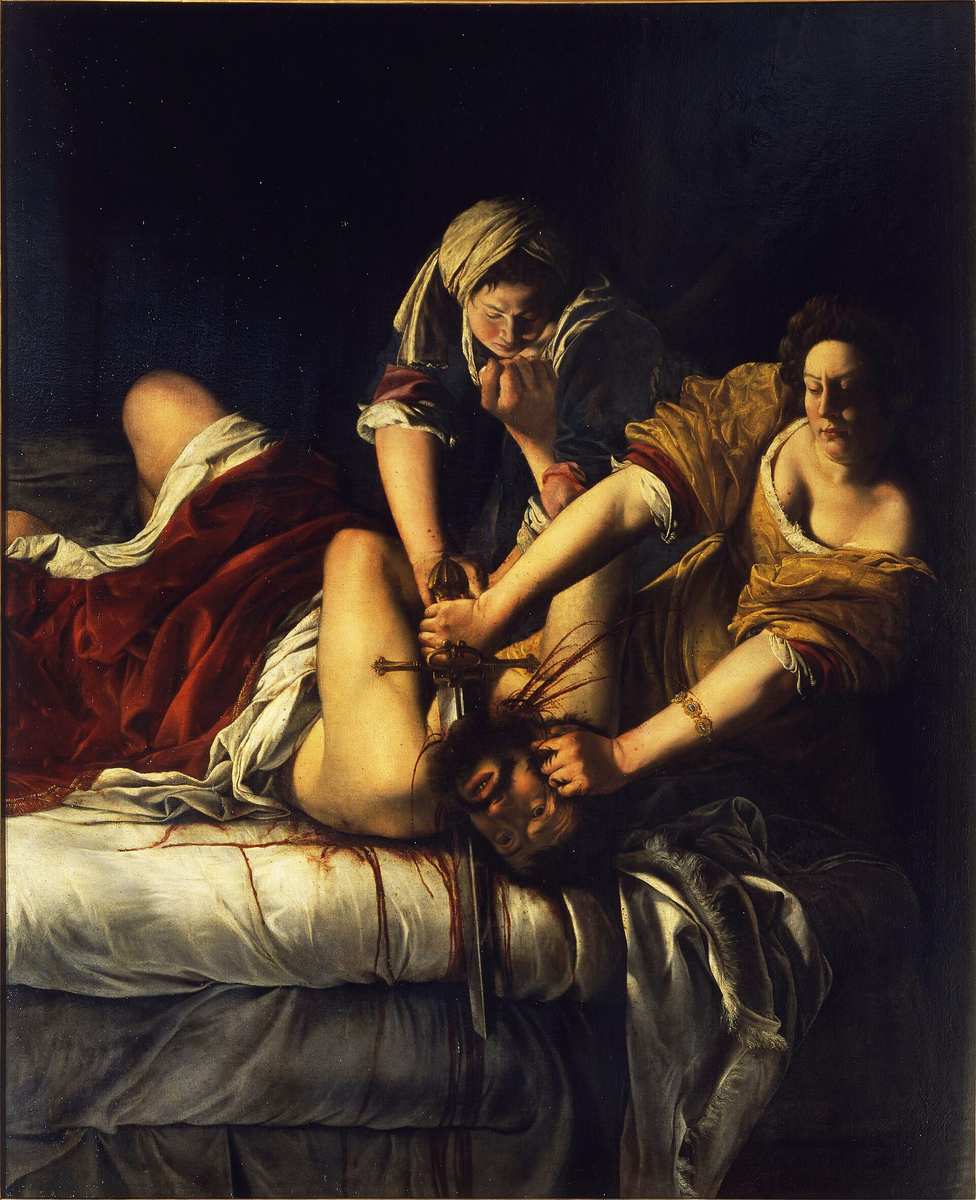
Judith does not kill Holofernes alone. Her maidservant restrains him, and the combined pressure of the two women sits at the centre of the composition. Their extended arms show how much physical effort the act demands, and the bedding leaves its consequences in plain view. Nothing here makes the killing graceful or distant.
This is the Uffizi painting. An earlier version in Naples is a separate work and should not be used as an interchangeable illustration.
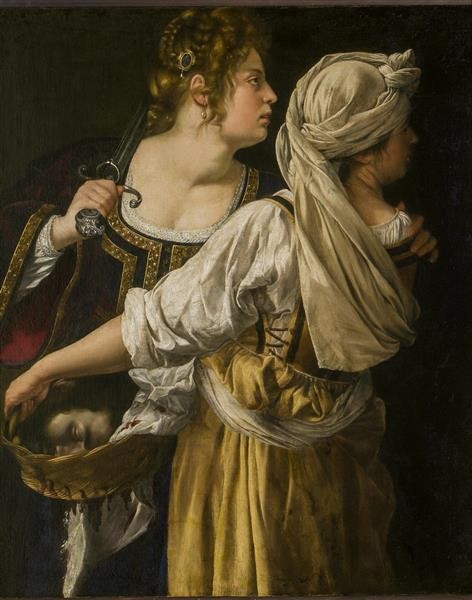
In the story, this scene follows the one in the Uffizi canvas, though the Pitti picture was painted earlier. Judith and her maidservant have stopped in the act of leaving. Holofernes's severed head lies in a basket and the sword rests against Judith's shoulder, but both women have turned towards something outside the picture. Nothing approaches within the frame. The danger lies entirely in their shared attention, perhaps to a sound, perhaps to the fear of one, and the story moves on through listening, with no further violence.
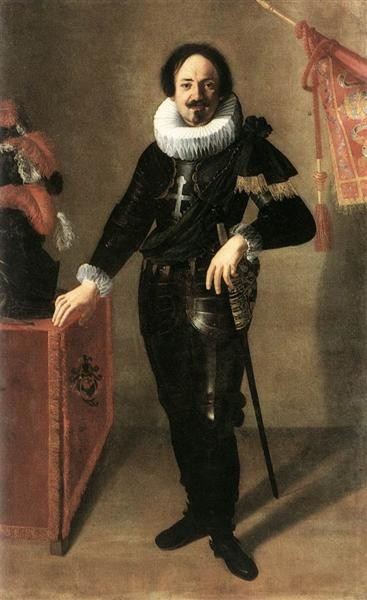
The sitter's name is uncertain, but his standing is not. Armour, a standard and the full-length format all present a man of public rank (gonfaloniere means standard-bearer), and a white ruff separates his head from his dark clothes. One hand rests on the table and the other at his hip. His authority comes from that steady pose, with no dramatic action. This is the only portrait in the selection of someone other than Artemisia herself.
1620s · Oil on canvas · The Metropolitan Museum of Art
Esther approaches a king who could have her killed for entering unbidden. She falters and her attendants hold her up, and Ahasuerus leans forward from his seat. An open stretch of floor lies between them, the distance her appeal has to cross. The imbalance of power comes through in two movements: one collapsing, the other only beginning to respond.
The hammer is raised and the blow has not yet fallen. Jael holds the tent-peg in place while Sisera sleeps across the foreground, unaware that his position is already fatal. The comparison with the Uffizi Judith is instructive. There, Holofernes has to be held down. Here, Sisera shows no resistance at all. Jael is the one who sees, chooses and acts.
A woman holding a compass personifies Inclination, in the sense of a natural aptitude for art. She was painted for a ceiling in Casa Buonarroti, as part of its tribute to Michelangelo, so she belongs to a larger decorative scheme and was never an independent easel picture. The drapery that now covers her body was added later by Volterrano. What survives is therefore the work of two painters, and the figure we see is not quite the one Artemisia painted.
The lute decides where the arms can go. Its broad body fills the lower part of the canvas, and its neck draws one hand away from the sitter's turned face. In the Allegory of Painting Artemisia appears at her own trade; here the accomplishment on show is music, presented as part of a public self-image. The arrangement also has a practical logic, keeping wood, skin and the open sleeve apart so that each surface has its own space.
The Magdalene's lowered head and supporting hand interrupt what is otherwise a display of costly fabric. No outward event marks her conversion. It is shown as a withdrawal inwards. Yet the gold dress and red curtain have lost none of their appeal. Is the viewer meant to see luxury renounced, or to go on enjoying it? The picture does not draw a clean line between the finery and the act of turning away from it.
Many of the biblical scenes pack their figures together, but Aurora, goddess of the dawn, has room to stretch out her body. Her arms are raised and her drapery moves with her across the dark ground. Dawn arrives as a figure in motion, not as a change of light over a landscape.
The angel addresses Mary, and her gathered hands answer him as one person might answer another. The light falling from above says something different: that the event comes from God. Near the floor, a broad spread of heavy drapery weights the lower part of a composition that otherwise reaches upwards.
Venus is asleep and does not look out at the viewer. She lies stretched out on blue bedding while Cupid fans her, and the room around her opens onto a landscape before closing again beneath a curtain.
An open book records; a trumpet announces. Together they set out the task of the muse of history, which is to preserve the past and to proclaim it. Clio is more than a stand for her attributes, though. Her turned head and the hand at her waist give the personification a physical presence of her own.
The satyr has caught the wrong thing. He stays crouched, gripping Corisca's false hair, while she moves away, her skirt billowing along the line of her escape. The episode comes from Guarini's pastoral play Il pastor fido and turns on a practical deception. A grasp seemed to join the two figures, but the small object in his hand was all that held them together, and once it comes away they separate. Set beside Susanna and the Elders, the picture reads almost as a comic counterpart. There the men press close and escape is not made easy. Here the woman simply gets away.
Here birth involves work. The child has to be supported, washed and passed from hand to hand, and these tasks fill the foreground, while in the background an older man attends to a writing tablet. Routine care takes up much of the picture space, and it is treated as part of the sacred event, not as a preliminary to it.
Fabrics and gifts display the kings' rank, but they kneel and bend, directing their attention to the child Mary holds. These changes of height give order to what could easily have become a parade of elaborate costume. Above them, broken architecture sets a larger scale. Beneath it, the homage stays close and concentrated.
Bathsheba's attendants work close beside her, while David watches from a separate, raised position some distance away. The picture gives two accounts of the same scene: the women's care for her body, and his observation from outside their circle. He is far from the foreground, yet his presence brings in the unequal power on which the story turns.
The dagger points to the end of Lucretia's story, her suicide following sexual violence. Her other hand, though, reaches outwards and her face turns aside. These gestures make her less settled than a simple emblem of resolve would be. Artemisia stays with the moment before the act, while the decision still seems to be in progress. The date given in the heading applies to this version in particular.
1644-48 · Oil on canvas · The Nivaagaard Collection
Susanna twists away but gains almost no distance. The elders lean into the same narrow space, and her arms have both to shield and to support her body. Their threat of a false accusation explains why they crowd so close. This is the later Nivaagaard version. Her resistance is plain to see, but the picture does not make escape easy.
Open these twenty works alongside books and events from their period. The lifespan view includes Artemisia Gentileschi, Orazio Gentileschi, Caravaggio and Peter Paul Rubens. These comparisons provide historical context, not claims of direct influence.
Hands at work
Hands recur throughout these paintings, and they rarely do the same job twice. The painter's own hand lifts a brush towards an unseen canvas, the maidservant's holds Holofernes down, and other hands wash the newborn John and pass him along. The gonfaloniere's rests on a table, the Magdalene's supports her as she lowers her head, and Mary's are gathered in answer to the angel. Susanna has to use her arms to shield herself and hold herself up at the same time. The satyr's fist closes on a hank of false hair as Corisca gets away.
Keith Christiansen and Judith W. Mann, with contributors · 2001 Free museum PDF and online reading
An exhibition catalogue that presents Orazio and Artemisia side by side, with entries on individual works and documentary material. It is a good place to compare the two painters' working methods and to follow the changing settings of Artemisia's career. Because it covers both painters, it treats Artemisia in relation to her father.
Jesse M. Locker · 2015; paperback 2021 Publisher page; purchase or library
Locker concentrates on Artemisia's later career and on literary culture, which makes the book particularly useful for pictures such as Clio and Corisca and the Satyr. It does not explain every painting through the events of her youth, and the early work is not its main subject.
 Art, literature & history