The State Hermitage Museum in Saint Petersburg grew out of the collections of Russia's imperial rulers, and much of it is associated with the Winter Palace and its neighbouring buildings. The collecting tastes of those rulers helped bring many of the paintings in this selection to the city. The museum's European paintings span several centuries and take in Italian Renaissance pictures, Dutch portraits and later French art.
Robert Campin's Madonna and Child before a Fireplace is the earliest of the twenty pictures chosen here. The Virgin and Child come back again and again among the older works: by Campin's fireside, fitted into Raphael's circular picture, in front of the landscape of a painting associated with Giorgione, and in the Madonna Litta, whose attribution to Leonardo is disputed. Rembrandt is represented by a myth and a biblical encounter, and Caravaggio, Velázquez and Van Dyck by a musician, a meal and a family. Élisabeth Vigée Le Brun's portrait of a mother and son, a square by Degas and landscapes by Cézanne and Van Gogh lead on to the modern pictures. Matisse has the strongest presence among these, with a still life, Zorah Standing, and Dance II with its companion Music. Picasso breaks both a house and the human figure into angular masses.
The works are drawn from documented Hermitage holdings, and the selection was made independently of the museum. Dates and attributions follow the linked records, with their qualifications kept.
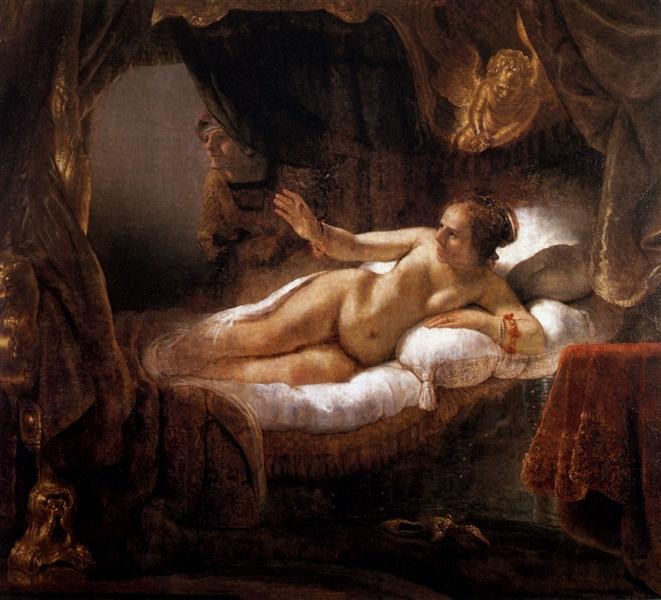
In the myth, Zeus comes to Danaë as a shower of gold. Here what she reaches towards is light, coming in from somewhere beyond the edge of the picture. Her gesture, her expression and the bedding all belong to a private room, and the visit of a god becomes surprisingly intimate.
The painting was seriously damaged in 1985 and went through a long restoration.
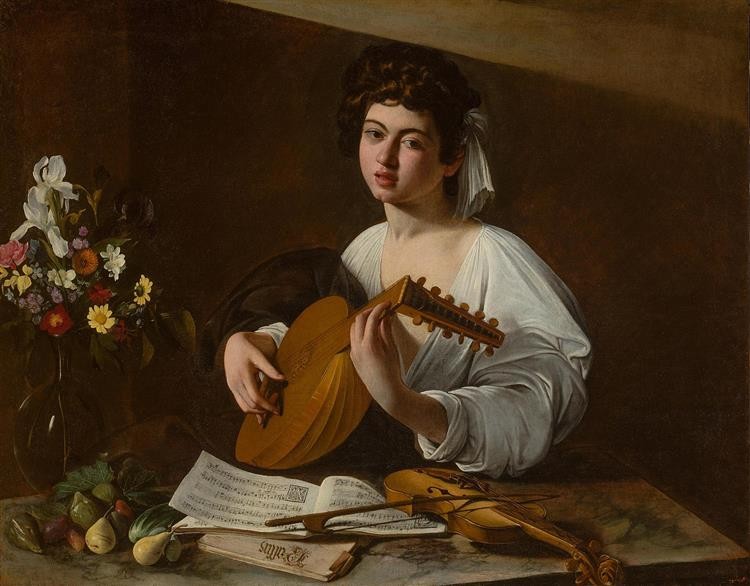
An open score, flowers and fruit crowd the front of the picture, so music, food and growing things share one confined space. The rounded body of the lute and the player's bright shirt bring the figure close. Even so, the face has competition, because the things laid out in front of the player hold the eye just as firmly. Is this a picture of a musician, or a still life that happens to include one?
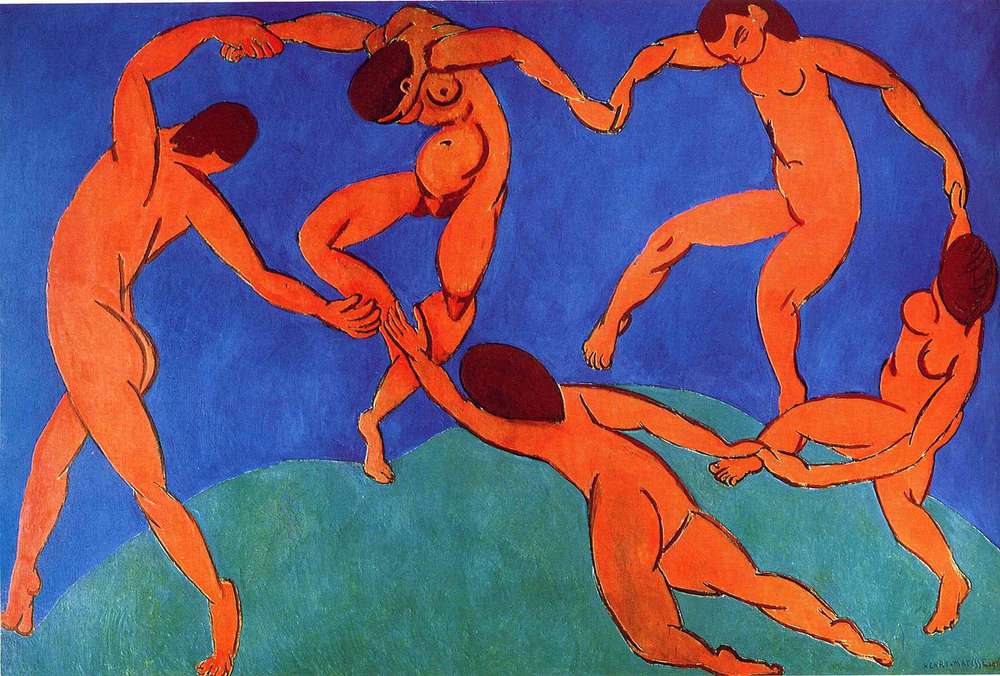
Three colours do the work: red-orange for the five dancers, green for the ground and blue for the sky. With no other setting and no story, the ring of bodies has to carry all the energy itself. At one point it is not quite a ring. Two dancers reach for each other but their hands do not meet, so the circle stays open, as if the movement were still going on.
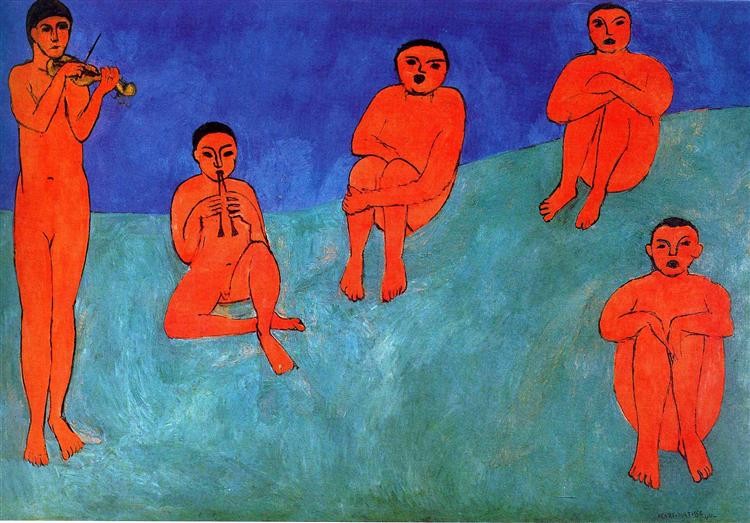
The companion to Dance II shares its pared-down green and blue setting, then turns its idea around. The dancers very nearly close their ring, but these figures stay apart. Open intervals separate them, and their different poses and instruments keep each musician distinct. What makes them a group is the red repeated from body to body and the measured spacing between them.
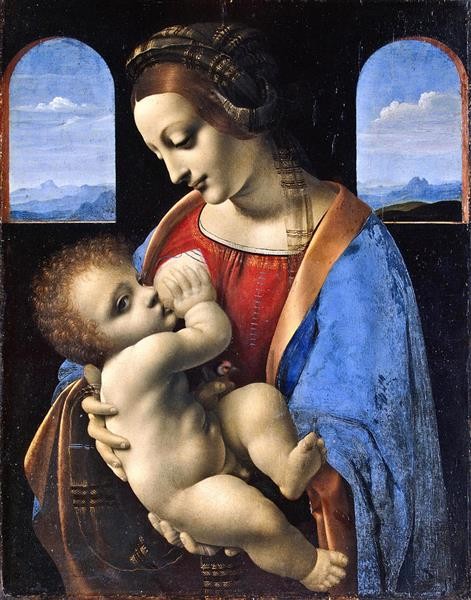
The Hermitage gives this painting to Leonardo da Vinci. Other scholars assign a larger part of it to his workshop, and the question remains open. Whoever painted it knew how to fold two heads and two bodies into one compact group: Mary bends over the nursing child until their outlines run together. Behind them, two openings look out onto distant blue, held firmly apart from the closeness in front.
A small incident inside a circle: the child reaches towards a book, and he and his mother both look down at it. Raphael does not balance the bodies symmetrically. He lets their curving contours answer the round edge of the picture, and the landscape runs on behind them without a break.
A fire, a window, small household fittings: Campin sets the Madonna indoors, whereas Raphael and the painter of the picture associated with Giorgione later put her out of doors. The household objects may carry symbolic meanings. Whatever they signify, they also make the room believable, a place where ordinary daily life could go on. Among all these particulars, mother and child keep to their own close relationship.
The square of the title is a broad open space, but the picture's real business happens at its edge. A man, girls and a dog cross close to the frame, which cuts through some of them abruptly, so the cropping becomes part of the subject. They are placed unevenly, without the settled arrangement of a conventional group, and seem to have come together by chance. The square carries on around them and makes no effort to hold them.
Blue and violet gather in the foliage around a lighter opening, and the buildings and terrain are only partly resolved. Where outlines give way, the landscape mostly stays readable through the relationships between patches of colour, though not everywhere. In places it is hard to tell where one form ends and the next begins, or which plane lies nearer.
Here the brush itself keeps things apart. Van Gogh's strokes change direction as they move from roofs to walls to the field in front, so each surface gets its own pattern of marks. On a canvas where texture is everywhere, that is what stops the clustered cottages from running together.
For a figure who made it into the title, the ploughman is remarkably small, almost incidental. Bands of yellow and red run across slopes shaped by farming. He gives that cultivated ground a human scale without becoming its centre, and the land stretches far beyond him.
A meal in very little room: two men seated, a standing figure, bread, containers and cloth. The fruit and flowers in Caravaggio's Lute Player compete with the musician, but these objects do not compete with the people. Each has its part in serving and eating, and the gestures make the meal a coordinated business. A raised vessel links the standing figure with the seated pair. In so tightly bounded a space, attention moves back and forth along that line because it has nowhere else to go.
In Danaë the light seems to stand in for the god himself. Here it does a quieter job, falling on one richly dressed figure while another is barely visible in shadow. The gesture that draws the eye is a restrained one, a hand held against the chest. Rembrandt does not lay out the stages of the story named in the title. He holds a single tense encounter, and what either man is thinking stays out of sight.
Pale hands and collars stand out against the dark clothing, and they fall where the figures touch, so what catches the eye is also what binds the family together. The adults lean in towards the child, their heads at different heights and turned different ways, and each face keeps its own expression.
Baroness Stroganova holds her son Sergey in an embrace, but the boy looks out towards the viewer. In Van Dyck's Family Portrait the adults' attention gathers on the child. Here the child's attention turns outward, and the picture gets to have it both ways: it records private affection and still does the public work of a portrait. Warm-toned clothing sets mother and child apart from the darker landscape behind them.
The house is still recognisable, walls, roofs and all, but it is given no special status. Its edges merge with the trees and plants around it. Building and garden are cut into the same faceted masses and lock together across a shallow, compressed space.
Zorah faces straight out, a narrow figure filling most of the tall, upright picture, with her hands gathered near the waist. Silhouette and repeated ornament tie body and garment so closely that figure and dress read almost as a single shape.
The earliest of the Matisses here takes liberties with the tabletop. Some objects tilt up towards the picture surface and do not fit any single view of the table, so not everything is seen from the same position. Colour and repeated shapes do as much as depth to link the dishes, fruit and patterned cloth.
This picture is associated with Giorgione. Red and green drapery anchors the closely joined Madonna and Child, but the landscape behind them is far from a neutral backdrop. Rocky outcrops, buildings and distant mountains are worked in detail and extend well beyond the devotional group. The Madonna Litta allows its distant view only two openings. Here the terrain has room of its own.
The two bodies are made of broad curves and abrupt angles. Their anatomy is visibly altered, yet you can still tell what they are doing. Little open space is left, and the surrounding forms press in on the figures much as the garden presses on the house in House in a Garden, from the same year. The scene never settles into a continuous place.
Explore this selection in Artline
See the selected works alongside books and events from their period, or compare when the artists lived. The books and events provide context, not evidence of direct influence. Works without confirmed dates remain in this guide.
Locating the paintings
Being in the collection does not mean a painting will be on the wall. By the time you visit, any of these works may have moved within the museum, gone out on loan or been taken off display.
Further reading
Leonardo da Vinci; translated by John Francis Rigaud · Read free · English
Leonardo's own notes on gesture, light and the body, in John Francis Rigaud's English translation. They are most useful beside the earlier paintings in this selection. They also make a pointed companion to the Madonna Litta: whatever share his workshop had in that picture, these are the principles of the painter to whom the Hermitage gives it.
 Art, literature & history