The National Gallery of Art in Washington, DC, was founded with the help of Andrew W. Mellon's collection and gifts from other donors. It now holds paintings, sculpture and works on paper from many centuries, and its paintings are especially strong in European and American art.
This selection draws on both strengths and mixes them. Jan van Eyck's Annunciation and Leonardo's portrait of Ginevra de' Benci share the list with Copley's rescue from a shark and Gilbert Stuart's portrait of a man on skates. Some pairings are built in, such as Vermeer's Lady Writing and his Woman Holding a Balance, or the self-portraits Van Gogh and Gauguin painted in the same year, which present their makers in very different ways. Other connections only appear as you read, between the flowers of Heade and O'Keeffe, for instance, or among the pictures that put people in boats. Several works are not quite what their titles lead you to expect. Manet's railway barely appears, and Peto's violin is made of nothing but paint.
Artline chose these works from documented holdings of the National Gallery of Art. The selection is independent of the museum, and its order is not a route through the galleries. Being in the collection does not mean a work is on view. Where the museum qualifies a date or an attribution, so does this guide.
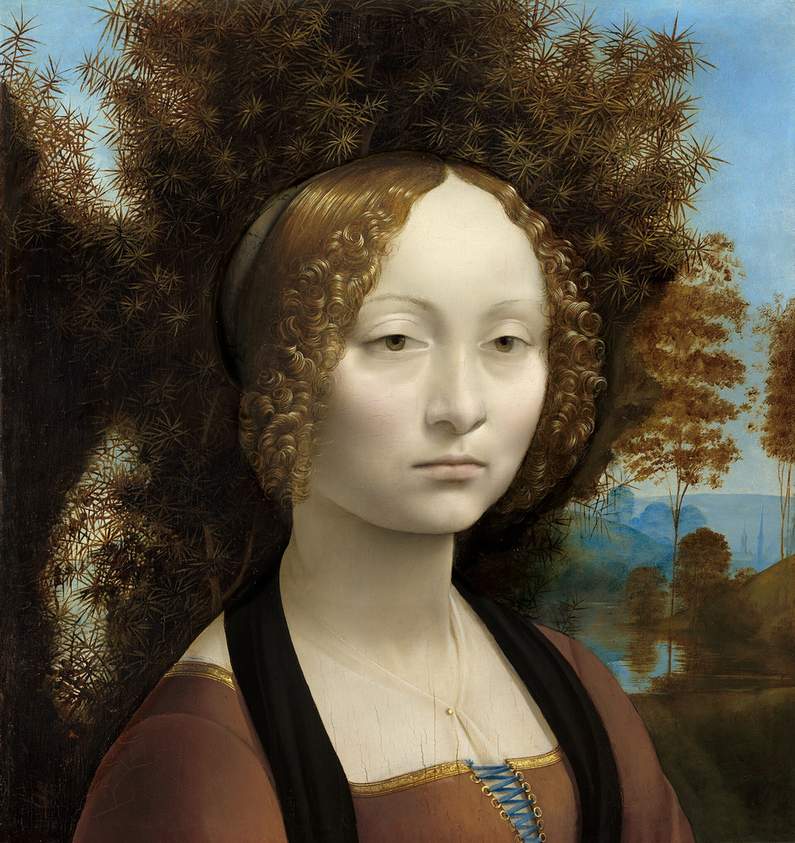
c. 1474–1478 · Oil on panel · National Gallery of Art
A dense juniper bush fills the space behind Ginevra's head, and her pale face stands out sharply against it. Beyond it, water and distant trees recede. But the bush is more than a foil. Juniper is connected to her name, so the plant points to the sitter as well as framing her, and it may carry other meanings too. The back of the panel is also painted. This account covers the front.
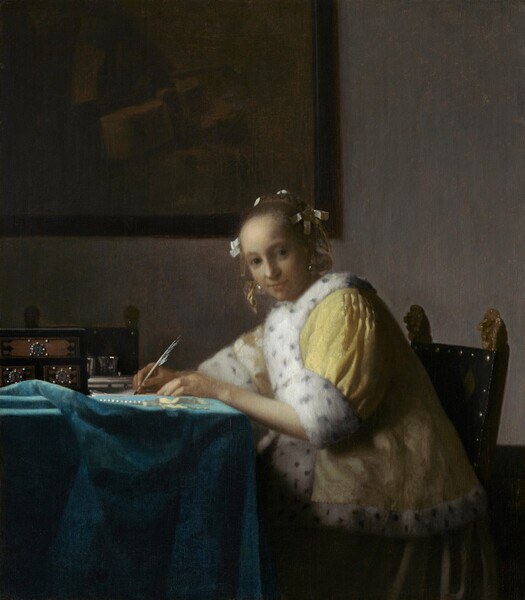
Her pen is still poised over the page, but she has turned to look out. Because she looks towards us, the interruption seems to come from our side of the picture. Light catches her yellow jacket against the dark wall. Vermeer gives no reason for the pause and no hint of how long it will last.
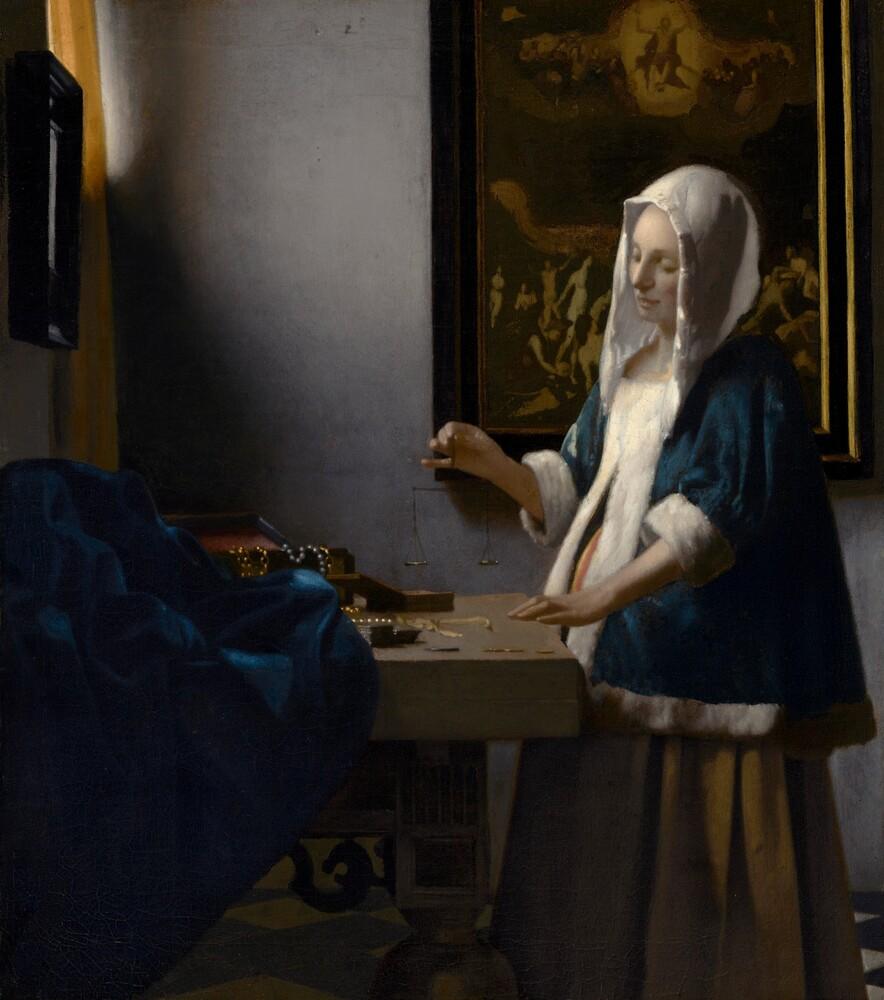
Valuables lie on the table, and above them a small balance hangs from the woman's delicate grip as if it weighed almost nothing. On the wall behind her is a painting of the Last Judgement, which carries the idea of weighing over to moral reckoning. It would be easy to turn this into a sermon, with the picture on the wall explaining the scales in her hand. Vermeer keeps both kinds of weighing in the same room, close together, but he never turns one object into a caption for the next.
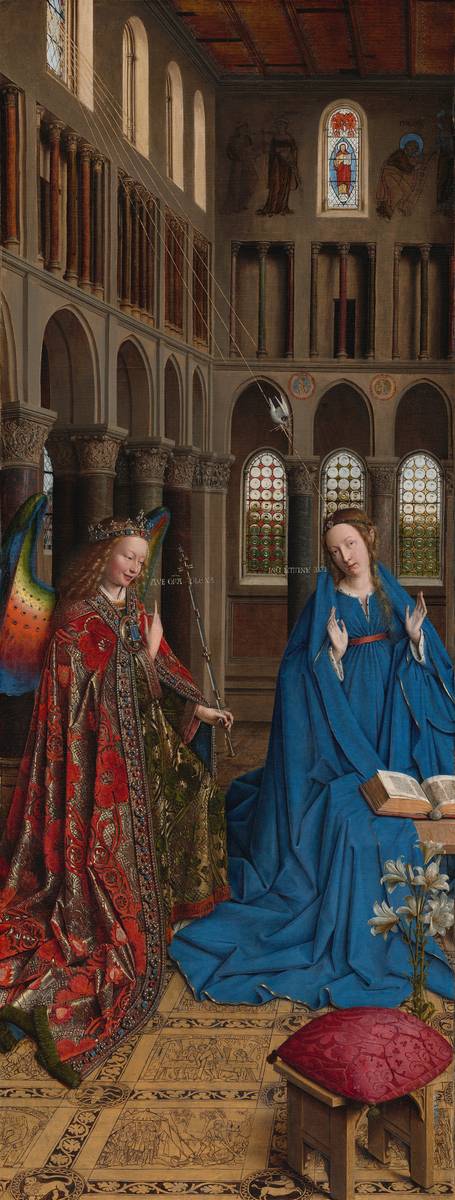
c. 1434–1436 · Oil on canvas transferred from panel · National Gallery of Art
Van Eyck sets the meeting of the angel and Mary inside a church, and the building carries much of the meaning. Its floors, inscriptions and distant architecture hold more information than the encounter itself, and they link the event being announced to a wider Christian history. The narrow format draws the eye on through the building instead of letting it settle on the exchange between the figures. The devotion the picture invites seems to lie partly in this slow reading of details.
The picture was painted on panel and later transferred to canvas, so it no longer sits on the support Van Eyck painted it on.
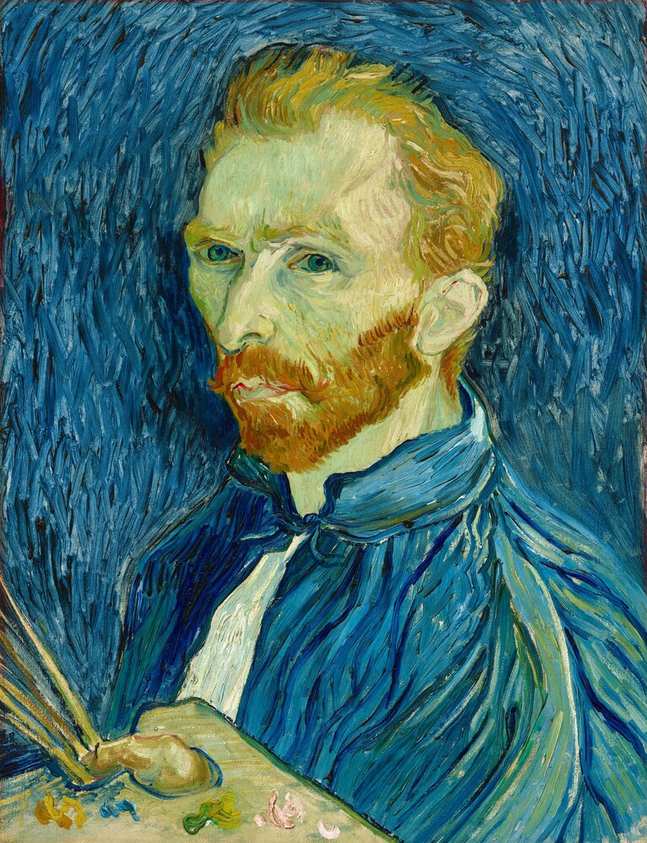
Palette and brushes announce the sitter's trade, and the paint backs them up. The strokes around and across the face are the visible evidence of a painter at work. They make no attempt to pass for smooth skin, yet the face reads clearly through them.
1873-1876 · Oil on canvas · National Gallery of Art
The title promises a fair wind, and the picture shows what that means in practice: a boat tilting on choppy water. The man and boys each sit differently as they adjust to its movement, and whatever pleasure the sail offers lies in balance and attention. A boatload of figures might have made a group portrait, but this boat is never steady enough for one.
Everything depends on timing, and the outcome is not yet settled. If the rescue is to succeed, men must reach the swimmer, the boat must be manoeuvred into position and the shark must be confronted, all at once. Copley spreads these efforts across a tangle of straining bodies, so no single figure carries the action. The waterfront in the distance shows where the episode takes place, but it is too far off to help.
From the waist up, with his arms crossed and his body composed, William Grant could be posing for any full-length portrait. Only the angled leg gives away the balance he needs below. Stuart has adapted the formal portrait to a skill performed in motion, and he keeps the motion almost out of sight. The other skaters in the distance share the pastime without rivalling the sitter.
Cole leaves little to decode. The river is the course of a life and the direction of travel stands for the passing years. The scenery does the rest, with a dark opening behind and a lush, bright world ahead. The child rides in the golden boat but does not steer it, and at this start of the voyage an angel keeps it company.
Giovanni Bellini, with later landscape alterations by Titian
1514; landscape reworked 1529 · National Gallery of Art
Food, vessels and loosely gathered bodies make the gods look like company at an outdoor meal. The picture is Bellini's, but the setting of the feast is not wholly his. Titian later reworked the landscape behind the gods, so the feasters and the world around them no longer come from a single hand.
El Greco takes the ancient story out of the conventional classical setting and stages it in front of a city resembling Toledo. The struggling figures pull in several directions against the serpents. The sky offers no relief, because its turbulent clouds continue the instability of their limbs.
This portrait argues a case, and the case is diligence. Papers, a clock and a candle present Napoleon as a ruler absorbed in administrative duty, and even the slight disorder of his uniform supports the impression. Whether he actually worked like this is another matter. The evidence on offer is a set of props, and David chose them.
A bridge ought to lead somewhere, but no path leads out of this picture. The bridge spans the upper pond, and nothing beyond it opens onto a distant horizon. The view stays inside the garden, where lily pads, reflected growth and vegetation overlap again and again. There is depth, but the strokes keep drawing the eye back to the surface. In all this tangle, the bridge is the one clearly defined shape.
The hoop runs from the girl's hand to the ground, which suggests a game that has paused, and the pause is what allows her to be portrayed. Broken garden light surrounds her, but she holds still. The toy places a particular child outdoors and hints at play, but Renoir stops short of telling a story.
Gauguin painted this in the same year as the Van Gogh self-portrait earlier in this selection, but he took a very different route to presenting himself. Van Gogh shows the tools of his trade. Gauguin gathers a halo, a snake and apples around his head, signs that pull between sanctity, temptation and the Fall, and puts fields of red and yellow where an ordinary room might be. These signs belong to his self-fashioning, his chosen way of complicating his public image, and are probably better read as performance than as confession.
For a picture called The Railway, there is very little railway to see. No locomotive is clearly shown. The railway is present mainly as railings and steam, which are the very things that block the view. The child turns towards them and towards whatever is happening beyond the bars, which stays out of sight. The seated woman looks out at us instead, with her book and dog for quieter company.
The title gives the velvet equal billing with the magnolias, and fairly so. Heade has taken the flowers out of any garden and laid them on heavy cloth, and the deep blue of its folds is what makes the white petals look so substantial. Leaves and dark stems separate the blossoms but keep the arrangement close.
The child doesn't so much sit in the armchair as sprawl across it, and the chair is so large that her hold on it looks temporary. Cassatt leaves the ungainly ease of the pose as it is and does not tidy it into something more formal. Patterned blue upholstery fills much of the room, and the furniture competes with its small occupant for attention.
Here flat paint passes for separate objects on a door, and Peto builds the illusion out of the age the title announces. Tattered music, marked wood and shadows do the persuading, and the wear is painted as carefully as the violin's apparent thickness. Nothing gleams.
Heade brings his flowers close by laying them on velvet, while O'Keeffe does it by enlarging hers. Dark folds and a narrow pale form nearly fill the canvas, and curving bands lead towards the central opening, so the flower becomes a matter of structure. At this scale it comes close to abstraction, though the Jack-in-the-Pulpit is still recognisable.
Explore this selection in Artline
See the selected works alongside books and events from their period, or compare when the artists lived. The books and events provide context, not evidence of direct influence. Works without confirmed dates remain in this guide.
Who is steering?
Several pictures in this selection put people in boats, and the boat does a different job each time. In Cole's allegory it carries a life, and the point is that the child is a passenger. The river supplies the direction and an angel keeps the child company. Homer's boat answers to the wind, and the man and boys have to keep adjusting to it, so the outing is work as well as pleasure. Copley's boat must be manoeuvred into position in time to reach a swimmer while the shark is confronted. Taken together, they run from a voyager who is carried along, through a crew that has to keep its balance, to men whose timing decides whether a rescue succeeds. Cole's is the only openly allegorical voyage. In Homer and Copley, the practical business of handling a boat makes up much of the drama.
Further reading
Leonardo da Vinci; translated by John Francis Rigaud · Read free · English
These are Leonardo's notes on painting, in John Francis Rigaud's English translation. They treat faces, gestures, light and landscape as practical problems. Several of them are the problems of the Ginevra de' Benci portrait, where a face has to hold its own against foliage and a landscape has to recede behind it. The book shows Leonardo working through such questions in his own notes.
 Art, literature & history