Munich's three great painting collections lie close together, and this selection draws on all three. The Alte Pinakothek, home of the Old Masters, supplies the earliest pictures, from Giotto's gold-ground Crucifixion to two very different Rembrandts. The Neue Pinakothek is known for nineteenth-century painting, though the pictures chosen from it stray a little beyond that century at either end, from Angelica Kauffman's biblical scene to Emil Nolde's dance. The Lenbachhaus is known above all for the Blue Rider circle, and it contributes Kandinsky, Münter, Marc and their associates.
One thread runs through all three collections: painters looking at painters, themselves included. Dürer and the young Rembrandt paint their own faces, and Corinth does the same with a skeleton for company. Manet watches Monet at work. Among the Blue Rider pictures the habit becomes almost a portrait of a circle. Münter paints Jawlensky, Werefkin and Kandinsky, and each of them also appears here with work of their own. Kandinsky turns up more often than anyone else: once at table in the Murnau house, and three times as a painter, with a railway view of Murnau, a colour study and an improvisation.
Artline chose these works from documented museum holdings, independently of the museums. A work in a collection is not necessarily on display: it may be on loan or off view, and works on paper in particular may rotate. Where museum records qualify a date or attribution, the qualification is kept.
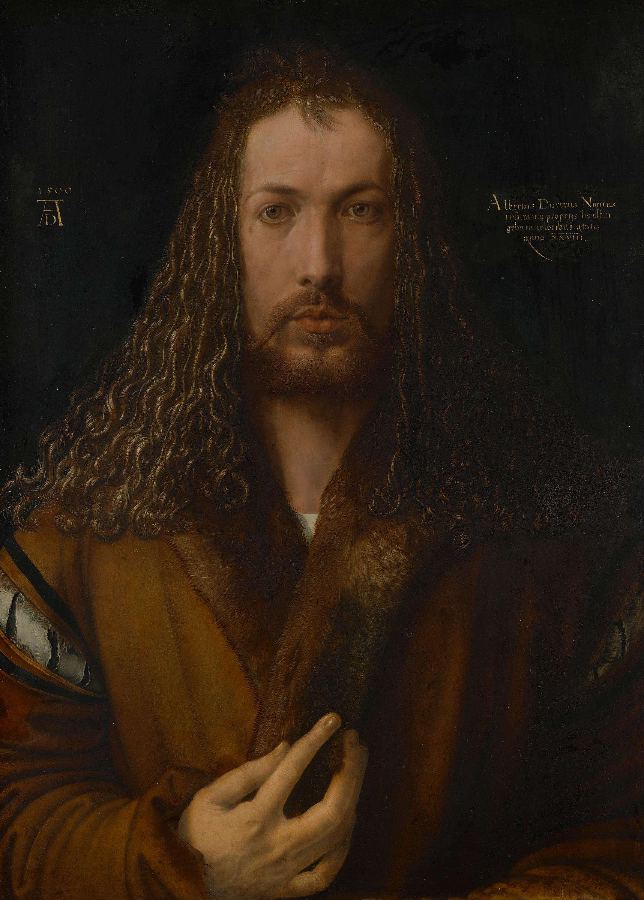
1500 · Paint on limewood; binder not specified in source · Alte Pinakothek — Bayerische Staatsgemäldesammlungen
Dürer faces straight out, one hand raised to the fur at his collar. The museum points out that the symmetry and frontal pose recall familiar images of Christ, which is a bold model to borrow for a picture of oneself. The painting doesn't say how far the comparison should be pressed, and the eyes, hair and features are unmistakably his own. The fur matters as much as the pose. It gives him a surface for the kind of close observation on which a painter's reputation depended.
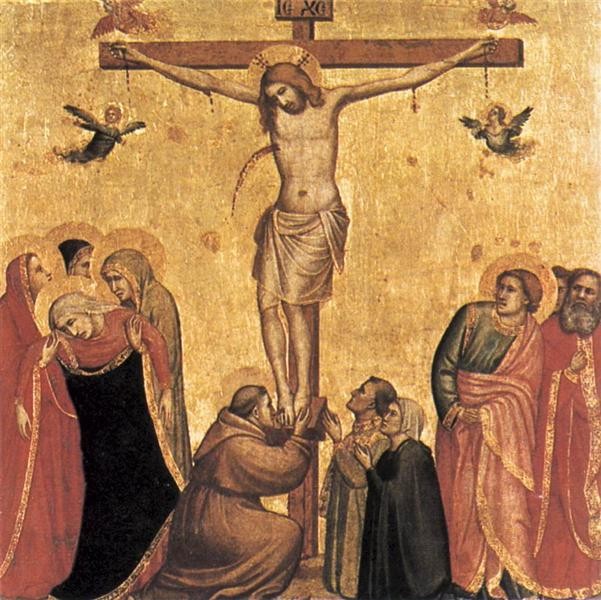
1320–1325 · Alte Pinakothek — Bayerische Staatsgemäldesammlungen
Gold fills the background and sets the scene apart from any earthly landscape, yet the mourners at the foot of the cross have real bodily weight. Giotto doesn't repeat one expression from face to face. Instead, grief runs through whole figures: they bend, turn and hold one another up, in gestures anyone might recognise.
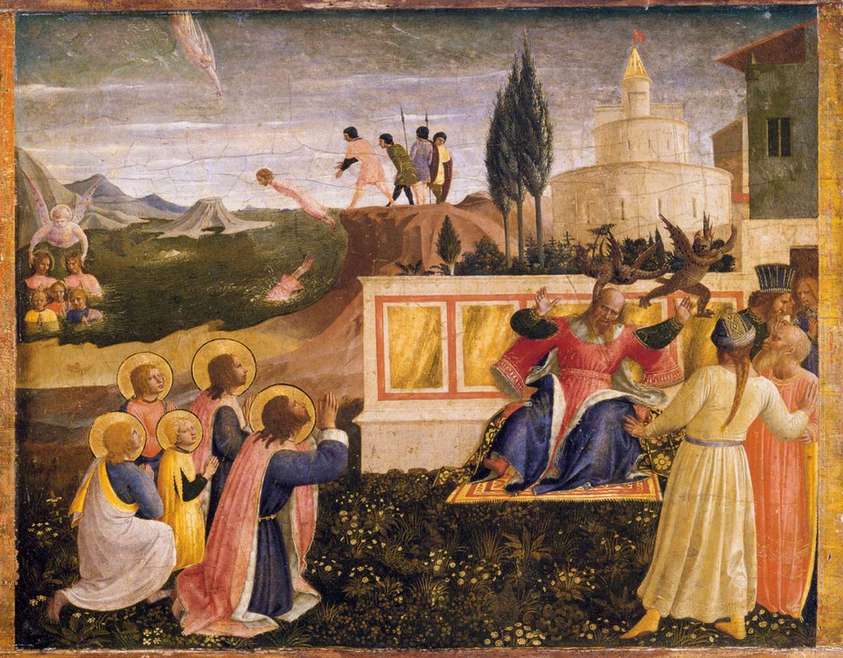
1438–1440 · Tempera on panel · Alte Pinakothek — Bayerische Staatsgemäldesammlungen
Fra Angelico fits more than one moment of the saints' story into a single landscape and lets the ground itself do the work of frames. Paths, buildings and changes of level separate the small groups of figures, so each episode can be followed on its own patch of ground.
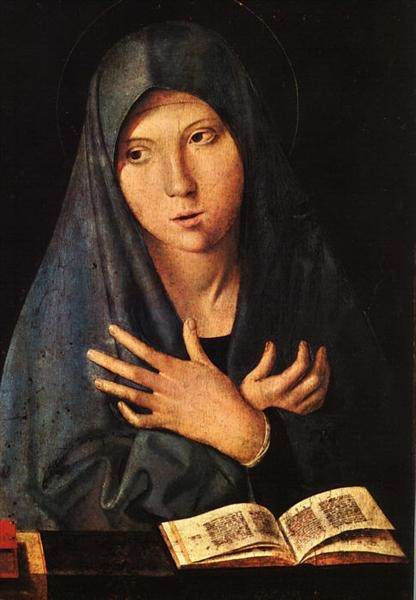
1473 · Alte Pinakothek — Bayerische Staatsgemäldesammlungen
An open book tells us that something has been interrupted. The rest is left to the Virgin herself. Her response lies in her lifted attention and crossed hands, and little around her explains it. Antonello concentrates the Annunciation in face, mantle and gesture, so a slight shift of posture carries what a more crowded treatment would share out among angel, architecture and landscape.
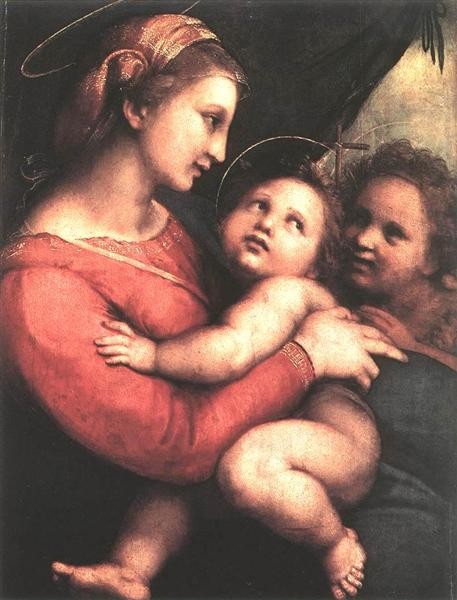
1512 · Oil on wood panel · Alte Pinakothek — Bayerische Staatsgemäldesammlungen
The curtain that gives the picture its name encloses the group without cutting across it. Within that space Raphael packs the figures closely, yet none is lost in the overlap. A hand or a glance always leads on from one body to the next, and you are never in doubt about who touches whom, or who looks at whom.
1570–1575 · Alte Pinakothek — Bayerische Staatsgemäldesammlungen
Poles and arms cross and press in on the seated Christ, and the arrangement alone would be violent enough. Titian's handling of the paint makes it more disturbing still. Edges between flesh, cloth and shadow break down, and the competing directions never quite settle.
c. 1617 · Paint on canvas; binder not specified in source · Alte Pinakothek — Bayerische Staatsgemäldesammlungen
A small reproduction keeps the design of this altarpiece but loses most of the effect of its size, because Rubens organised it to work at more than one scale. From a distance the broad currents of rising and falling bodies read first and make the crowd legible, while light separates passages that would otherwise be hard to make out as individual figures. Particular limbs and faces come forward only after that.
1615–1616 · Alte Pinakothek — Bayerische Staatsgemäldesammlungen
Rubens forces horses, hunters, a hippopotamus and a crocodile into a shared centre with little room to retreat. Weapons and limbs pull against one another, and the contrasts between hide, flesh and clothing keep each part of the struggle legible. The hunt is staged as a collision, which makes the picture a poor guide to how either animal behaves outside a painting.
1661 · Alte Pinakothek — Bayerische Staatsgemäldesammlungen
Without its title, how much of this picture would tell you its subject? The museum identifies the figure as Christ after the Resurrection, but the wounds of the Passion are not shown, and little surrounding action explains the event. What remains is a half-length figure seen frontally, the torso lit and a hand close by. He has the nearness of a portrait sitter.
1629 · Paint on oak; binder not specified in source · Alte Pinakothek — Bayerische Staatsgemäldesammlungen
Dürer set out his face frontally and in full. The young Rembrandt lets his hair throw shadow across his features, while his collar and curls catch the brighter accents, so the light shows less of the face than it first seems to promise. Concealment is a curious thing to build into a picture of your own face, and the likeness has to hold up despite it.
1888 · Oil on canvas · Neue Pinakothek — Bayerische Staatsgemäldesammlungen
Sunflowers was painted as a series, and the blue-green background is one of the things that sets this Munich version apart from the others. Against it the yellow repeats, but no two flowers are the same. With so narrow a range of colour, the differences lie in shape and stage: open blooms, curling petals, heavy seed heads. Each head faces its own way and shifts the balance of the group.
1874 · Oil on canvas · Neue Pinakothek — Bayerische Staatsgemäldesammlungen
The studio boat puts Monet inside the very conditions he is painting. Its dark shelter frames his pale clothes and an easel, while broken marks describe the water around it. Manet's portrait is partly a record of equipment, of a working arrangement for painting out of doors, and the landscape is no longer the only subject.
1839 (museum record) · Neue Pinakothek — Bayerische Staatsgemäldesammlungen
An umbrella has become indoor equipment, sheltering the bed in an attic room. Books, papers and the low ceiling complete the poet's makeshift working arrangements. Spitzweg gets his comedy from these material details, not from any grand claim about genius. The date in the heading is the one the museum records for the Munich version.
1818 · Oil on canvas · Neue Pinakothek — Bayerische Staatsgemäldesammlungen
The title names the shelter, not the view. A distant spire is seen through an opening of plants and supports where two figures pause. By including the place the view is taken from, Friedrich frames the distance and gives it a physical starting point.
1796 · Neue Pinakothek — Bayerische Staatsgemäldesammlungen
Kauffman tells this biblical conversation through hands. The two figures' gestures break the exchange into steps that can be followed across the well, and red and blue set the bodies apart against a restrained landscape. She brings in no crowd to make the meeting look more eventful than it is.
1884 · Neue Pinakothek — Bayerische Staatsgemäldesammlungen
The only picture in the selection with Munich in its title shows a crowd at leisure with no centre. Tree trunks keep breaking up the view of tables and visitors, and sunlight scatters further breaks across clothing and ground. Many people are busy at once, encounters are only partly seen, and Liebermann puts no single incident first.
1906–1907 · Oil and tempera on canvas · Neue Pinakothek — Bayerische Staatsgemäldesammlungen
The title speaks of children, but it is the child holding the bowl who anchors the picture. Modersohn-Becker builds that figure from broad shapes and firm boundaries, with little careful modelling, so it reads almost as a silhouette. The bowl keeps attention close to the child's body, and leaves and objects crowd the narrow field without dislodging it.
1871 · Oil on canvas · Neue Pinakothek — Bayerische Staatsgemäldesammlungen
Pissarro takes an ordinary suburban street, with no landmark and no event, and treats it as a landscape subject in its own right. The road and rooflines lead back beneath a broad grey sky. Small walkers fit into that recession, and bare branches interrupt it.
1874 · Neue Pinakothek — Bayerische Staatsgemäldesammlungen
Sisley uses the same basic device as Pissarro's Upper Norwood street, a route leading away, to quite different effect. A warm-coloured path runs into the distance beside cooler water, and trees and figures recur at diminishing sizes, so you could almost measure the recession. Pissarro's street is enclosed. Here the river leaves one side open, and there is far more room between the near ground and the sky.
1910 · Neue Pinakothek — Bayerische Staatsgemäldesammlungen
Stretched limbs vanish into areas of colour and reappear at emphatic boundaries. In places it is hard to tell a pose from its setting. Nolde's yellow, red and blue imitate no ordinary light, yet they organise the scene, and the abruptness with which they meet keeps the dance going.
1911 · Städtische Galerie im Lenbachhaus und Kunstbau München
The horse is blue, but its lowered head could only be a horse's. Rounded hills repeat the curve of its neck, so animal and landscape are joined by shape and the colour no longer has to describe anything. Marc keeps just enough of the body familiar for the blue to do that work without losing the animal.
1913 · Städtische Galerie im Lenbachhaus und Kunstbau München
Each square holds a set of concentric rings. From square to square the neighbouring colours change, and so do the width, order and proportion of the rings, so you can compare how strong a colour looks under different conditions. That is what a study is for, and there is no hidden figure to hunt for. Still, the rings are irregular enough that it never looks like a mechanical chart.
1910 · Städtische Galerie im Lenbachhaus und Kunstbau München
Close façades narrow the walkers' passage and leave little sky above. Werefkin builds the pressure into the proportions of the street itself. Whatever the figures are thinking, the architecture alone suggests why the way into the night might be hard going.
1908–1909 · Städtische Galerie im Lenbachhaus und Kunstbau München
The painter of Into the Night is seen here at rest beside Jawlensky, under a good deal more sky than her own walkers get. Münter sets the pair on a green slope that tilts them towards the picture surface, and their clothes form distinct patches beneath the broad blue. Each has a pose of their own, but both are held within the larger arrangement of colour, and the slope counts for as much as the people resting on it.
1912 · Städtische Galerie im Lenbachhaus und Kunstbau München
This time Münter's sitters are indoors, at table in the Murnau house of the title. A pale tablecloth and the sitters' faces stand out against a dark wall, and chairs and small objects make it a particular room. Members of an artistic circle appear as ordinary domestic company, without ceremonial poses, and large blocks of colour keep the gathering compact.
1909 · Städtische Galerie im Lenbachhaus und Kunstbau München
There is barely a trace of a stage, yet Jawlensky paints Sakharoff in costume and make-up, and seems to treat that appearance as part of who the dancer is. The red costume gathers the body into one forceful area beneath the pale, made-up face. The body turns while the gaze looks outward, and hair, eyes and mouth take their intensity from the colour around them.
1913 · Städtische Galerie im Lenbachhaus und Kunstbau München
In Liebermann's beer garden, tree trunks get in the way of the visitors. In Macke's promenade they set a pattern that the upright figures continue. Walkers and vegetation share the same surface, and only clothing and changes of direction keep the figures distinct among the broad, interlocking foliage.
1909 · Oil on cardboard · Städtische Galerie im Lenbachhaus und Kunstbau München
A train runs low across this view as a firm horizontal, beneath bright, angular land and sky. Kandinsky's colour is becoming independent of what it describes, yet enough of the locomotive, a pole and some buildings remains for the place to be recognised, and that steady lower line holds the fragments together.
1896 · Städtische Galerie im Lenbachhaus und Kunstbau München
A skeleton is ordinary studio equipment, something for a painter to study. Corinth gives this one nearly equal standing with himself: painter and skeleton stand upright before the windows and take up comparable amounts of space. Set beside his living, clothed body, it also invites a reading about mortality, and the picture needs little further symbolism to support it.
1914 · Oil on canvas · Städtische Galerie im Lenbachhaus und Kunstbau München
The title promises terrain. Diagonals may suggest a slope, but they carry on across boundaries that break up any consistent view, and the lines and colours never settle into a single place that could be surveyed. Nothing here steadies the picture the way the train did in the Murnau view.
Explore this selection in Artline
See the selected works alongside books and events from their period, or compare when the artists lived. The books and events provide context, not evidence of direct influence. Works without confirmed dates remain in this guide.
Where the collections overlap
The three museums are known for different periods, but the line between the Neue Pinakothek and the Lenbachhaus is looser than the labels suggest. Corinth's self-portrait belongs to the Lenbachhaus, yet it is older than the Modersohn-Becker or the Nolde, both in the Neue Pinakothek's collection. Nolde's Dance Around the Golden Calf and Werefkin's Into the Night were painted in the same year, one now in each collection, and they make a useful pair. Both are built on blue and red, with yellow added in Nolde's case and violet in Werefkin's, yet the shared colours pull in opposite directions. Nolde uses them to dissolve the edge between a body and its surroundings, so that the dance seems to belong as much to the painted ground as to the dancers. Werefkin uses them to harden that edge. Her walkers stay distinct from the façades, which shows all the more clearly how tightly the buildings hem them in.
Further reading
Wassily Kandinsky; translated by M. T. H. Sadler · Read free · English
Kandinsky's own account of colour, form and the aims of painting, in M. T. H. Sadler's English translation. Its arguments bear on several pictures in this selection, his own among them.
 Art, literature & history