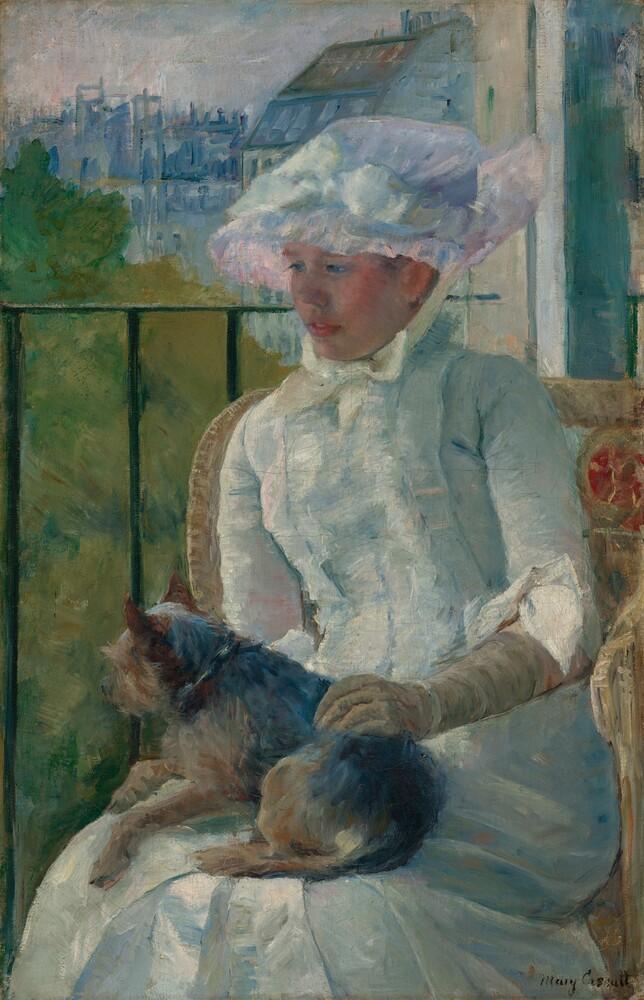
Mary Cassatt, an American painter who worked in France, exhibited with the Impressionists and made domestic life her subject. She painted women at the theatre, children at play, people arranging their hair or sealing letters, showing her subjects absorbed in what they were doing rather than holding a formal pose. The twenty works below include oil paintings, a pastel, and colour prints. In the colour prints, made using drypoint, softground etching and aquatint, a few outlines and areas of flat colour are enough to establish a room or a figure.
An editorial selection, not a complete catalogue of Cassatt's work.
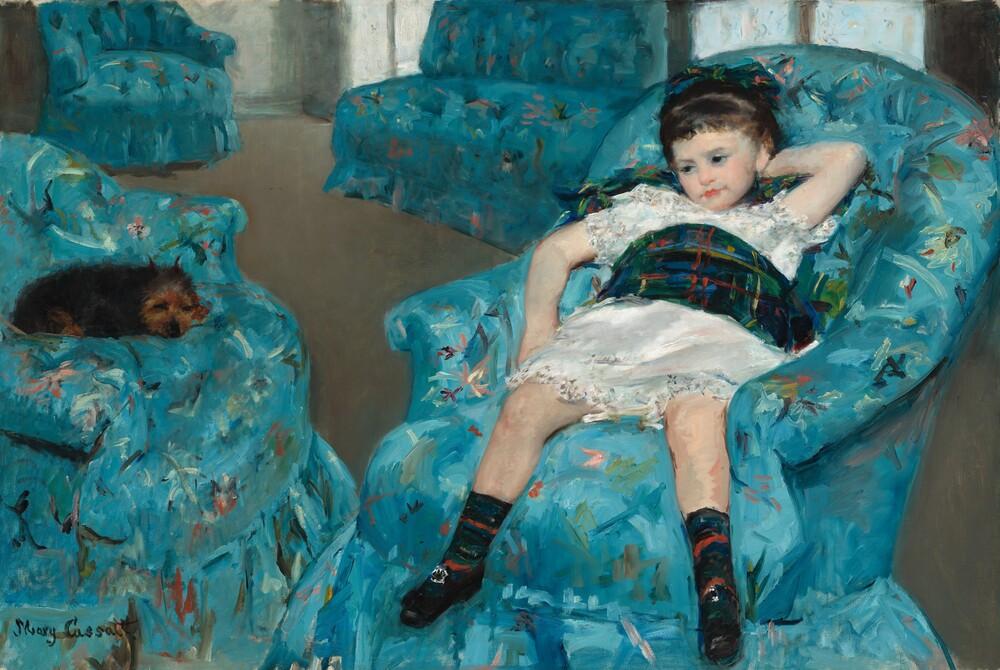
A girl has sprawled in a blue armchair, legs stretched across the seat, while a small dog rests on another chair. Cassatt gives as much space to the furniture as to the child, and the scale of the large chairs makes the unstudied posture all the more apparent.
c. 1878-1880 · oil on canvas · National Gallery of Art
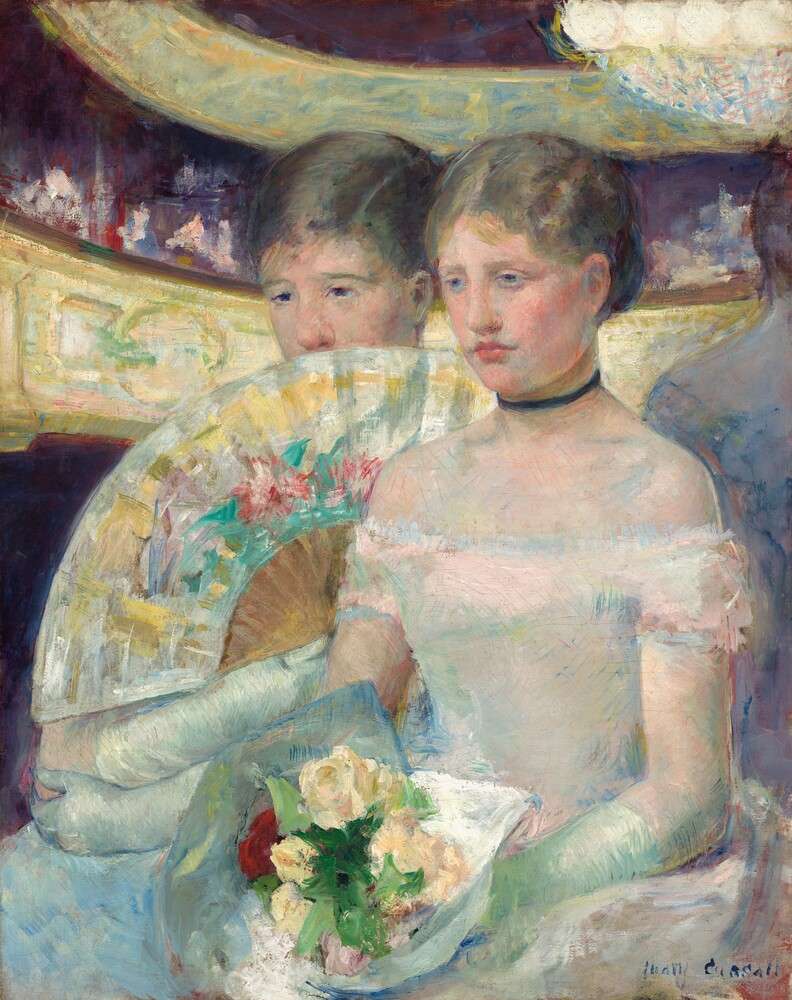
A loge is a theatre box. Two women sit in the box, dressed in bright fabric and flowers. An open fan partly covers one woman's face; the other holds flowers in her lap. The stage is not shown.
Cassatt places the children in the foreground, leaving the sea as a narrow band behind them. The digging is shown in detail: awkward grips, bent arms, small bodies concentrated on the task.
Against a plain background, a child in simple clothing stands with hands joined, wearing a straw hat with an uneven brim. The face is unsmiling, the cheeks warm-coloured.
1888 · Pastel on blue-gray wove paper (faded to tan), mounted on canvas, on a strainer · Art Institute of Chicago
The child reaches up to touch the adult's cheek; the adult supports the child from below. The faces are worked in detail, with broader pastel strokes left visible in the clothing. The paper, originally blue-grey, has faded to tan.
1890-1891 · color drypoint, softground etching, and aquatint on laid paper · National Gallery of Art
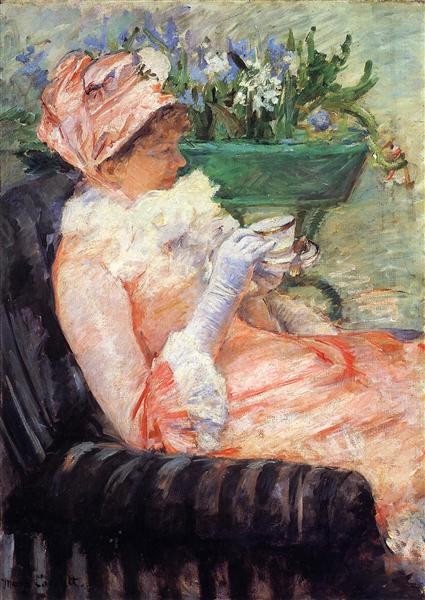
Much of the paper is left bare. A few lines and touches of colour establish two women at tea, one with a raised cup. The inking in this impression is light; others can be much darker.
1890-1891 · color drypoint, softground etching, and aquatint on laid paper · National Gallery of Art
Two women share a bench. One looks away; the other attends to the baby. The compartment is tight, the figures compressed between a strip of window and the bulk of skirts filling the foreground.
1890-1891 · color drypoint, softground etching, and aquatint · National Gallery of Art
The child throws an arm around the woman's neck and presses toward her face. The embrace is outlined as a single continuous shape, the patterned dress distinguishing one body from the other.
1890-1891 · color drypoint, softground etching, and aquatint on laid paper · National Gallery of Art
A coiffure is a hairstyle, or the act of arranging one. The woman is seen from behind; a mirror shows her face, bent shoulders and raised arms. With little shading, the line of her back carries the figure against the striped upholstery and patterned wallpaper.
1890-1891 · color drypoint, softground etching, and aquatint on laid paper · National Gallery of Art
A woman leans toward a washstand, seen from behind with a mirror providing a second view. Her back is outlined with almost no shading; the stripes of her skirt bend around her hips and define the form.
1893/1894 · oil on canvas · National Gallery of Art
The rower's dark back occupies much of the foreground; the mother and child sit facing him. The boat's curved edge encloses all three, with water rising high behind them. Broad areas of flat colour make the unequal division of the canvas immediately plain.
Viewed from above, a woman holds a child on her lap and washes one of the child's feet in a basin. Both heads are bent to the task. The round basin and interlocked limbs hold the composition together amid the stripes and patterns surrounding them.
A child looks into a hand mirror while a larger mirror behind reflects the pair. The round centre of the sunflower echoes the shape of the small glass.
Open these twenty works alongside books and events from their period. The lifespan view includes Mary Cassatt, Berthe Morisot, Edgar Degas and Claude Monet. These comparisons provide historical context, not claims of direct influence.
Collections and print states
The works reproduced here are held in different collections. Cassatt's colour prints exist in multiple impressions that can vary in inking and overall tone. The print entries describe the particular impressions illustrated.
Jennifer A. Thompson and Laurel Garber · 2024 Publisher page; purchase or library
An exhibition catalogue examining Cassatt's working methods and the depiction of labour in her paintings. Includes technical research and correspondence relevant to The Fitting and the bathing scenes.
 Art, literature & history