Twenty paintings from the Uffizi: altarpieces, portraits, mythologies and a battle, from Duccio and Giotto to Caravaggio, Artemisia Gentileschi and Claude Lorrain.
The Uffizi in Florence grew out of the Medici collections. It is now one of the best-known art museums in the world, and its galleries matter particularly for the history of Renaissance painting. Botticelli, Leonardo and Michelangelo draw much of the attention, but there is a good deal to learn from the painters around them.
Much of this selection of twenty paintings works by repetition. Duccio and Giotto both paint the Virgin enthroned; Gentile da Fabriano and Mantegna both paint the Magi arriving; Ghirlandaio, Botticelli and Perugino each gather saints around the Madonna. Seen together, these shared subjects make the differences between painters unusually easy to see. Botticelli also appears away from his famous mythologies, as the painter of an armoured Fortitude and a Madonna among saints. Portraits by Piero della Francesca and Bronzino, Uccello's battle and Titian's Venus of Urbino widen the range, and the latest picture, Claude Lorrain's imagined harbour, is a long way from the altarpieces.
Artline chose these works from documented Uffizi holdings, independently of the museum. Being in the collection does not mean a work is on display. Dates and attributions keep the qualifications given in the linked records.
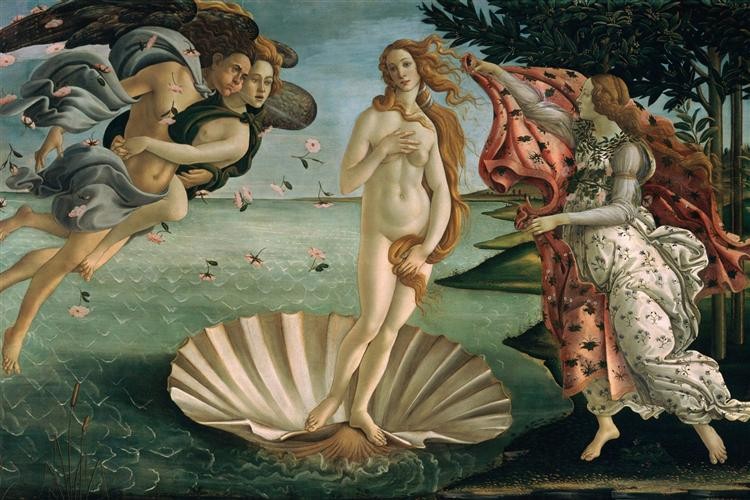
Venus has reached the shore on her shell, but the wind is still blowing: it blows her hair and the cloak that a waiting figure holds out for her. The bodies are unusually long and graceful, and the stretching looks deliberate. The picture is made out of the flowing outlines of hair, drapery and limbs rather than the proportions of observed figures.
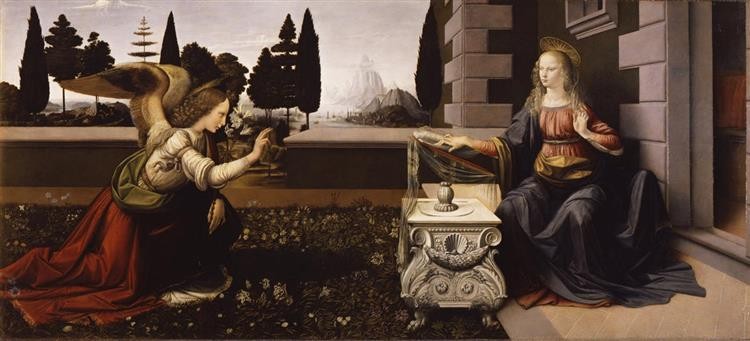
A lectern and a garden wall enclose the meeting of Mary and the angel in a space that feels close enough to measure. Beyond the wall the rules change. Water and mountains grow steadily less distinct, and Leonardo marks distance by how clearly he paints things, not only by how small he makes them.
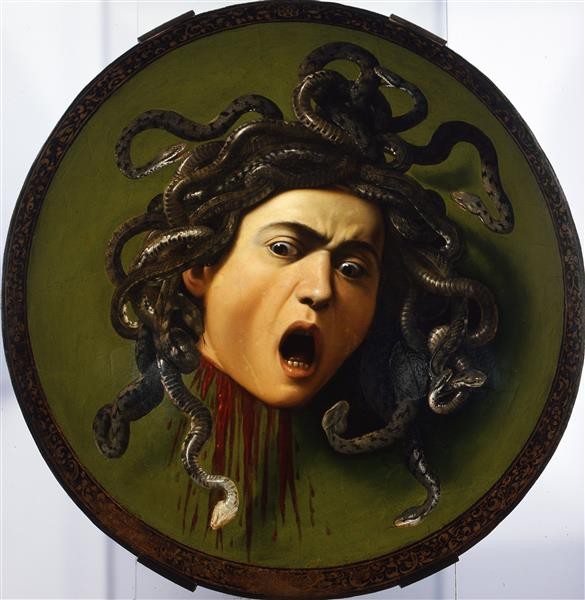
The support is a convex shield, and Caravaggio lets the object and the image pull against each other. The surface bulges out towards the viewer, while the severed head seems to sit in some uncertain space inside it. The mouth is open in a cry that no severed head could sustain. Blood below and snakes above leave almost no neutral ground around the face.
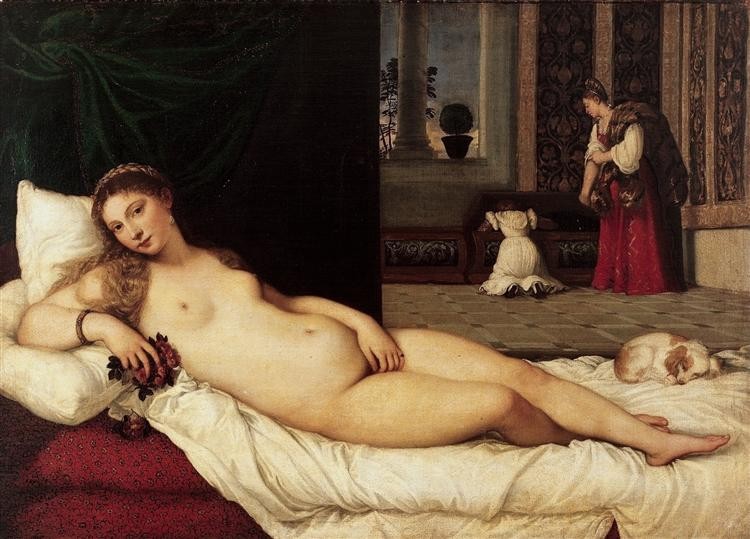
The title calls her Venus, but she lies in what looks like a household going about its business. Behind her, maids attend to a chest and a dog sleeps. Their attention is turned elsewhere or switched off altogether, which makes her own gaze out of the picture all the more direct. The Uffizi reads these domestic details in relation to marriage, which would give the nude a place in a social world.
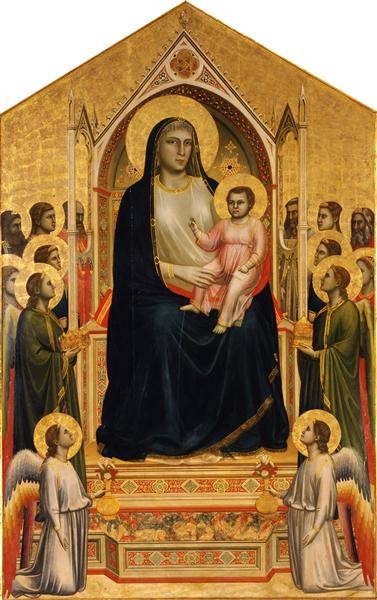
Scale settles the hierarchy at once: Mary is painted larger than anyone around her, so her rank is clear before any gesture is read. Her size does not make her weightless, though. Giotto gives her robe the weight of a seated body, and the throne that holds her is built with architectural depth.
The Magi's procession is already on its way through the distant hills, so reading across the painting means following the journey to the child. At its end, elaborate clothes and horses crowd round the meeting. All that finery might have produced a closed ceremonial group, but the landscape keeps the journey in view. These visitors have come from somewhere.
Caravaggio's Medusa is all aftermath. Here the beheading is still under way, and it takes two women. Judith and her maidservant each have a different task, and their arms are locked so tightly that the act depends on both. Braced shoulders and gripping hands show resistance as well as effort. The killing is hard physical work.
A gold edge runs through the broad blue of Mary's robe and turns where the body beneath it turns. So there is a body here, but the figure keeps a clear, ceremonial outline. The angels support the throne and attend the Virgin rather than sharing an ordinary room with her. Set beside Giotto's later Ognissanti Madonna, with its heavy seated figure, Duccio's Virgin holds on to more of the ceremony.
Gentile da Fabriano crowds his arrival with rich clothes and horses; Mantegna lets the rock do the organising. Mary and the child are placed in a narrow, rocky opening, and the approaching procession has to cross difficult ground to reach them. The rock encloses the meeting, and the thin route behind it records the distance travelled.
Several kinds of movement share the picture: a pursuit at the right, a dance, and a stiller centre. Botticelli keeps these groups distinct, although repeated contours link them beneath the trees. How the episodes add up, and what the painting means as a whole, is still debated.
Jewels and a patterned bodice show Battista Sforza's status, but the portrait's authority lies elsewhere. It comes from the strict profile, its edge cut hard and exact against a landscape that stretches far into the distance behind her.
The title names a single incident, the unhorsing of Bernardino della Ciarda, but the most telling detail may be on the ground. Fallen weapons lie beneath the colliding horses, pointing in clear directions, and they make the space measurable while the fighting above is in violent disorder. The most orderly things on the field are the ones that have been dropped.
A virtue in armour who strikes no one. Botticelli gives Fortitude a seat and a restrained gesture, and her strength shows as readiness, in the braced posture and firm grasp, rather than as action. The hard metal of the armour stands out against a broad sweep of red cloth.
Everything in the devotional group is in order (Mary's hands joined, the child supported) until one angel turns and smiles out of the picture. It is an ordinary, friendly glance, and it opens up a group that might otherwise seem closed to whoever is looking at it.
The title ties the scene to the Villa Medici, but the harbour itself is imagined. Buildings and ships supply the solid forms, and Claude places them so that a passage stays open towards the light. Small workers in the foreground give a human scale, but the scene is organised around distance rather than around them. In a selection crowded with Madonnas, saints and sitters, this is the one picture in which people are not the subject.
Piero's Battista Sforza takes her authority from the edge of a profile; Bronzino's sitter takes hers from stillness. Lucrezia Panciatichi rests a hand on a book. Jewels and dark trim break up the expanse of red satin, and all of it is arranged around a face held absolutely still.
The title reads like a list of names, and Ghirlandaio might have painted it as one. Instead an architectural recess gives the saints a shared focus, and their heights vary because some kneel while others stand. Floor and arches hold the gathering in one coherent space, so the saints read as a company rather than a row of separate sacred portraits.
The kneeling saints occupy the nearest part of the patterned floor and bridge the distance up to the raised Virgin and child. From there, turns of the head lead from figure to figure. Little moves in this group; its structure comes from small shifts of posture.
Ghirlandaio and Botticelli draw their saints together through posture and the turn of a head. Perugino gives his saints room instead. Open space surrounds each one, and the gaps read as clearly as the figures. Repeated arches measure out these intervals without breaking up the group, and the way through to Mary stays clear.
The title names the feature nobody misses, but the neck is only part of it. The angels crowd together on one side, while the space beside the column is left open. The bodies are out of balance in the same way: Mary's neck is extended and her fingers long, and the child has unusual proportions. Botticelli's Venus is stretched too, but her length follows a flowing line. Here there is no single settled scale to measure anything by.
Explore this selection in Artline
See the selected works alongside books and events from their period, or compare when the artists lived. The books and events provide context, not evidence of direct influence. Works without confirmed dates remain in this guide.
Near and far
One way through the selection is to ignore the order and follow a single question. Distance is a good one, because it does a different job from picture to picture. In Leonardo's Annunciation it lies beyond the garden wall, water and mountains losing definition as they recede. For Gentile da Fabriano and Mantegna it is the story itself: the road the Magi have already travelled, through distant hills in one case and along a thin route behind the rock in the other. Behind Battista Sforza a far-reaching landscape gives Piero something to cut her profile against. In each of these, distance serves the figures in front of it. Claude turns the relation round. His small foreground workers are there to give scale, and the open passage towards the light is what the harbour has been arranged to show. Hands would make another route through the same selection, from Mary's joined hands in Filippo Lippi's Madonna to the locked grip of Judith and her maidservant, Lucrezia Panciatichi's hand on her book and Parmigianino's long fingers.
Further reading
Leonardo da Vinci; translated by John Francis Rigaud · Read free · English
John Francis Rigaud's English translation gathers Leonardo's writings on proportion, movement, light and the arrangement of figures. These are a painter's working observations, set out as general principles rather than as commentary on particular pictures, so they can be tested against the paintings here. Leonardo's own Annunciation is the obvious place to begin.
 Art, literature & history