Tate is a group of museums rather than a single gallery. Its collections cover several centuries of British art, along with international modern and contemporary art, and are shown in London and at other locations. The twenty works here are drawn from that wider collection, not from one building.
Most of the artists are British; the others are Whistler, Sargent and Van Gogh. Literary subjects recur among the earlier pictures, from Shakespeare's Ophelia to the Lady of Shalott, and so does a pull between precise detail and dissolving form. Millais and Waterhouse paint plants and fabrics closely, and Dadd crowds his picture with detail. The three Turners go the other way, letting a castle, a steamboat and a funeral sink into light and weather. Among the later pictures, Bomberg and Nevinson fracture bodies and space, Lowry spreads industry across an entire landscape, and Spencer and Bacon bring physical strain into pictures whose titles refer to the Disrobing of Christ and the Crucifixion.
Artline selected these works from documented museum holdings, independently of Tate. A place in the collection is no promise of a place on the wall: individual works may be on loan or off display. Dates and attributions keep the qualifications given in the linked records.
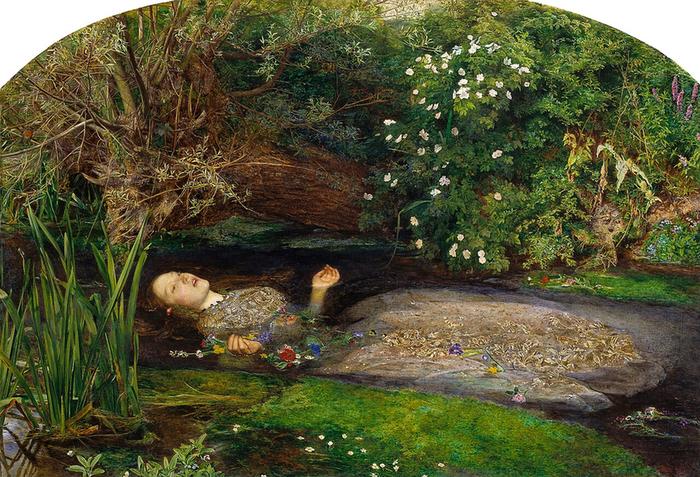
Shakespeare's Ophelia lies in the stream, hands open, her dress spread across the water. Millais painted the landscape outdoors first and added the figure afterwards, and the long process shows in the bank, a record of closely observed leaves and flowers. The flowers carry symbolic associations, but each is also painted as a particular plant, so the symbolism comes through the observation rather than sitting on top of it.
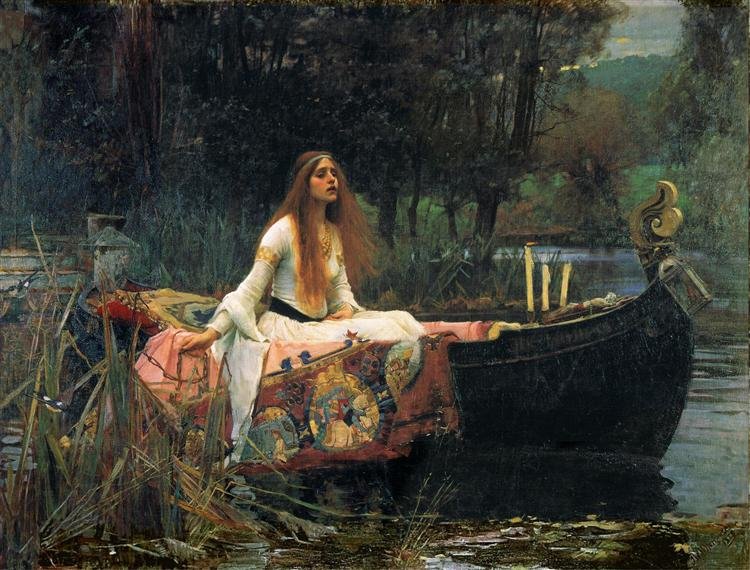
The boat is still chained to the bank. Waterhouse stops the story just short of the Lady of Shalott's departure, and paints everything around her with the attention of a still life: the candles, the patterned fabric, her white dress. Only her face, lifted towards something outside the picture, looks beyond the moment.
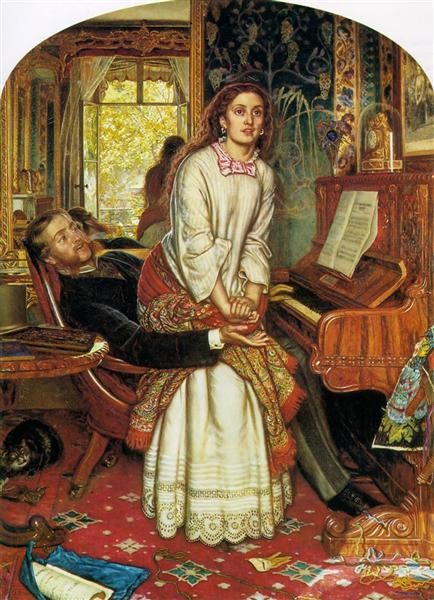
The title names an inner event, which Hunt has to make visible. He does it with a small shift of posture: in a densely furnished room, a woman begins to rise, changing her position in relation to the other figure. For all the clutter, it is her movement that carries the story. A mirror opens the interior in another direction, towards a garden and daylight that appear only in reflection, and it is tempting to link that glimpse of outside light with the awakening of the title.
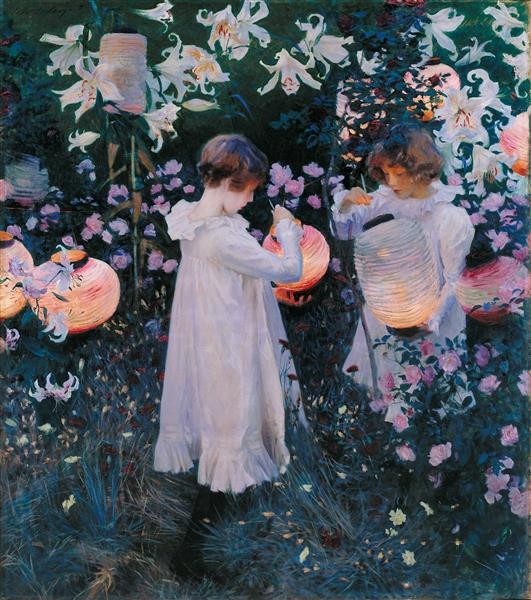
Warm lantern light reaches only a short way into the cooler garden. The children's pale dresses and the flowers around them pick up both the lanterns' glow and what remains of the daylight. Sargent holds the picture in the brief overlap between the two.
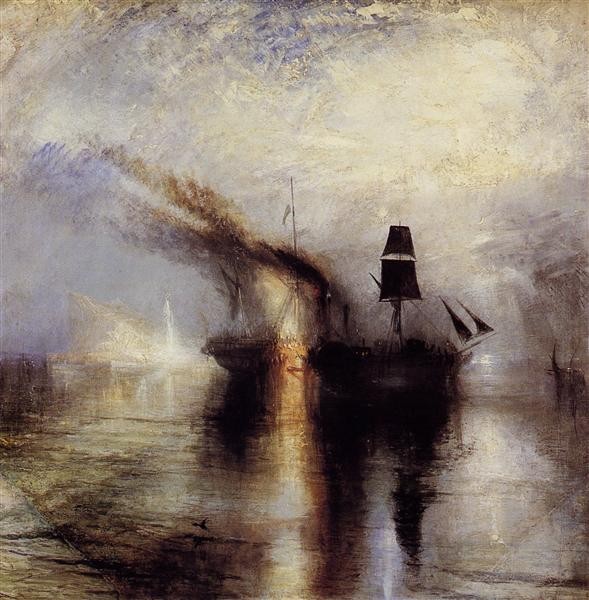
Turner exhibited this as a memorial to his fellow painter David Wilkie, who had been buried at sea. The burial itself is hard to make out. The mourning is carried instead by the black of the vessels, whose dark sails are the heaviest things in an atmosphere that otherwise seems to dissolve.
This painting is unfinished. The castle, the low ground and the river can all be recognised, though few edges are firm. Broad areas of light blue and yellow place them in relation to one another, doing the job that detailed architecture might otherwise have done. Whether Turner would have added that detail, and what each passage was meant to become, can only be guessed.
This dates from the year in which Turner exhibited Peace: Burial at Sea, and the two pictures are worth holding side by side. In Peace the black sails anchor everything. Here nothing does. The steamboat is hard even to find among the circling marks, and sea and sky refuse to separate along the steady line of a conventional marine painting. The storm comes across through that disruption as much as through any individual wave or detail of rigging.
Her eyes are closed and her hands are still, so she offers the viewer nothing directly. Rossetti places her state of mind in the things around her instead: a red bird approaching, and a warmer space behind her, less distinct than the foreground. They suggest an inner life without pinning it to a single readable thought.
Angular blue and white forms cross a red ground. They suggest bodies, but no anatomy runs continuously and there are no individual faces. What the group is doing survives only in directions and intersections; the overall arrangement registers first, and the figures have to be pieced together afterwards. Without the title, would a mud bath be the first thing to come to mind? Bomberg's fragmentation seems to concern the construction of the picture at least as much as the movement of the bathers.
The title singles out one action, the woodcutter's stroke, but so many onlookers surround him that they compete with it, and the crowding becomes part of the subject. Grasses, leaves and tiny figures overlap in a shallow space. For all Dadd's detail, or perhaps because of it, the picture cannot be taken in at once: attention moves from one area to the next, and much always lies outside the part in focus.
For a ghost, Blake's creature is remarkably solid: muscular, weighty, standing as if walking. Its body is partly animal, with just enough recognisable anatomy for the departures from it to register. Curtains make the scene look staged, and the vessel it carries gives it a small action to perform. The materials set it apart from almost everything else here: tempera and gold on mahogany, where most of this selection is oil.
The bridge is a large, dark shape over the water, and most of the scene stays dark with it. A few scattered lights and a small boat give a sense of distance. The blue and gold of the title link passages painted in very different amounts of detail; Whistler supplies only a few points of reference and lets the missing detail become part of the night.
The title names no particular place, and the picture is not about any single workplace either. Chimneys and buildings extend well beyond the bounds of any one works, roads link one part of the built environment to the next, and small figures among the repeated forms supply the human scale. Industry appears here not as a set of separate incidents but as a whole environment, one that people live in.
The title speaks of figures; what the three boards hold are creatures, each given a separate space on a similar orange ground. Long necks, mouths and low supports supply just enough bodily information for the distortions to matter. The panels do not form one continuous room or a sequence of events. Repetition links them, while each creature's predicament stays its own.
A clear rainbow crosses a sky that otherwise breaks up into unstable cloud and darkness. Below, light picks out only some parts of the heath, so the ground is unevenly lit. The brief arc ties separate areas of the picture together, and the weather decides how much of the landscape can be seen.
The badges on Peter Blake's jacket carry images he has chosen, which makes them part of how he presents himself. They break up the surface and add a layer of affiliation and taste to what a portrait usually records. Face and stance still count, but what he has chosen to display shares the picture with the features he was born with.
Spencer keeps this sacred episode tied to awkward physical contact. Several figures work together to pull the cloth away in a cramped, angular space, and Christ, nearly naked, is exposed and handled, never shown on his own. The fabric hides, connects and resists the people pulling at it, so the disrobing looks like hard work.
There is no safe distance from which to watch this explosion. Wedges and lines radiate across the whole picture, carrying the force beyond any single object. No injured body is shown in detail and there is no documentary incident; the violence belongs to the space itself, which breaks apart. Bomberg's Mud Bath also splits its subject into angular pieces, but there the bathers can still be reassembled. Here the breaking apart is the event.
Dorelia stands with her arms loosely crossed, composed but not rigidly symmetrical. The black dress of the title belongs to a narrow range of colour, so a pink accent and small changes of light do much of the work of setting her apart from the plain wall. Gwen John gives the background nothing else, and attention falls on face, hands and slight adjustments of posture.
Van Gogh's marks run in different directions across thatched roofs, trees, walls and sloping ground, and hardly any area of paint settles into one unbroken field. Yet the busy surface does not make everything look alike: thatch, foliage and wall remain distinct materials, and the crowded buildings and the structure of the slope can still be followed.
Explore this selection in Artline
See the selected works alongside books and events from their period, or compare when the artists lived. The books and events provide context, not evidence of direct influence. Works without confirmed dates remain in this guide.
Planning a visit
The entries follow neither chronology nor a route. Treat them as a list: find out where the works you most want to see are hung, then group them by venue. Comparisons made in the entries, such as Turner's Peace beside his Snow Storm or Bomberg beside Nevinson, are best tested with both pictures in front of you, if current hangs allow.
A practical drawing manual rather than a study of these paintings. Ruskin sets out exercises built on close observation of natural forms, which makes the book a good companion to Pre-Raphaelite plant painting such as the bank in Millais's Ophelia. His attention to edges and to the behaviour of light also helps explain why Turner's surfaces are so hard to separate into distinct objects. The later works in the selection lie outside its range.
 Art, literature & history