The Scottish National Gallery in Edinburgh shows European painting from the Renaissance onwards alongside the work of Scottish artists. Its strengths in Scottish portraiture and landscape sit beside devotional pictures, still lifes and scenes from Italy, Spain, France and the Low Countries.
The twenty works here draw on both sides of the collection. The skating minister attributed to Raeburn, Landseer's stag, Peploe's still life and landscapes by Paterson and Guthrie appear with Raphael's Madonna, devotional pictures by Lotto and El Greco, Velázquez's kitchen, Watteau's garden gathering, Gauguin's vision on its red field and French landscapes by Pissarro, Sisley and Monet. A surprising number of them have water in them, from Paterson's stream and Guthrie's bay to Seurat's riverside, Pissarro's Marne and Monet's Epte. The skater glides across it frozen.
Artline chose these works from documented holdings, independently of the museum, and a work's place in the collection does not mean it is on view. Dates and attributions keep the qualifications given in the collection records.
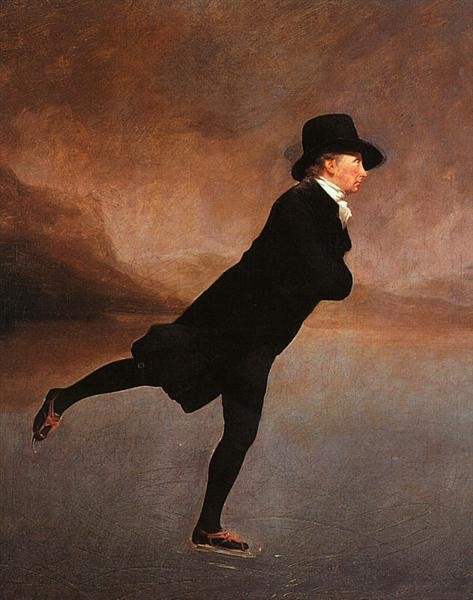
A man in sober black glides across the ice, arms folded, one leg stretched forward. Against the pale ground he reads almost as a silhouette. Folded arms usually go with standing about, and the clothes look meant for some more solemn occasion, yet the movement is entirely easy. Much of the picture's charm lies in that mismatch. The familiar title is a nickname, and the history of the painting's attribution to Raeburn remains uncertain.
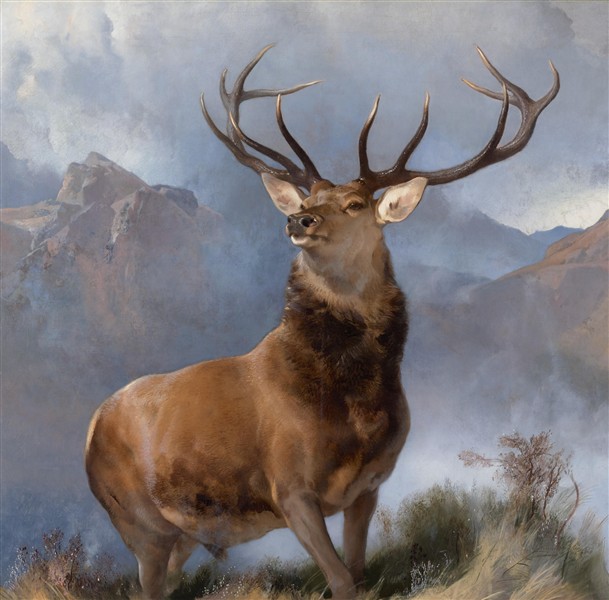
The title calls the stag a monarch, and the picture treats it as one. We see it from a low viewpoint, standing above the surrounding landscape with its antlers outlined against the sky, in the commanding position a formal portrait usually gives its sitter. Scale and placement supply the authority, and even the mountains are part of the display.
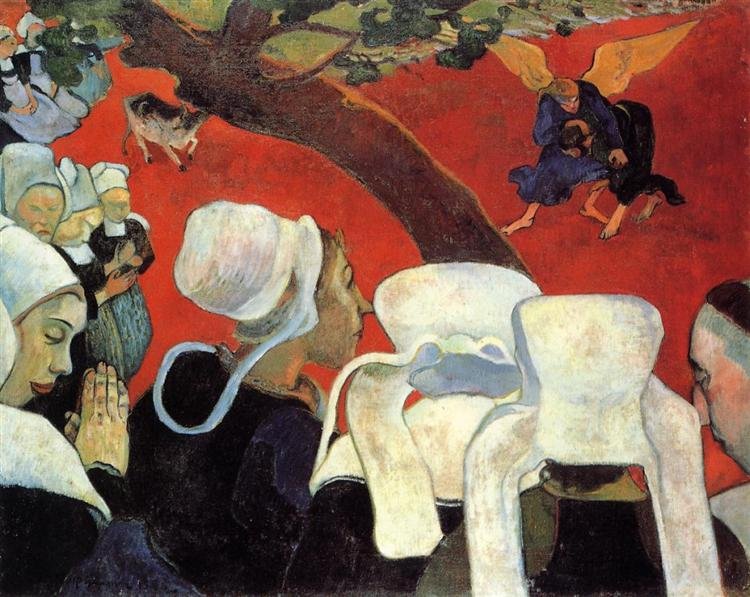
The title supplies the key. The women in white caps have presumably just come from the sermon, and the wrestlers far off on the same red field are the vision they witness. No naturalistic space could hold both. A tree cuts diagonally between them, the jump in scale from women to wrestlers is abrupt, and Gauguin leaves the construction plain to see. Much depends on the red. It serves as ground and as air, helps to divide the watchers from what they watch, and gives the whole scene an intensity no ordinary field would have.
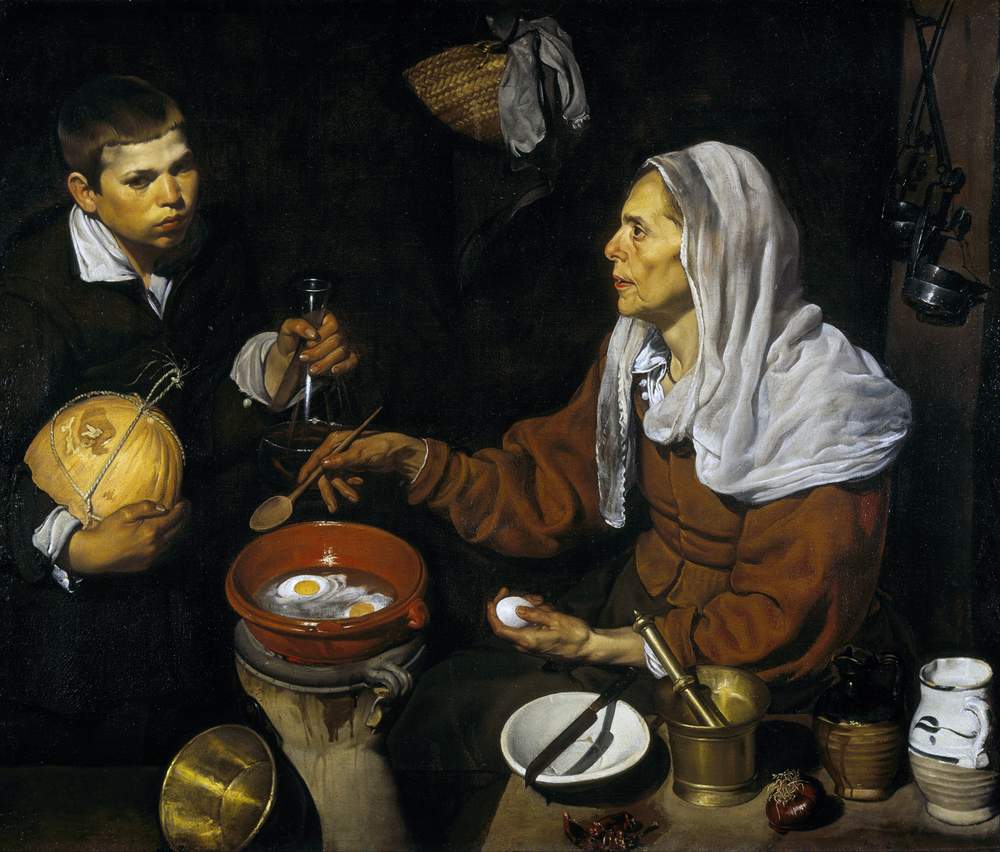
The title names the old woman and her eggs, but Velázquez does not let the people outrank the things. In this cramped kitchen the utensils, the glass and the food are painted as exactly as the faces, and each material keeps its own surface. The boy brings his offerings, the woman cooks, and the care spent on every object gives that everyday task its substance.
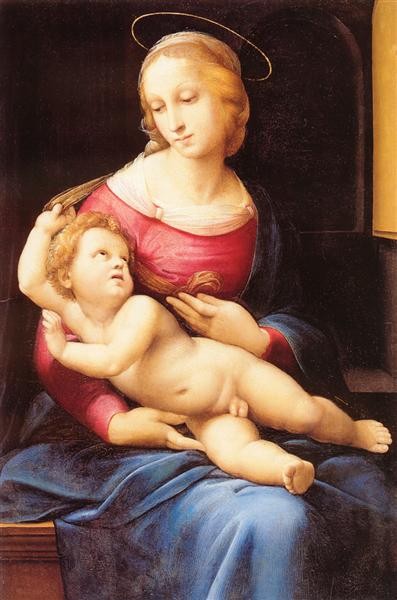
The Christ Child twists across Mary's lap, and her hands have to contain the movement. Against the dark setting the relation between the two bodies is especially clear: the group holds steady because her support answers his turn.
c. 1590 · Oil on canvas · Scottish National Gallery
The title promises a fable, and whatever allegory it may carry, what the picture shows first is simple: a boy lighting a candle. The flame draws him, an ape and an older man (the fool of the title) into one small circle of light. Gathering a boy, an animal and a fool round the same flame invites comparison. The shared light shows how unlike one another they are, while the darkness beyond keeps each face apart.
Paterson's autumn comes from the overall tone of the scene, not from any single emblematic tree. Browns and closely related colours run through the vegetation, the fields and the reflections, and a pale stream cuts through them to keep the view open. Low hills and cloud hold it to a modest scale.
Seurat painted this small wooden panel in brief, abbreviated strokes that set down bodies, bank and far shore and leave many surfaces unresolved. The boy and horse of the title get no more finish than anything else. Together with the more distant figures, they mark intervals along the riverside, which is all the picture asks of them: enough to show the place in use.
Poussin spreads the sacrament of confirmation across the whole group, so that the participants stand at different stages of a single ordered rite, waiting, approaching or receiving. Bright clothing marks their places against the darker architecture. A ceremony that takes time to perform can therefore be read across the canvas, figure by figure.
Veronese builds this encounter on touch: armour pressed against yielding cloth, hard surface against soft. Mars and Venus are joined by posture as well as by contact, and Cupid, below, adds a further link to the tangle of limbs.
c. 1894 · Oil on canvas · Scottish National Gallery
Dark dress and surrounding shadow take up most of the canvas, which leaves the few pale passages to carry unusual weight: the trim and her resting hand. Sargent makes those accents do two jobs at once, describing the costume and showing how the sitter has adjusted her pose. The skater's black reads as a silhouette against pale ice. Here the darkness is the ground itself, and the light has to be found in small places.
Guthrie builds Oban from broad, closely related greys laid along the curve of the bay. He scarcely details a single building, yet the town stays legible because the line of the shore sets out its layout. A pale promenade leads the eye through, and boats on the subdued water give a sense of scale.
Among rounded forms and folded white cloth, the black bottle of the title is the one firm, dark vertical. It steadies the arrangement, and beside it the whites turn out to be several whites, their differences easier to see. There is no story to follow. Peploe builds the picture from contrasts of weight, height and light.
There is dancing at Watteau's garden gathering, but not everyone is equally absorbed in it. Companions, performers and onlookers take different positions around the fountain, and the crowd shares no single mood. A pale dress gives the strongest accent without becoming the subject. Attention drifts across the scene rather than settling on one event, much as it might at an actual party.
Lotto leaves almost no room between his figures. The Christ Child reaches out, the four saints are drawn into a close exchange of hands and faces, and only a narrow strip of landscape shows above them.
No single historical event brought Jerome, Peter, Clare and Francis together. Their closeness belongs to the devotional arrangement and records no actual meeting.
Dark branches and narrow fences break across the broad, pale surface of the snow, and they are almost the only hard marks. Elsewhere the pastel is softer and keeps the buildings close in tone to the winter air, so nothing looks cut out against a uniform white ground. With so few strong contrasts, the poor visibility becomes part of the place.
In the Fable, El Greco's figures lean towards a candle. Here Christ faces out, looks straight at the viewer and raises one hand in blessing. A portrait sitter may meet our eye, but the raised hand turns the gaze into an address, and that pairing sets the picture apart from an ordinary likeness. Red and blue drapery frames the elongated figure, and the globe belongs to his sacred role.
The poplar trunks repeat along the bank like ruled lines and then repeat again in the water, where the reflections shift and break. The verticals look alike, but each has its own colour and its own surrounding touches, so the rhythm never becomes mechanical.
The Marne lies between a wooded bank and a settlement in the distance. Boats and buildings give small, particular signs that the place is used and lived in, but the broad divisions of water, land and sky keep those details from breaking up the open view.
The body of Patroclus lies on a diagonal, and the gestures around him all point towards it. Achilles bends close, and his companions take the weight of a body that can no longer support itself. The grief is personal, yet Hamilton gives it the scale and formal gravity of public history painting.
Explore this selection in Artline
See the selected works alongside books and events from their period, or compare when the artists lived. The books and events provide context, not evidence of direct influence. Works without confirmed dates remain in this guide.
Comparisons
Some of the most useful comparisons in this selection have nothing to do with chronology. Several pictures turn on how a body is held up: the skater keeps his own balance on the ice, Raphael's Christ Child depends on his mother's hands, and the dead Patroclus has to be carried by his companions. Velázquez and Peploe make another pair. Velázquez paints pots, glass and food in the service of a kitchen task, while Peploe arranges bottle and cloth with no story attached, so the objects answer only to one another. Paterson and Guthrie each work within a narrow range of tone, browns for an autumn glen and greys for a town on its bay. Seurat's riverside and Pissarro's Marne both show a place in use, Seurat through figures spaced along the bank, Pissarro through boats and buildings.
Reynolds's Discourses make an eighteenth-century case, often a prescriptive one, for what painting should aim at and how it should go about it. They are good company for Raeburn and Hamilton.
 Art, literature & history