The Philadelphia Museum of Art is one of the largest art museums in the United States. European and American painting is only part of it: the museum also has major holdings in many other fields. The twenty works chosen here run from Campin's Christ and Virgin set against gold and El Greco's Pietà to Kupka, Miró and Pollock. Along the way come Turner's burning Houses of Parliament and Toulouse-Lautrec's dance floor at the Moulin Rouge.
Several of them do not give quite what their titles or subjects lead one to expect. Rousseau's carnival has no crowd, Duchamp's bride and bachelors turn out to be machinery, and Magritte's elements make an unlikely assortment. Elsewhere the subject is plain and the treatment is the surprise, as when Bronzino presents a Medici ruler as a nude Orpheus.
Two artists appear twice, and each pair is worth seeing together. Eakins is represented by a surgeon teaching before an audience and by a sculptor at work in his studio. Duchamp is represented by a construction on glass and by a length of twine held by metal plates and long screws.
Artline chose these works from the museum's documented holdings, and the selection is independent of the museum. Dates and attributions keep the qualifications recorded for each work.
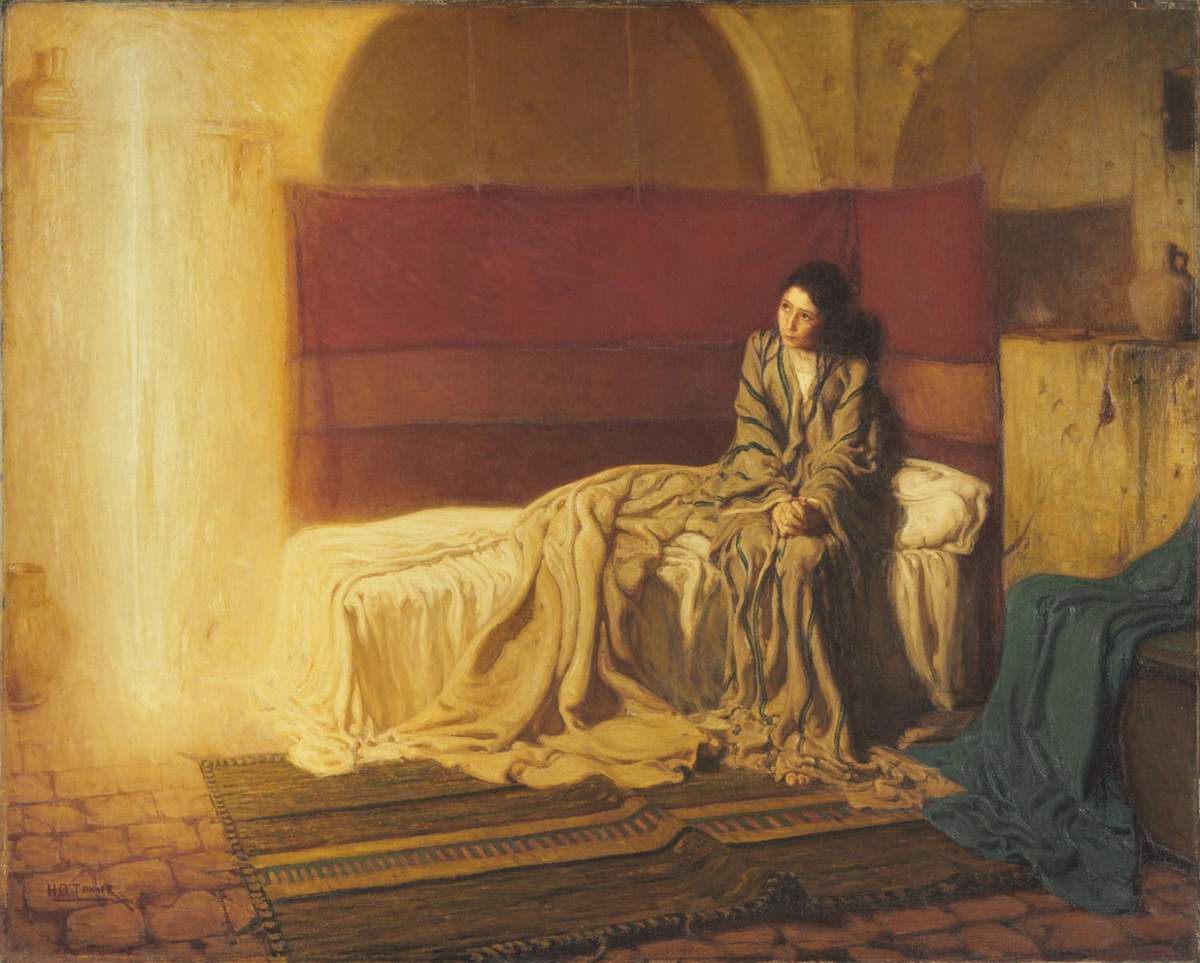
Tanner's Annunciation does without the angel, or at least without the familiar winged figure. A brilliant vertical light is the only sign of Gabriel's visit, and Mary, seated in a modest room, looks towards it. With no visitor in bodily form, everything depends on her. Her startled, attentive pose has to carry the story by itself.
1875 · Philadelphia Museum of Art and Pennsylvania Academy of the Fine Arts (joint ownership)
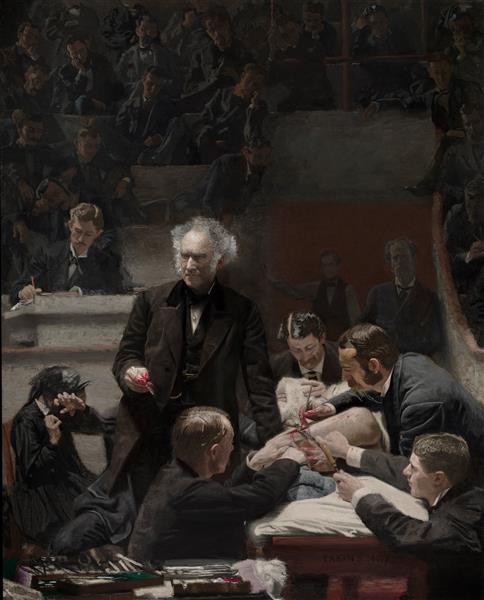
This is an operation and a lesson at the same time. The standing surgeon addresses the onlookers in the theatre while his assistants carry on with the physical work, so explanation and handiwork go on side by side. Eakins does not tidy any of it up. The medical knowledge on offer is made public through a patient's vulnerable body, and the blood is shown as plainly as the concentrated attention around it.
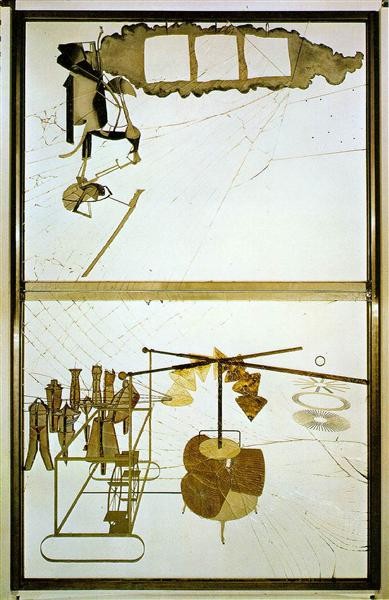
Duchamp's mechanical forms are carried on transparent glass, so this is a work without a back wall. The room beyond shows through and becomes part of the image, visitors included, and the cracks remain part of the surface. The title promises a bride, her bachelors and something happening between them, which sounds like a scene with figures. What the glass carries instead is a set of mechanical forms, and they never settle into anything like an ordinary scene.
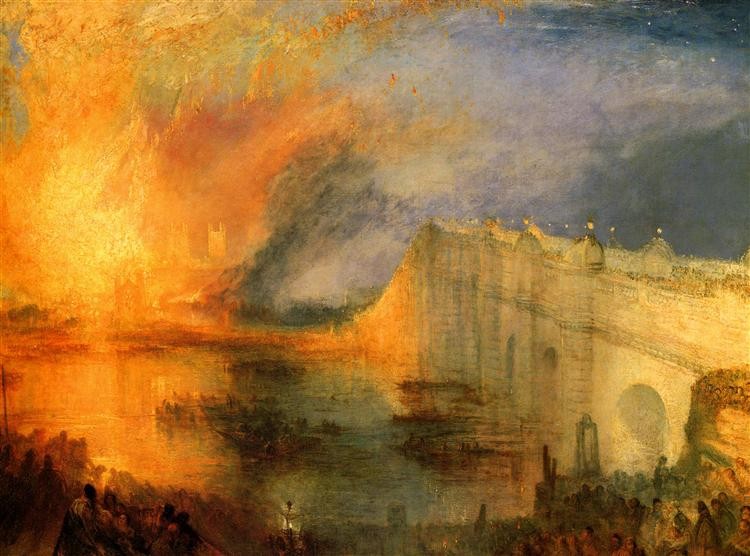
The fire broke out on 16 October 1834. Turner paints it largely through what it does to everything around it: light thrown across the river, smoke spreading through the sky, the view of the buildings altered by the blaze. Crowds and boats show how many people watched it together. This was a disaster with an audience, and the picture seems as concerned with the spectacle as with the destruction.
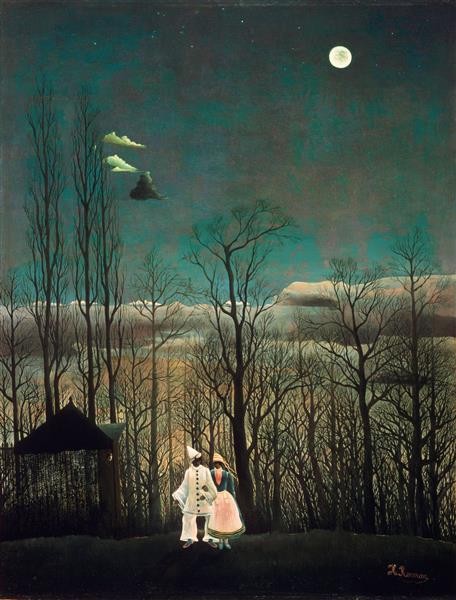
For a carnival, it is remarkably quiet. Rousseau places two pale figures in costume beneath bare trees and a moon, small against the darkness, and their clothes are the only sign of festivity. There is no crowd and no noise, and the landscape does little to confirm the occasion named in the title. If there is a party, it is out of sight.
Miró sets the dog and the crescent moon far apart on a dark ground and adds so little else that every gap counts. A long ladder seems to offer a way between them, though its scale makes the idea peculiar, and the moon is hardly an ordinary destination. Taken together with the title, the picture can seem both comic and a little forlorn.
The dancers have only the patch of floor that the people around them leave free, so the crowd matters as much as the performance. Some figures perform, while others watch, talk or stand at the edge, and their attention is not necessarily fixed on the same thing. Bright clothing picks individuals out of the press.
These arcs belong to no machine and no body. They pass over and behind one another, and whatever movement the picture has comes from the sequence and repetition of colours and curved bands. The title looks two ways, to Newton and to music, and it calls the picture a study for a Fugue in Two Colours. A fugue is built from interweaving voices, which describes the overlapping bands well enough. But the comparison is only an analogy, and there is no score to follow.
Numbers are not what one expects in a picture called Male and Female. Pollock puts them among loops and patches of colour around two upright forms that can still partly be read as figures, the couple the title asks for. He never fully separates those figures from the surrounding activity, and bodies and independent marks compete on equal terms.
Bronzino dispenses with court dress, and indeed with dress of any kind. Cosimo appears as Orpheus, the musician of Greek myth, with a stringed instrument, and his recognisable face is set on an idealised nude body. The face supplies the likeness. The body and the myth attach the ruler to a story that reaches well beyond his everyday appearance.
Campin shows Christ and the Virgin close up against gold, leaving almost no room for a setting, so there is no episode to follow. Christ raises a hand in blessing, and the Virgin joins her hands in prayer. In these images the meaning lies in small differences of gaze and gesture between the two sacred figures.
Metal plates and long screws hold twine in a compact assembly. This is a ready-made, Duchamp's term for an existing object chosen and presented as art. The title points to what the eye cannot check: something hidden inside, and the sound linked to it. Examine the outside as closely as you like; it is under no obligation to tell you what is within.
A man stands near the doorway while a woman bends over elsewhere in the dim room. Furniture and scattered objects widen the distance between their very different poses. It is hard not to start constructing a plot. Degas supplies enough detail to prompt one, but nothing that would settle it.
1575 · Tempera on panel · Philadelphia Museum of Art
As in any Pietà, Mary mourns over the dead Christ, but here she is also physically holding him up. The effort of supporting his pale body binds the angular group together. El Greco lengthens the limbs and sharpens the folds, so the grief never settles into a smooth, balanced display. Behind the figures, a broken landscape carries the unrest further.
c. 1912 · Charcoal and oil on canvas · Philadelphia Museum of Art
A few curves are enough to suggest a violin, though its full outline never appears. Braque sets this partial instrument beside lettering, so reading goes on alongside looking, and the overlapping planes do not agree on a single viewpoint. The violin has to be pieced together from clues, much as the newspaper's letters build meaning out of separate marks. Even the medium is mixed: charcoal, a drawing material, is used together with oil on the canvas.
Eakins shows an allegory of the Schuylkill River before it has become one. The model poses, Rush carves, and the figure is only half-finished, so each stands at a different stage in the making of a public image. The clothes, the tools and a seated companion share the studio with them. The river takes on human form through labour and posing, and Eakins leaves the ordinary conditions of that work in view beside the idealised result.
Putting a pope and a cardinal on one compact panel means showing rank at close quarters. David overlaps the two figures. Even so, their positions, their contrasting garments and the different turn of each face keep them distinct as individuals, and the hierarchy between them is never in doubt. Pale robes and red accents stand out from the dark setting.
The poet of the title has a green head, turned at an unusual angle, in a room whose furniture can still be recognised. Chagall runs bright geometric divisions through the setting and the body alike, so neither is stable. Yet the room stays ordinary enough for the body's departure from it to register. The alternative title, Half Past Three, names a time and explains nothing about the head.
The child in Mary's embrace is writing, and that is the unusual thing here. The infant has a book, and writing gives the small hands something to do. Pinturicchio keeps this activity within the physical closeness of mother and child, with a landscape opening out beyond. The result is a very familiar composition changed in one respect: the child attends to learning as well as receiving care.
The compartments promise an orderly classification, and the title promises elements. Fire answers to the word well enough. A torso and a landscape are harder to account for, and the other forms differ just as widely in scale and kind. No consistent rule decides what goes where, and the regular framework only makes the mismatch more obvious.
Explore this selection in Artline
See the selected works alongside books and events from their period, or compare when the artists lived. The books and events provide context, not evidence of direct influence. Works without confirmed dates remain in this guide.
Eakins and Duchamp, in pairs
Neither Eakins picture shows a finished piece of work. In the clinic, knowledge is handed on during the operation itself, before an audience. In Rush's studio a public image is still being made, with the model, the tools and the half-carved figure all in the room. Both seem more interested in work under way than in its outcome. Duchamp's pair pull against each other. The glass takes in whatever and whoever is behind it, and in that respect it has something in common with the Rush picture, where the studio stays in view around the allegory. With Hidden Noise, by contrast, is closed: the title announces what it contains, but the object does not show it. That makes it an unlikely neighbour for Degas's Interior, which also keeps back what a viewer most wants to know, though what is missing there is a story, not an object.
Harold Speed covers drawing and the arrangement of tone in plain, practical terms. That makes the book useful grounding for the pictures here that depend most on tone and drawing, among them Tanner's Annunciation, Degas's dim interior and both of the Eakins pictures. It has less to offer on the abstract and assembled works.
 Art, literature & history