The Museum of Modern Art, usually called MoMA, opened in New York in 1929, and its collection has done much to shape how modern art is shown and studied. The twenty works chosen here include Monet's Agapanthus, Van Gogh's The Starry Night and Rauschenberg's Bed, which is made from real bedding.
The selection also includes Picasso's Les Demoiselles d'Avignon, Dalí's soft watches and Warhol's soup cans, which borrow the look of commercial printing. Rousseau, Matisse and Klee appear twice each, so you can compare an artist with himself. Mondrian, Pollock and Reinhardt each take abstraction in a different direction, and Boccioni and Sheeler arrive at very different pictures of building and industry.
Artline made this selection independently of the museum, drawing on documented holdings in MoMA's collection. A work being in the collection does not mean it is on view. Dates and attributions keep the qualifications given in the linked records.
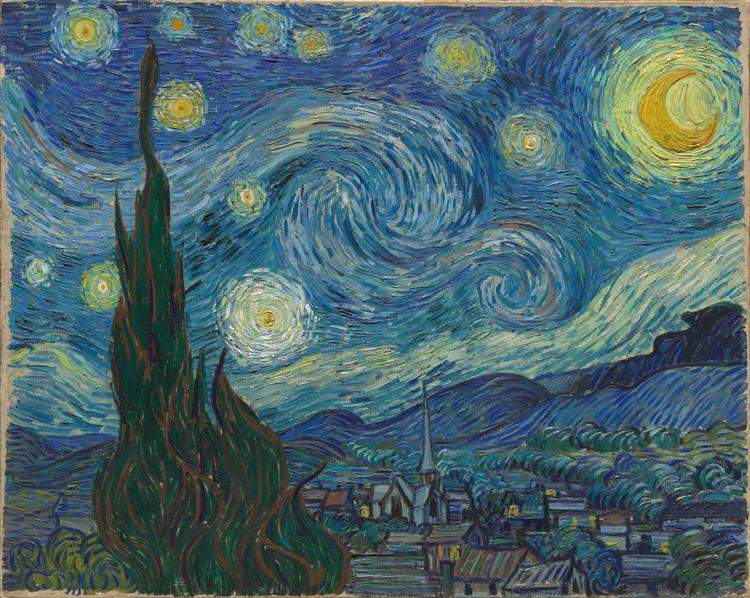
Saint Rémy, June 1889 · Oil on canvas · Museum of Modern Art
Van Gogh painted this while staying at Saint-Rémy, and it is not a straightforward view: the scene combines what he observed with what he remembered and imagined. The village sits small beneath a sky of sweeping curves, bright stars and a glowing moon. In the foreground a cypress rises like a dark flame, a form on the ground that seems to share the sky's movement.
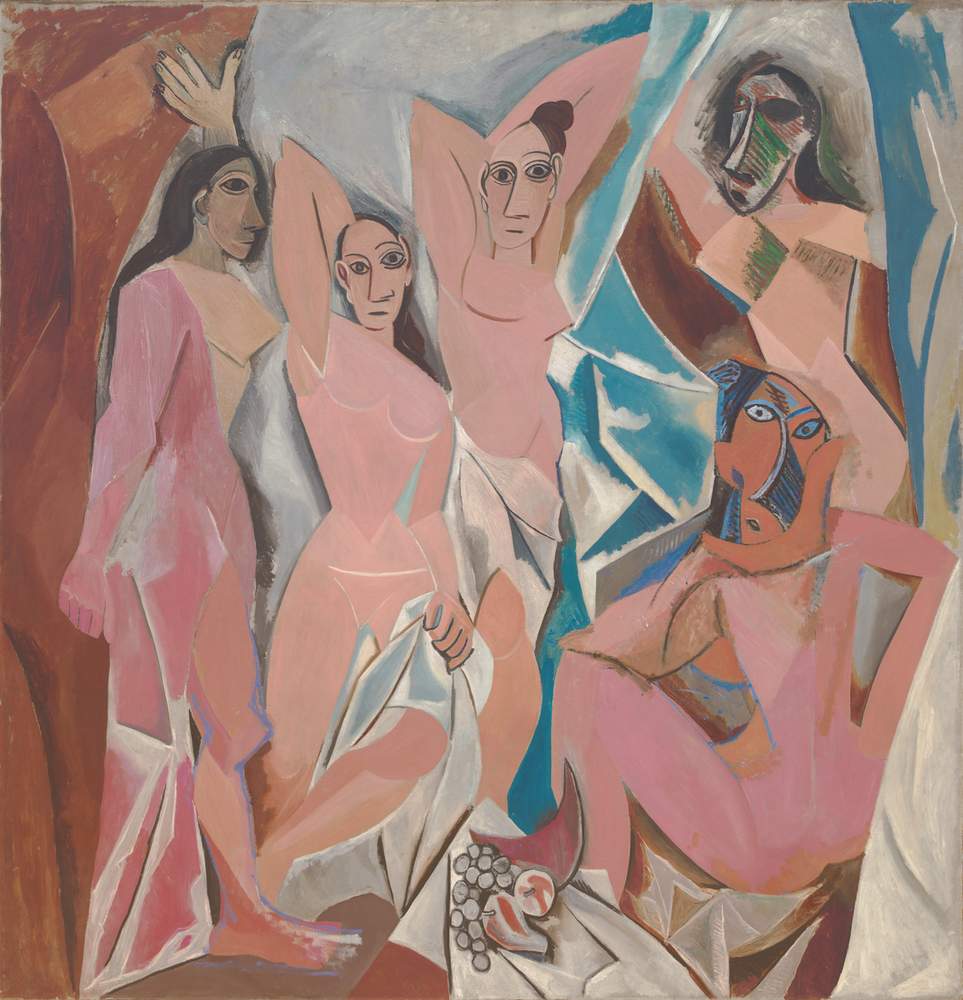
Paris, June-July 1907 · Oil on canvas · Museum of Modern Art
Five figures face outwards, but angular planes break across their bodies and the space around them, and they never settle into one continuous room. The faces show this most clearly. They are treated in markedly different ways, so no single method of representation holds for the whole group.
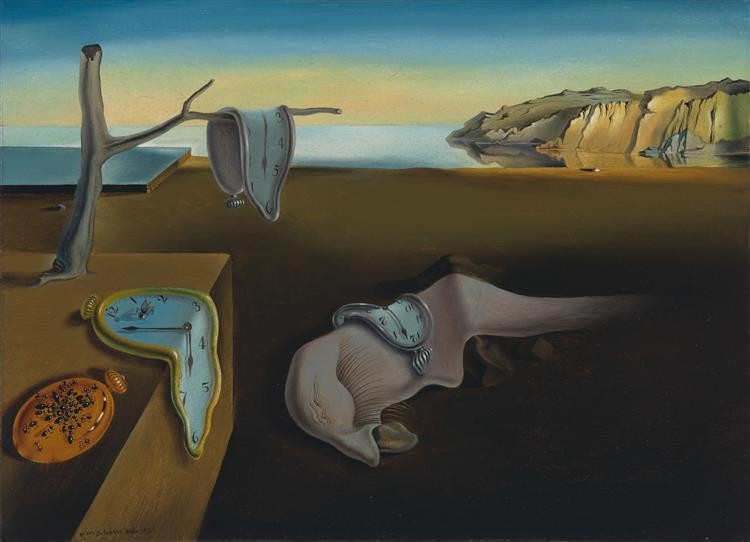
Dalí gives the soft watches precise edges and solid-looking surfaces. They are instantly recognisable as timepieces, though no clock that bends like this could keep time, and the exact handling is what makes the impossibility so hard to dismiss. The cliffs in the distance keep a firmer appearance.
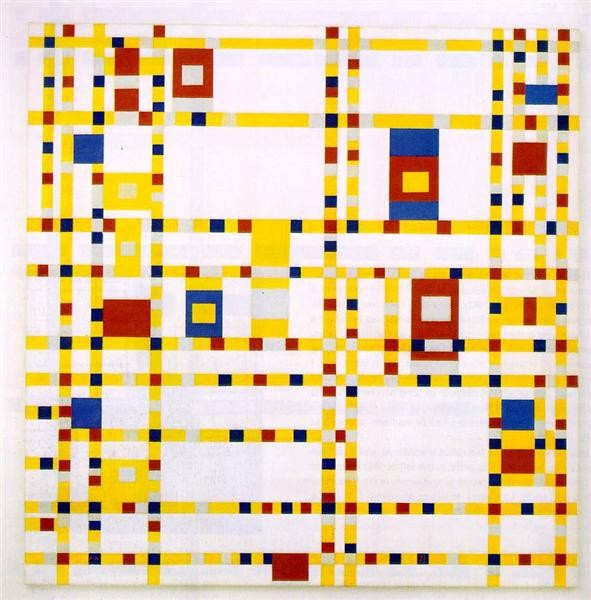
Small squares of colour break up the yellow lines of the grid, so the lines no longer act as continuous boundaries. Mondrian keeps to right angles, but the spacing of these interruptions gives the still surface a restless pulse. The title refers to a city and a musical rhythm. There is no street scene, and that stop-start pulse is perhaps as close as the painting comes to either.
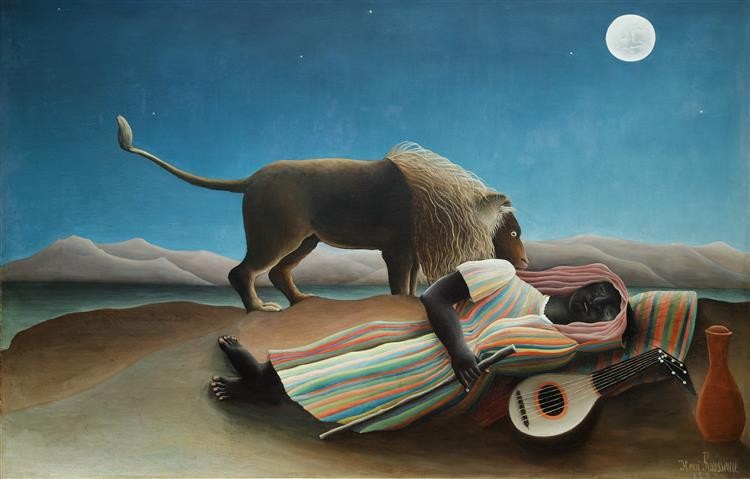
In an open landscape, a lion leans towards a sleeping woman but does not attack. Her instrument and vessel lie beside her, sharply drawn. Rousseau stops at a moment when the animal's closeness could mean danger, curiosity or something the picture leaves unexplained.
The title is Rousseau's own historical wording for the sleeper. It does not make the painting an ethnographic record.
A sofa stands among oversized leaves, animals and a musician. That single piece of indoor furniture is enough to show the jungle as an arranged, invented place, where nothing needs to work as real geography. As in The Sleeping Gypsy, each part is painted clearly, but the scene as a whole has no ordinary explanation.
1962 · Acrylic with metallic enamel paint on canvas, 32 panels · Museum of Modern Art
The canvases look as though they came off a press, but Warhol painted all thirty-two by hand. When they were first exhibited, they stood on shelves like groceries. Because the design repeats, what changes from one canvas to the next stands out: the variety of soup.
1950 · Enamel and oil on canvas · Museum of Modern Art
Pollock's loops and threads of enamel and oil paint spread across the broad canvas without gathering round a main figure, and every crossing, break and successive layer is left visible. There is no depicted object to look through to. The structure lies in how the marks relate to one another: where one line crosses or slips under another, and how the density shifts from one area to the next.
A green-faced man and an animal look each other in the eye above small houses and figures. Chagall mixes scales freely, and circles and diagonals link areas that could not belong to one measured space. The exchange between the two large faces gives the picture an intimate centre. The village of the title is suggested around it, never laid out as a street plan or a panorama.
A classical head, a rubber glove and a green ball, each distinct and clearly painted, share a space whose perspective is easier to follow than its contents. Why these three things? De Chirico gives no practical reason for bringing them together. In the distance a train adds a more everyday kind of movement, but it throws no light on the foreground.
The red horse strains, and its effort seems to spill into the brushstrokes around the workers and the building site. Boccioni blurs edges, so it is hard to separate a body in motion from the activity of the city around it, and no individual task is picked out. For a picture called The City Rises, there is no finished skyline. The rising is labour still under way.
Klee's birdlike figures have thin, separate bodies, comic and fragile, yet all of them are attached to a single crank. That shared mechanism is the troubling part, since it suggests their sound or movement, the twittering of the title, could be operated from outside. A few connecting lines bring living creatures and mechanical control into one small structure that is half toy and half something more coercive.
At first the blue can look continuous. Gradually, subdued rectangles divide it into darker and greenish passages, none of them strongly outlined, and the search for a subject gives way to telling neighbouring colours apart. The values are so close that a reproduction may alter them considerably, so one that looks flat or simple is no reliable guide to the painting.
Paris, Boulevard des Invalides, early 1909 · Oil on canvas · Museum of Modern Art
At one point the reaching hands nearly fail to close the ring. Matisse keeps the setting spare, so the movement comes from that small gap and from the uneven spaces between the five bodies. The figures do not form a mechanically repeated pattern. Their hold on one another takes effort, and the circle looks as though it is being kept going.
1924 · Oil on canvas mounted on board · Museum of Modern Art
Thin divisions turn the green face into a constructed surface, more grid than flesh. The eyes and mouth are enough to make it read as a face, though they never settle into an easy expression. Chagall's green-faced man, elsewhere in this selection, is caught up in an exchange of looks. Klee's image sits between a face to be read and a mask to be worn. The title refers to performance but supplies no character or story.
Monet paints the nearby flowers and the reflected growth with the same long, overlapping marks. Clear outlines do not consistently separate plant, water and distance, so you have to make out the scene from changes in the brushwork, not leaf by leaf. The garden reads less as a place laid out in depth than as a dense field of colour close to the surface.
Red and black shapes gather unevenly against a brownish ground. Gorky's thin contours come close to describing bodies and fragments without quite fixing them, and the forms stay open to other readings. The title suggests pain, though the painting illustrates no particular event.
Still water and sharply placed buildings give Sheeler's factory complex an unusual composure, and a small boat gives a sense of scale against the industrial forms. Set against Boccioni's The City Rises, this picture shows a place of work without showing the work. Boccioni's construction scene is full of physical strain. Sheeler keeps the effort of running the plant out of view, and the machinery sits settled in a carefully spaced landscape.
Cavalière, summer 1909 · Oil on canvas · Museum of Modern Art
Painted at Cavalière a few months after Dance (I), the Bather cuts descriptive detail just as sharply, yet the body stays physically present. The turned back and large limbs carry real weight with little anatomical shading. Firm contours and broad areas of blue and green do most of that work.
1955 · Oil and pencil on pillow, quilt, and sheet on wood supports · Museum of Modern Art
The pillow, sheet and quilt are real bedding. Rauschenberg marked them with oil paint and pencil and set them upright on wooden supports. They remain recognisably household things, but stood on end they can no longer be used, and they take on the upright format of a painting. The work sits uneasily between furnishing and painting.
Explore this selection in Artline
See the selected works alongside books and events from their period, or compare when the artists lived. The books and events provide context, not evidence of direct influence. Works without confirmed dates remain in this guide.
Telling the methods apart
Several of these works do something odd to ordinary things, and the differences between them are worth keeping straight. Warhol repeats an image of an object, while Rauschenberg uses the object itself. Dalí changes how things behave physically, bending watches that ought to be rigid. De Chirico leaves his head, glove and ball intact and changes only the company they keep, much as Rousseau does when he puts a sofa in a jungle.
Further reading
Edited by William Rubin · Digitized catalogue under Publications · English
This digitised catalogue of MoMA's Picasso retrospective, edited by William Rubin, places Les Demoiselles d'Avignon among studies and later works. Seen alongside them, the painting's departures from conventional figure drawing are easier to follow. It records a single-artist exhibition, so here it helps only with Picasso.
 Art, literature & history