The Musée Condé occupies the Château de Chantilly, north of Paris. Henri d'Orléans, Duke of Aumale, assembled the collection and left the château and its contents to the Institut de France. Its paintings, books and manuscripts remain closely tied to the château's rooms and to the man who brought them together.
The twenty paintings chosen here run from angels dancing on a gold ground to a heron hunt in Algeria. The earliest are Italian, by painters including Giovanni di Paolo, Filippino Lippi and Raphael. Most of the later works are French. Ingres appears more often than anyone else: as a young painter showing himself at work, as a portraitist, and as the painter of a Venus that took him years to finish. In several of the French pictures the animals hold the eye more than the people with them do, from Géricault's horse at a stable door to Rosa Bonheur's animals in the Pyrenees. Elsewhere the interest lies in how a well-known person is presented, or in how much a title can actually tell you about the person shown.
Every painting here is documented in the Musée Condé's holdings, but the selection was made independently of the museum. Dates and attributions keep the qualifications given in the linked records, from approximate dates to traditional identifications.
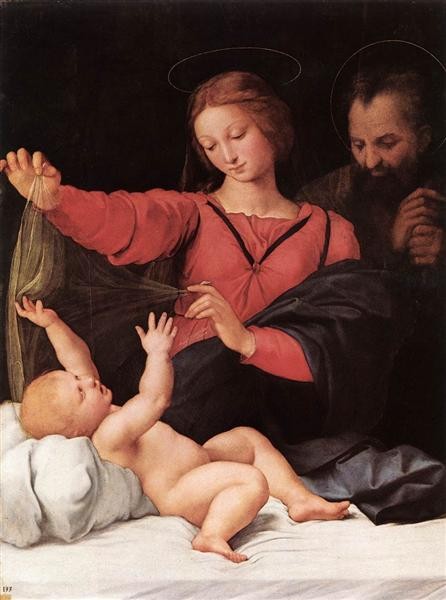
Mary lifts a veil above the Christ Child, who reaches up to her with both arms, while Joseph is visible farther back. There is no grand setting, and the picture rests almost entirely on the exchange between mother and child. The detail to watch is the veil. Mary raises it above the child rather than drawing it over him, so the gesture can be read as a small unveiling.
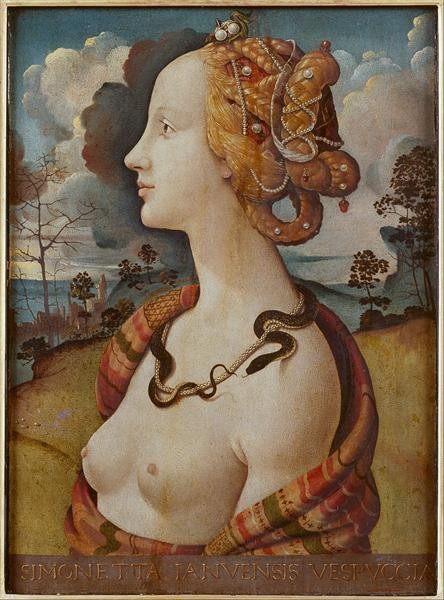
Take away the serpent and the dark clouds and this would be a profile portrait, drawn precisely enough to suggest one particular sitter. With them, the picture stops behaving like a straightforward portrait, and whatever those attributes mean, they cannot tell us who she is. The name in the title, Simonetta Vespucci, is a traditional identification and remains unconfirmed.
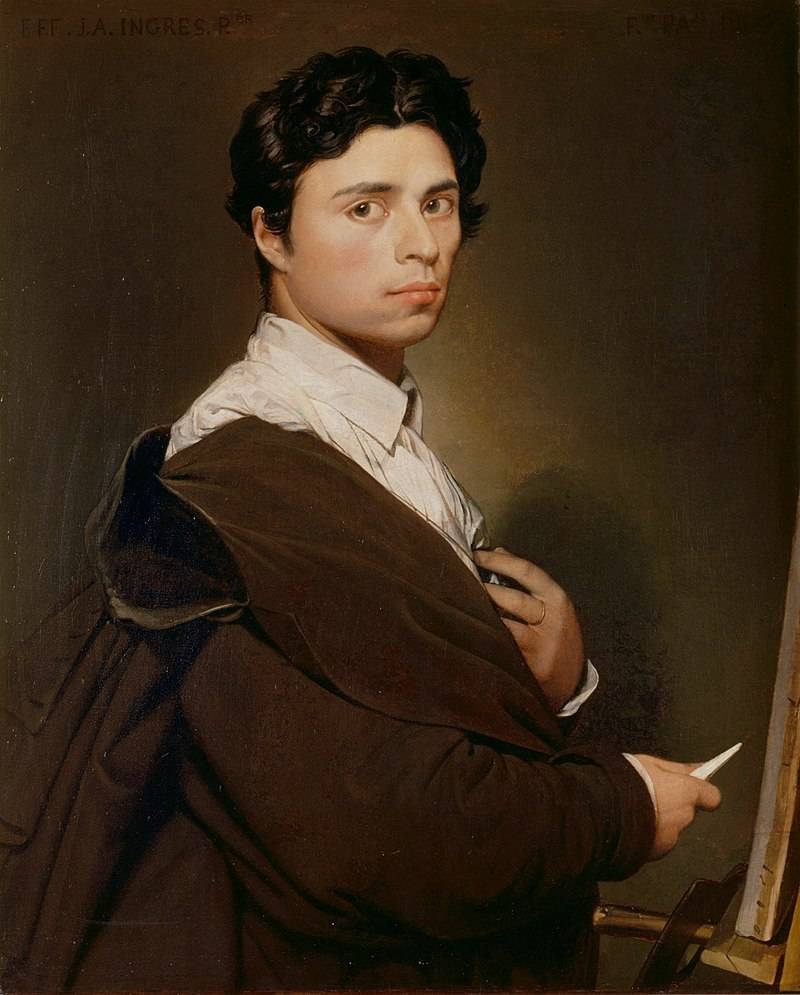
At twenty-four, Ingres presents himself as a painter at work, not a sitter simply posed. He turns from his task to look out of the picture, so the one pose makes him both. The pale shirt sets his upper body off against the dark coat.
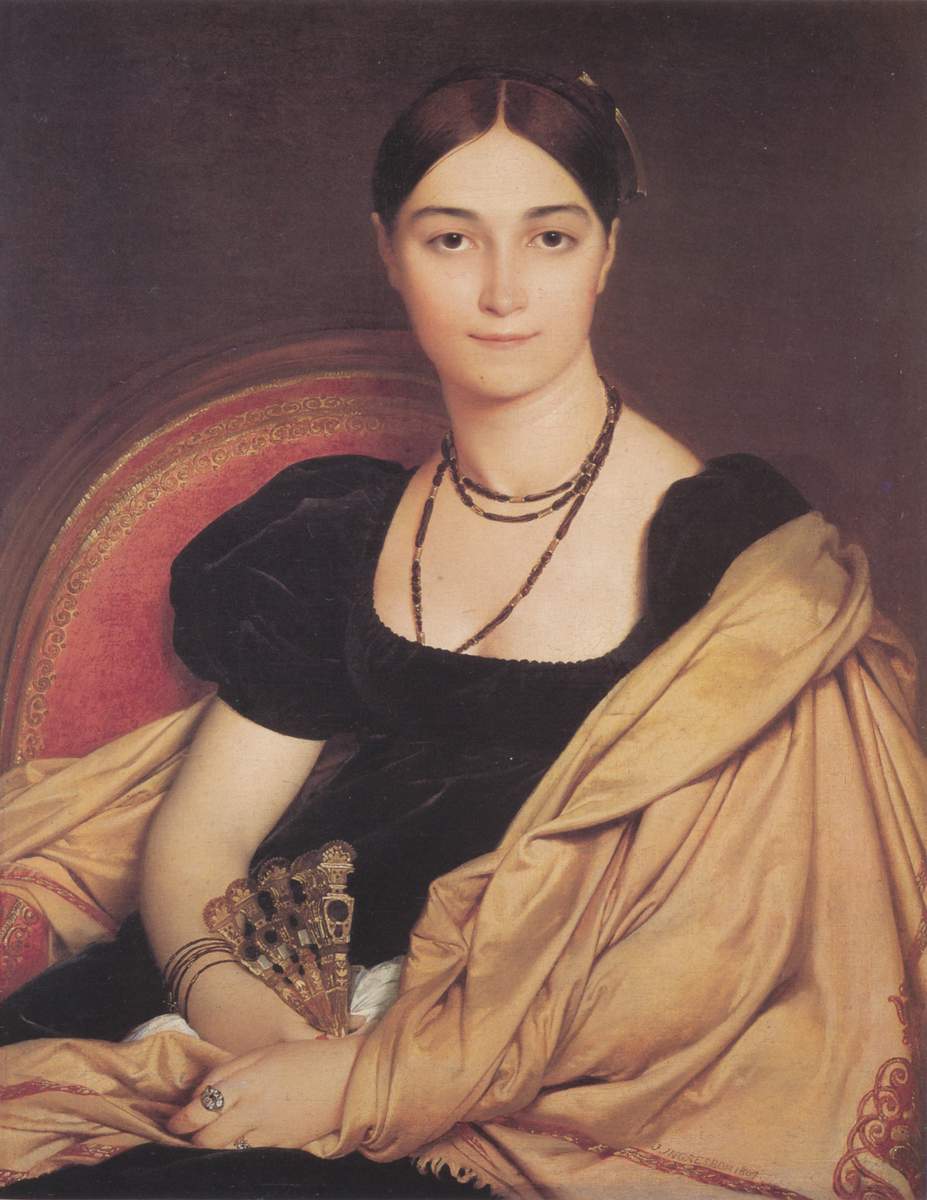
The title keeps both of her names: Vauçay by marriage, de Nittis by birth. The portrait is built from enclosures fitted one inside another. The red chair gives the seated figure a firm outer edge, her dress and shawl curve within it, and at the centre her joined hands are the quietest point in the picture.
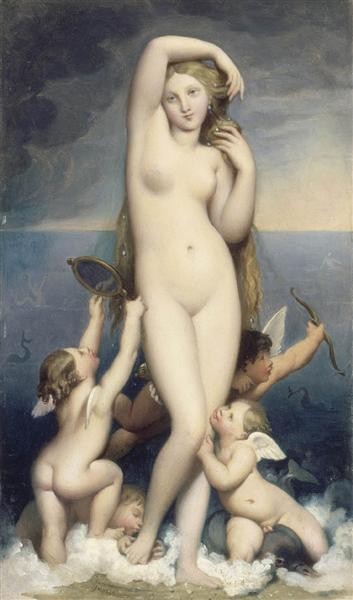
Anadyomene is the Greek epithet for the goddess rising from the sea. Ingres began the picture during his early years in Rome, in 1807, the same year as his portrait of Madame de Vauçay. The portrait carries that single date, but the Venus was not finished until 1848. The finished goddess stands tall, pale and upright above winged figures much smaller than herself, and the difference in scale leaves no doubt about who outranks whom.
Five angels dance in a ring, hand in hand. Behind them is gold itself rather than painted space, and it offers them no depth to move into. The dance has to be carried by the bodies instead, through folds of drapery and poses that alternate from one figure to the next. The angels with their backs turned outward do much to set the ring turning, and against the gold each figure reads as a clear silhouette.
A serenade is a sound, and a painting cannot make one, so here the player's body has to carry the music. The crossed legs and the instrument held on a diagonal already look like performance, and the costume frames the face.
Watteau painted this allegory at about the same time as The Serenader, but on canvas rather than panel, and in an oval. It turns on a bow held just out of reach. Cupid stretches for it while the other figure keeps it beyond his hand. The oval holds the pair close, and the whole of the action comes down to the small gap between his fingers and the weapon. If the title is anything to go by, he will not close it.
The horse is caught on the threshold, one foreleg lifted: no longer standing still, but not yet out of the stable. A handler is close by, yet the light belongs to the horse, picking out its weight and musculature against the darker doorway.
The title names a shepherd, but Bonheur seems to give most of her attention to the animals in the shepherd's charge. Nothing dramatic happens. A shepherd's staff, the animals and the rough mountain ground of the Pyrenees make up the scene, and the animals are told apart by texture and posture, and by the way each one stands on the uneven terrain.
Bacchus, the god of wine, is still an infant here, surrounded by figures and satyrs in a woodland. A company like this could easily become a crush of bodies. Instead it is broken into smaller groups linked by gestures, so that the episodes of the myth can be followed one after another.
Raphael's Christ Child reaches for his mother. Luini's raises a hand and, with the cross-staff and the orb, claims the authority of the Saviour of the World, though his size still says infancy. Hand, staff and orb are kept distinct within a clean silhouette, so each sign of office reads clearly on so small a figure.
The subject comes from the Old Testament Book of Esther and centres on King Ahasuerus's choice of Esther. Filippino Lippi spreads that one decision across a whole court on a wide tempera panel. A run of arcades divides the space into connected chambers, giving the scene more than one place to unfold, and bright clothing picks out groups of figures within the repeated architecture. The royal throne provides a focus, but no single figure takes over. Even the woman named in the title has to share the panel with the court.
Armour covers most of Count Henri de Bergh, and it does most of the work of declaring his military rank. Only his face and one hand are left comparatively exposed, and even the hand rests near his sword.
Marie-Antoinette, then Dauphine of France, appears as Hebe, cupbearer to the gods. A jug and an eagle are all it takes to establish the role. Her face and elaborately dressed hair stay within the conventions of court portraiture, so the mythology sits on her like fancy dress.
The title promises ham, but the picture is more interested in conversation. The meal is laid out in a park, and a white tablecloth gathers it into a single bright area. Bottles rest beneath the table and gestures cross above it, with several small exchanges going on at once. None of the diners is made the centre of the occasion, and the company never stiffens into a group portrait.
Of all the pictures here, this is the one most plainly concerned with a public image. Bonaparte has come among the plague-stricken at Jaffa, and inside an arcaded enclosure he touches a plague tumour on one of the sick. The light that separates the bodies makes his approach conspicuous, and the visit becomes a display of leadership in the face of contagion. Gros does not hide the suffering, but the sick seem to be there largely as the setting for Bonaparte's gesture.
The canvas is catalogued as a sketch related to the larger painting in the Louvre, which explains the "Chantilly Version" in its title.
A roadside shrine gives travellers in the Abruzzi, in central Italy, a reason to stop, while the road runs on towards distant mountains. Figures are spaced along the route, some pausing and others moving on, and because they stand at different distances they also measure how far the view reaches. Against all that distance, the shrine keeps the scene at human scale.
For a hunting picture, this one contains remarkably little confrontation. The mounted hunters are scattered across shallow water as they chase the herons, and birds and riders alike break a low horizon under a large sky. The distances between them are part of the subject, and the chase never narrows to a single encounter between rider and bird.
Second half of the 16th century · Oil on canvas · Musée Condé
Nothing here stands on the ground. Giovanni di Paolo's dancers have a flat field of gold behind them; Carracci's angels have clouds instead. Gabriel opens his arms at the centre of a rising assembly of clouds, cherubs and smaller angels, among them the musical angels of the title. With no floor to anchor anyone, colour has to single him out, and his blue and red drapery stands out against the softer tones around him.
Explore this selection in Artline
See the selected works alongside books and events from their period, or compare when the artists lived. The books and events provide context, not evidence of direct influence. Works without confirmed dates remain in this guide.
What a title settles
A precise face and a secure name are not the same thing, and the titles in this selection settle quite different matters. A profile as exact as Piero di Cosimo's invites a name, and "Said to Be" offers one while keeping it at arm's length. Drouais works the other way, laying a borrowed identity over a certain one: even cast as Hebe, Marie-Antoinette is never in doubt. Gros's Bonaparte is just as certain, and his picture is just as much an exercise in presentation, though his part is leadership among the sick rather than a role from mythology. Here the qualification in the title, "Chantilly Version", refers to the canvas and not to the man.
Further reading
Leonardo da Vinci; translated by John Francis Rigaud · Read free · English
John Francis Rigaud's English translation of Leonardo's Treatise on Painting covers gesture, light and the observation of the human body. It gives the reader a historical vocabulary for how a figure is posed and lit, which is worth having to hand beside the figures here by Raphael, Piero di Cosimo and Ingres.
 Art, literature & history