The port of Le Havre and the changeable weather of the Normandy coast drew painters long before Impressionism had a name. MuMa, the city's museum of modern art, is now best known for its Impressionist and related painting. The museum was rebuilt after the Second World War, and its modern, glass-fronted building opened in 1961.
With a working port outside the museum, harbour and shore are the obvious place to start: Boudin's boats, Jongkind's quay at Honfleur, Courbet's heavy sea. From there the water carries the selection inland, to Pissarro's Oise, Sisley's Loing and the barges along Marquet's quay. It turns up again as a misty reflection beneath Monet's Parliament.
The selection also falls easily into pairs. Monet and Guillaumin both paint snow. Degas and Renoir each show a woman from behind. Sérusier appears once indoors and once on a hillside, and both Renoir and Matisse go south.
Artline chose these works from MuMa's documented holdings, independently of the museum. Inclusion here does not mean a work is on view, since any of them may be on loan or off display.
1879–1880 · Oil on canvas · Musée d’art moderne André Malraux (MuMa)
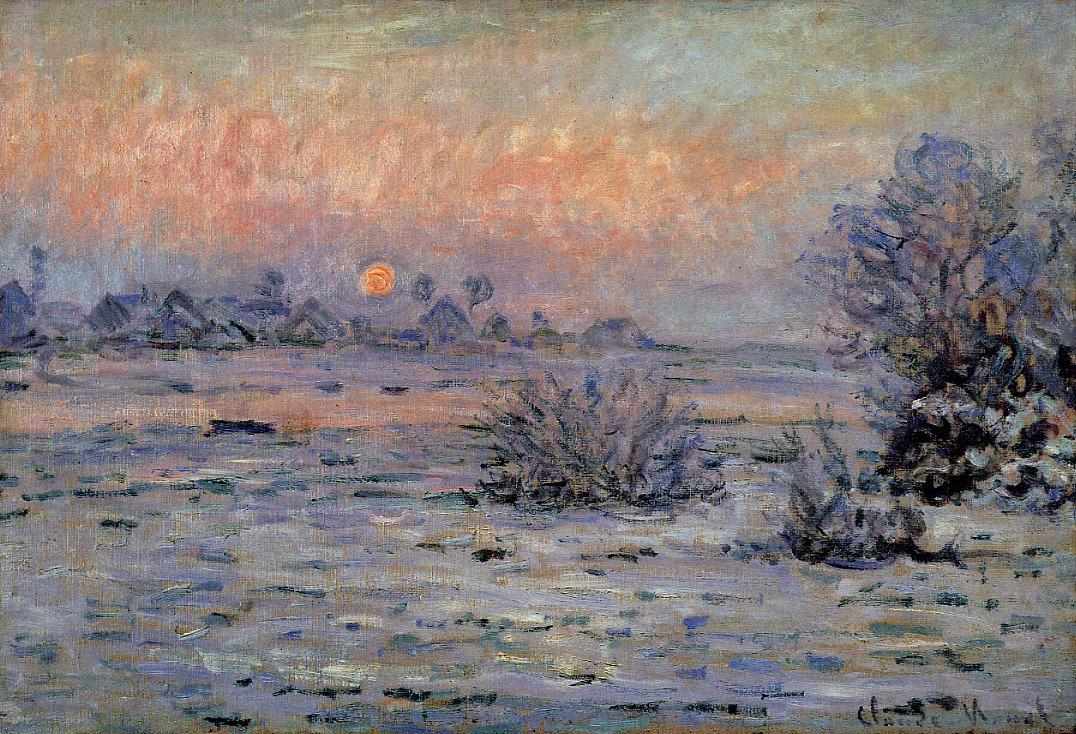
The title promises winter sun, and Monet supplies it, if sparingly. The sun is small, orange and easy to find, but it takes up very little of the canvas. The rest is cold blue, violet and grey. In those colours the snow and water seem to shift with the light, while the trees and buildings hold steady.
1903 · Oil on canvas · Musée d’art moderne André Malraux (MuMa)
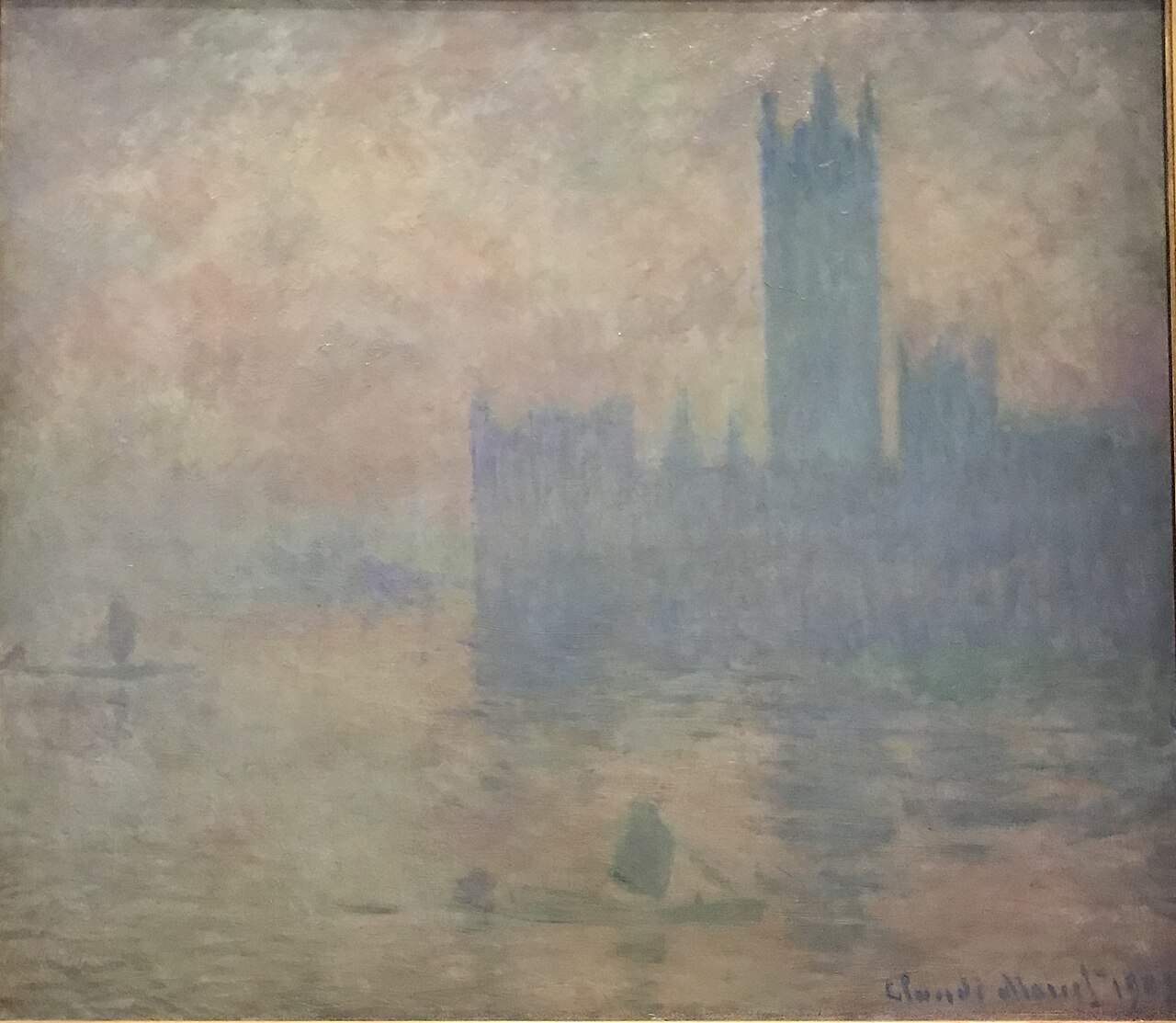
Mist softens the edges of the towers, though they remain recognisable. The same related colours run through the building, the sky and the broken reflection, and a small boat marks the water in front. Monet painted Parliament as a series under different conditions, and MuMa's canvas is one of them.
1890–1897 · Oil on canvas · Musée d’art moderne André Malraux (MuMa)
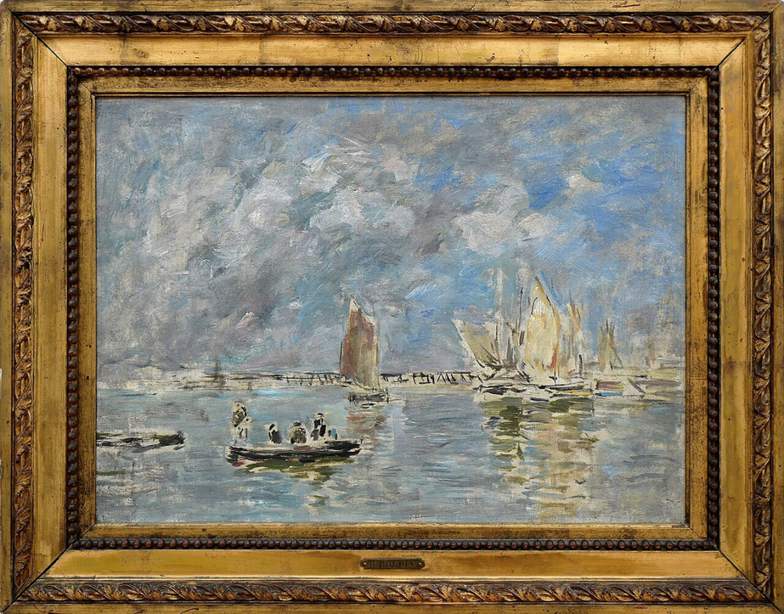
Hulls and masts give the harbour a firm framework. The scene stays easy to read until it reaches the water, where the reflections break into separate marks. The workers are small figures scattered across the wide view, and no single event draws them together.
1873 · Oil on canvas · Musée d’art moderne André Malraux (MuMa)
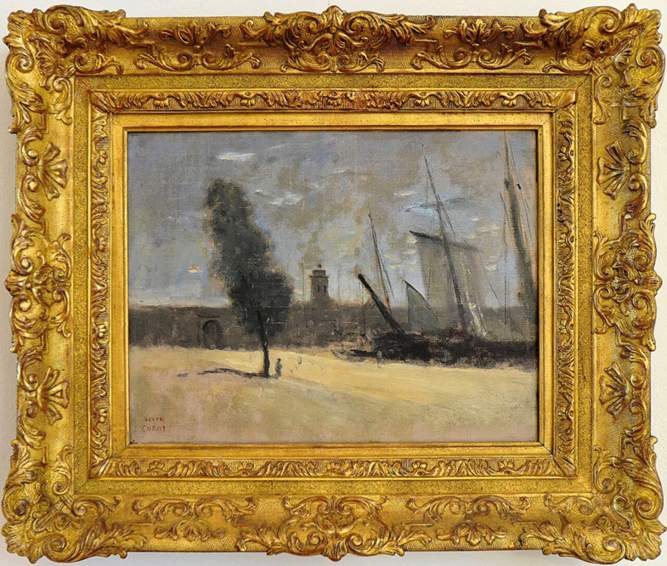
Corot's harbour is quieter than Boudin's. Broad, pale ground carries the eye towards the ramparts and the harbour entrance with little incident on the way. He keeps strong contrast for a few points, among them a dark tree that cuts into the sky.
1869 · Oil on canvas · Musée d’art moderne André Malraux (MuMa)
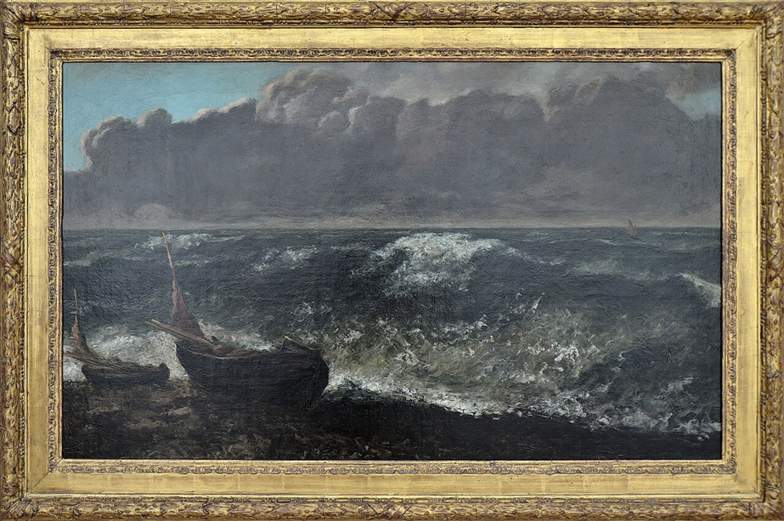
Courbet shows no disaster here, only a sense of threat, and the threat comes from scale. Boats on the shore give a human measure for the oncoming waves, and they look small beneath the heavy sea and the dark cloud above. The paint plays its part too. Pale breaking crests stand against dense, darker paint, so the waves have mass as well as movement.
1885 · Oil on canvas · Musée d’art moderne André Malraux (MuMa)
Water, ground and foliage each get their own kind of brushwork, and so many small marks might easily have scattered. The curve of the bank holds them together. It leads to a group of houses and trees in the middle distance, painted more firmly than anything around them, and there the view comes to rest.
1866 · Oil on canvas · Musée d’art moderne André Malraux (MuMa)
Thin lines of rigging divide the bright sky without closing it off. Below, the heavier hulls and the figures give the waterfront a practical scale. There is enough harbour equipment to keep the quay at Honfleur recognisably a place of work.
1882 · Oil on canvas · Musée d’art moderne André Malraux (MuMa)
Figures make their way along the path towards distant buildings, past a boat at rest and the trees, and Pissarro folds this everyday traffic into the receding line of the bank. Several views are associated with the Pothuis quay. MuMa identifies this one as the 1882 painting.
1894 · Oil on canvas · Musée d’art moderne André Malraux (MuMa)
Trees break the light into narrow openings. Pissarro spreads repeated touches of paint over the ground and vegetation, so the light comes back fairly evenly across the whole surface, and the structure of the trees can still be read beneath it. There is a small figure as well. Unlike the walkers on the Pothuis quay, it carries no more weight than the marks around it.
1881 · Oil on canvas · Musée d’art moderne André Malraux (MuMa)
The vegetation on the sunlit slope is built from many small touches, while the bay beyond is laid in with fewer, broader areas, so after the busy foreground the water seems to open out. Renoir uses no sharp outlines here. The change of handling does much of the work of creating distance.
1876 · Oil on canvas · Musée d’art moderne André Malraux (MuMa)
Renoir saves his closest definition for the face, where small changes of colour place the cheeks, eyes and hair. He leaves the dark dress and the setting looser, so the face is the most particular part of the portrait. Lower down, a blue-green bow adds a separate accent.
c. 1884–1886 / 1890 / 1900 · Pastel on wove paper · Musée d’art moderne André Malraux (MuMa)
A woman dries herself, her back and bent arm turning towards the edge of the picture. Degas frames her closely and follows the awkward reach of the movement rather than setting her out frontally. The pastel strokes stay active across body and cloth alike. The museum records successive phases of work on the sheet, which is why the heading carries more than one date.
c. 1875–1879 · Oil on canvas · Musée d’art moderne André Malraux (MuMa)
This is another woman seen from behind, painted in a quite different way. In the Degas pastel the crossed strokes assert the drawing, but Renoir lets the contours ease into the neighbouring colour, and parts of the shoulder and back soften into the surrounding blue. The head and gathered hair are easier to place. The edge is firmer in some places than in others, but the body keeps its form.
c. 1849 · Oil on canvas · Musée d’art moderne André Malraux (MuMa)
In the earliest picture in this selection, most of the activity belongs to the weather. Few landmarks compete with the unsettled sky, and there is no prominent human incident. Dark trees and shifts between warm and cool ground give just enough bearings, and Delacroix sets the scale through the balance of large areas.
1919 · Oil on canvas · Musée d’art moderne André Malraux (MuMa)
Where should the eye settle in Bonnard's room? The bright opening seems the obvious answer, but it has rivals: the table in front of it, the patterned floor and the objects scattered about. None of them becomes the main focus. Even the figure at the edge is just one more place to rest.
1907 · Oil on canvas · Musée d’art moderne André Malraux (MuMa)
The poplars of the title are thin trunks that form a screen in front of the broader bands of colour on the hill. They repeat across the picture, though no two are quite the same. Sérusier keeps the two scales of structure apart, the narrow uprights and the rounded land. What holds the view together is the relationship between them, more than any fine atmospheric transition.
1904 · Oil on canvas · Musée d’art moderne André Malraux (MuMa)
Tall reeds rise above a compact group on the table, and their pale lengths repeat against the dark background. Bowls and other forms collect below. In this earlier still life Sérusier was already setting repeated uprights against a different scale of form, here on a tabletop rather than a hillside.
c. 1895 · Oil on canvas · Musée d’art moderne André Malraux (MuMa)
Snow again, and again the shadows are blue and violet, here showing the slope of the white ground. Guillaumin's valley, though, is more broken and steeply divided than Monet's winter river at Lavacourt. Walls and a watercourse interrupt the snow, and warmer branches above bring in a different temperature of colour.
1905–1906 · Oil on canvas · Musée d’art moderne André Malraux (MuMa)
Seen from above, the embankments and barges become strong diagonals beside the pale water. Further off, the buildings merge into grey, which leaves the nearer edges to organise the city. Marquet includes enough figures for movement and scale without filling every gap, and his restrained colour keeps the larger shapes of a busy place clear.
1919 · Oil on canvas-covered cardboard · Musée d’art moderne André Malraux (MuMa)
Matisse's street, painted on canvas-covered cardboard, comes down to a pale road, a pink building and dark trees. He paints them as broad areas of warm and cool colour, and that is enough to keep the street recognisable. Renoir built the southern light of The Bay of Salerno from many small touches. Here each patch carries much more of the description.
See the selected works alongside books and events from their period, or compare when the artists lived. The books and events provide context, not evidence of direct influence. Works without confirmed dates remain in this guide.
Dates and versions
Where MuMa's catalogue qualifies a date or an attribution, the headings keep the qualification, whether as a 'c.', a span of years or a sequence of dates. Some of these details show how a picture relates to others. Monet's Parliament belongs to a series of separate canvases made under different conditions, so MuMa's misty view is one state of the building among several. The Pothuis quay has several associated views, and the museum's identification is what fixes which one this is. The Degas works the other way round: it is a single sheet that carries several dates because the work on it came in successive phases.
Théodore Duret's early history of Manet and his work, in French. Manet is not among the painters chosen here, but the book gives background on how modern French painting was received.
Musée d’art moderne André Malraux Read online · French
MuMa's own illustrated commentaries, in French, with entries on individual works in the collection, several of them chosen here. They are the closest companion to this selection.
 Art, literature & history