The Solomon R. Guggenheim Museum in New York is best known for Frank Lloyd Wright's spiral building, but it began as a collection of modern art. Its holdings include an important group of works by Kandinsky, alongside other artists who found ways to paint without relying on traditional representation.
This guide leaves the building aside for the paintings. The twenty chosen come mostly from New York, with a few from the Peggy Guggenheim Collection in Venice. They run from a Pissarro landscape and a Cézanne portrait to Mondrian's grid and Kelly's colour panels. Kandinsky, Chagall, Miró and Pollock are each represented by a pair of works, so each can be compared with himself. Miró is crowded in one and spare in the other. Kandinsky's forms are hard to separate in one and set cleanly apart in the other. Pollock's tangled web can be set against a later painting in which eyes and pieces of bodies seem to surface.
Artline chose these works from documented Guggenheim holdings, and the selection is independent of the museum. Owning a work is not the same as showing it, so any of these may be on loan or off display. Dates and attributions follow the linked records, including their qualifications.
1913 · Oil on canvas · Solomon R. Guggenheim Museum
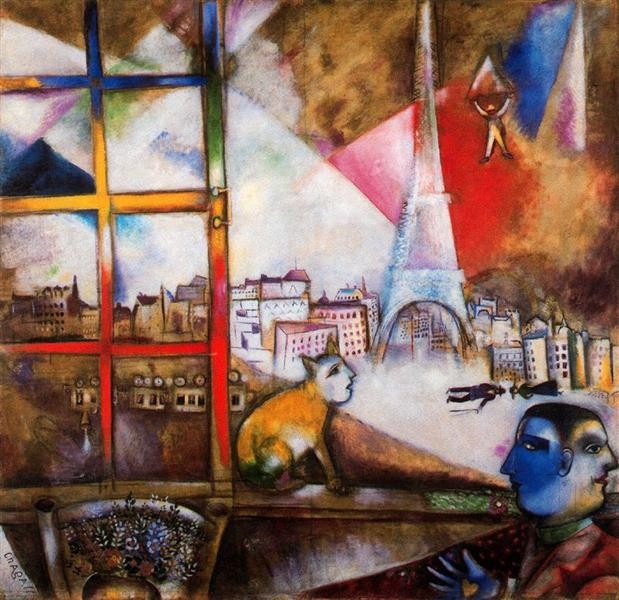
A window looking out over a city is a familiar device, and Chagall uses it to frame a view that no street could supply. You can recognise Paris landmarks, but they share the scene with a two-faced figure, a cat with a human expression and much else besides. The city is real enough to name. The view is not, though: nobody could have seen it from any actual apartment. What lies beyond this window comes from the painter's imagination as much as from Paris.
1966 · Oil on canvas · Solomon R. Guggenheim Museum
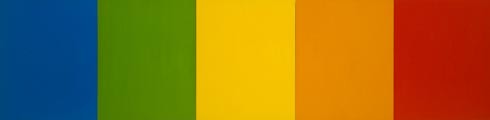
The title is a list, and the painting keeps to it: five upright panels of colour set side by side, with no room or landscape depicted. Where blue meets green there is no painted line, only the edge where one panel stops and the next begins. That physical division does the job an outline does in other paintings, fixing how far each colour extends. What it cannot fix is how strong each colour looks, because that depends partly on its neighbours.
1922 · Oil on canvas · Solomon R. Guggenheim Museum
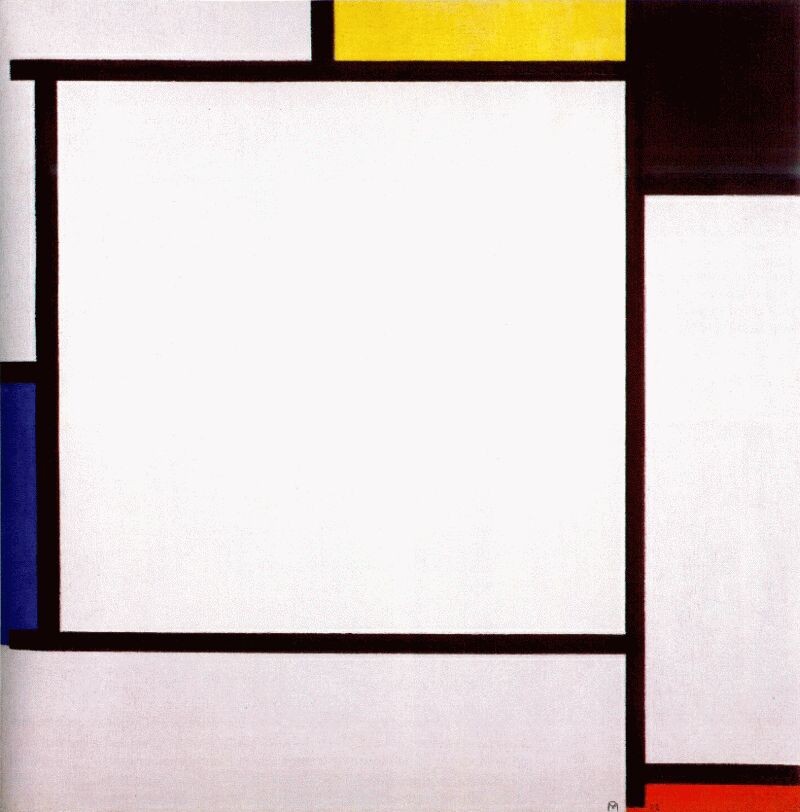
'Grid' is the obvious word, but it is not quite the right one. The rectangles enclosed by Mondrian's black lines are unequal, so no regular pattern ever forms. Much of the square is left white, and the colour is confined to smaller areas pressing in near the edges. The balance owes nothing to symmetry. At first the white can look empty, but the black divisions around it give it weight.
1947 · Oil and alkyd enamel paint on canvas · Peggy Guggenheim Collection, Venice (Solomon R. Guggenheim Foundation, New York)
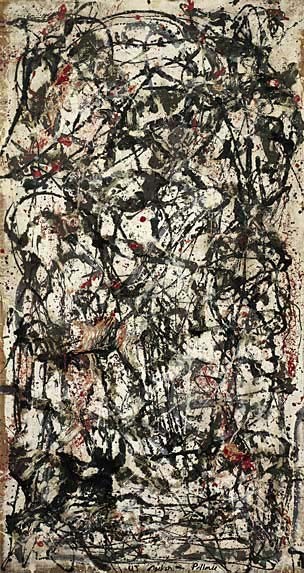
Try following a single line through Enchanted Forest, and sooner or later it disappears beneath another. The paint is oil and alkyd enamel, in black, white, gold and red. The lines overlap without forming any single object, and there is no central figure to arrive at. Even so, the web never thickens into a solid mass, because open areas between the strands keep individual lines legible.
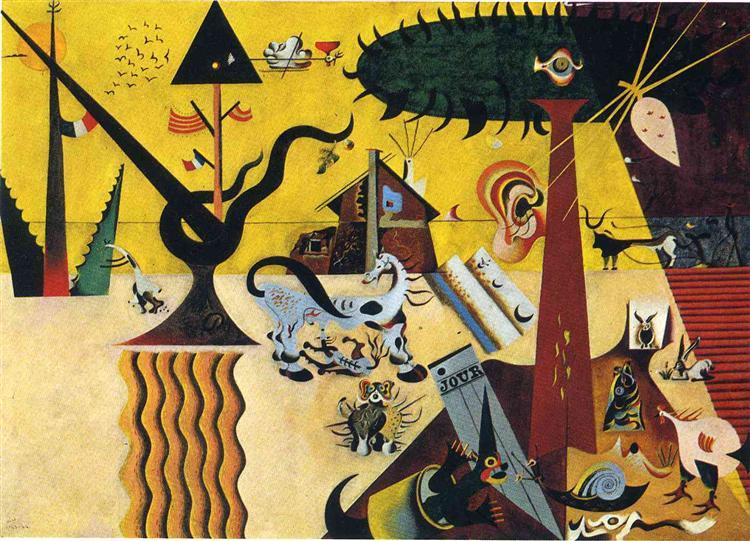
Miró gives us enough for a recognisable rural place: animals, plants, a house, flags. Then he makes the recognition unreliable. Proportions shift, details turn improbable, and the creatures do not keep to a consistent anatomy. The yellow ground holds these separate inventions together, so the eye can pass from a familiar animal to a sign that resists a name.
1867 · Oil on canvas · Solomon R. Guggenheim Museum
This is the earliest painting in the selection by a long way, and it has a modest subject: houses among trees on a slope, linked by the routes that run through the settlement. Pissarro lets neither the buildings nor the vegetation take over. Roofs break into the foliage, trees partly hide the houses, and the road makes sense of their scattered arrangement. Nothing monumental dominates the view. The landscape takes its structure from ordinary habitation.
After the crowded inventions of The Tilled Field, Miró gives his hare a great deal of room. Much of the canvas is left to orange above a darker band, and the white, oddly jointed creature stands exposed against it. Only a few details mark it out as the animal of the title, but there are enough.
1913 · Oil on canvas · Solomon R. Guggenheim Museum
Here the title gives you a foothold, and a helpful one. The slanting marks read easily enough as rain. The hills and buildings are harder. Brighter and darker areas hint at them, but Kandinsky gives no stable viewpoint from which to reconstruct them. The diagonals also carry the weather across the whole surface, over forms that are already difficult to tell apart.
1900 · Oil on canvas · Solomon R. Guggenheim Museum
The folded arms give the sitter a compact shape, and the tilt of his head slightly unsettles it. Cézanne builds the blue coat and the face from patches of colour that stay visible. They never blend into a smooth imitation of cloth and skin. The man looks solid, but the solidity is assembled: his stillness depends on many small adjustments between neighbouring areas of paint.
1917 · Oil on canvas · Solomon R. Guggenheim Museum
Modigliani gives the reclining body almost the whole canvas. Little of the interior is shown and the furnishings are kept to a minimum, so you take in the pose at once and there is not much else to read. What holds the eye is the contour, a continuous line that keeps the warm flesh distinct from the darker setting. The stretched-out figure fills the picture so closely that its relation to the edges of the canvas becomes conspicuous.
Enchanted Forest is a web that forms no object. Ocean Greyness, by contrast, keeps hinting at images. Black curves separate pale forms from a grey field, and some passages suggest eyes or parts of bodies. None of them adds up to a figure, and recognising one shape tells you nothing about the shape beside it. Despite the title, there is no dependable horizon dividing water from sky. If there is an ocean here, the grey seems to carry it alone.
1893 · Oil on canvas · Solomon R. Guggenheim Museum
Rousseau's uniformed men gather around a cannon beneath trees, and nothing happens. There is military equipment but none of the movement of battle; the cannon simply tells you what the men's role is. The order in the scene comes from the way the group is put together. The bodies repeat, as a unit's should, but each face is individually distinct.
1911–1912 · Oil on canvas · Solomon R. Guggenheim Museum
Like Rousseau's artillerymen, Chagall's soldier is shown doing something other than fighting, and the action could hardly be plainer: a soldier, a drinking vessel, a table. It is the room that will not behave. Its tilted forms and figures at different scales make it hard to measure. The vessel does more to hold the subject in place than any consistent perspective could.
1962 · Oil and sand on canvas · Solomon R. Guggenheim Museum
Bacon gives the eye nowhere comfortable to rest. Bodies and meat-like forms are split across three panels instead of being gathered into one scene, and the bright orange and red settings make the pale flesh hard to overlook. Fragments of rooms provide a partial framework and little more. The title names a crucifixion, but the images do not resolve into an ordinary religious narrative, so it is fair to wonder how much of the religious subject survives beyond the word. What carries from panel to panel is the body's exposure, arranged differently each time.
Klee's rectangles work on the same principle as Mondrian's. They suggest a grid, but their proportions are unequal and nothing repeats mechanically. The two painters part company over colour. Mondrian sets his colour against broad areas of white. Klee keeps his muted throughout, with darker divisions giving each unit a different weight. The harmony of the title lies in these adjustments, which keep an order without making every part match.
October 1929 · Oil on cardboard · Peggy Guggenheim Collection, Venice (Solomon R. Guggenheim Foundation, New York)
Painted in oil on cardboard, Upward keeps its forms apart in a way Landscape with Rain never does. Enough of the turquoise-green field is left between them for their precarious connections to be easy to follow. A narrow vertical line supports semicircular and angular shapes, balanced off centre. The arrangement could pass for a figure built from parts, but the title points instead to the direction in which it seems to travel.
Finding the cats takes some effort. Yellow, pink and dark diagonals cross the surface so insistently, running through animals and background alike, that the distinction between them wears away. The title sends you looking for bodies, and they can be found. The diagonals, though, keep pulling the picture towards an order of their own.
Metzinger conveys speed by crowding. Fragmented forms, lettering and glimpses of the track are pressed into close contact with the cyclist and the wheels, which remain identifiable throughout. Information from different parts of the event arrives together, and the gap between rider and setting narrows. There is no blurring of a stable view. The sense of speed comes from how much the picture shows at once.
Marc's pale steer curls into a landscape built from green, red and blue forms, and their curves echo those of its body. The animal therefore seems fitted into its setting, not laid on top of it. Colour still marks off one area from the next, while the shared shapes connect them. Of the animals in this selection, the steer is probably the one most at home in its surroundings.
This is another window onto a city, and a very different one from Chagall's. Chagall keeps his window as a frame and fills the view beyond it with inventions. Delaunay breaks windows and view alike into overlapping areas of blue, green, yellow and red. Hints of both survive, but they compete with the divisions and connections that the colour makes by itself. The edges that ought to separate inside from outside become just more material for the surface. The last word of the title fits: the picture can be read in several directions at once and never settles into a single view.
Explore this selection in Artline
See the selected works alongside books and events from their period, or compare when the artists lived. The books and events provide context, not evidence of direct influence. Works without confirmed dates remain in this guide.
Planning a visit
Enchanted Forest, Upward and At the Cycle-Race Track belong to the Peggy Guggenheim Collection in Venice. The other paintings belong to the museum in New York. Check each museum's current records separately before travelling, since inclusion in this guide does not guarantee that a work is on display.
Further reading
Wassily Kandinsky; translated by Michael Sadleir · Read free · English
Kandinsky's own account of his ideas about colour and form, in Michael Sadleir's English translation. It sets out the painter's argument in his own words, which makes it useful company for Landscape with Rain and Upward.
 Art, literature & history