 Art, literature & history
Jean Metzinger
1883–1956
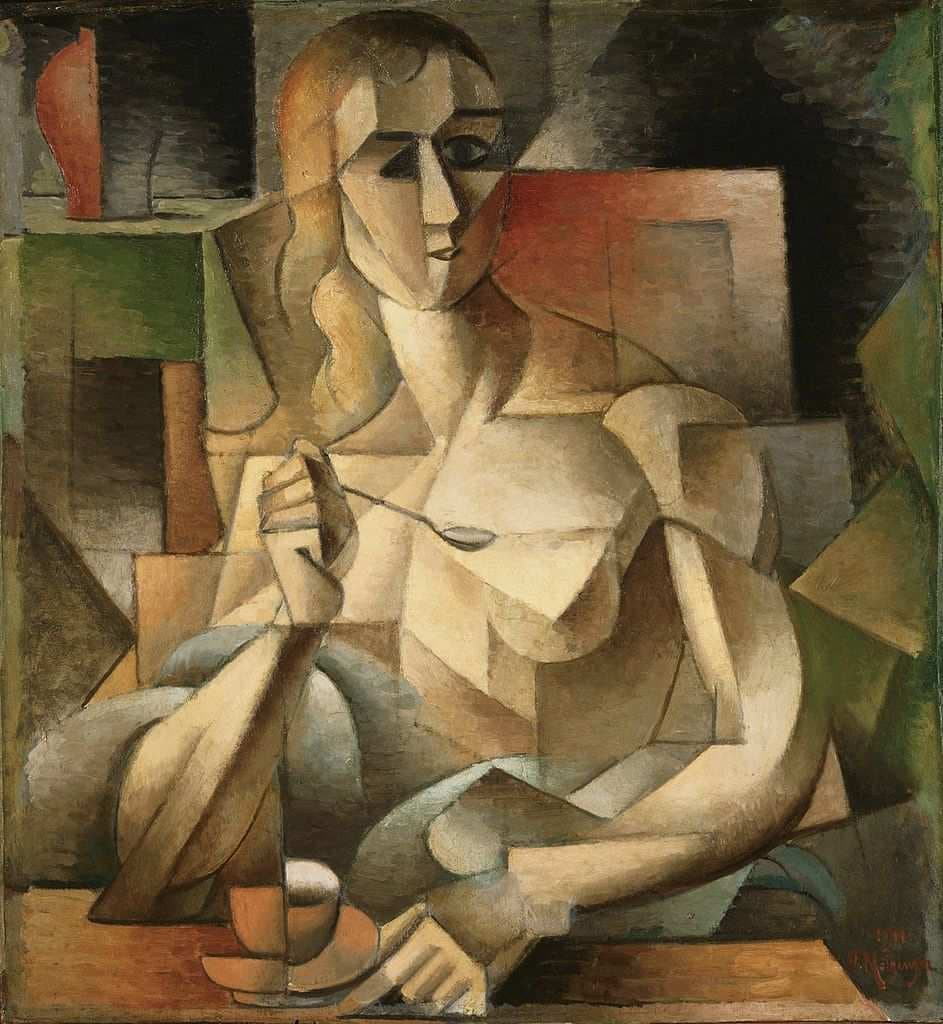
Selected artwork
Le goûter (Tea Time)
1911
Other names (3)
Jean Dominique Antony Metzinger, Jean Metzanger, Metzinger
Biography
Jean Dominique Antony Metzinger (French: [mɛtsɛ̃ʒe]; 24 June 1883 – 3 November 1956) was a major 20th-century French painter, theorist, writer, critic and poet, who along with Albert Gleizes wrote the first theoretical work on Cubism. His earliest works, from 1900 to 1904, were influenced by the neo-Impressionism of Georges Seurat and Henri-Edmond Cross. Between 1904 and 1907, Metzinger worked in the Divisionist and Fauvist styles with a strong Cézannian component, leading to some of the first proto-Cubist works.
From 1908, Metzinger experimented with the faceting of form, a style that would soon become known as Cubism. His early involvement in Cubism saw him both as an influential artist and an important theorist of the movement. The idea of moving around an object in order to see it from different view-points is treated, for the first time, in Metzinger's Note sur la Peinture, published in 1910.
Before the emergence of Cubism, painters worked from the limiting factor of a single view-point. Metzinger, for the first time, in Note sur la peinture, enunciated the interest in representing objects as remembered from successive and subjective experiences within the context of both space and time. Jean Metzinger and Albert Gleizes wrote the first major treatise on Cubism in 1912, entitled Du "Cubisme". Metzinger was a founding member of the Section d'Or group of artists.
Metzinger was at the center of Cubism both because of his participation and identification of the movement when it first emerged, because of his role as intermediary among the Bateau-Lavoir group and the Section d'Or Cubists, and above all because of his artistic personality. During the First World War, Metzinger furthered his role as a leading Cubist with his co-founding of the second phase of the movement, referred to as Crystal Cubism.
He recognized the importance of mathematics in art, through a radical geometrization of form as an underlying architectural basis for his wartime compositions. The establishing of the basis of this new perspective, and the principles upon which an essentially non-representational art could be built, led to La Peinture et ses lois (Painting and its Laws), written by Albert Gleizes in 1922–23. As post-war reconstruction began, a series of exhibitions at Léonce Rosenberg's Galerie de L'Effort Moderne were to highlight order and allegiance to the aesthetically pure.
The collective phenomenon of Cubism—now in its advanced revisionist form—became part of a widely discussed development in French culture, with Metzinger at its helm. Crystal Cubism was the culmination of a continuous narrowing of scope in the name of a return to order; based upon the observation of the artist's relation to nature, rather than on the nature of reality itself. In terms of the separation of culture and life, this period emerges as the most important in the history of Modernism.
For Metzinger, the classical vision had been an incomplete representation of real things, based on an incomplete set of laws, postulates and theorems. He believed the world was dynamic and changing in time, appearing different depending on the observer's point of view. Each of these viewpoints was equally valid according to underlying symmetries inherent in nature. For inspiration, Niels Bohr, the Danish physicist and one of the founders of quantum mechanics, hung in his office a large painting by Metzinger, La Femme au Cheval, a conspicuous early example of "mobile perspective" implementation (also called simultaneity).
Wikipedia contributors. Opening excerpt, formatted for reading. CC BY-SA 4.0. Source revision.
Influenced by
- Henri Rousseaueditorial inference
Evidence
Explicit secondary-source assertion; independent historical verification remains pending.
- Henri-Edmond Crosseditorial inference
Evidence
Explicit secondary-source assertion; independent historical verification remains pending.
Later influence
- Marc Chagalleditorial inference
Evidence
Explicit secondary-source assertion; independent historical verification remains pending.
Artworks by year
Loading chronology…Museum / collectionAll collections
Finding recorded artworks…
Museums & collections
Documented holdings of works attributed to Jean Metzinger. Check the museum’s record for current display information.
- Musée d'art moderne de Paris6 recorded works
- Art Institute of Chicago4 recorded works
- musée des Beaux-Arts — Nantes3 recorded works
- Minneapolis Institute of Art2 recorded works
- Museum of Modern Art2 recorded works
- Statens Museum for Kunst (SMK)2 recorded works
- The Metropolitan Museum of Art2 recorded works
- Buffalo AKG Art Museum1 recorded work
- musée Cantini — Marseille1 recorded work
- musée des beaux-arts — Caen1 recorded work
- Musée des Beaux-Arts de Rouen1 recorded work
- Solomon R. Guggenheim Museum1 recorded work
- Tate1 recorded work
Sources 9
- Wikidata (CC0)
- Museum authority country review
- Pantheon 2025 — Datawheel (CC BY-SA 4.0)
- Museum authority country review
- Tate Collection metadata (October 2014 snapshot)
- Statens Museum for Kunst (SMK)
- Pantheon 2025 — Datawheel (CC BY-SA 4.0)
- Expanded artwork research — official museum evidence
- Pantheon 2025 — Datawheel (CC BY-SA 4.0)