The Museo Nacional Thyssen-Bornemisza in Madrid grew out of a private collection assembled by the Thyssen-Bornemisza family. Its range is unusually wide, running from medieval painting through the Renaissance and into the twentieth century, which makes it a useful companion to the Prado and the Reina Sofía.
The twenty paintings chosen here cover much of that ground, from early Netherlandish panels by Rogier van der Weyden and Petrus Christus to Rothko. They are not in date order. Over so long a span the same subjects come round again in very different hands, and the sequence lets some of them meet. There are two Crucifixions, by Uccello and Zurbarán, and two toilet scenes: a mythological one by Rubens and one by Boucher set among fabrics and screens. Other recurrences are less expected. The moon appears over Friedrich's Easter morning and again above O'Keeffe's New York, in very different company.
Artline made this selection from the museum's documented holdings, independently of the museum. Dates and attributions keep the qualifications given in the records. Where sources disagree, as they do over the date of the Dalí, both versions are given.
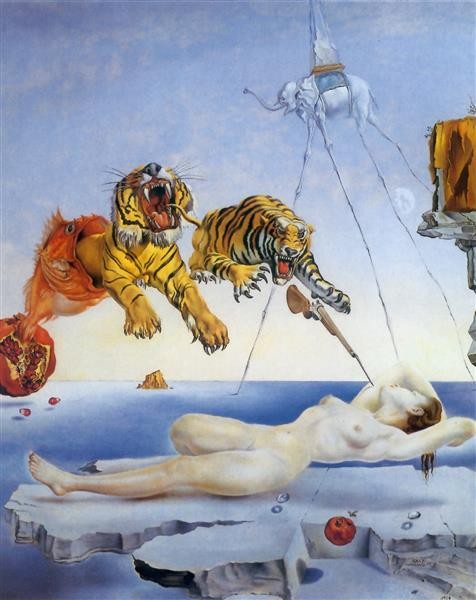
1947 in the current Thyssen record; c. 1944 in the Dali Foundation catalogue · Museo Nacional Thyssen-Bornemisza
A woman sleeps while an impossible sequence unfolds above her. Fish, tigers and other forms follow one another, each painted with hard-edged clarity, though only dream logic links them. The title reads almost like a diagnosis: it fixes the moment, a second before waking, and names the cause, a bee's flight around a pomegranate. Whether that accounts for the tigers is another matter.
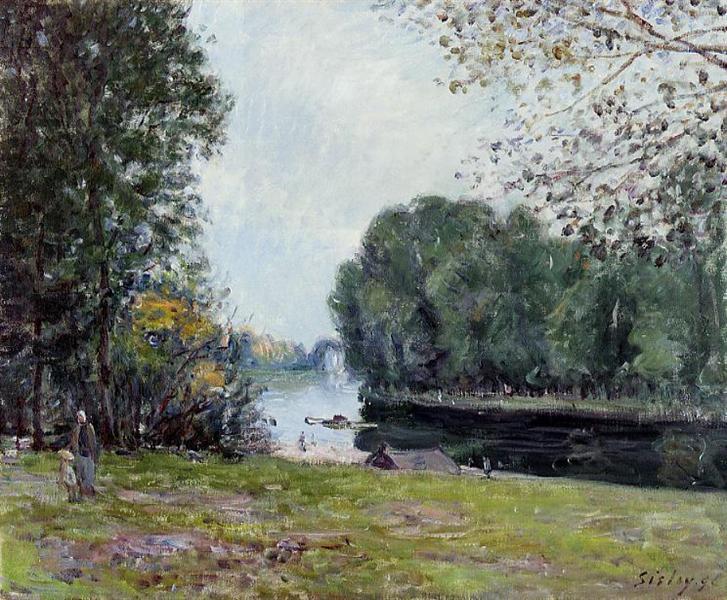
1896 · Oil on canvas · Museo Nacional Thyssen-Bornemisza
Not the Loing in general but a bend in it, and the bend is the point. Beyond the near bank the river turns away and its further course is hidden. Trees and grass line the water, the reflected light changes along its length, and a few small figures at the water's edge give the scale.
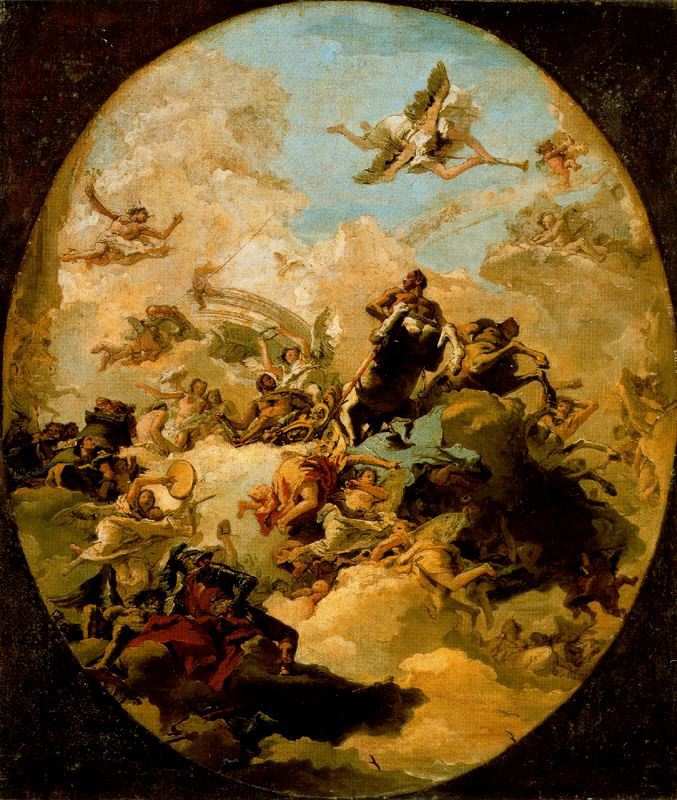
An apotheosis is a raising to divine status, here that of Hercules, and the picture is built around the upward movement the word implies. Giandomenico Tiepolo packs a crowded assembly into an oval and lets the shape decide the arrangement. Darker figures and clouds gather towards the rim, while a brighter opening marks the direction of ascent. The scene is composed to be seen from below.
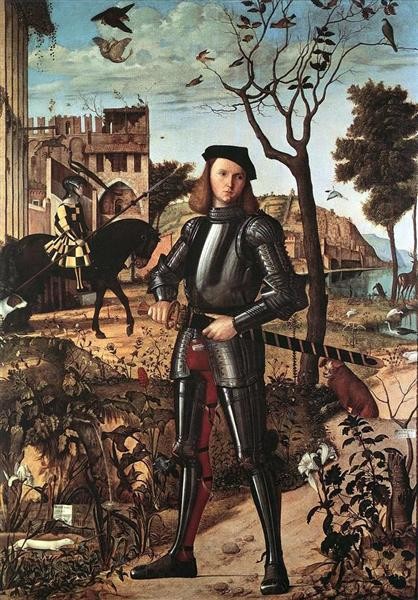
A young man in armour stands firmly in a landscape full of plants, animals and a rider. Carpaccio gives him the concentrated focus of a portrait, and the details around him look as though they ought to tell us who he is. Perhaps they do. But the sitter's identity is uncertain, and so is the meaning of the individual details.
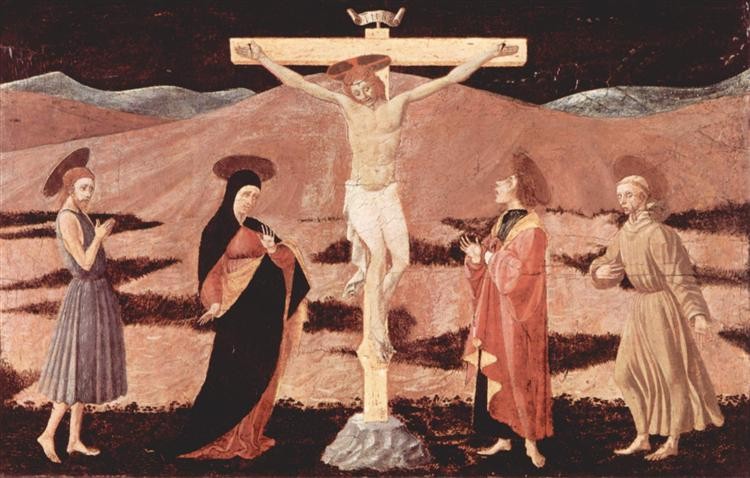
1438 · Tempera on panel · Museo Nacional Thyssen-Bornemisza
For a scene of suffering, this is remarkably orderly. The cross rises through a low, broad group of mourners, its upright set against their horizontal line, and the angular hills of a simplified terrain hold the bodies apart. Each mourner has a fixed place in relation to the death at the centre.
1627 · Oil on canvas · Museo Nacional Thyssen-Bornemisza
Beside Uccello's, this is a Crucifixion made by subtraction: no mourners, no hills, almost no setting at all. Against near black, the pale body and the white cloth carry the image, and the cross supports them. Nothing around the figure tells the story. The viewer has to bring it.
1835 · Oil on canvas · Museo Nacional Thyssen-Bornemisza
Three walkers head away between bare trees, under a sky in which the moon is still visible. What makes this Easter morning rather than any early walk? Friedrich paints no miracle. If the picture answers its title, it does so through light and season: a moon lingering in the morning sky, trees not yet in leaf. The walkers help too. Small as they are in the landscape, their movement along the path gives it a purpose.
1723 · Oil on canvas · Museo Nacional Thyssen-Bornemisza
The title names the viewpoint. From Campo San Vio, Canaletto fits foreground steps, small boats and long palace façades into a single, legible space. His carefully managed perspective sets out the large structure first, and the boats can wait. Small as they are beside the palaces, each can still be followed on its own course across the water.
1712 · Oil on canvas · Museo Nacional Thyssen-Bornemisza
A costumed company gathers round a musician among trees. They are playing theatrical roles, but no clearly bounded stage contains them. The pale costume, presumably the Pierrot of the title, catches the eye first, and the title's claim comes with it. Is its wearer really as happy as all that? The costume announces a role, not the mood of the person inside it, and pauses and still faces in the group unsettle the cheerfulness.
1925 · Oil on canvas · Museo Nacional Thyssen-Bornemisza
There is no open view of the city. O'Keeffe paints the buildings from below, and their height hems in the sky that the moon of the title has to share. Overhead, hard architectural edges meet softer forms. Lower down and nearer to us, a streetlamp and a red accent claim attention of their own, so the moon has competition.
c. 1450 · Oil on panel · Museo Nacional Thyssen-Bornemisza
The dry tree of the title is exactly that: bare, lifeless-looking branches close round Mary and the Child, and golden letters hang among them. Writing, plant forms and sacred figures are combined in a compact image that does not behave like an ordinary landscape. The tree is less a setting than a frame, and because it looks so dead, the pair stand out all the more.
c. 1723 · Oil on canvas · Museo Nacional Thyssen-Bornemisza
Canaletto's other view in this selection is close in date to the Grand Canal, but it trades water for stone. The arcaded rows lead the eye to the basilica, and the plan of the square is clear at once. The pedestrians take longer. Small and scattered, they break the broad paving into separate encounters and paths, doing for the piazza what the boats do for the canal.
c. 1598–99 · Oil on canvas · Museo Nacional Thyssen-Bornemisza
Catherine kneels and looks straight out of the picture. Around her, at oblique angles, lie the broken wheel and the sword, the instruments of her martyrdom. They are there to identify her, not to show the martyrdom taking place, and it is her direct gaze, more than the story, that holds the picture.
The title reads like an inventory, and at first it seems a complete one: a red band between dark areas, its edges soft and uneven. But the painting rests on close differences, and a quick look flattens the darks into a uniform black. Given time, the relationships between the areas begin to emerge, and the inventory starts to look too short.
c.1657 - c. 1667 · Oil on canvas · Museo Nacional Thyssen-Bornemisza
Fish, vessels and a white-covered table might have made a still life, but this picture is named after a person. Metsu attends closely to provisions and equipment, which make the work of preparing food concrete and specific, yet the cook's face stays clearly visible among them. The room is set up for work, not as a display of plenty.
Little light is left: a narrow yellow-orange band at the horizon, above rough ground and thin trees. Van Gogh keeps the foreground uneven and subdued, so the distant glow carries more weight.
1742 · Oil on canvas · Museo Nacional Thyssen-Bornemisza
The toilette, or process of dressing, takes place here in a room crowded with fabrics, screens and small objects. A seated woman and a second figure attending to clothing keep their gestures legible amid it all, and the clothing being handled seems of a piece with the textiles that fill the room. For all its decoration, the room is shown in use.
1608 · Oil on canvas · Museo Nacional Thyssen-Bornemisza
Where Boucher spreads the toilette across a crowded room, Rubens closes in. Much of the view is filled with pale flesh, white fabric and attending hands, and the mythological subject becomes an intimate action. The figures touch directly, and Cupid's mirror adds a second line of sight, bringing an image within the image into their exchange.
An elaborate Gothic niche encloses the Virgin and Child, and the whole arrangement has the look of carved stone. The colour of the clothing and bodies keeps the figures from reading as sculptural ornament, so they have the look of sculpture and the life of painting at once. The niche shelters the pair and also sets them apart from the viewer's space. Petrus Christus's dry tree may work in a similar way, enclosing the figures in something lifeless: dead branches where Rogier has stone.
For a picture named after a boulevard, this shows remarkably little of it. We stand behind two men on a balcony, and their bodies and the rail already take up part of the view. Trees and neighbouring façades are visible, but the street itself is mostly out of sight, and from where we stand we presumably see less of it than they do. Looking at the city becomes something that happens within the picture: the men watch from above, at a remove from whatever is going on below.
Explore this selection in Artline
See the selected works alongside books and events from their period, or compare when the artists lived. The books and events provide context, not evidence of direct influence. Works without confirmed dates remain in this guide.
Above and below
Tiepolo and O'Keeffe both put the viewer underneath, with very different results. Tiepolo's oval is made for that position: to look up at it is to follow the direction of the hero's ascent, out of the shadowed crowd and towards the light. O'Keeffe keeps us low too, but in her New York the upward look runs into architecture before it reaches the sky, and the moon gets only what the buildings leave. Height might seem the remedy. Caillebotte does lift us to a balcony, but then stands us at the back of it, behind the men and the rail, where the street below is still largely hidden.
Further reading
Anne Dayez, Michel Hoog and Charles S. Moffett · Read online or download · English
An exhibition catalogue on Impressionism and its contexts, which you can read online or download. Here it is most useful for background on Sisley and Caillebotte, and on how the subjects of nineteenth-century painting were changing. It has little to say about the earlier and later works in this selection.
 Art, literature & history