The Städel in Frankfurt has been collecting art for more than two hundred years. Its paintings run from the Renaissance to the modern period, with particular strength in German, Dutch and French art, and this selection covers that range. The famous names are here: Jan van Eyck's Lucca Madonna, Hieronymus Bosch's Ecce Homo, a portrait by Dürer, paintings by Monet and Max Liebermann's scenes of Amsterdam.
Less familiar painters make up most of the rest. Justus Juncker appears more often than anyone else, with a scholar's study, a kitchen interior and sparse still lifes of single fruits with insects. Johann Ludwig Ernst Morgenstern painted the Baroque and Gothic church interiors, and Ottilie Roederstein and Hanns Katz the portraits of women. Johann Georg Trautmann, Ferdinand Brütt and Jean-Bloé Niestlé contribute subjects as far apart as a fire at night, a stock exchange and deer in a landscape of decorative colour.
Artline chose these works from documented holdings at the Städel Museum, independently of the museum. A painting's inclusion here does not mean it is on display, since any of them may be on loan or in storage. Dates and attributions keep the qualifications given in the linked records.
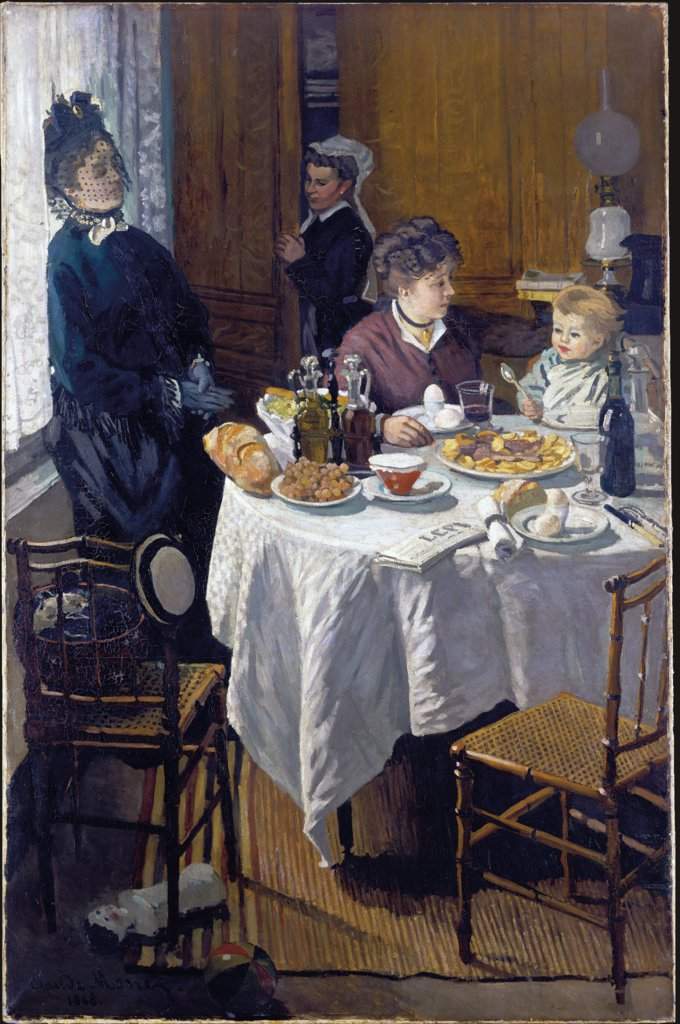
The picture is more than two metres wide, and the meal takes up much of it, with the tablecloth reaching almost to the viewer. The people gathered round the table are placed in a clear overall order, yet no shared conversation or gesture draws them together. For a domestic scene it is oddly quiet: each person seems held in a pause of their own.
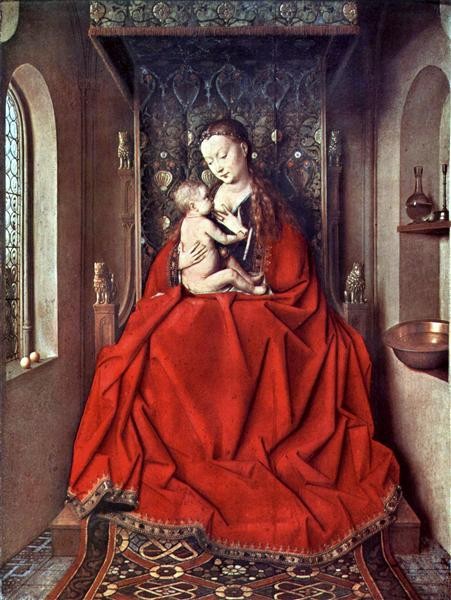
The Virgin sits on a throne in a red robe, holding the Christ Child close. Throne and robe establish her ceremonial importance, but the room around her is narrow, enclosed and entirely specific. Van Eyck describes its windows and small furnishings in material detail and gives the space real depth, so that the sacred figures occupy a room you could almost measure.
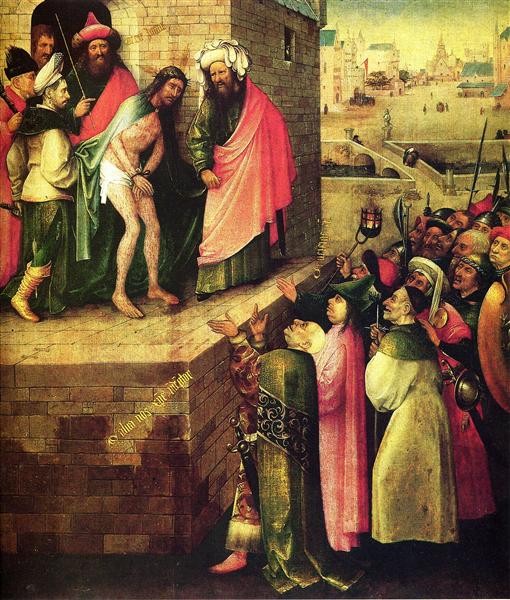
The title repeats the words Pontius Pilate spoke when he presented Christ to the crowd: 'Ecce Homo', Behold the man. Bosch raises Christ on a platform, set apart by the architecture that presses around him. Below, the crowd is packed tight, a mass of upturned faces and bright clothing. Its hostility comes through numbers and closeness, all those people crowded together and looking up at him.
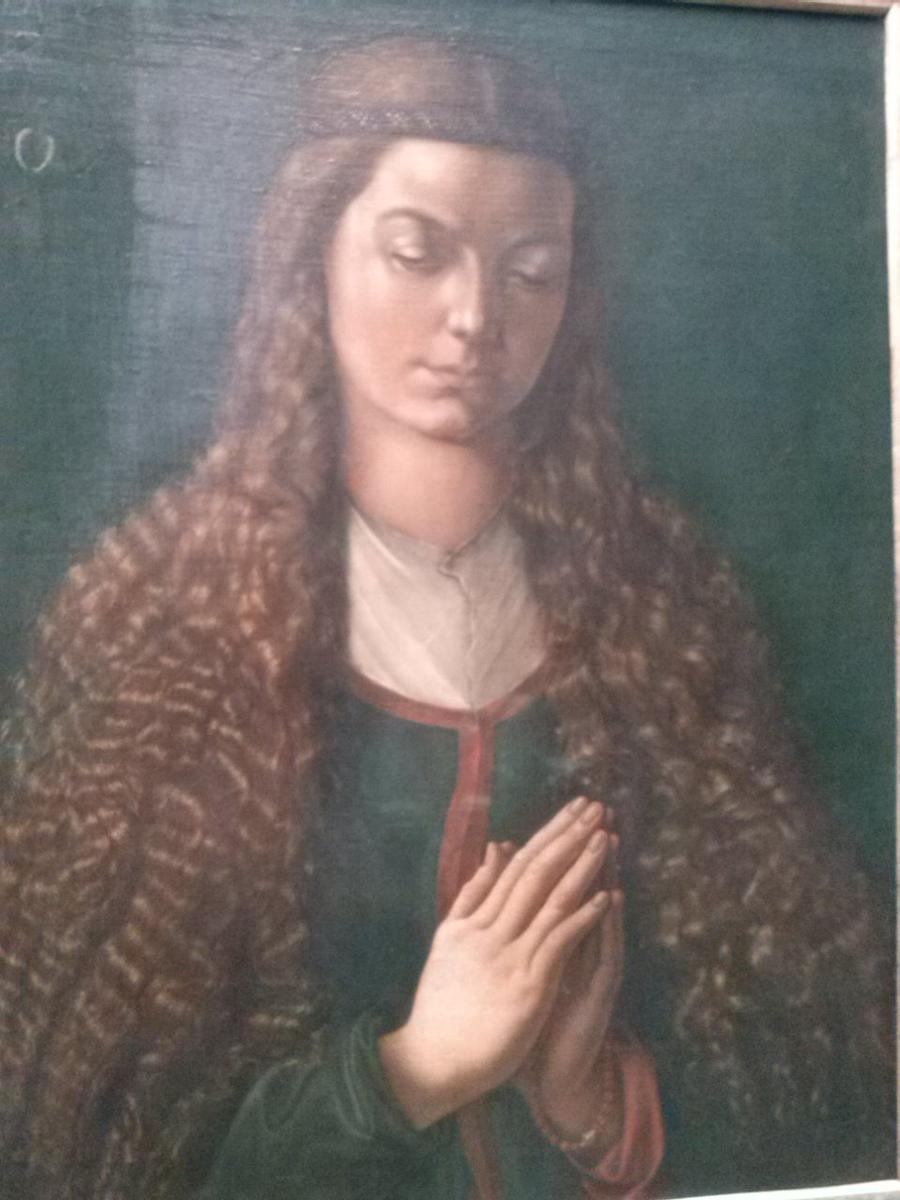
The title singles out her loose hair, and so does Dürer. Her eyes are lowered and her hands joined, so the pose turns inwards, away from the viewer. The curls that fall around her face, by contrast, are described with great care, and the plain background keeps their outline clear. The hair, more than the face, seems to be what the portrait is really about.
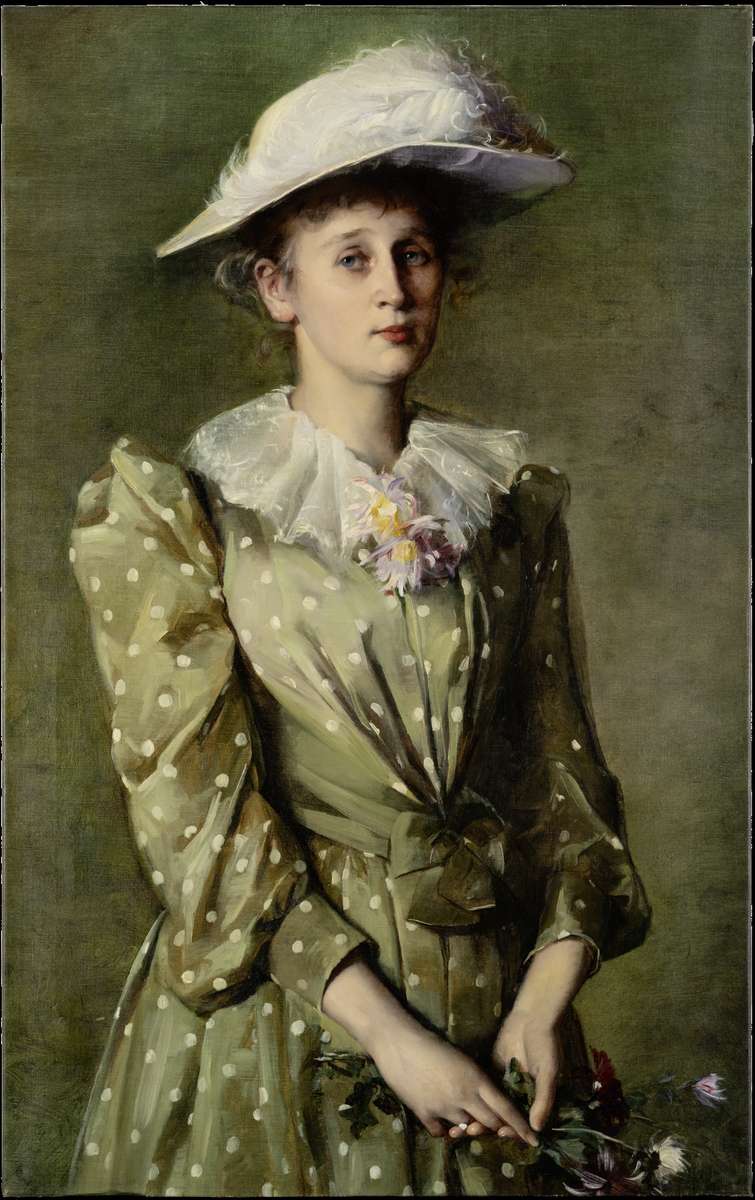
A patterned green dress fills the lower half of the portrait with restless detail, and the face above it is steadier and more reserved. Roederstein joins the hands to anchor the pose and sets a pale hat between the head and the darker background. The pattern stays prominent without overwhelming the sitter.
One apple, a few insects, a stone ledge. Juncker raises the apple on a stepped stone support, which gives it the formality of an object on display, and beside the tiny creatures near it the fruit looks substantial. Many fruit still lifes heap up abundance. This one keeps only the apple's outline and skin, and the small lives around it.
Painted in the same year as the apple, this related work sets a pear on a similar stone ledge, with a butterfly and another insect close to the fruit and the cracked stone. With so little else changed, small differences carry weight. The pear's outline is less regular than the apple's and its form less balanced.
Next to the bare ledges of Juncker's still lifes, the scholar's room is crowded with books and accumulated objects. Juncker gathers the light at the worktable and lets the edges of the room fall into shadow, so the clutter surrounds the working space without crowding into it.
The wicker chair curves protectively around the young woman, yet the picture feels compressed. She sits upright and narrow, her hands kept close to her knees, while the composition presses in around her. Strong colour, in her red hair and blue clothing, keeps her distinct within it.
Matching uniforms mark the girls as members of an institution, but Liebermann does not line them up. Some stand and some sit, each pausing on her own along the shaded building, while overhead the sunlight breaks through the trees in uneven patches. The uniforms work in the painter's favour: because the clothes are alike, the differences in posture are easier to read.
Around the face, Corinth's touch firms up just enough to keep the sitter from dissolving into the paint. Everywhere else the brushwork is loose and energetic. Strokes break up edges and solid forms, and in places the dress and the background almost merge into one restless surface.
The fire is also the picture's source of light. It shows the damage it is doing to the buildings and catches small figures in its glow, and beyond its reach the darkness hides everything else. Trautmann pushes a tree into the bright area, breaking up the blaze so that it does not spread as one uninterrupted mass.
The deer are easy to recognise, but the sharply coloured plants and ground around them follow no single consistent perspective. Niestlé arranges everything instead into a decorative pattern of curves and contrasts. The title names a Japanese landscape, but the picture makes no pretence of being a window onto any place.
Whatever the drinker has swallowed, it has wrecked any composure. The eyes narrow, the mouth opens and the hand grips the vessel. Brouwer makes this grimace the whole subject, and it is specific and vivid enough to carry the picture without the help of a larger story.
A row of green-fronted houses along the Zaan sets up a steady rhythm. In the water below, their reflections break into shorter, less stable strokes. Monet keeps the buildings solid, with firm edges, which makes it all the clearer how the reflections fracture and dissolve.
Brütt builds his stock exchange from small groups in conversation, figures turned close together and gestures only half-glimpsed. What is being said, and what is being traded, stays out of reach. Above them the high public interior gives the institution a physical scale that dwarfs the individual deals being struck below.
Arches, columns and the central dome are linked so that the eye passes from one part of the church to the next, drawn through openings layered one behind another towards the far end. The forms are rounded and the space is expansive. Small figures show the scale, but the architecture is the subject.
Morgenstern painted this Gothic interior a year after his Baroque church. Pointed arches and slender columns repeat down the building towards the distant altar, and the forms reach upwards. Beside the earlier picture the change is plain: the Baroque church is broad and rounded, and this one vertical and taut.
After the uniformed girls of the orphanage courtyard, Liebermann's other Amsterdam scene here is a crowd. There is no landmark building, only people around a street stall in the Jewish quarter, with brick façades running the width of the panel behind them. Bright touches pick out produce and small transactions within the darker mass of figures. Some of what is happening at the stall can be made out, but not all of it.
As in his scholar's study, Juncker puts the strongest light on the work at the table, here falling on sleeves, utensils and ingredients. Each of the three women makes a different gesture, and their positions come from the shared task of preparing food, not from an arranged group pose.
Explore this selection in Artline
See the selected works alongside books and events from their period, or compare when the artists lived. The books and events provide context, not evidence of direct influence. Works without confirmed dates remain in this guide.
Comparisons across the selection
Some comparisons come ready-made: Juncker's apple and pear, Morgenstern's Baroque and Gothic churches, Monet's luncheon table and his houses by the river, and Liebermann's orphanage courtyard and his crowded street. Others cut across the list. The subjects vary greatly in scale, from a single piece of fruit and Brouwer's grimacing face to the high interiors of Brütt's stock exchange and Morgenstern's churches.
Further reading
Anne Dayez, Michel Hoog and Charles S. Moffett · Read online or download · English
The catalogue of a major Impressionist exhibition, by Anne Dayez, Michel Hoog and Charles S. Moffett. It gives context for Monet's Luncheon and Houses on the Zaan, but has little to say about the older paintings or the German painters in this selection.
 Art, literature & history