The Royal Museums of Fine Arts of Belgium in Brussels hold one of the country's major painting collections. Old Masters, nineteenth-century art and modern work are kept in separate departments, and Belgian art sits alongside the wider European traditions that shaped it.
The twenty works chosen here cross those departments, from Flemish painting by Rogier van der Weyden, Dieric Bouts and Pieter Aertsen to Magritte and Dalí. Some of them are worth reading together. Three portraits by Théo van Rysselberghe make a small sequence: Regoyos at his guitar, then Octave and Madame Maus in settings painted in quite different ways. The three Magrittes cover a surprising amount of ground, from the plainly staged meeting of Natural Encounters to the rough surface of The Depths of Pleasure, and one of them is not a canvas at all but a plaster cast of the Venus de Milo. And Teniers's archduke among his pictures is a painting about collecting that now belongs to a collection.
Bruegel's name needs the most care. The Fall of the Rebel Angels is given to him without qualification. The other two works associated with him, Landscape with the Fall of Icarus and Yawning Man, have uncertain attributions.
Artline chose these works from the museum's documented holdings, independently of the museum. Where a linked record qualifies a date or an attribution, the qualification is kept here.
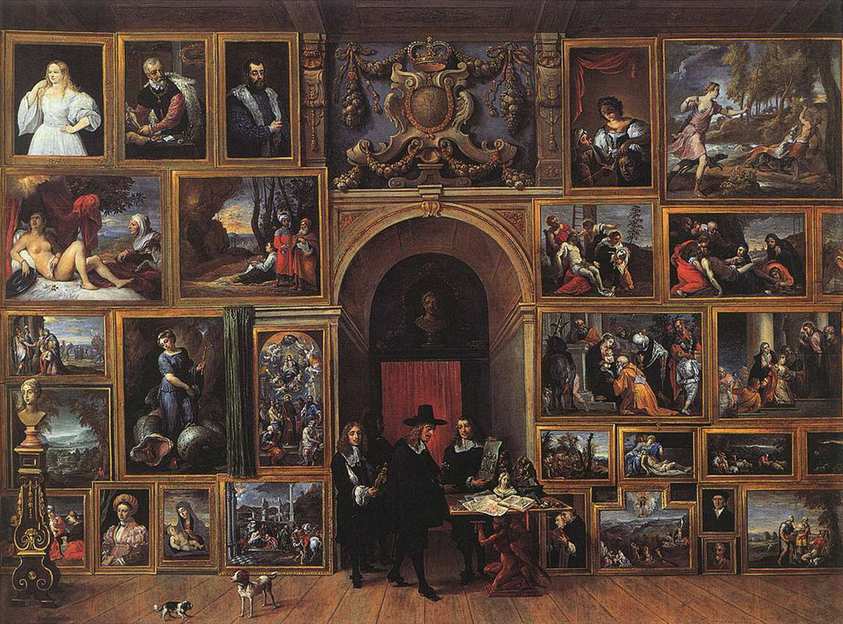
1651 · Oil on canvas · Royal Museums of Fine Arts of Belgium
The archduke is not the only thing on show. Paintings cover the walls and fill the room, and he stands among visitors who are examining them, one figure in a space his possessions have taken over. Teniers's subject is collecting itself. A gallery like this displayed its owner's wealth, taste and ambitions, at a time when owning pictures could be a public statement of status.
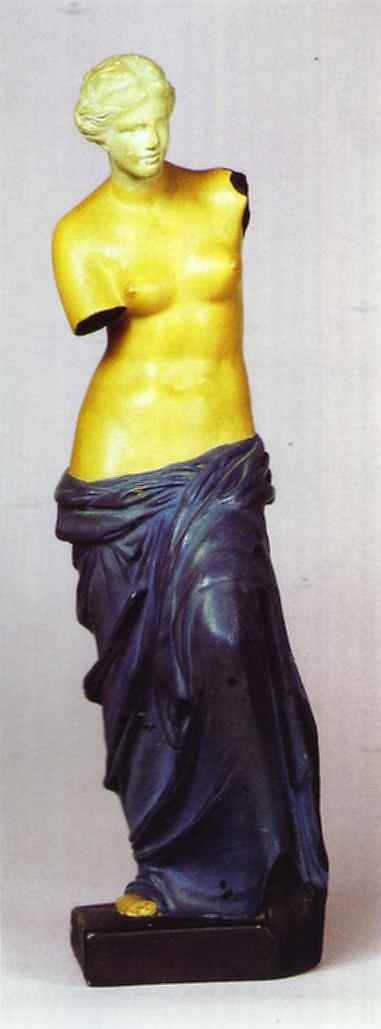
1931 · Oil on plaster · Royal Museums of Fine Arts of Belgium
Strictly speaking, this is a painted object rather than a painting. Magritte took a plaster cast of the Venus de Milo, made no attempt to disguise its source and left the statue's familiar outline intact. The colour is where the change lies: the torso is yellow and the drapery dark blue, so a form that would otherwise read as one continuous whole is divided. Because the figure is so easily recognised, the division is all the harder to ignore.
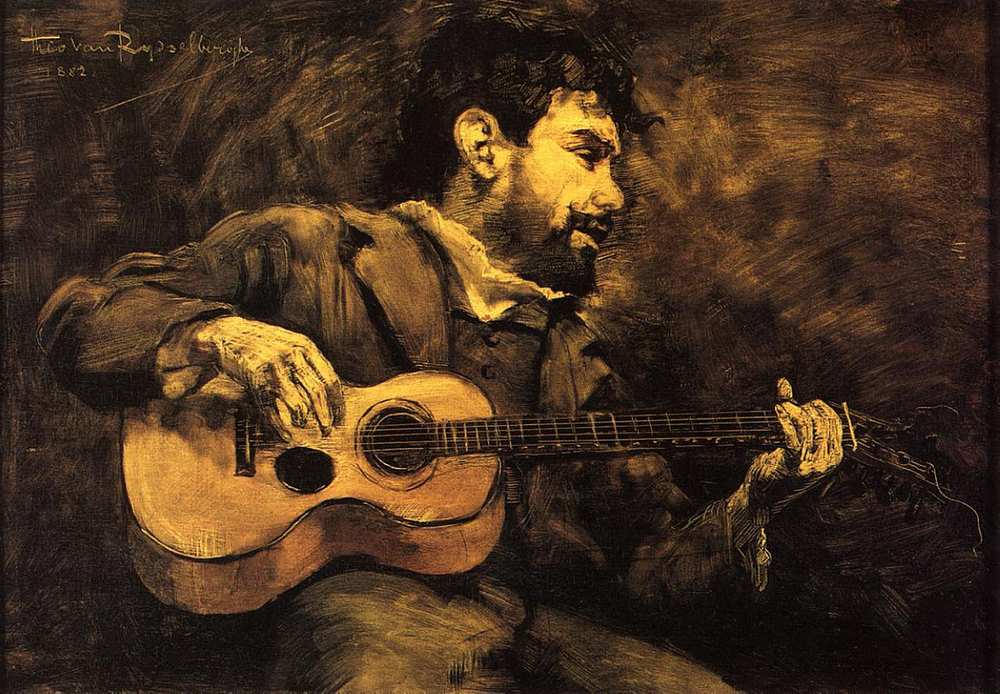
1882 · Oil on panel · Royal Museums of Fine Arts of Belgium
The earliest of the Van Rysselberghe portraits here, and the only one on panel, shows Regoyos in the act of playing. The guitar lies across his body and gives his arms something to do, and its warmer colour lifts it clear of his dark clothes.
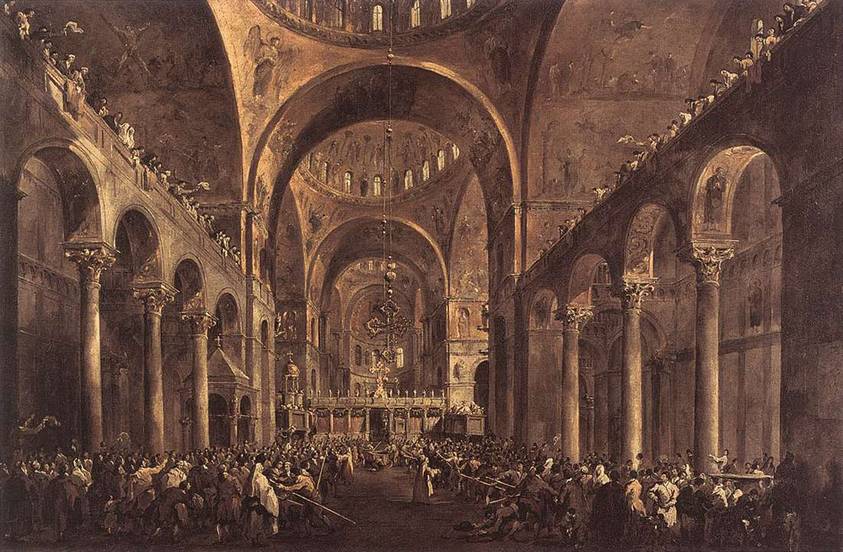
1775 - 1777 · Oil on canvas · Royal Museums of Fine Arts of Belgium
Doge Alvise IV Mocenigo's appearance before the people is a small event here, set inside the basilica of Saint Mark's, and the building does more than the gathering to give the occasion its scale. Arches and columns carry the eye upwards, and patches of light keep all that architecture from looking immovable.
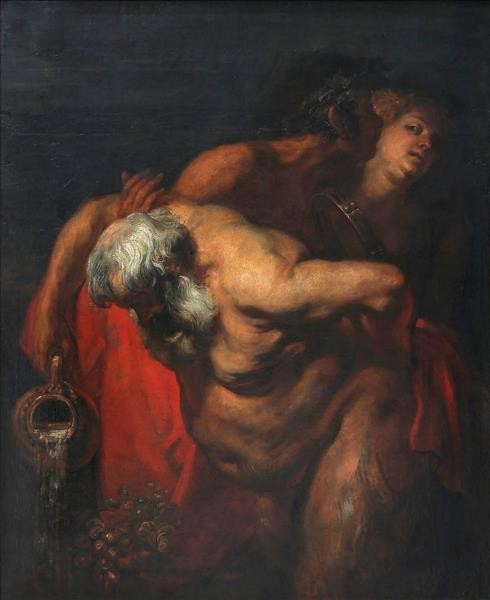
Silenus, the drunken companion of the wine god Bacchus, has become a dead weight, and the first thing the picture tells you is simply how heavy a drunk man is. Holding him up leaves the figures around him little room, so they crowd together. Bent limbs and gathered drapery make the effort plain before you have worked out who anyone in the group is.
1908 · Oil on canvas · Royal Museums of Fine Arts of Belgium
You might expect a bright window behind a figure to make that figure the most clearly described thing in the picture. Bonnard does otherwise. Pattern, warm interior colour and cooler light compete around the body and keep cutting into it, until the model becomes one part of a wider field of surfaces rather than the obvious centre of the picture.
1945 · Oil on canvas · Royal Museums of Fine Arts of Belgium
The title calls these encounters natural, yet the creatures meeting here are impossible: birdlike figures in red robes. Part of the strangeness comes from how plainly the meeting is set out. The robes give the figures something like bodily solidity, openings onto the sky make space around them, and each form is calmly separated from the next. Nothing is hidden in darkness or lost in movement.
1460 · Oil on panel · Royal Museums of Fine Arts of Belgium
An arrow is an unusual thing to set in front of a portrait sitter, yet here it does much of the work, along with a gold chain that follows Antoine's neckline. Both stand out against his dark clothes, and both signal status and allegiance in a portrait that is otherwise restrained. His face stays controlled.
1890 · Oil on canvas · Royal Museums of Fine Arts of Belgium
Madame Maus sits in a dark dress whose outline stays solid, while the lighter room around her is built from small, separate touches of colour. The difference is easiest to follow along the edge where dress meets interior. In the earlier portrait of Octave Maus, the flowers and furnishings are softened rather than broken into marks. Between the two pictures Van Rysselberghe has changed the way he paints a setting, though in both he keeps the sitter distinct from it.
1529 · Oil on wood · Royal Museums of Fine Arts of Belgium
Cranach gives Schöner almost no setting. No office, landscape or possession says who he was or what he did. Instead, hair, fur and a red garment crowd close around his head, packing several textures into a compact portrait, and his hands are joined below. Whatever authority the sitter has comes from the figure itself.
1885 · Oil on canvas · Royal Museums of Fine Arts of Belgium
This is a full-length portrait, so Maus's bearing counts for as much as his face. His dark silhouette holds its shape against flowers and furnishings painted with softer edges.
1562 · Oil on panel · Royal Museums of Fine Arts of Belgium
The figure at the top is recognised quickly enough. The mass below takes far longer to sort out: familiar wings, shells and limbs turn out to belong to bodies that behave like no known animal. The further down the eye travels, the denser and more hybrid the crowd becomes, and that loss of order can be seen as the fall itself.
1946 · Oil on canvas · Royal Museums of Fine Arts of Belgium
The animals look heavy enough to carry architecture, yet they stand on extremely thin legs. The kneeling saint raises a cross against a procession whose scale is hard to judge. Every object is clearly described. The trouble lies in how the objects relate to one another, because weight, size and balance do not behave as they would in the physical world.
Date not established · Oil on panel · Royal Museums of Fine Arts of Belgium
Whoever painted it, this is a picture of a yawn and nothing else. The yawn takes over the whole face: the mouth opens, the eyes close and the upper lip rises. Formal portraiture has little room for an expression like this. The attribution to Bruegel is uncertain, and no date has been established.
1715 · Chalk on paper · Royal Museums of Fine Arts of Belgium
Watteau drew the same woman in a hat three times in chalk, from different angles. Bare paper keeps the studies apart, so they look like alternative poses rather than three people sharing a room. Together they show how her clothes change shape as she turns.
Abundance is an abstract idea, and Jordaens makes it intensely physical. Fruit, children and overlapping bodies are packed in so densely that plenty is built into the composition itself. The turning female figure does not preside over it all as a detached symbol. She is caught up in the crush, and rounded shapes recur in flesh and produce alike.
The title gives her an occupation, not a name. Meat, vegetables and vessels fill much of the foreground and set out the materials of her work. But she is painted on a large scale and looks out at the viewer, and she holds the picture as firmly as the provisions around her.
This is a less polished Magritte than most. Loose outlines and rough patches of red, orange and blue take the place of the smooth clarity found in much of his work, and although the female form is still recognisable, its surface never settles into a continuous whole. The Copper Handcuffs also breaks up a familiar female figure with colour, but there the division is clean, a yellow torso against dark blue drapery, and the statue's outline survives intact.
In an ordeal, a claim was judged by putting the body in danger, in this case by fire. Bouts stages it in a tiled hall before upright witnesses, and the onlookers are as much a part of the event as the test itself. Their composure and the regular floor give the scene the look of an orderly procedure, though the physical risk remains at its centre.
Date not established · Royal Museums of Fine Arts of Belgium
A ploughman and ships make the landscape easy to take in, until a small pair of legs in the water interrupts it. That easily missed detail is the fall of Icarus. It is the title that has to point out what the composition almost hides.
Neither the attribution nor the date has been established. In 2026 the museum announced new technical research, and the painting cannot be presented as a certain Bruegel original.
Explore this selection in Artline
See the selected works alongside books and events from their period, or compare when the artists lived. The books and events provide context, not evidence of direct influence. Works without confirmed dates remain in this guide.
Reading by date
The entries are not in date order, but the headings make them easy to sort, and sorting them shows how unevenly the selection covers its ground. It begins with Rogier van der Weyden's Antoine, the Bastard of Burgundy. The widest gap falls between Guardi's Saint Mark's and Van Rysselberghe's Regoyos, after which the three Van Rysselberghe portraits follow one another before Bonnard. At the far end the works bunch closely, and Dalí's Temptation of Saint Anthony lands between two Magrittes, Natural Encounters and The Depths of Pleasure. The Dalí has something in common with the earlier Magritte, since both describe impossible things with complete clarity. The Depths of Pleasure, the last picture in the sequence, lets that clarity go, so within this selection the shift happens inside Magritte's own work rather than simply between two painters. Two pictures cannot be placed at all. Yawning Man and Landscape with the Fall of Icarus have no established dates, which means that of the three works linked with Bruegel, only The Fall of the Rebel Angels, the one with an unqualified attribution, has a place in the sequence.
Further reading
Royal Museums of Fine Arts of Belgium · Read or download the museum booklet · English
The museum's own illustrated booklet, which you can read or download in English, looks closely at details of the Bruegel works in its collection. Its attributions predate current research. The authorship of Landscape with the Fall of Icarus is still under investigation, so for that painting, read the booklet alongside the museum's current research notice.
 Art, literature & history