Dresden's Gemäldegalerie Alte Meister grew out of the collections of the Saxon rulers, and several of its pictures were bought because they were already highly valued in their own day. The gallery is best known for Raphael and Vermeer, and both are here: Raphael with the Sistine Madonna, Vermeer with the girl reading a letter at an open window and with The Procuress.
The rest of the selection includes Giorgione's Sleeping Venus, Cima da Conegliano's Presentation of the Virgin, Cranach's martyrdom of Saint Catherine, Van Dyck's drunken Silenus, Claude's Acis and Galatea and Poussin's Adoration of the Magi, along with pictures by Mateo Cerezo and Bernardo Strozzi. Rembrandt appears in his own costumed double portrait with Saskia. He also appears at one remove, as the name behind a portrait catalogued as the work of a follower. Canaletto's Venetian views make a small group of their own and are best looked at together. Among the less familiar works are portraits by Rosalba Carriera, Marcello Bacciarelli and Angelica Kauffman. They show a count surrounded by the trappings of his rank, a named woman painted in pale tones and an unnamed woman cast as a vestal virgin.
The paintings were chosen independently from the museum's documented holdings. Being included here does not mean a painting will be on view. Uncertain attributions and approximate dates keep the qualifications given in the linked records.
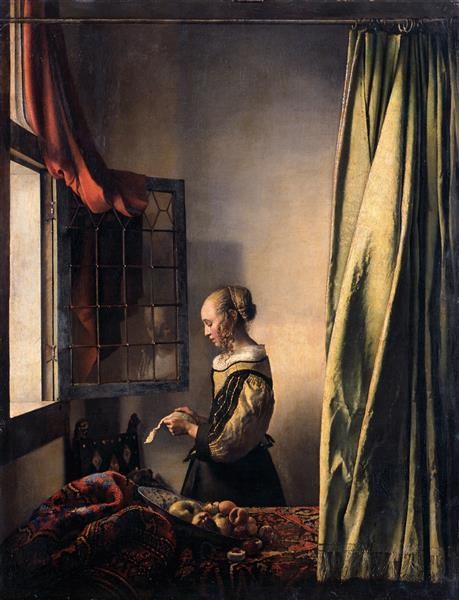
A young woman stands at an open window reading a letter. Daylight fills the room, yet Vermeer keeps the moment private.
The back wall has a history of its own. A painting of Cupid on that wall lay hidden for a long time under later overpainting, and restoration has since uncovered it. The reproduction in this guide shows the earlier state, with the Cupid still covered, so recent photographs look noticeably different. The change is more than a matter of furnishing. With a Cupid on the wall behind a woman absorbed in a letter, it is hard not to suppose that the letter is about love, though the painting never lets us read it.
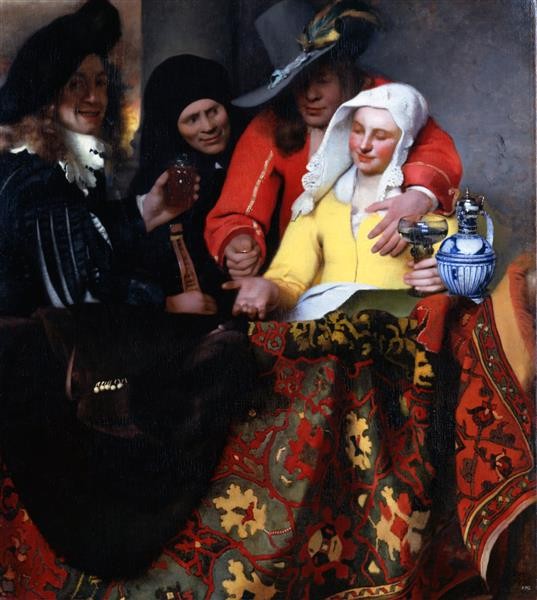
The title does some of the explaining. Hands meet above a richly patterned covering, and the exchange there is more concentrated than the crowded group of faces might suggest. The textile is worth looking at for its closely worked surface. It also lies across the foreground like a barrier, so the figures are close to us but on the far side of something solid.
The picture is close in date to the letter reader, but its company could hardly be more different. She has the room to herself, while here a cluster of faces gathers round a single transaction.
1657 · Oil on canvas · Gemäldegalerie Alte Meister
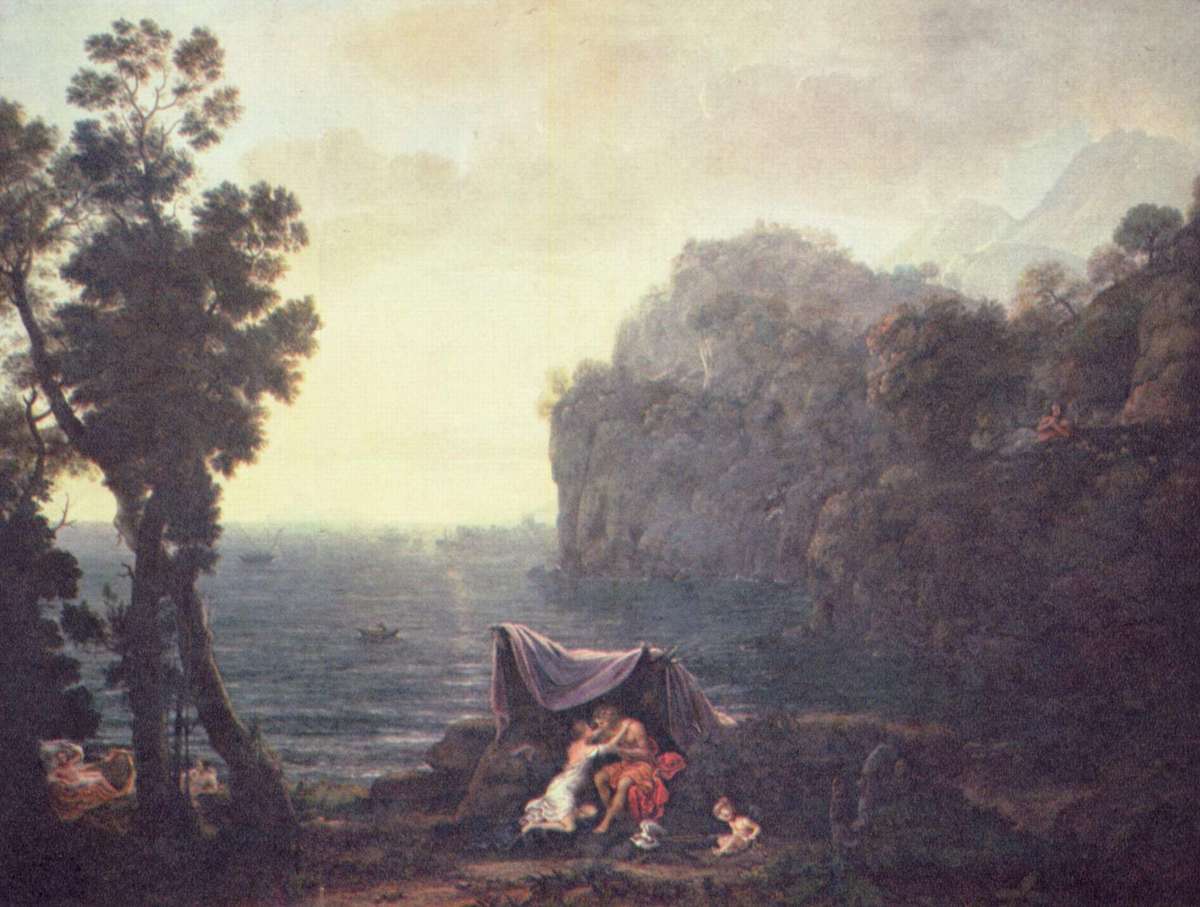
Claude gives the mythological lovers only a small part of his landscape. Trees shelter them, while water and a bright distance open out beyond. A viewer who does not know the story of Acis and Galatea loses less than might be expected, because the setting has a movement of its own, from enclosure to openness.
1633 · Oil on canvas · Gemäldegalerie Alte Meister
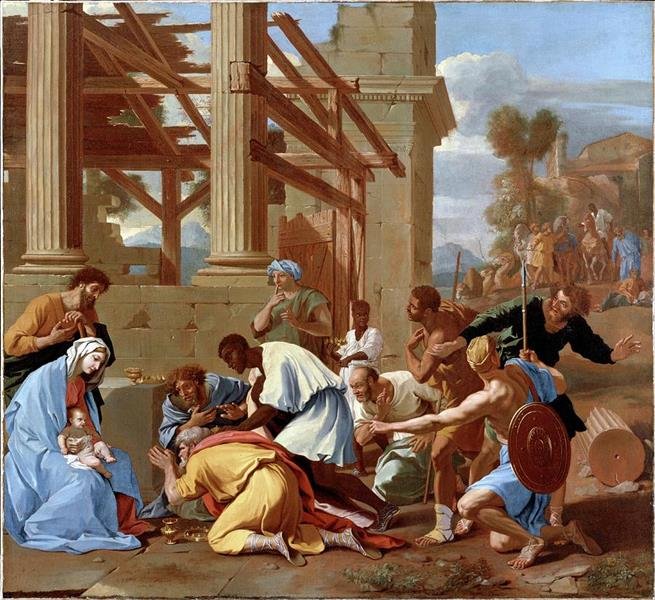
Claude leaves his lovers little room, but in Poussin's picture the figures carry the meaning. They bend and gesture towards Mary and the child, and their bright robes keep each person distinct within the shared act of homage. The architecture gives the group a framework without drilling it into a line. Devotion shows in posture, as each body adjusts to the next.
1725 · Oil on canvas · Gemäldegalerie Alte Meister
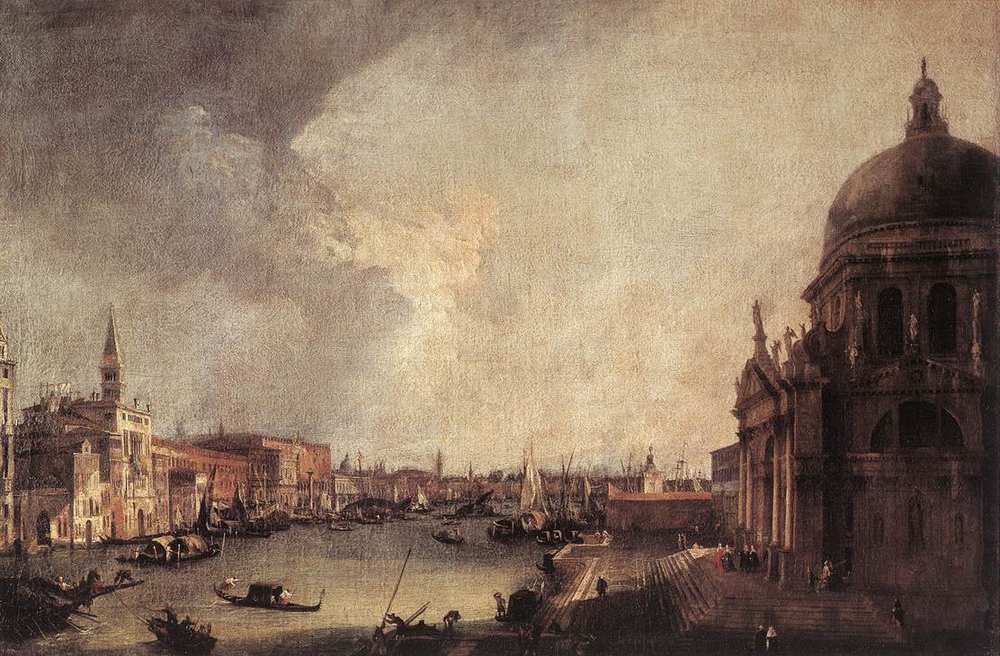
Open water fills a broad area in front of the buildings, and the small boats crossing it do more than decorate it. They measure the monumental architecture against everyday traffic, and they make the canal a working route as well as a view. Without them, the façades could look like a set of detached architectural elevations.
c. 1725 · Oil on canvas · Gemäldegalerie Alte Meister
Here the waterway bends, so the façades come into view at different angles. One stretch of canal therefore holds several architectural rhythms instead of a single orderly recession into the distance. Boats are scattered across the water between the banks.
c. 1726 · Oil on canvas · Gemäldegalerie Alte Meister
Seen from Palazzo Balbi, the canal is wide enough to compete with the buildings. Fairly open water separates the long rows of façades, and the boats are dotted across it rather than crowding it. None of the other canal views here gives the distance between the banks as much weight.
1621 · Oil on canvas · Gemäldegalerie Alte Meister
Silenus leans his heavy body against the figures holding him up, and they visibly bear his weight. The title explains why he needs them. The painting is about what follows: being drunk is his affair, but keeping him upright falls to everyone else, and in the crowded space that is a practical problem of balance. Warm flesh and red cloth hold the group together.
1725 - 1726 · Oil on canvas · Gemäldegalerie Alte Meister
Here the open space is a paved square rather than water. The church façade, with its prominent clock, gives the scene a fixed centre, and the surrounding buildings frame the square. The small figures crossing the foreground do much the same job as the boats in the canal views, adding movement and showing how big the buildings are.
Rich clothing and a crowd of faces turn Catherine's ordeal into a public spectacle, while the broken wheel and a troubled sky add to the turmoil. Cranach does not clear an empty space around the saint. She kneels, comparatively still, in the middle of it all, and her stillness is what singles her out.
A staff and a partial drape of cloth identify the saint, and the setting adds little else. Cerezo turns the head towards a brighter area above. Nothing in the surrounding darkness competes with that upward look, which is the picture's main action.
The title names her only by her instrument, so we cannot tell whether this is a particular woman or simply a player. The viola da gamba is large, and it reads as something she is doing rather than a prop added to identify a sitter. Above its curved body she looks straight out at the viewer, and Strozzi gives that direct gaze and the instrument's solid bulk equal weight.
The title gives the sitter's rank, and the painting spells it out. Red and blue clothing, a table and an architectural setting all present the count's status, which comes across through pose, costume and surroundings at least as much as through the face.
Pale blue and white clothing keeps the portrait light against a muted background, and jewellery and flowers add small accents near the face. Carriera's transitions are soft, yet the sitter stays distinct. Slight differences between pale surfaces define her, not hard edges.
The title promises a hat decorated with pearls, yet much of that hat is lost in darkness. The light goes instead to the face and the decorated chest.
The picture is catalogued as the work of a follower of Rembrandt, not of Rembrandt himself. Picking a face out of the dark was a way of handling light that could spread beyond one painter, and a resemblance in handling does not by itself establish who painted a picture.
The title calls the sitter simply 'Woman', so we are given her role rather than her name. Pale drapery and a small vessel make her a figure from antiquity, though no ancient story is told around her. She turns towards the viewer as directly as the subject of a likeness would, while her costume and gesture present her as a vestal virgin. She is a portrait sitter and a classical figure at once.
The staircase lets the viewer measure the child's climb. Its long, open flight separates the small figure from the one waiting at the top and from the onlookers below. Cima uses the architecture to give a modest physical action ceremonial weight. Because the steps are empty, the distance is visible, and a child climbing stairs stands out from the surrounding crowd.
With a raised glass and a broad smile, the pair act out a lively scene. The sitters are recognisably Rembrandt and Saskia, but the title casts them in the parable of the Prodigal Son. Costume, gesture and warm light make it a performance rather than a record of their home life, and the parts they play need not match their own.
Parted curtains reveal the sacred group, as though it had only just come into view. Below, a ledge with two small angels marks a second boundary between the painted space and the viewer's side. Raphael brings Mary and the child forward but frames their approach twice over. The familiar angels are part of that framing, placed on the boundary itself.
The long horizontal outline of the body is echoed by the rising and falling ground beyond, and pale cloth lies between the sleeper and the landscape. The title names a goddess, but no story is told. Body and land are linked only by their shapes.
Explore this selection in Artline
See the selected works alongside books and events from their period, or compare when the artists lived. The books and events provide context, not evidence of direct influence. Works without confirmed dates remain in this guide.
Reproductions and captions
Images of these paintings are easy to find, though not all of them are recent. For the letter reader, the back wall tells you which state an image shows. If the Cupid is visible, it records the painting after restoration. If the Cupid is covered, it records the earlier state. Captions elsewhere may also leave out the qualifications kept here, such as the 'c.' before some of the Canaletto dates, the span of years given for the Sleeping Venus, or the word 'follower' in the attribution of the man in the pearl-decorated hat.
Further reading
Walter Liedtke · Read online or download · English
Walter Liedtke's catalogue of the Metropolitan Museum's Dutch paintings gives detailed accounts of individual pictures, including works by Vermeer and Rembrandt, with background on how they were made and what they depict. Its entries cover the Metropolitan Museum's own paintings. For the Dutch pictures in this selection, its value lies in what it explains about the painters' methods and subjects.
 Art, literature & history