Twenty works from the National Museum in Kraków: Leonardo's Lady with an Ermine, Matejko's history paintings, Polish portraits and self-portraits, and Wyspiański's pastels.
Polish painting is at the centre of much of the National Museum in Kraków's work: portraits, historical scenes and art made while the country's political borders were repeatedly redrawn. The museum is also connected with collections that hold some very famous European paintings, and the single exception to the Polish rule in this selection comes from one of them: Leonardo's Lady with an Ermine, which belongs to the Princes Czartoryski Museum.
Everything else is Polish, and much of it belongs to Jan Matejko and Stanisław Wyspiański. Matejko's history paintings take in a royal poisoning, a prophecy, the aftermath of a battle and Poland personified under constraint. Some background helps with them, though the paintings themselves give more help than you might expect. Wyspiański has the largest group, mostly in pastel, ranging from window designs to a child resting his chin on his hands. Around them are Olga Boznańska's portraits, Józef Chełmoński's horses and weather, and a run of self-portraits in which painters decide how to be seen: Anna Bilińska at work, Jacek Malczewski in costume, Wyspiański beside his wife and then, late, in crayon.
Artline chose these works from the museum's documented holdings, independently of the museum. A place in the collection is no guarantee of a place on the walls: any of these works may be on loan or off view. Dates and attributions keep the qualifications given in the linked records.
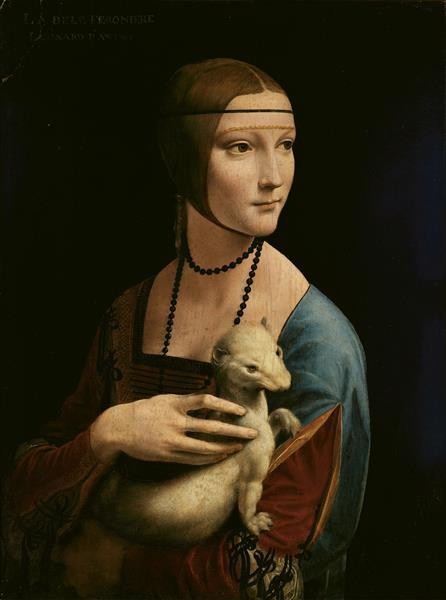
Cecilia Gallerani holds the ermine carefully against her body, and neither she nor the animal looks at us. Both turn their attention elsewhere. Her hand, which Leonardo makes unusually long, links the two movements. The ermine has been associated with her patron and with ideas of purity, but neither association settles what the portrait means.
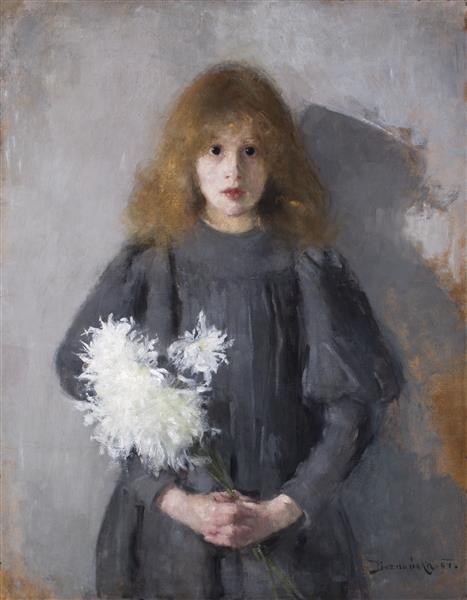
The girl looks straight out with dark eyes. Boznańska keeps the setting spare and holds the colour to a close range of greys. So little interrupts them that the white chrysanthemums lower down become an event: they break up the grey and set off her clasped hands.
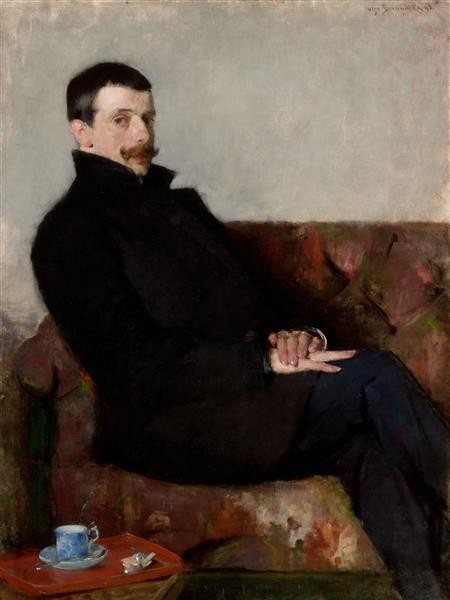
Paul Nauen's body is turned sideways and his head turns in response, as though he has paused in a room where other people are present. A cup nearby adds to the sense of an interrupted visit, which is a fairly informal arrangement for a formal likeness. His dense black clothing isolates his face and hands. It does the job the white flowers do in Girl with Chrysanthemums, in a much darker key.
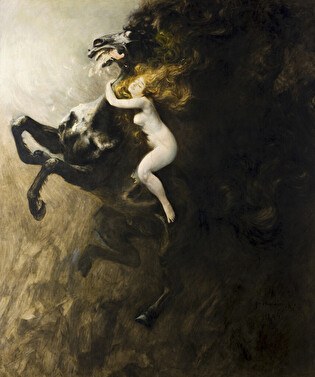
Whose frenzy is it, the horse's or the woman's? The title names a state of mind without assigning it, and Podkowiński binds the two figures so closely that the question is hard to settle. Her grip fastens her pale body to the dark, rearing horse, and the force carrying one of them upwards puts the other's balance at risk. Below them the ground is indistinct and gives little support.
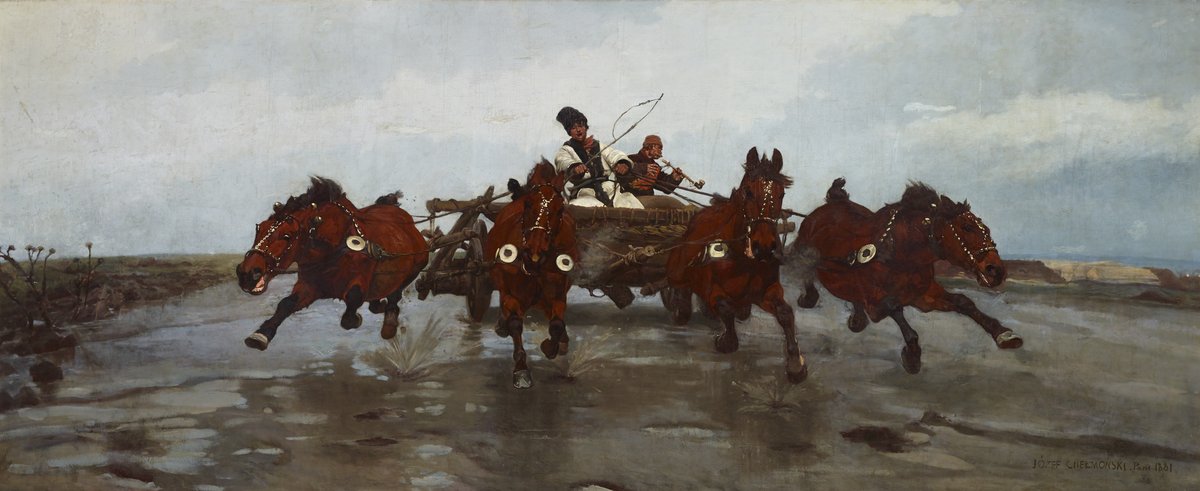
Chełmoński spreads the team across the full width of a large horizontal canvas as it comes towards the foreground, and the scale does much of the work: at this size the approach is hard to hold at a distance. Legs and bodies break up the forward drive, so the horses never settle into one compact mass.
This is the large Kraków picture. A smaller, related carriage scene belongs to the Warsaw collection.
The horses of Four-in-Hand drive forward. The people here have to win every step against resistance. Bent over and hurrying, they show the force of the weather before you even notice the lightning, and their clothes and the bundles they carry drag against them. Those bundles tie the field to work as much as to the storm.
A raised hand, presumably the prophet's, marks where the authority lies. The painting is at least as interested in the listeners, though. Their faces differ and they look in different directions, so the pronouncement does not land in one way but spreads unevenly through the gathering.
Matejko turns the aftermath of the battle into a public gathering, with banners, riders and raised gestures collecting around a mounted figure at the centre. The foreground tells the same event differently. The wounded lie there, and they and the other smaller figures complicate the victory that the main gathering presents.
Matejko painted this while the year in its title was still recent. The personification of Poland is hemmed in among soldiers and restrained figures in a cramped interior, with no distance left between those who hold power and the figure on whom it is used. An outstretched pale arm makes coercion a matter of bodies in contact.
A vessel is on its way to a seated woman and has not yet reached her. Matejko centres the picture on that exchange before it happens, and the faces around it turn an ordinary offering into something dangerous. The subject depends on who knows what. Without its title, the scene in this furnished room might pass for an act of service.
1904 · Pastel on cardboard · National Museum in Kraków
This is a design for a window. At its centre a yellow figure, presumably the god, is caught in a network of curved blue bands and smaller forms. With Copernicus's solar system named in the title beside Apollo, it is hard not to read those curves as orbits. A window is divided into separate areas, and Wyspiański keeps every boundary clear.
1905 · Pastel on cardboard · National Museum in Kraków
A mother nursing her infant is the centre of the group, and the girls around them lean their heads towards the pair. Patterned clothes and flowers fill the surface and Wyspiański's repeated curves run from figure to figure. For all that ornament, the nursing itself stays clear.
1904 · Pastel on laid paper · National Museum in Kraków
Wyspiański and his wife face out together, shoulder to shoulder, but he does not make them match. Their expressions differ, and so does their dress: red beads and a headscarf set one of the two apart. The pastel he used for window designs that year is turned here, on laid paper, on his own household.
1907 · Crayon drawing on paper · National Museum in Kraków
According to its title, this was drawn a month before Wyspiański's death. Beside the colour of the pastels it is stark. The darkest crayon marks gather around the eyes, the mouth and the loose hair, and much of the sheet is left open.
1904 · Pastel on paper · National Museum in Kraków
Mietek rests his chin on his folded hands, and the title records this unceremonious pose as plainly as the pastel does. The child's weight, settled on his arms, becomes part of the likeness. His brow is lowered, but there is nothing theatrical about it.
1904 · Pastel and tempera on canvas · National Museum in Kraków
Unlike the Apollo, this is not a design but a replica of one, worked in pastel and tempera on canvas. A tall robed figure extends through an arched field. Its pale divisions remain visible, but here blue and yellow forms sweep across them instead of keeping to their compartments.
With the palette of the title, the rest of her equipment and a pale apron, Bilińska presents herself as a working painter rather than a sitter dressed for the occasion. She faces the viewer directly, her expression composed, and the setting is kept plain: no grand studio backdrop competes with her.
Malczewski faces straight out, hands at his waist, in an elaborate white outfit and hat, with red accents breaking up the pale clothing. The costume has been chosen with evident care, and he is plainly playing a part. That puts him a long way from Bilińska in her working apron.
Ellenai's death comes from literature, and Malczewski tells it almost entirely through stillness. Heavy fabrics enclose the pale, horizontal body, and a seated man stays upright beside it in the same close room. The picture rests on the weight of the body and the short distance between the living man and the dead.
Mehoffer builds the paths, beds and dense trees into a structure of their own, so the garden is more than a setting. The seated woman is small and takes up only part of it. What leads the eye to her is the red parasol of the title, a single bright point of rest among all that cultivated planting.
Explore this selection in Artline
See the selected works alongside books and events from their period, or compare when the artists lived. The books and events provide context, not evidence of direct influence. Works without confirmed dates remain in this guide.
Matejko's onlookers
Each of Matejko's titles here names a single figure: Wernyhora, Kościuszko, Queen Bona, Poland personified. None of the paintings leaves that figure to carry the event alone. The prophet's authority is measured by people who take it in differently. At Racławice the gathering is answered by the wounded. The danger to Bona is lodged in the surrounding faces and the title rather than in anything the vessel shows. For a visitor who does not know the history, those secondary figures are often the surest guide to what is happening. The painting of Poland changes the arrangement. Nobody there stands back to watch. The people around her are soldiers and others under restraint, packed in too close to be an audience.
Further reading
Leonardo da Vinci; translated by John Francis Rigaud · Read free · English
This is Leonardo's own writing on painting, in John Francis Rigaud's English translation. It is built on close observation of movement, light and the body, which makes it a natural companion to Lady with an Ermine, where sitter and animal turn together. For the Polish works it serves mainly as a contrast, for instance with the more emphatic outlines of Wyspiański's pastels and drawings.
 Art, literature & history