 Art, literature & history
Jan Matejko
1838–1893
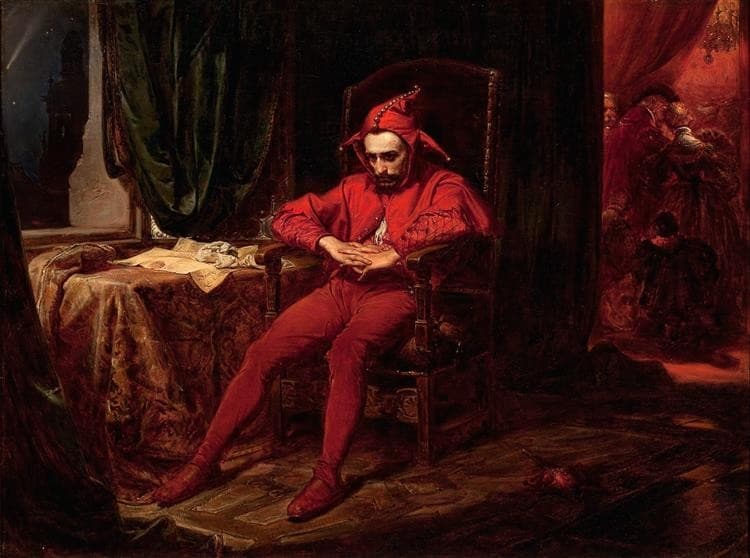
Selected artwork
Stańczyk during a Ball at the Court of Queen
1862
National Museum in Warsaw
Other names (8)
Jan Alojzy Matejko, Jana Matejki, jan matejko, Jean Aloysius Matejko, J. Mateijko, j. matejko, Johann Matejko, Matejko
Biography
Jan Alojzy Matejko (Polish pronunciation: [ˈjan aˈlɔjzɨ maˈtɛjkɔ] ; also known as Jan Mateyko; 24 June 1838 – 1 November 1893) was a Polish painter, a leading 19th-century exponent of history painting, known for depicting nodal events from Polish history. His works include large scale oil paintings such as Stańczyk (1862), Rejtan (1866), Union of Lublin (1869), Astronomer Copernicus, or Conversations with God (1873), or Battle of Grunwald (1878). He was the author of numerous portraits, a gallery of Polish monarchs in book form, and murals in St. Mary's Basilica, Kraków. He is considered by many as the most celebrated Polish painter, and sometimes as the "national painter" of Poland.
Matejko spent most of his life in Kraków. He enrolled at the Kraków Academy of Fine Arts at age fourteen, where he studied under notable artists such as Wojciech Korneli Stattler and Władysław Łuszczkiewicz and completed his first major historical painting in 1853. His early exposure to revolutions in Kraków and the military service of his brothers influenced his artistic themes. After studying art in Munich and Vienna, he returned to Kraków and set up a studio.
He gradually gained recognition, selling key paintings that settled his debts and created some of his most famous works, including Stańczyk and Skarga's Sermon. Matejko's art played a key role in promoting Polish history and national identity at a time when Poland was partitioned and lacked political autonomy.
At the same time, Matejko's painting style has been criticised as old-fashioned and overly theatrical, labeled as "antiquarian realism". His works often lost their nuanced historical significance when displayed abroad due to the audience's unfamiliarity with Polish history. Matejko's support for the Polish cause was not just through his art; he also contributed financially and materially to the January Uprising of 1863. Later, he became director of the art academy in Kraków, which was eventually renamed the Jan Matejko Academy of Fine Arts.
A number of his students became prominent artists in their own right, including Maurycy Gottlieb, Jacek Malczewski, Józef Mehoffer and Stanisław Wyspiański. He received several honors during his lifetime, including the French Légion d'honneur. Matejko was among the notable people to receive an unsolicited letter from the German philosopher Friedrich Nietzsche, as the latter tipped, in January 1889, into his psychotic breakdown while in Turin.
Wikipedia contributors. Opening excerpt, formatted for reading. CC BY-SA 4.0. Source revision.
Influenced by
- Feliks Szynalewskieditorial inference
Evidence
Wikidata assertion retained for review; its references, if supplied, have not been independently verified. Teaching is recorded separately and does not itself establish artistic influence.
- Wilhelm von Kaulbacheditorial inference
Evidence
Wikidata assertion retained for review; its references, if supplied, have not been independently verified.
- Władysław Łuszczkiewiczeditorial inference
Evidence
Wikidata assertion retained for review; its references, if supplied, have not been independently verified. Teaching is recorded separately and does not itself establish artistic influence.
- Wojciech Stattlereditorial inference
Evidence
Wikidata assertion retained for review; its references, if supplied, have not been independently verified. Teaching is recorded separately and does not itself establish artistic influence.
Later influence
- Stanisław Radziejowskieditorial inference
Evidence
Wikidata assertion retained for review; its references, if supplied, have not been independently verified. Teaching is recorded separately and does not itself establish artistic influence.
- Stanisław Grocholskieditorial inference
Evidence
Wikidata assertion retained for review; its references, if supplied, have not been independently verified. Teaching is recorded separately and does not itself establish artistic influence.
- Franciszek Bruzdowiczeditorial inference
Evidence
Wikidata assertion retained for review; its references, if supplied, have not been independently verified. Teaching is recorded separately and does not itself establish artistic influence.
- Aleksander Augustynowiczeditorial inference
Evidence
Wikidata assertion retained for review; its references, if supplied, have not been independently verified. Teaching is recorded separately and does not itself establish artistic influence.
- Maria Dulębiankaeditorial inference
Evidence
Wikidata assertion retained for review; its references, if supplied, have not been independently verified. Teaching is recorded separately and does not itself establish artistic influence.
- Stanisław Wyspiańskieditorial inference
Evidence
Wikidata assertion retained for review; its references, if supplied, have not been independently verified. Teaching is recorded separately and does not itself establish artistic influence.
- Jacek Malczewskieditorial inference
Evidence
Wikidata assertion retained for review; its references, if supplied, have not been independently verified. Teaching is recorded separately and does not itself establish artistic influence.
- Jacek Malczewskieditorial inference
Evidence
Wikidata assertion retained for review; its references, if supplied, have not been independently verified.
- Leon Wyczółkowskieditorial inference
Evidence
Wikidata assertion retained for review; its references, if supplied, have not been independently verified. Teaching is recorded separately and does not itself establish artistic influence.
- Józef Mehoffereditorial inference
Evidence
Wikidata assertion retained for review; its references, if supplied, have not been independently verified. Teaching is recorded separately and does not itself establish artistic influence.
- Maurycy Gottliebeditorial inference
Evidence
Wikidata assertion retained for review; its references, if supplied, have not been independently verified.
- Wojciech Weisseditorial inference
Evidence
Explicit secondary-source assertion; independent historical verification remains pending.
- Wojciech Weisseditorial inference
Evidence
Wikidata assertion retained for review; its references, if supplied, have not been independently verified. Teaching is recorded separately and does not itself establish artistic influence.
- Maurycy Gottliebeditorial inference
Evidence
Wikidata assertion retained for review; its references, if supplied, have not been independently verified. Teaching is recorded separately and does not itself establish artistic influence.
Artworks by year
Loading chronology…Museum / collectionAll collections
Finding recorded artworks…
Museums & collections
Documented holdings of works attributed to Jan Matejko. Check the museum’s record for current display information.
- National Museum in Kraków10 recorded works
- National Museum in Wrocław10 recorded works
- Royal Castle in Warsaw3 recorded works
- National Museum in Warsaw2 recorded works