The National Gallery on Trafalgar Square holds European paintings from the thirteenth to the early twentieth century. That range lets this selection set Van Eyck's exact detail beside Titian's colour, Caravaggio's drama and Turner's changing weather.
The twenty works chosen here run from early religious images to later portraits and landscapes, and the subjects are just as mixed: a baptism and a supper, an execution, a locomotive coming through rain, a legendary horse still under construction and another horse with almost nothing around it. Several put something important where you might not look first: a small convex mirror in Van Eyck's interior, a distorted skull at the feet of Holbein's two men, Christ glimpsed through an opening at the back of a Velázquez kitchen. Holbein and Turner each appear more than once. The closing section reads some of their pictures together, along with a few other pairings.
Artline chose these works from the National Gallery's documented holdings, and the selection is independent of the museum. Being in the collection does not mean a picture is on display, and any of these may be on loan or off view at a given time. Where the linked records qualify a date or an attribution, the qualification is kept, which is why some dates appear as approximations or ranges.
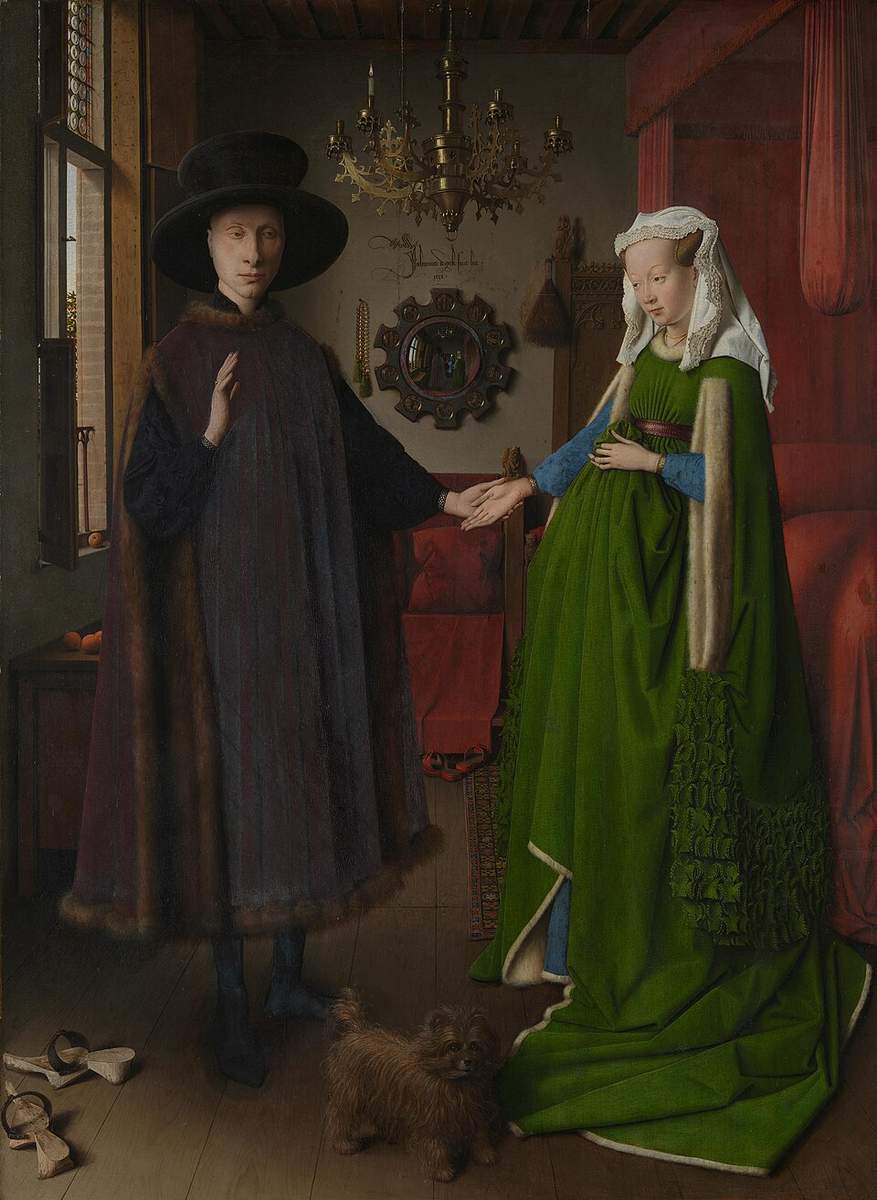
A man and a woman stand together in a room. The dog, the chandelier, the shoes and the fruit are all rendered with the same close care, and that evenness has made almost every object a candidate for symbolism. Some of the readings are better founded than others, and the uniform finish gives little help in telling which. The signature, at least, is not hidden. Jan van Eyck placed it prominently on the back wall, just above a small convex mirror that reflects figures who are otherwise out of view.
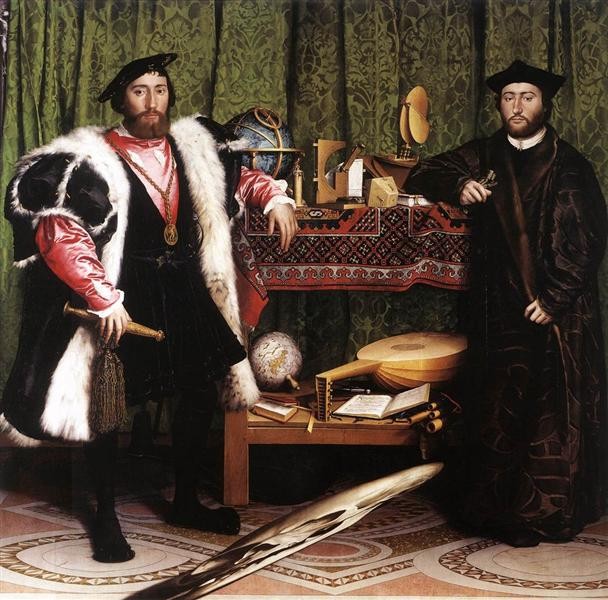
The instruments and books on the shelves are painted with complete clarity. The pale shape near the men's feet is not. It becomes a skull only when seen from an oblique angle, so Holbein's reminder of death and his display of the sitters' status and learning cannot be brought into focus from the same position.
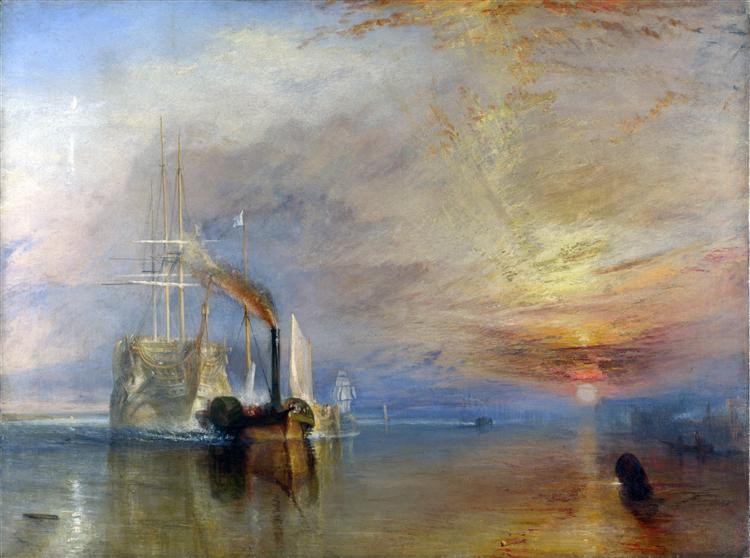
Size and substance do not match here. The large, pale sailing ship seems almost to float against the sky, while the small, dark, smoking tug is the vessel that looks solid and does the work. Turner paints them in very different light. Across the water, the sunset makes a second broad area of brightness.
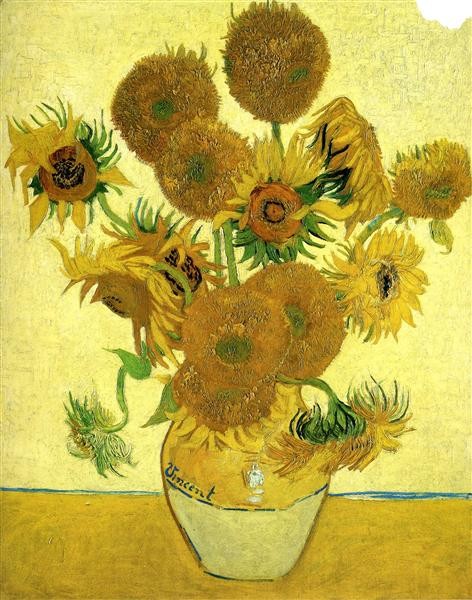
The flowers are not all at the same stage. Some heads keep their open form; others droop, or have their centres exposed. The palette is narrow, yet the yellow shifts enough across vase, background and petals to keep these states distinct, and the bunch never settles into a row of identical blooms.
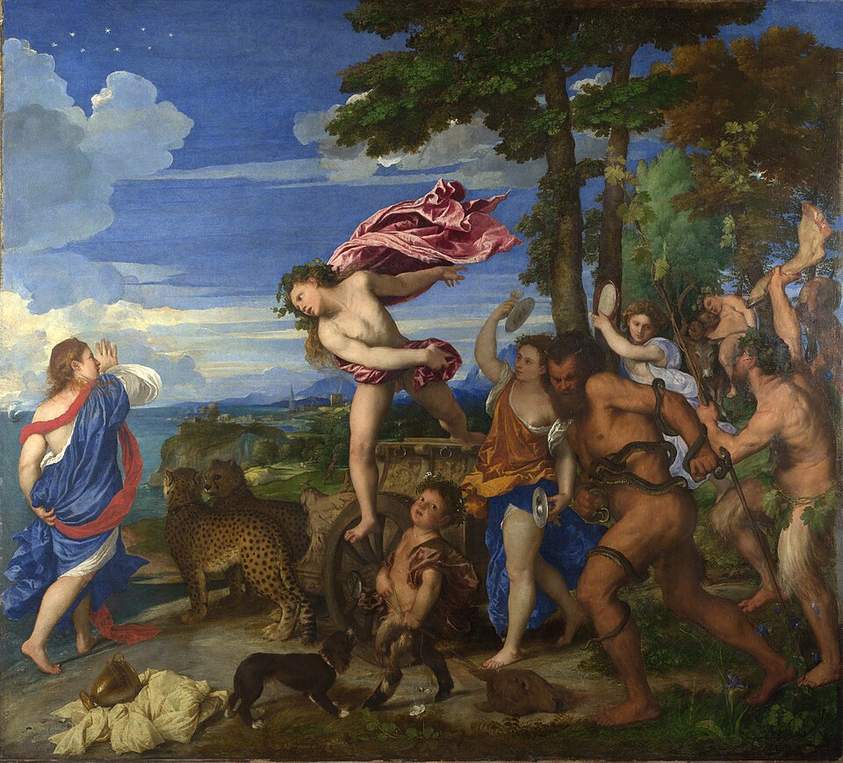
Ariadne turns between Bacchus's approach and the departing ship, as if pulled both ways. Bacchus himself has left the ground, his cloak flying out across the sky, and the gap beneath his feet holds the meeting at a single suspended instant. Elsewhere in the picture, movement runs in still other directions, so the moment does not belong to him alone.
Nothing on the table is out of the ordinary, and the food is painted as plain and solid. An outstretched arm and a basket near the table's edge push the scene out towards the viewer. What transforms the meal is the way the figures react, and it is their hands and arms that record the moment of recognition.
The wagon stands in shallow water, a working vehicle in working land. Trees close in the side of the view where the cottage stands, which makes the field beyond look more open, and light carries across from that sheltered side into the distance.
Christ stands upright beside a pale tree trunk, the two forms running parallel, and the dove spreads its wings above him. Very little in the arrangement leans or hurries. The baptism itself comes down to a small act: John pouring the water.
There is no rider and no descriptive landscape. The rearing horse is the entire subject. Against the nearly empty ground each part of the body stands out sharply, and movement runs through all of it, from the lifted forelegs and turned head to the flowing tail. Stubbs gives the animal its own presence and balance. It is not painted as anybody's mount.
Jane cannot see the block she is reaching for, and an attendant guides her towards it. Around them the scene is given over to grief and waiting, while her white dress holds the eye and keeps her vulnerability in view. Delaroche narrows a historical catastrophe to a single physical difficulty: she has to find the place where she must put her body.
The young woman has turned from the keyboard towards the viewer. Around her, the tiles, the pictures and the instrument itself make a sequence of rectangles. Against so much regularity, her slight turn is the one event in the room.
Rain and steam can be painted more or less directly. Speed has to be implied, and here it is implied by the engine's dark front coming closer through the haze. Rain and vapour blur much of the land, but not the line of the bridge, which gives the locomotive a clear direction.
Nearly all of this full-length figure is black clothing. Only the face and the joined hands are light. Holbein varies the dark fabric just enough to stop it flattening into a silhouette. There are so few other accents that the placing of those hands carries much of the portrait.
The kitchen fills the foreground with food, vessels and work. Christ appears in a smaller opening behind, and the painting does not make clear how that scene relates to the kitchen in space. Is it another room, a window or a picture? The answer matters. If it is a window or a view into another room, the teaching is taking place at the same moment as the kitchen work. If it is a picture, the teaching becomes an image rather than an event.
The armed man turns, and a child appears below his outstretched arm; between them they check his approach to the reclining woman. The title names the virtue, Respect, and invites a moral reading. Yet the restraint is not shown as a settled calm. These bodies could still move off in another direction.
The dancers hold on to one another, and their linked movement runs as one line across the clearing, carried beyond any single figure by raised arms and flying drapery. Other figures are set at different angles to the dance. For all that energy, the group still reads as a whole, which is more order than the word bacchanal might lead you to expect.
The wooden horse belongs to legend, but the people around it have a builder's problem: how to raise something much larger than themselves. Tools, ladders and poles show the work being coordinated. The deception that made the horse famous comes later in the story. Here it is still a construction job.
The danger here has no face. Much of it is carried by a bright sail leaning sharply against dark waves, while a larger vessel lies farther off. The viewpoint is low, which leaves the nearer boats little room between themselves and the water around them, and staying upright looks like an urgent problem.
The Doge's visit shows partly in what it has done to the building. Temporary hangings and pictures have been put up on the façade, so the building appears dressed for the occasion rather than in its everyday state. Against its measured order, the crowd's smaller, irregular movements stand out.
Explore this selection in Artline
See the selected works alongside books and events from their period, or compare when the artists lived. The books and events provide context, not evidence of direct influence. Works without confirmed dates remain in this guide.
Pictures to hold together
Because the reading order mixes centuries, some pairings worth making end up far apart. Holbein's two portraits work by opposite means. The Ambassadors piles up evidence of rank and learning and hides death within it, while Christina of Denmark holds back almost everything except a face and a pair of hands. Turner's pictures can be read as a running inquiry into what stays solid when weather or light dissolves everything else: a single sail in Dutch Boats in a Gale, the small tug rather than the great ship in The Fighting Temeraire, the line of a bridge in Rain, Steam, and Speed. Caravaggio and Velázquez both make room for ordinary food but put the decisive moment in different places. Caravaggio sets it at the table, in the figures' hands and arms. Velázquez moves it to the back of the kitchen, into a space whose relation to the work in front is never made clear. Titian's Bacchus and Poussin's bacchanal make another pair, because they handle movement in contrary ways. Titian holds a leap in suspension while other motions pull elsewhere; Poussin joins his dancers in a continuous line that holds together for all its energy.
Further reading
Leonardo da Vinci; translated by John Francis Rigaud · Read free · English
Leonardo's treatise, in John Francis Rigaud's English translation, deals with light, distance, gesture and observation. It offers a historical vocabulary for the problems of space and appearance that the painters here solve in very different ways, from Van Eyck's mirror to Turner's haze, though it discusses none of these pictures.
 Art, literature & history