The Metropolitan Museum of Art in New York holds works from many thousands of years of human history. The twenty pictures in this guide are all European paintings. Even within that limit they range widely. They run from Bruegel's harvesters and Clara Peeters' flowers, through Hals, Rembrandt, Poussin, El Greco and Velázquez, to Jacques-Louis David and Élisabeth Vigée Le Brun, and on to Rosa Bonheur, Manet, Degas, Monet, Seurat, Cézanne and Van Gogh.
A few subjects come up more than once. Work, and the breaks in it, links Bruegel's meal under a tree with Bonheur's horse handlers and Degas's rehearsal room. The portraits show a cardinal, a comtesse, a scientist at his table with the wife who worked beside him, and Juan de Pareja, a man then enslaved in the painter's own household. Flowers appear in a still life, in a portrait where a bouquet takes the centre, and on the surface of Monet's pond. The order is not chronological, and pictures by the same painter are not placed side by side.
Artline chose these works from the Met's documented holdings, independently of the museum. Being included here does not mean a work is on view, because any of them may be on loan or off display. Where the museum's records qualify a date or an attribution, the qualification is kept.
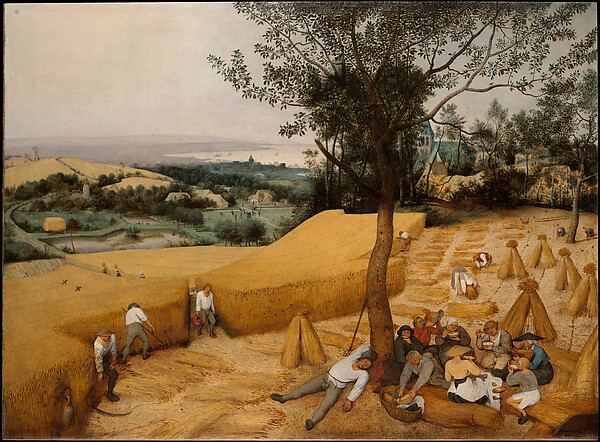
1565 · Oil on wood · The Metropolitan Museum of Art
Under a tree, some of Bruegel's harvesters have stopped for a meal. Others are still at work in the fields, and beyond them the landscape runs a long way into the distance. The panel belongs to a series showing the seasons, so this break and the labour around it are part of a larger account of the year. Bruegel finds room for a great many small incidents without letting any of them take over the scene.
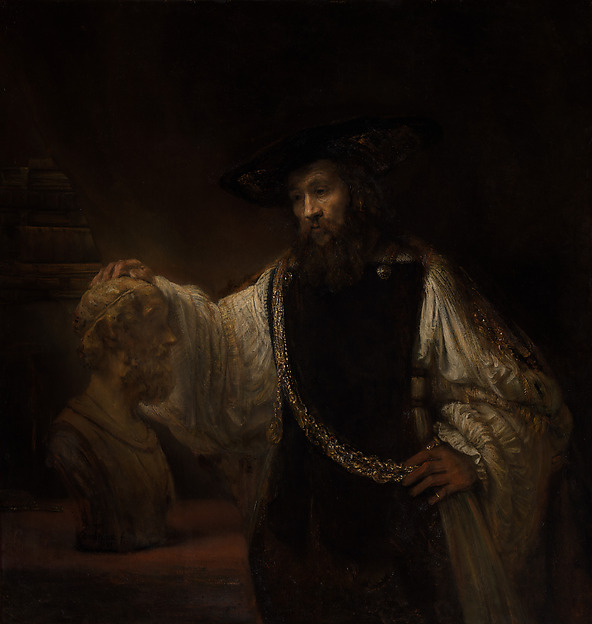
1653 · Oil on canvas · The Metropolitan Museum of Art
Aristotle rests his hand on a bust of Homer, so that a philosopher touches the sculpted head of an earlier poet. The painting does not settle what the touch means. It might be reverence or possession, or perhaps some reflection on the distance between philosophy and poetry. Rembrandt's light complicates matters further. It picks out the sleeve and the gold chain more clearly than much of the face, so that cloth and metal compete with the gesture for attention.
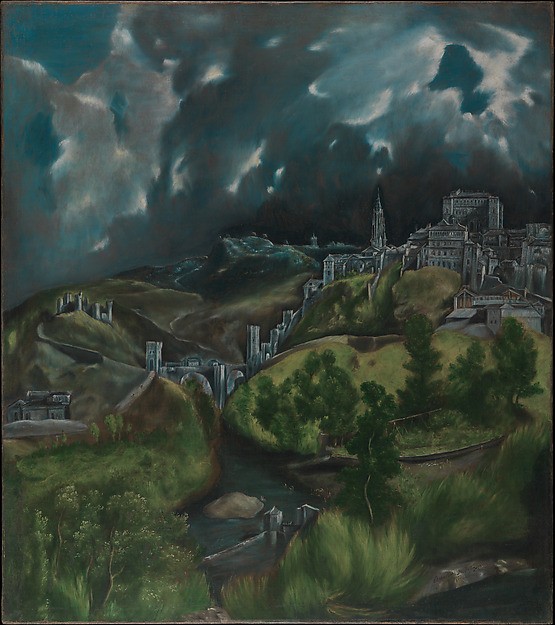
c. 1599–1600 · Oil on canvas · The Metropolitan Museum of Art
Toledo's pale buildings climb a green ridge under a sky so dark and broken that a storm could be either gathering or passing. El Greco sharpens the city's edges, and what might have been a backdrop becomes the subject. The light shifts across the view and makes the familiar outline look unstable. A bridge and walls link the separate stretches of ground.
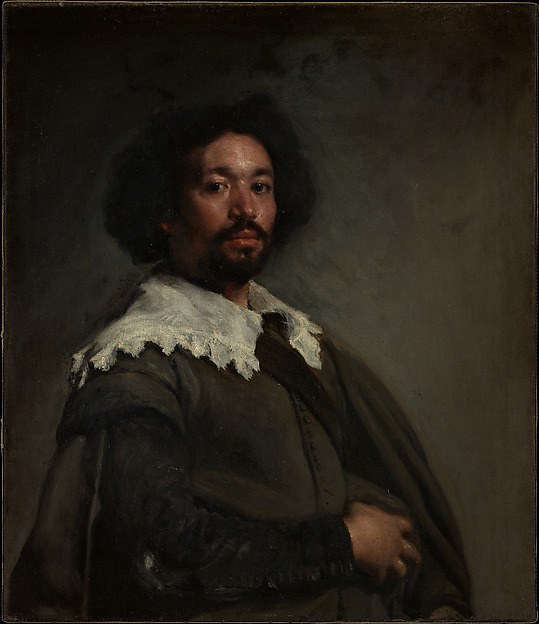
1650 · Oil on canvas · The Metropolitan Museum of Art
When Velázquez painted this portrait, Juan de Pareja was enslaved in the painter's household and studio. Pareja later gained his freedom and worked as a painter in his own right. None of this is recorded in the picture. What it does show is a face set off by a white collar against dark clothes and a plain background. He looks straight out, his arm drawn across his body, and the portrait has great firmness.
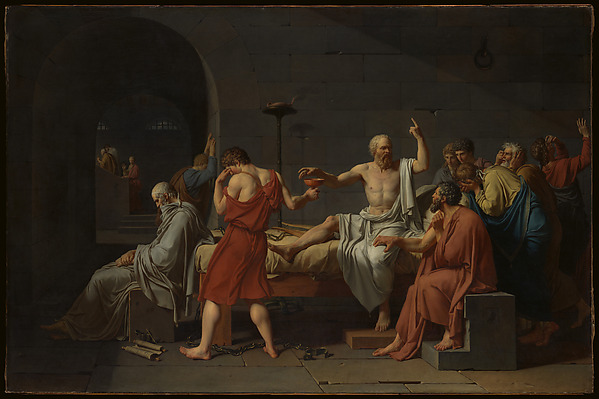
1787 · Oil on canvas · The Metropolitan Museum of Art
Socrates reaches for the cup of poison while raising his other hand. David divides him between two actions: accepting what will kill him and going on speaking. His body, at the centre, is upright and still. Around him his grieving companions bow their heads or turn away, and their distress sets off his composure.
1852–55 · Oil on canvas · The Metropolitan Museum of Art
Horses wheel and plunge across the front of the picture as their handlers haul on the reins. Each struggle within the larger circuit can be followed on its own: a head yanked to one side, a body forced to follow, another animal pressing close. White coats stand out from the darker horses and the trees behind. Bonheur's composition is orderly enough to read, but it keeps hold of the animals' weight and force, and of the effort it takes to manage them.
1874 · Oil on canvas · The Metropolitan Museum of Art
A rehearsal is under way, and the dancers are not all doing the same thing. Some wait, and others stretch or adjust their clothes. The floorboards lead the eye past them to the crowded back of the room, where more figures gather. Degas paints the pauses and preparations that are part of a dancer's work but usually happen out of public view.
1889 · Oil on canvas · The Metropolitan Museum of Art
Curving brushstrokes run through the wheat, the hills and the rounded clouds. Each area keeps its own colour, but the same rhythm passes through all of them, so the marks that describe the field are visibly related to those that describe the sky. The dark cypress rises among them as an upright interruption, and its stillness makes the movement around it easier to gauge.
1890–92 · Oil on canvas · The Metropolitan Museum of Art
Three players sit around a table, watched by two other figures. Their heads are lowered and their arms bent inward, and they keep their attention within the group. Cézanne builds each body as a solid, separate form, and none of them looks likely to move.
1867 · Oil on canvas · The Metropolitan Museum of Art
Monet lays the picture out in broad horizontal bands of flowers, terrace, water and sky, and lets flagpoles cut upright across them. Seated figures look out to sea, and a pair stands at the terrace rail. The effect is bright and decorative but firmly structured. The garden in front is neatly measured, and beyond the terrace the sea stretches away.
1874 · Oil on canvas · The Metropolitan Museum of Art
Behind the man in white and the woman in blue, water fills almost the whole picture. There is no distant shore and no horizon to anchor the view. The boat comes unusually close and the cropping is tight. The hull's diagonal cuts across broad, flat areas of colour without leading the eye anywhere beyond them. Manet shows the outing already under way and gives no landscape to contemplate.
1887–88 · Oil on canvas · The Metropolitan Museum of Art
The dark heads of spectators form a band along the bottom of the picture, beneath the musicians and a row of lights. Seurat keeps these levels sharply apart, and the upright figures and lamps repeat across the composition with a geometric regularity. The central player stands out slightly, but the scene as a whole is still and oddly remote. These are strange qualities for a subject associated with noise and movement.
1788 · Oil on canvas · The Metropolitan Museum of Art
Marie Anne Lavoisier stands beside her seated husband, Antoine Laurent. Her pale dress rises above the red table covering and the glass apparatus spread in front of him. The instruments matter. Marie Anne recorded experiments, drew illustrations for scientific publications and worked alongside her husband. Together with the couple's linked poses, the apparatus points to a field of work they shared.
1865 · Oil on canvas · The Metropolitan Museum of Art
The bouquet takes the centre, the place a portrait would usually give its sitter. The woman is pushed to the right edge, resting a hand near her face and looking away. She has been tentatively identified as Madame Paul Valpinçon, and the question mark in the title keeps that identification open.
1899 · Oil on canvas · The Metropolitan Museum of Art
The bridge arches over water crowded with lilies and reflected greenery. Behind it, dense vegetation shuts off the distance and leaves almost no open sky. Leaves float near the picture surface while reflections seem to sink into the water, and colour alone does not always tell the plants from their reflections. The bridge is the clearest structure in a space that otherwise closes in.
c. 1615 · Oil on canvas · The Metropolitan Museum of Art
Faces, hands, food and bright costumes crowd towards the front. Mouths are open, gestures overlap, and several figures seem to be addressing someone outside the frame, perhaps the viewer. Hals packs the revellers so tightly that there is no comfortable distance from which to survey them, and their separate conversations tangle together.
1658 · Oil on canvas · The Metropolitan Museum of Art
The blind giant Orion strides forward in search of the rising sun, with a much smaller figure riding on his shoulder. Poussin leaves no doubt about the difference in scale. Even so, the giant belongs to the same continuous landscape as everything around him, moving through trees and clouds while ordinary human figures go about below.
c. 1600 · Oil on canvas · The Metropolitan Museum of Art
Red silk spreads across the seated cardinal's body and over the chair. The angular furniture and tiled floor set up a firmer geometry around him. Within this display of ecclesiastical office, El Greco paints the face small and sharp. The spectacles catch the light, the gaze is direct, and the hands break into the flow of the silk.
c. 1612 · Oil on wood · The Metropolitan Museum of Art
The bouquet stands upright in its dark vase, but Peeters extends the still life down onto the ledge. There, fallen blossoms, shells and other small objects make a second area of close detail. Beside the flowers still in the arrangement, the loose blossoms show how easily something so carefully assembled could come apart.
1789 · Oil on canvas · The Metropolitan Museum of Art
The comtesse holds an open book and turns as though she has just looked up from it. Vigée Le Brun builds this passing moment into a formal portrait. The dark hat and ribbon frame the pale face and dress, and her bearing is poised and elegant. The sitter held this position for a long time, yet it is made to look like an interruption, and that fiction gives the portrait its liveliness.
Explore this selection in Artline
See the selected works alongside books and events from their period, or compare when the artists lived. The books and events provide context, not evidence of direct influence. Works without confirmed dates remain in this guide.
Painters who recur
El Greco, David, Degas and Monet each recur in this selection, and it is worth comparing each painter's pictures. El Greco brings the same sharpness to very different material: the edges of Toledo's buildings under a broken sky, and the cardinal's small, precise face set among his red silk. David turns from an ancient philosopher facing death among his companions to a scientist and his wife among their glass instruments. In both of his pictures, Degas moves the expected subject aside. We see the dancers in rehearsal, and the sitter gives up the centre to a bouquet. Monet's pictures make the sharpest contrast. At Sainte-Adresse the view opens over the terrace rail to sea and sky, while over the lily pond the vegetation crowds in and the sky has almost gone.
Further reading
Walter Liedtke · Read online or download · English
Walter Liedtke's two-volume catalogue has detailed entries on the Met's Dutch paintings. Of the artists in this guide, it covers Rembrandt and Hals. Both volumes can be read online or downloaded from the museum.
 Art, literature & history