Twenty works from the Hamburger Kunsthalle's collection, from Master Francke and Dürer through Friedrich and German Romanticism to Liebermann, Beckmann, Magritte and Baumeister.
The Hamburger Kunsthalle is one of Germany's major art museums, and its collection spans several centuries. German Romantic painting is a particular strength, and Caspar David Friedrich is the reason many people visit.
This selection of twenty works sets Friedrich's Wanderer above the Sea of Fog among pictures by Johan Christian Dahl, Carl Blechen and Jacob Gensler. Dahl contributes a southern view over the Bay of Naples and a rough northern woodland, Blechen a palm house, and Gensler Hamburg itself after the fire. Further back are a panel by Master Francke and a drawing by Dürer. Manet, Rousseau, Beckmann, Magritte, Paula Modersohn-Becker and Willi Baumeister carry the selection into modern art. Max Liebermann appears more often than anyone else, and his paintings are considered together at the end.
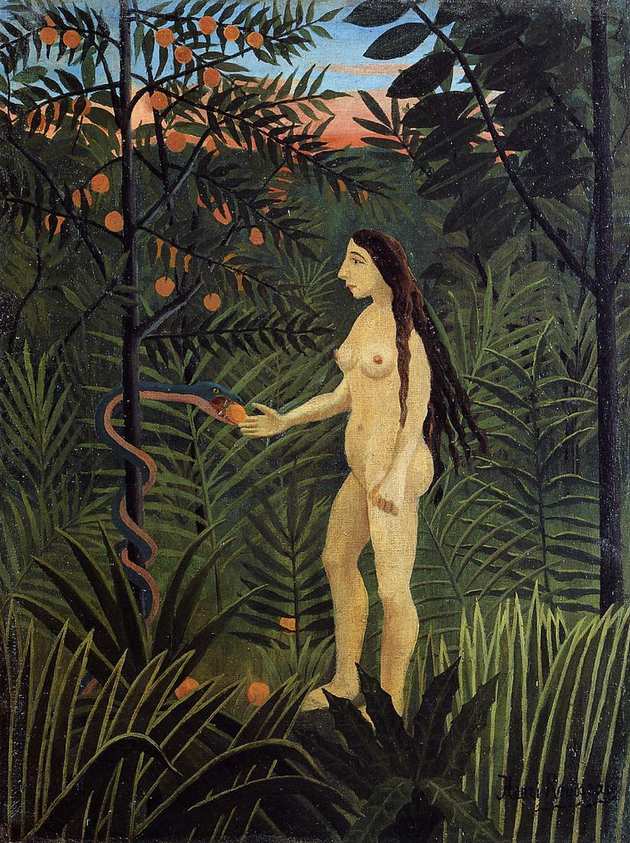
Some subjects reach across the centuries. Biblical stories turn up in very different hands, from Francke's Adoration to Liebermann's boy Jesus among the elders and Rousseau's Eve with the serpent. Other pictures are best read in pairs: Dahl's south against his north, Beckmann's beach against his circus, Modersohn-Becker's mother and child beside her old peasant woman. Magritte stands apart. What makes him difficult is not a story but the labels he paints.
The works were chosen from the Hamburger Kunsthalle's collection, independently of the museum. Dates and attributions keep the qualifications recorded for each work, including approximate dates and date ranges.
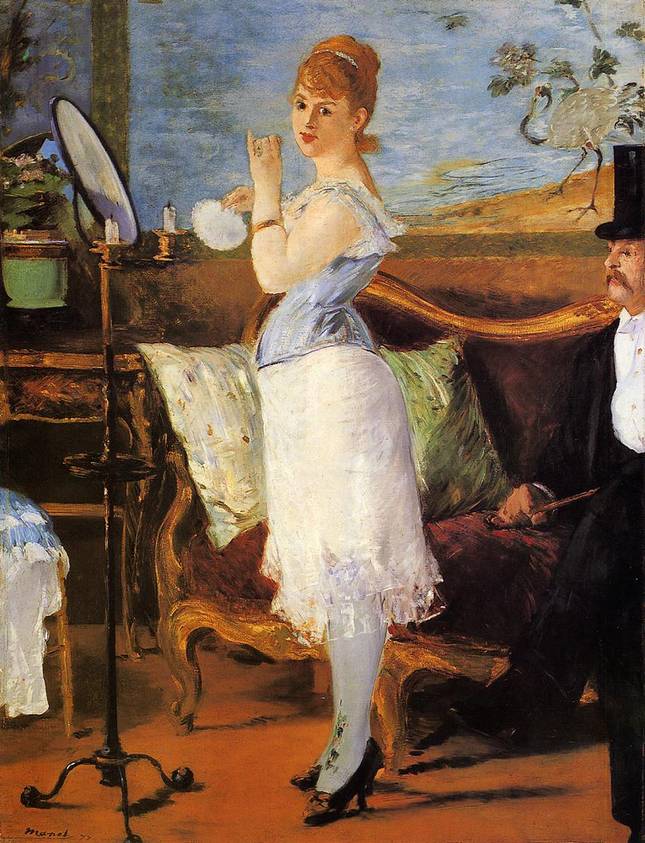
Nana has turned from her mirror to look out of the picture, as if something has interrupted her. A second figure is only partly in view at the edge of the room, and Manet does not say what, if anything, passes between them. Whatever has caught her attention lies outside the scene, possibly on our side of the frame.
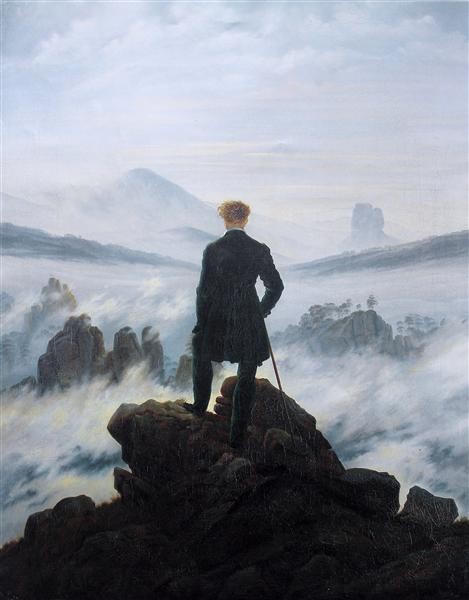
A man stands firmly on high ground with his back to us, above mist that has swallowed much of the land below. With so much of the terrain hidden, distances are hard to judge, and with his face turned away there is no expression to tell us what he makes of the view. Friedrich withholds both. That may account for much of the picture's hold: with no face to read, it is easy to stand where he stands.
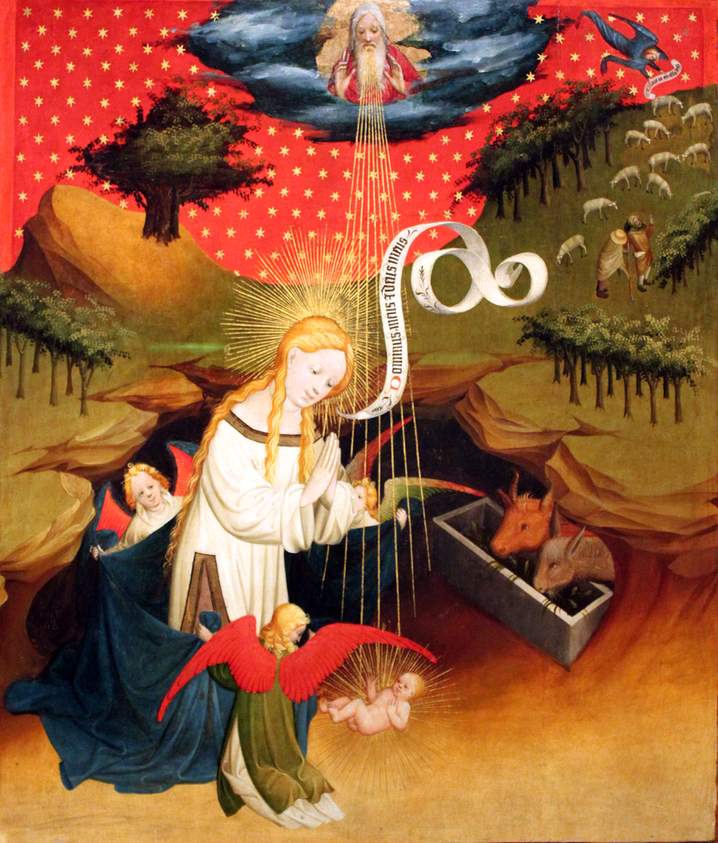
The earliest work in the selection is a tempera panel on oak, dense with colour and pattern. For all that richness, the newborn child and the group at the centre take up surprisingly little of the surface. They hold their place because everything else is arranged around them, and the kneeling figures, in effect acting out the adoration of the title, keep turning attention back to the child.
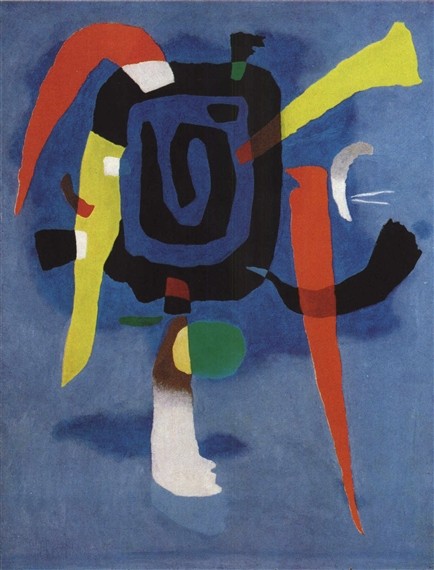
The latest work in the selection is painted in oil on cardboard. Darker forms cluster in the middle of a blue ground, and bright extensions reach out from them in several directions. It is easy to start seeing a figure, and Baumeister allows the reading without confirming it, since not every part answers to a piece of anatomy. What he does make definite is weight and direction: the dark centre holds against the pull of its brighter arms.
c.1906 - 1907 · Oil on canvas · Hamburger Kunsthalle
Leaves and fruit close in around Eve and the serpent, standing up like a screen rather than receding into a garden. Rousseau paints each plant separately, so the repeated leaves and fruit keep their own shapes instead of merging into foliage, and there is little depth to push anything back. The vegetation ends up as prominent as the figures, which matters for this subject. In a picture of Eve and the serpent, the fruit is hard to dismiss as decoration.
Words are painted on the canvas as though they were labels, but the shapes beside them do not obviously show what the words name. A label usually settles what we are looking at; these point somewhere without reliably identifying anything. Elsewhere in this selection a title does that settling work, telling us, for instance, that Liebermann's girls in the garden are Amsterdam orphans. The title Swift Hope gives no help of that kind.
Matching dresses and aprons, an institution's uniform, mark the girls out as a group, and Liebermann keeps them together in the garden. Yet each is absorbed in her own piece of work. The birds on the ground around them move more freely.
This work is shared too, but Liebermann does not gather the workers together as he did the orphan girls. They are spread across open ground: a standing figure in the foreground sets the scale, and the others take up different positions, each on a different part of the task. What connects them is the nets themselves, which link one worker to the next.
Travellers among rocks and trees in the foreground give a measure for what lies beyond, where the Bay of Naples opens out. Dahl does not paint near and far in equal detail. Far off, smoke rising from the volcano brings movement into the broad view.
Heavy dark outlines run round sails, hulls and people alike, so the bodies carry no more weight than the boats. The beach does not open into depth. Beckmann compresses it into wedges and curves set against strong areas of sand and water, and the figures have to fit into whatever gaps the boats leave.
The white coat is all Liebermann needs to show that Ferdinand Sauerbruch is a surgeon. No operation is under way and no instrument is in sight. Coat and surroundings are both kept pale, and against them the turn of his head keeps attention on the man himself.
Tables, chairs and tree trunks repeat along the terrace as it recedes beside the river, a regular framework that Liebermann loosens with patches of light and shade scattered across it. Within that order, the visitors sit in separate groups, each with room to itself.
Dürer draws only the child's head, with no other figures and no story. The eyes are closed and the lips slightly parted. It could be sleep or something briefer, and nothing in the drawing settles which. One kind of mark serves for the curling hair and another for the smooth planes of the face, and the marks stay visible as marks even as they build the form.
Gensler's view of Hamburg dates from the year of the fire, and it shows the city partly through what the fire took away. Surviving masonry and scattered remains fill the foreground, and small figures among the debris show how much ground has been laid bare. The destruction also opened a view across the water to what could now be seen beyond. Gensler makes use of it, so that the picture rests, a little uncomfortably, on a prospect the loss itself created.
Among the landscapes and city views around Friedrich, this is the one picture set indoors, with its nature kept under glass. Blechen lets neither the palms nor the building win. The palms dwarf the people beneath them and spread their leaves across the framework of the glazing, yet the foliage is never allowed to hide how the building is made.
Of Liebermann's paintings here, this is the only one with a biblical subject, and he treats the episode as an exchange between speaking and listening. The boy talks to a close group of elders whose age, books and clothing suggest established authority. Where they are placed, and how they respond, makes the reversal plain: the boy has the floor, and age and learning listen.
Modersohn-Becker paints mother and child as continuous forms, the larger body enclosing the smaller, with broad areas of colour building up the mass. The faces carry so little detail that neither has a sentimental expression. The subject is carried instead by the physical act of holding, one body taking the weight of another. Beside the dense colour and pattern of Master Francke's Adoration, this picture keeps almost nothing but that act.
Rough ground, fallen timber and tangled woodland fill the foreground, with a bright distance beyond. Dahl does not clear a path into the view for the sake of a pleasing prospect. The fallen trees and uneven ground stay where they are, their textures standing out against the light. In the view over the Bay of Naples, painted a year earlier, the foreground gave a measure for the distance. Here it is in the way.
She rests her head on one hand, the other arm crossed over her body, in a pose that could mean rest or weariness. As in Mother and Child, Modersohn-Becker simplifies the forms without making them slight. The clothing is kept dark, which leaves the hands and face to carry the picture, and they are painted plainly, without idealising.
The narrow format is crammed with hoops, performing sea lions and the coloured structures of the circus. As in Boats on the Beach, heavy contours keep each element distinct, but here there is almost no empty space between them. The performers have very little room to perform in.
Explore this selection in Artline
See the selected works alongside books and events from their period, or compare when the artists lived. The books and events provide context, not evidence of direct influence. Works without confirmed dates remain in this guide.
Following Liebermann
Taken in order of date, Liebermann's paintings here form a small sequence of their own: the young Jesus in the Temple, the orphan girls in the garden, the net menders, the hotel terrace and, last, the portrait of Sauerbruch. The subjects move from scripture through labour to leisure, and the company loosens as they go, roughly speaking. The elders press close round the boy, and the uniformed girls are kept together. The menders are scattered and joined only by what they are mending, and the visitors on the terrace sit apart in their own groups. Then the company goes altogether. Sauerbruch has no one beside him and next to no setting, and work returns to the sequence only as a sign, in his white coat.
Further reading
Wassily Kandinsky; translated by Michael Sadleir · Read free · English
Kandinsky's treatise, in Michael Sadleir's English translation, sets out a painter's own argument about colour, form and the spiritual in art. It is one artist's case, and good company for the abstract and expressionist pictures in this selection.
 Art, literature & history