The Basil and Elise Goulandris Foundation in Athens houses a private collection that the two collectors built up over decades. It follows their taste and makes no attempt to cover every school or movement equally. European modernists share it with Greek painters working at roughly the same time, so Cézanne, Van Gogh and Picasso keep company with Parthenis, Hadjikyriakos-Ghika and Moralis. Many of the European names will be familiar, but here they are seen in different company.
The twenty works chosen here run from Cézanne's landscape at Auvers, the earliest, to Hadjikyriakos-Ghika's balcony, the latest. On the way they take in Monet's pink cathedral front, Kandinsky's striped forms and Hundertwasser's crowded field of heads. Van Gogh, Derain and Fautrier each appear twice, so you can watch one painter take on very different subjects: a coffee pot and an olive grove, a near-empty Italian square and a nude among foliage, a glass of water and a hostage's head.
Artline chose these works from the Foundation's documented holdings, independently of the Foundation. Being in the collection does not mean a work is on view. Dates and attributions keep the qualifications given in the linked records.
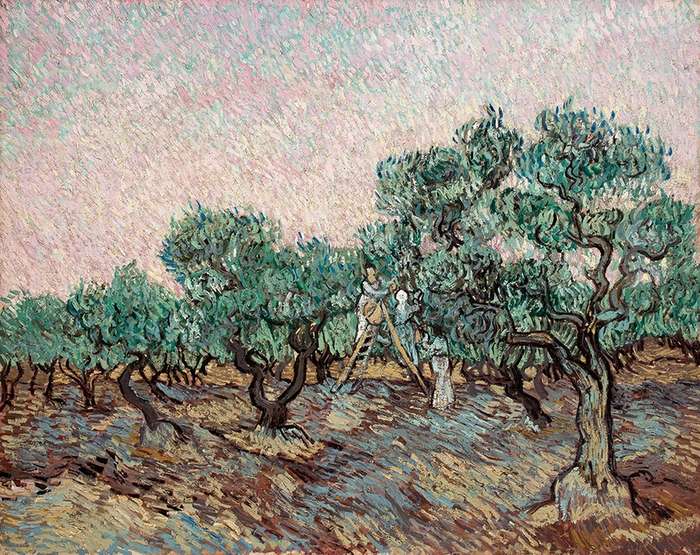
December 1889 · Oil on canvas · Basil & Elise Goulandris Foundation
Van Gogh kept returning to olive groves at this time, trying out different ways of catching their shapes and colours. There are workers among the trees here, but the twisting trunks and the changing light take up far more of the canvas than the picking does. Short, lively strokes keep the whole grove moving, even where the figures stand still.
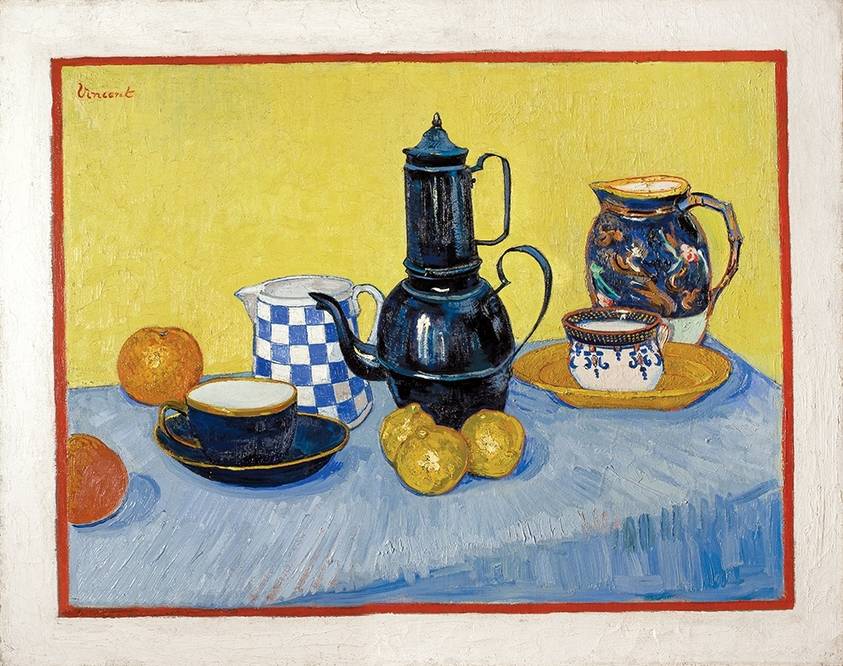
May 1888 · Oil on canvas · Basil & Elise Goulandris Foundation
The olive grove is all movement. This is a picture of things standing still. The blue coffee pot holds firm against yellow, and the smaller objects around it bring in their own patterns and contours. Van Gogh treats these ordinary vessels as material for a colour arrangement without letting any of them lose its identity. The cup's outline and shadow are strong enough to count as shapes on the painted surface, and it is still, unmistakably, a cup.
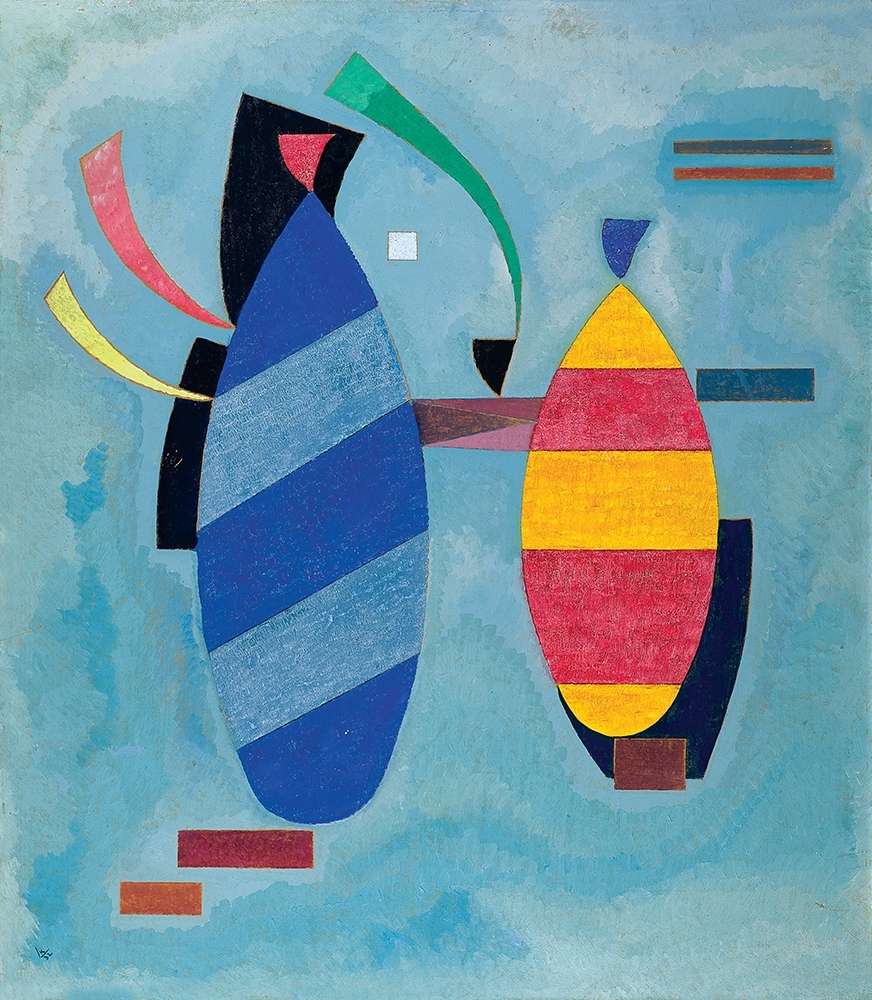
1932 · Oil and gouache on board · Basil & Elise Goulandris Foundation
The title is almost deadpan, naming the one thing the two large forms have in common. Both are striped, but the bands differ in direction and scale, so they relate the pair without making them twins. Smaller arcs and rectangles fill the space around them. The way the two are placed hints at some kind of exchange, and it is tempting to give them a story. There are no characters here, though, and no event to illustrate.
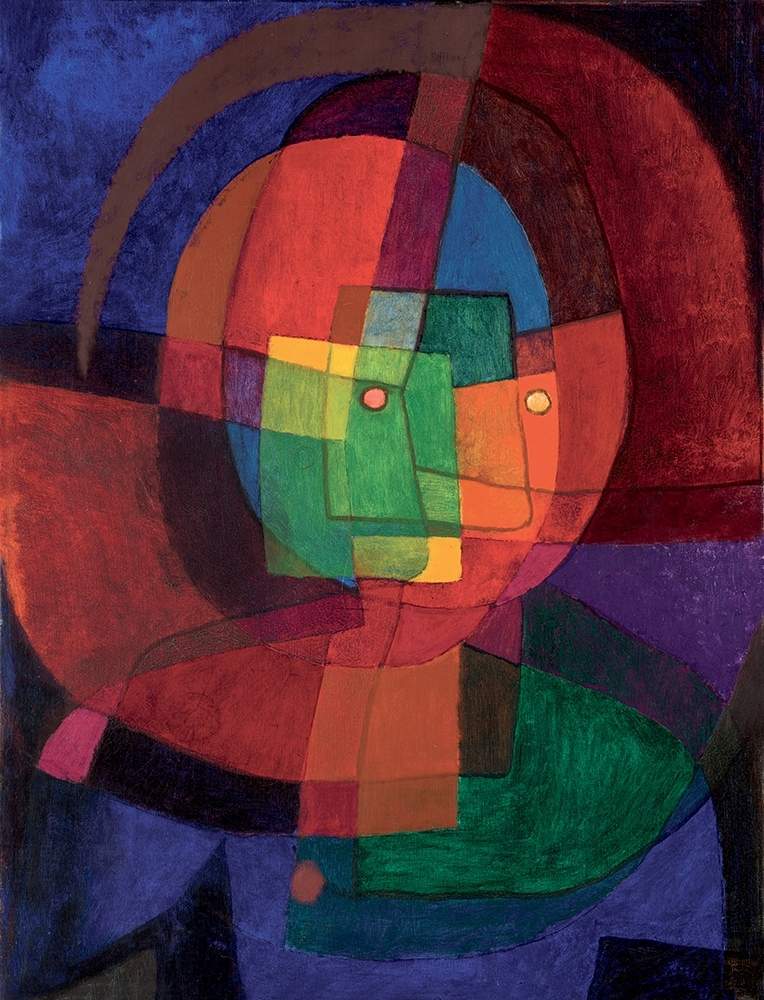
1934 · Oil on canvas · Basil & Elise Goulandris Foundation
Klee's arrangement is too ordered to be a random scatter of patches, but it never settles into a conventional likeness. Everything hangs on the pale circles. Read them as eyes and a face assembles itself out of the overlapping bands of colour, though even then the bands stay visibly separate shapes and never melt into features.
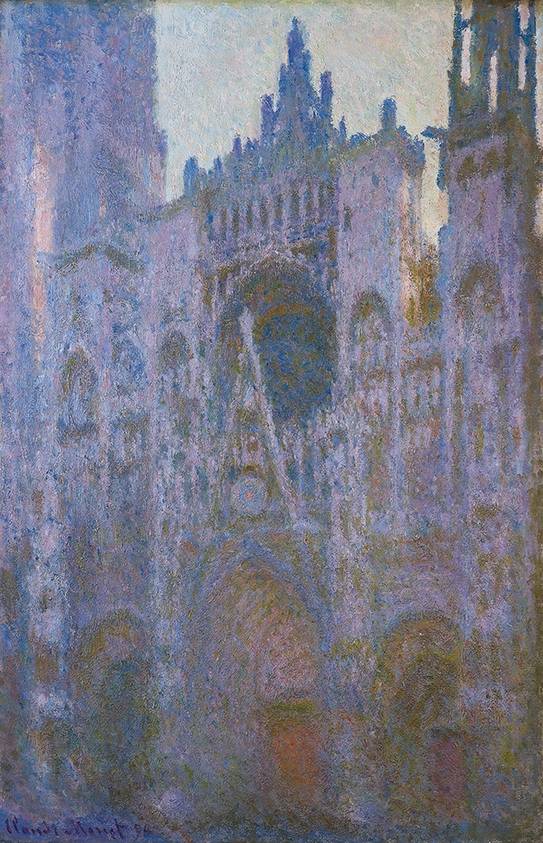
1894 · Oil on canvas · Basil & Elise Goulandris Foundation
Monet's title ends with a colour, not with the building. The façade is made of pink and violet marks broken by dark openings, and the stone is hard to separate from the morning light falling on it. A cathedral front is about as fixed a subject as a painter could choose, and it is that fixity which lets slight shifts of colour become the main event.
1926 · Oil on canvas · Basil & Elise Goulandris Foundation
Thin lines and small coloured forms spread across a yellow ground, interrupted by a darker shape lower down. Would anyone find a grasshopper here without the title? Probably not. Miró's sparse signs never add up to a clear body, though they are enough to suggest something alive.
1947 · Oil on hardboard · Basil & Elise Goulandris Foundation
Fragments and pool-like shapes are scattered across a textured brown field, and nothing settles their scale. The surface can look close and material, like heaped-up matter you could touch, and then the same forms open out into a wide stretch of terrain. A blue area near the bottom is handled differently from the rest. Stamos shows no identifiable place, but the word "archaic" in the title invites you to read the fragments as though they carried some distant history.
1954 · Oil on canvas · Basil & Elise Goulandris Foundation
The balcony is only a starting point. Hadjikyriakos-Ghika rearranges it freely, fitting bands, grids and curved forms together without keeping to a single viewpoint, and tucking small decorative details inside the larger divisions. This is no architectural record. What survives of the architecture is its structure, held together by repetition and by planes that lock into one another.
c. 1914 · Pencil and gouache on paper laid down on canvas · Basil & Elise Goulandris Foundation
A caryatid is a carved female figure that takes the place of a column: a body doing the work of architecture. Modigliani's is not carved at all. It is drawn and painted, in pencil and gouache on paper. His kneeling woman raises her arms as though bearing a load, although no building rests on her, and her joints are simplified into broad curves that give the compact body an architectural weight of its own.
1881-1882 · Oil on canvas · Basil & Elise Goulandris Foundation
Tall trees frame a road leading back towards houses on rising ground, which is a familiar enough way into a landscape. What is less familiar is how the land is built. Cézanne makes it from adjoining patches of green and ochre instead of smooth gradations, and the repeated strokes stay visible on the surface. The road and slopes supply the depth. The ground feels solid as much because of the way each patch of colour meets and holds against the next.
c. 1926-1930 · Oil on canvas · Basil & Elise Goulandris Foundation
The bending figure takes a little while to find. Patterned tiles, bathroom fixtures and fabrics compete with it, and so much of the room is intensely coloured that the body has no neutral ground to stand out against. Bonnard leaves it half caught up in the decorated surfaces around it, as though the bathroom might absorb the person in it.
1947 · Mixed media on paper laid down on canvas · Basil & Elise Goulandris Foundation
Glass and water are about as transparent a subject as a still life can offer, and Fautrier gives them a rough, heavily worked surface. The glass is easy enough to identify, its outline held by thin ridges and thicker matter, but nothing in the surface imitates transparency. The worked material is as physically present as the vessel it depicts.
1930 · Oil on canvas · Basil & Elise Goulandris Foundation
Long pale bodies are barely separated from the pale field around them. Parthenis gives them no setting and little sense of flesh, and the run of their curved outlines connects them more than any anatomy does. The allegorical title points away from narrative action towards a looser idea of accord or balance. Who or what the figures stand for, the picture does not say.
1944 · Mixed media on paper laid down on canvas · Basil & Elise Goulandris Foundation
A pale oval and a few marked features give just enough to hold a face against the rough ground. The number in the title points to a series, and the word "hostage" means the reduction cannot be treated as merely formal. Fautrier brings the human subject close to the point where it would stop being recognisable, and he does it without any descriptive scene of violence. In its place there is damaged-looking matter, and a face on the edge of disappearing.
c. 1930 · Oil on canvas · Basil & Elise Goulandris Foundation
The rearing horses supply the only sudden movement in an otherwise strangely still arrangement of beach and architectural fragments. De Chirico paints each element clearly, but he offers no ordinary reason why they should share this precisely depicted place.
1936 · Gouache on board laid down on canvas · Basil & Elise Goulandris Foundation
Not much happens in this broad square, and its near-emptiness gives proportion and spacing unusual weight: the intervals between sharp-edged façades, the small clouds floating in a large expanse of sky.
1937 · Oil on panel · Basil & Elise Goulandris Foundation
The chair, the floor and the cast shadow behave as they would in any room. The upright figure beside them does not, because it combines bodily and object-like parts in a way no anatomy allows. The believable interior is what makes this impossible figure seem to occupy real space, and the very ordinariness of the room sharpens the contradiction.
1919 · Oil on canvas · Basil & Elise Goulandris Foundation
Tubes, discs and bands suggest machinery, and the picture is as lucid as a diagram. The parts will not assemble into a working mechanism, though, and there is no telling how this machine would run. Léger gives forms associated with practical use another job, as curves, overlaps and contrasts in a composition.
June-August 1952 · Oil on hard fibre board primed with chalk, zinc white and fish glue, with photo affixed and lilac watercolour · Basil & Elise Goulandris Foundation
Faces gather across the red field, many of them set in smaller coloured compartments. They vary so much in size, and some larger eyes confuse matters further, that anyone trying to check the ninety-nine of the title will soon lose count. Each head stays distinct, but together they spread across the surface like a pattern, with no hierarchy and no consistent scale. Not all of it is oil paint, either. There is lilac watercolour and an affixed photograph, and the hard fibre board underneath was primed with chalk, zinc white and fish glue.
c. 1948-1950 · Oil on canvas laid down on cradled panel · Basil & Elise Goulandris Foundation
Derain's Italian Town depends on sharp edges. Here the edges give way. A pale torso stands out from dark foliage and rough, curving marks, but the body is painted with something of the same handling as the vegetation. The seated pose and outstretched arm give it real weight as a figure, though it lacks the clear boundaries of a studio nude. Like Bonnard's bather among the tiles and fabrics, it is only partly separated from its surroundings.
Explore this selection in Artline
See the selected works alongside books and events from their period, or compare when the artists lived. The books and events provide context, not evidence of direct influence. Works without confirmed dates remain in this guide.
Objects, titles and abstract forms
Seen together, these pictures differ most in how far they let their subjects be named. Van Gogh's vessels stay vessels however hard they work as colour, while Kandinsky's forms need no names at all. Between those two extremes, titles do much of the identifying. Miró's insect, Modigliani's woman as support and the long past of Stamos's fragments all depend on what the title tells you. Sometimes the title is the more precise of the two: Hadjikyriakos-Ghika specifies even the direction of his pilasters, while the painting handles the balcony with great freedom. Fautrier's pair puts the point most sharply. The two works share a medium and a rough, worked surface, but one is called a glass with water and the other a hostage, and the same kind of matter reads quite differently under each name.
Further reading
Wassily Kandinsky; translated by Michael Sadleir · Read free · English
This is Kandinsky's own argument, in Michael Sadleir's English translation, that colour and form can work without representing visible objects. It is a painter's theory in his own words, not a historical survey, and it belongs naturally beside Both Striped. Its claims can also be tested against Klee's head, Léger's machine parts and the heavy matter of Fautrier's surfaces.
 Art, literature & history