The Galleria Borghese grew out of the collecting of Cardinal Scipione Borghese, and its rooms still convey something of the collection's aristocratic origins. Every work chosen here was made for or collected by wealthy patrons. The gallery is best known for Bernini's sculpture, but its paintings by Caravaggio, Raphael, Titian and others are just as good a reason to visit.
This selection leans towards the paintings. Bernini's Abduction of Proserpina is the only sculpture, though Bernini returns twice as a painter, in a pair of self-portraits. Caravaggio has more pictures here than anyone else, from the earlier Boy with a Basket of Fruit and Sick Bacchus to the later, pared-down Saint John the Baptist. Raphael's Deposition and Titian's so-called Sacred and Profane Love sit within a wider cast that includes Lavinia Fontana, Jacopo Zucchi and Dirck van Baburen. Several pictures make natural pairs: Bronzino's Baptist and Caravaggio's, the round devotional panels of Lorenzo di Credi and Fra Bartolomeo, and Baburen's crowded arrest beside Gerard van Honthorst's equally crowded concert.
The works were chosen independently of the museum from documented Galleria Borghese holdings, and dates and attributions keep the qualifications found in the collection records. A work being in the collection does not mean it is on show, as any of them may be on loan or off display. The entries do not follow a route through the rooms.
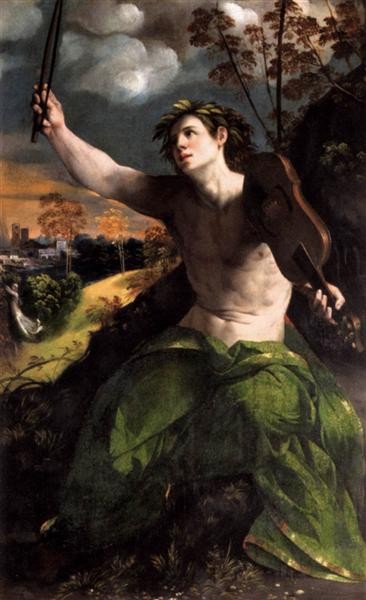
Dosso Dossi brings Apollo and his instrument close to the front of the picture and leaves the story of Daphne to play out farther back, in the landscape. For a myth of desire and flight, it is a curious arrangement. The pursuer has the foreground to himself, along with his music, while the chase is pushed into the distance. The picture may be less about the pursuit than about Apollo the musician, with his story attached behind him.
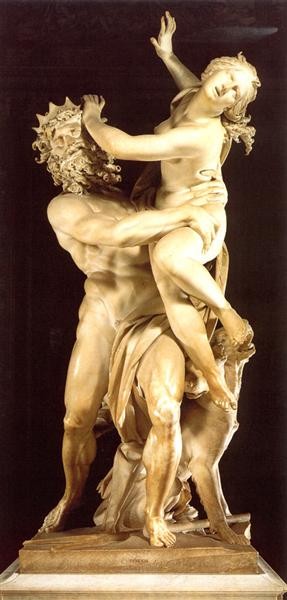
Pluto grips Proserpina and lifts her. She twists against him, one hand pushing at his face. Bernini holds both forces within a single marble group, and under Pluto's fingers her thigh seems to give, as though the stone were flesh being pressed. The carving is astonishingly skilful, and it is worth being clear about what it renders so convincingly: an abductor's grip on a body that is fighting him.
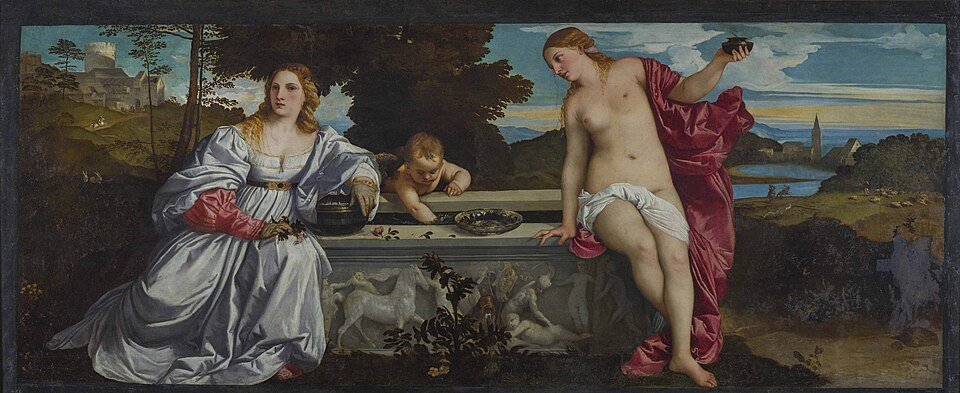
Two women with strikingly similar faces appear in different states of dress, and between them Cupid reaches into the water. The familiar title invites a tidy moral sorting, sacred against profane, with one woman ranked above the other. Yet if they are meant as opposites, their likeness is hard to account for, and the title settles nothing. The Galleria Borghese itself discusses a range of readings and favours one connected with marriage.
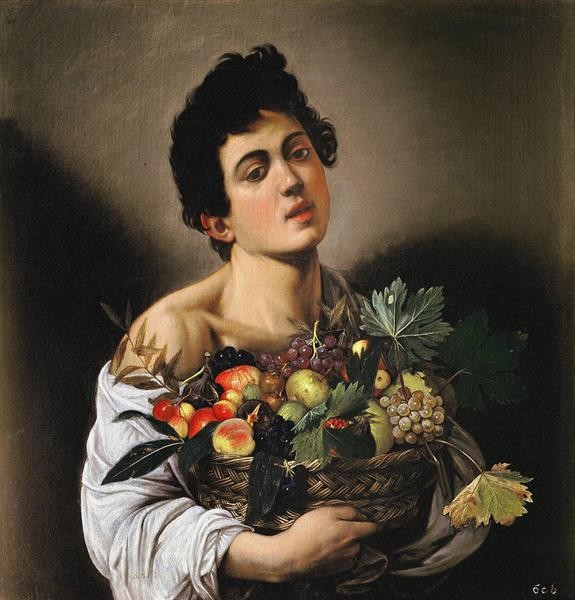
Which is the subject here, the boy or the basket? Caravaggio pushes the fruit and leaves so far forward that they fill much of the space between the young man and the viewer and compete with his face for attention. The still life carries far more weight than an accessory to a portrait would. Nor is the figure a neutral support for it: his body is turned, his shirt slips from one shoulder, and the picture makes little effort to hide its sensuality.
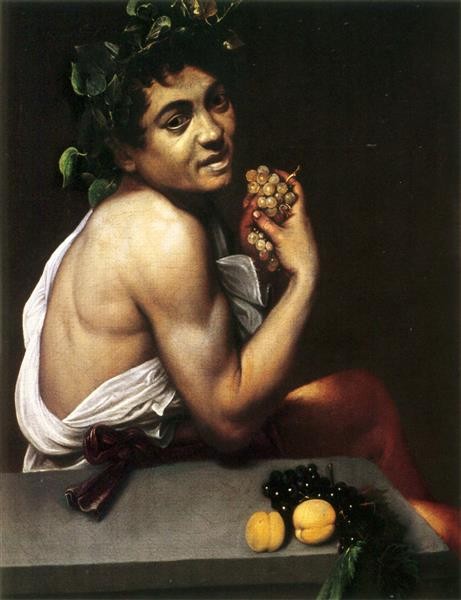
Many of the ingredients of the Boy with a Basket of Fruit return: a young man, fruit, a turned body, a bare shoulder. This time ivy and grapes cast him as Bacchus, and the role sits uneasily on an unidealised sitter, awkwardly hemmed in by the table and the fruit. He makes a thoroughly unheroic god. His skin is pallid, and the title calls him sick, though that is more than a painted complexion can establish.
The smallest figure in the picture crushes the serpent, but he cannot manage it alone. As the child's foot comes down, Mary's hands hold him upright, while Saint Anne looks on, and differences in size set out the three generations in the dark setting. Whatever its devotional purpose, the action rests on something very ordinary: a mother keeping a small child steady on his feet.
Pietro da Cortona gives Marcello Sacchetti no dramatic gesture to perform. He stands in black, with an architectural support lending him a formal setting, and his public standing comes across through his controlled bearing and the contrast of materials in his dress. The white lace at collar and cuffs does the directing, drawing the eye to the face and the hand.
Jerome's bare arm stretches across the table to the page he is writing, a long diagonal of lit flesh through the dark. At the other end of that line is a skull, sharing the workspace with the writing. Caravaggio treats scholarship as physical labour, done by an ageing and vulnerable body.
The helmet and armour tell us this is Minerva, but she has not yet put them on. Lavinia Fontana catches the goddess partway through dressing, her body turned as she reaches for her clothes, while the war gear around her keeps her identity in view. For a figure so defined by that equipment, it is an oddly domestic moment.
Zucchi crowds the scene with flowers, fabric and pale bodies, yet the story turns on a single gesture: Psyche raising her lamp as she approaches the sleeping Cupid. Seeing is the decisive act. The light is of her own making, and the lamp that lets her see him also exposes her in the act.
Raphael puts two kinds of carrying side by side. The bearers take Christ's weight, trying to coordinate steps that pull in opposite directions. Close by, a mourner collapses and has to be held up as well, so that the living need support as much as the dead. Grief, in this picture, is something that has to be physically borne.
Bronzino twists the Baptist's torso across a rocky seat and sends the pointing arm off in another direction. Blue cloth sets off the bare body but does nothing to simplify the pose. Little story is told; the saint is presented chiefly as a body arranged to be looked at.
The man who carved Proserpina's struggle paints himself with almost nothing happening. Light gathers around the eyes and cheek, and a small white collar is the only other bright note against the dark clothes. Elsewhere the brushwork is economical, and the face is left to hold the attention.
Here Bernini's head turns one way while his body, under a broad collar, faces another. Dark hair and shadow frame the eyes and make the direction of the gaze conspicuous. There is a little more movement than in the Self-Portrait as a Mature Man, but not much. Set beside it, the differences are modest, a matter of pose and lighting.
Baburen crams the arrest into a narrow, dark space where faces and armour get in one another's way. Reflected light picks out fragments of the struggle and leaves other points of contact hard to untangle. With no room to stand back, the event becomes a scrum.
Honthorst's company is as tightly packed as Baburen's arresting party, but here the crowding is sociable. An open music book gives the group a common focus, and their attention moves between the page and one another. Playing, reading and listening remain distinct tasks within the huddle, and feathered hats lift the outline of the group above the table.
Beside Bronzino's carefully displayed saint, Caravaggio's Baptist is slack. He sits slumped, shoulders dropped and legs partly extended, with a red cloth and a ram nearby. Those traditional signs are enough to identify him, so he has no need of an energetic, prophetic pose, and he is given none. Whether this is rest or exhaustion, the picture does not say.
A round picture has no corners to fill. Lorenzo di Credi fits Mary, the Child and the infant Saint John inside the circle, with Mary held upright while the figures' attention runs in several directions around her. The children's different poses keep the group lively without loosening it, and a landscape opens behind them.
Where Lorenzo di Credi builds his circle around an upright Mary, Fra Bartolomeo builds his around a child lying on the ground, and everyone else has to come down to him. The adults bend low, their attention forming a broad triangle that descends to the infant. Ruins and a landscape lie behind; in front, the action is simply a lowering of bodies.
Orazio Gentileschi leaves out the fight. David looks down towards Goliath's severed head, his body comparatively settled against a dark tree, and pale cloth and limbs set him off from the darkness. What happened has to be inferred from what remains: the boy and his trophy.
Explore this selection in Artline
See the selected works alongside books and events from their period, or compare when the artists lived. The books and events provide context, not evidence of direct influence. Works without confirmed dates remain in this guide.
Attributes that do the work
One thread runs through many of these pictures: an attribute can identify a figure so securely that the body is free to do something else. With helmet and armour in view, Fontana's Minerva needs none of it on her and can be shown dressing. Ivy and grapes are enough to make a pallid young sitter into Bacchus, however poorly he fits the part. Caravaggio's later Baptist can slump while the red cloth and ram still say who he is, whereas Bronzino, painting the same saint, puts the effort into the pose itself. Gentileschi's David can remain comparatively settled because Goliath's head tells the story for him. Titian's two women are the reverse case. There the labels come from a title, and the title has not settled who they are.
Further reading
Leonardo da Vinci; translated by John Francis Rigaud · Read free · English
Leonardo's treatise, in John Francis Rigaud's English translation, sets out general principles of painting rather than discussing particular works. Its sections on movement and on the arrangement of figures make a useful companion when looking at the bearers labouring under Christ's weight in Raphael's Deposition, or at Proserpina twisting against Pluto's grip in Bernini's marble.
 Art, literature & history