Twenty paintings and works on paper from the Fitzwilliam Museum in Cambridge, drawn from several European schools, from Italian altarpiece panels to Rossetti and Steer.
The Fitzwilliam Museum belongs to the University of Cambridge and was founded through the bequest of Richard Fitzwilliam. Its collections include manuscripts, antiquities and decorative arts as well as paintings. This selection keeps to paintings and works on paper.
The twenty works are not arranged by date. The selection opens with Millais's The Bridesmaid. The earliest pictures are two predella panels by Domenico Veneziano, painted for a single altarpiece, and the latest is Steer's Hydrangeas. Elsewhere there are religious scenes by Ghirlandaio, Tristán and Gaulli, Guardi's view across the Venetian lagoon, Walton's tombs near Cairo, Fantin-Latour's still life of a single white cup and an early landscape by Gauguin. Rossetti appears more often than anyone else, in oil and in bodycolour, and Thomas Girtin's watercolour of Lindisfarne is included alongside the oils. The portraits range from a queen of the Two Sicilies to a family on a terrace. Two of the sitters, the men painted by Frans Hals and Charles Beale, remain unidentified.
The works were chosen from the museum's documented holdings, independently of the museum itself, and individual works may be on loan or off display. Dates and attributions keep the qualifications given in the linked records.
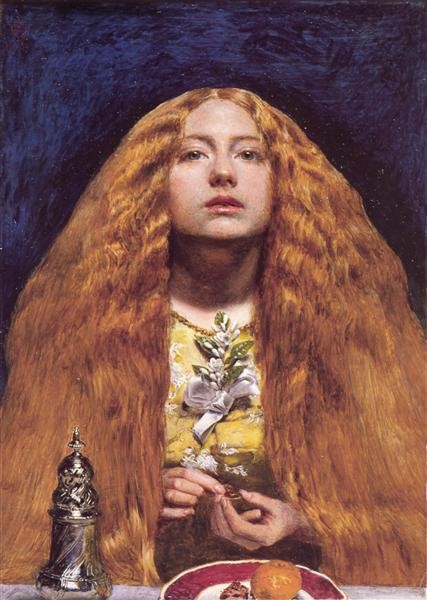
Millais surrounds the young woman's face with a great mass of red hair. Between her hands she holds something small, and her expression gives little away. The symbolism is elaborate, but much of Millais's attention goes to plain physical things: the weight and texture of the hair, skin, fabric, the slight movement of her fingers.
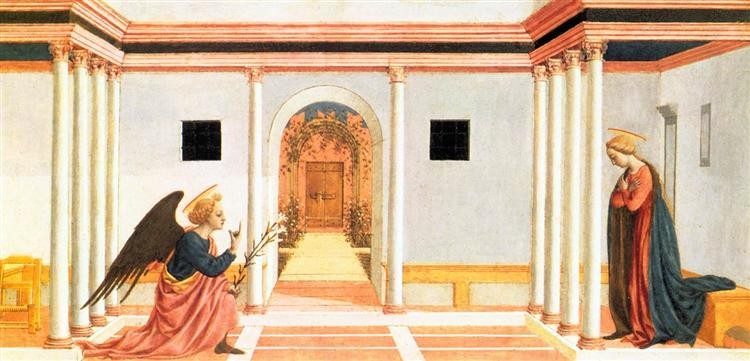
Gabriel and Mary are held noticeably apart. Between them an open passage runs back through the architecture to a closed door, so the place where the two might meet is left empty. That arrangement needs reading with some care. The museum notes that the panel has been trimmed on the left, and the cut disturbed the original symmetry of the architecture. The building no longer sits exactly as Domenico designed it.
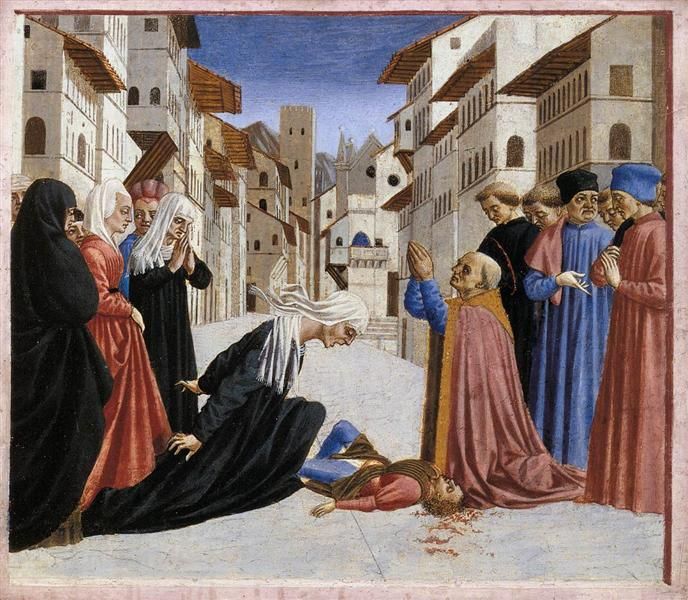
This panel and the Annunciation were once part of the same predella, the strip of small narrative scenes along the base of an altarpiece, beneath a much larger sacred image. Side by side they show Domenico putting architecture to quite different uses. In the Annunciation it keeps two figures apart. Here it organises a miracle in the street. The bishop, the child and the witnesses each have a clear place, and the buildings keep their gestures distinct without breaking the episode into pieces.
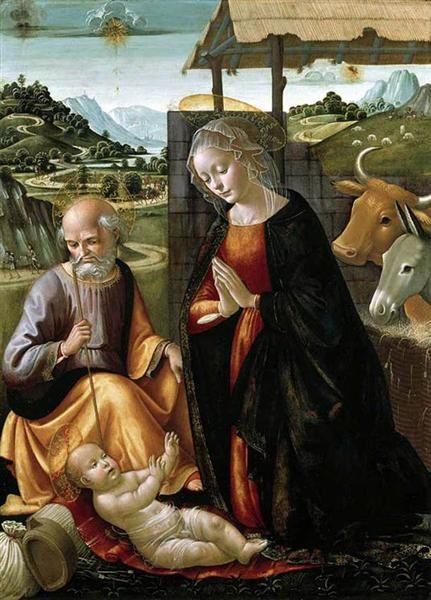
Figures crowd round the child, heads and hands overlapping. The shelter and the animals keep the foreground compact, while a landscape continues behind. There is little dramatic movement. Ghirlandaio holds the group together by where the figures look and where they kneel. Luis Tristán's Adoration of the Shepherds, later in this selection, handles a crowd of similar density by quite different means, chiefly light.
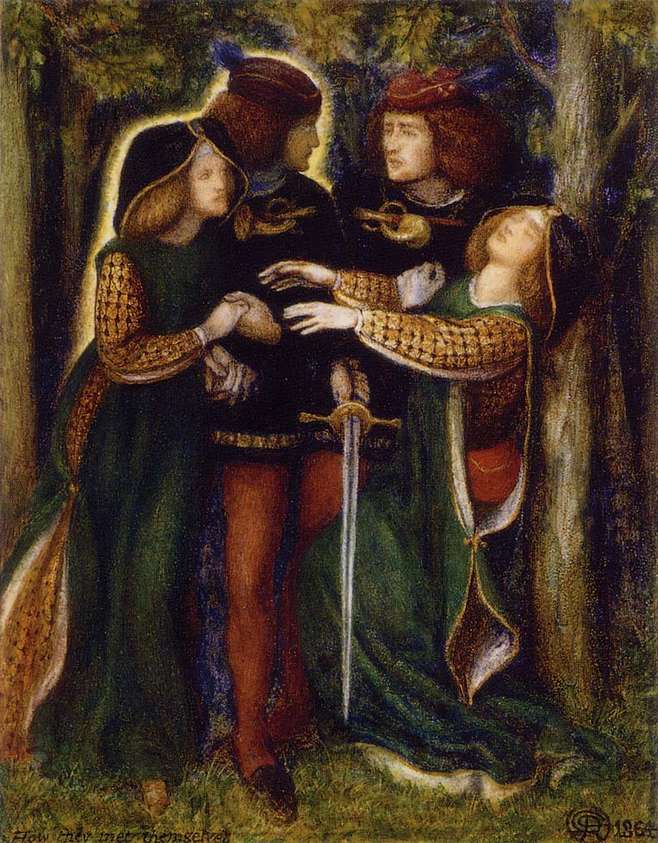
A couple walking in a wood meet their own doubles. Rossetti gives them almost no room: the trees press in, and crossed hands and swords fill the narrow gap between the two pairs. There is no monster here. The unease comes from meeting the familiar where it cannot be, at a distance too short to back away from. Bodycolour, an opaque form of watercolour, gives the sheet a denser surface than transparent wash would, and that seems to add to the closeness. This is the coloured version, not the museum's separate ink drawing.
This is the latest of the Rossetti pictures in the selection. Joan looks upward as the sword rises close to her face. The armour marks her as a soldier, but the gesture is not a straightforward act of combat, and the lifted gaze suggests devotion. Rossetti frames her so tightly that the two roles cannot be pulled apart. Metal and rich fabric give the figure real physical weight, so whatever devotion the picture shows belongs to a solid, armoured body.
The woman leans close to the window ledge, with flowers on the sill near enough to touch. Her face is turned aside, so she does not simply return the viewer's look. Beyond the lattice the view is left indefinite, far less clearly stated than her stillness beside it, and the window serves mainly to frame her.
Very little moves in this picture, whatever story the title may hint at. A woman holds a dark vessel against her body, and the way her arms enclose it makes its weight felt. Her hair, her pale clothing and the plants around her continue the upright line of the figure. Such action as there is lies in the holding.
Nobody knows who this man was. Hals paints the grey garment loosely, as a field of separate strokes that does not describe every fold. The face is far more fully resolved, looking straight out from beneath a broad black hat that sets the head firmly in place. The difference in handling does much of the portrait's work, drawing attention away from the coat and up to the face and its direct gaze.
The title names a precise viewpoint, from the Fondamenta Nuove towards Murano, yet the buildings have shrunk to low marks along the horizon. Water and grey sky take up far more of the canvas, and no grand façade dominates. Guardi identifies the place through the lagoon itself, and through the boats and slender masts spaced across it, which tie the open water to somewhere particular.
Fantin-Latour gives the cup no elaborate setting and no story. The interest lies in the white, which changes with the light across the rim, the handle and the rounded body, while the saucer and spoon add a few related shapes. The picture shares its year with Rossetti's How They Met Themselves, and it would be hard to find two subjects further apart than a couple meeting their doubles in a crowded wood and a white cup on its saucer.
Anyone who knows Gauguin from his later work may need a moment to recognise him here. This early landscape is built quite differently from the flatter arrangements of what came afterwards. Workers and animals are set within broad stretches of cultivated ground, and trees, low buildings and sky join their labour into one continuous place.
Girtin lets the sky do structural work. It shows through the gaps in the ruined masonry as well as above the walls that survive, and those openings belong to the design as much as the stone does. He keeps stone and air distinct and makes no attempt to reconstruct the building. What has gone gives the remaining arches their rhythm, and leaves them exposed.
It takes a moment to find the woman. Flowers, clothing and surroundings almost merge into one busy surface of light and marks, and only her face and reaching hand stand out enough for her action to be followed. The rest of her belongs to the same pattern as the hydrangeas.
c.1684 - c. 1685 · Oil on canvas · Fitzwilliam Museum
The subject is a discovery of absence. The women come to Christ's tomb and find it empty, and angels point to it as they approach, so the picture has to make a vacancy the centre of its story. Gaulli keeps each figure distinct through colour, and their gestures show how they relate to one another and to what is missing.
The crowd here does not stay on the ground: from the child it rises into angels and, above them, darkness. It is the light that keeps so many figures in order. It falls unevenly, so they do not compete on equal terms, and attention keeps returning to the newborn. Faces and bright cloth pick out individuals within the mass.
The sunset takes up more of the picture than the tombs beneath it, and most of the change happens in the sky. Below, dark tracks cross the rough foreground and lead into the view. Walton shows the monuments at a particular hour and in a particular atmosphere, and the evening counts for as much as the architecture.
Five people share a terrace, some seated and some standing, at different heights and turned different ways. No two of them strike matching poses. What makes them read as a family is the shared space and the coordinated way they are presented, with trees and landscape giving a setting broad enough to hold them all.
The queen is dressed for ceremony: elaborate sleeves and headwear, a dark dress, red fabric. She holds a controlled standing pose, one hand supported. For all the display, the portrait is organised around her face, and the costume leads the eye back to it.
Like Hals's sitter, this man is unidentified, and the two portraits make a useful pair. Where Hals's man looks straight out, Beale's turns his head against the darkness. He wears a white neckcloth and a warm brown robe, and the light gathers on his face and chest.
Explore this selection in Artline
See the selected works alongside books and events from their period, or compare when the artists lived. The books and events provide context, not evidence of direct influence. Works without confirmed dates remain in this guide.
Empty spaces
Several pictures here are built around something absent. Domenico Veneziano leaves the ground between Gabriel and Mary unoccupied, Gaulli makes an empty tomb the whole point of his scene, and the view beyond Rossetti's lattice is never resolved. In other works the emptiness is open sky. It gives shape to Girtin's ruin, takes up most of Guardi's view of the lagoon, and in Walton's Cairo holds the sunset that outweighs the tombs.
Ruskin's practical manual is a course of drawing exercises in observing edges, tones and natural forms. It keeps sending the reader back to a particular visible feature before any broad judgement. That habit suits both the detailed nineteenth-century pictures here and the sparer watercolours.
 Art, literature & history