Budapest's Museum of Fine Arts is best known for its European paintings. It is a separate institution from the Hungarian National Gallery, which looks after Hungary's own traditions. The Museum of Fine Arts looks outward, to Italian, Spanish, Dutch and other European schools.
The twenty works chosen here run from Michele Pannonio's enthroned muse to Munkácsy's crowded Paris interior. Some of the names, such as Giorgione, Bruegel, El Greco and Velázquez, will be familiar. The subjects range widely: a lamentation and a martyrdom, a muse and an allegory, a sea battle, a horse caught in a storm, a man trimming his quill, a meal, a landscape and several portraits. A good number of the pictures assume that the viewer knows the biblical or classical story behind them. In these, much depends on which moment the painter chose to show: a hammer raised but not yet brought down, a dead body that takes several people to hold, an angel still descending.
The selection is independent of the museum and drawn from its documented holdings. Dates and attributions keep the qualifications given in the collection records.
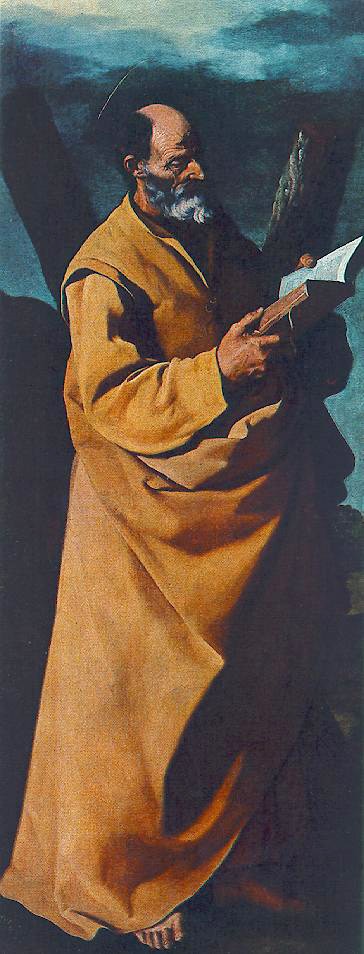
Zurbarán gives Saint Andrew an open book, but it is hard to say whether he is reading it or has drifted into thought. Little in the background competes with him. Much of the picture rests on the pose, the book and the carefully directed light.
c.1660 - c. 1670 · Oil on wood · Museum of Fine Arts
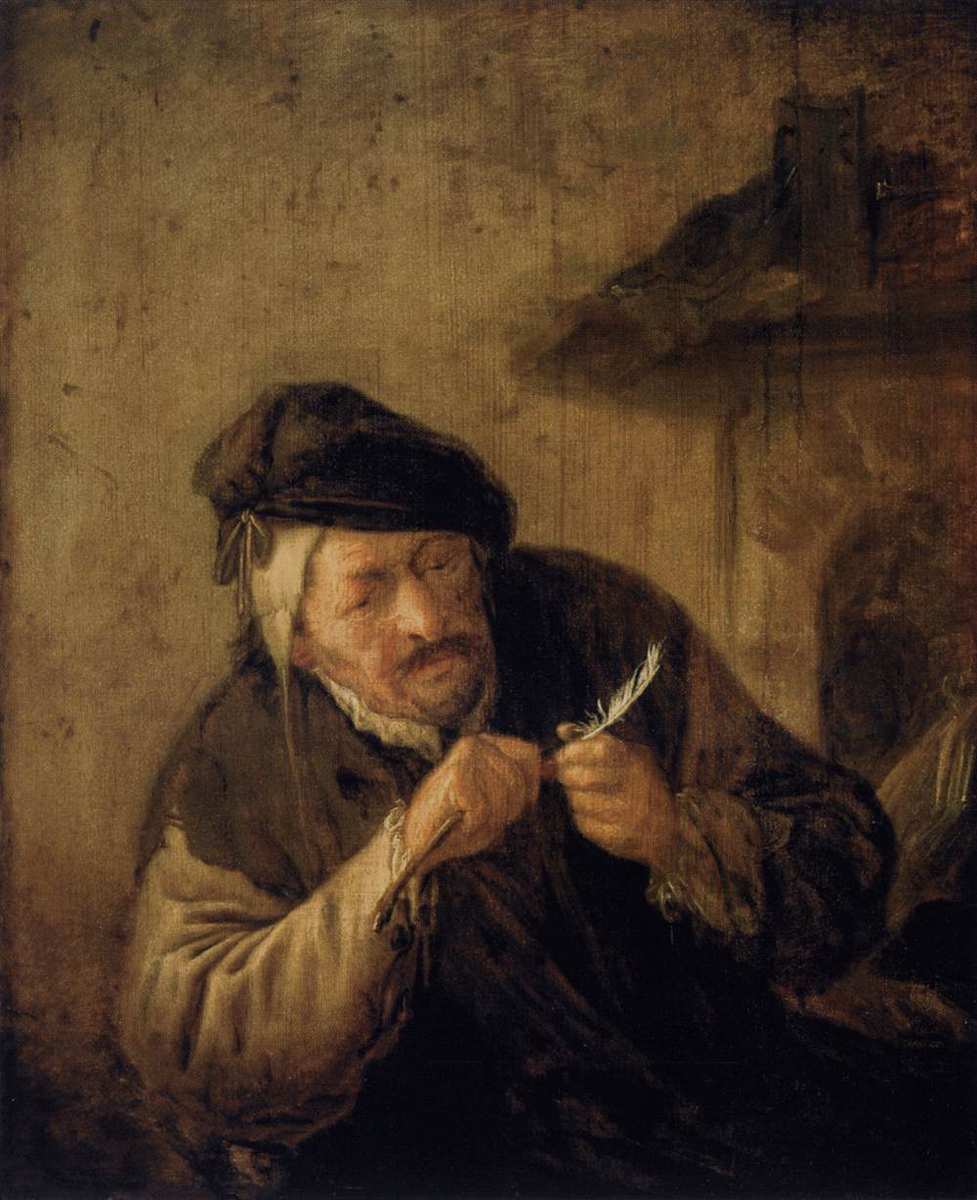
The writing has not begun yet. A man trims his quill, his eyes and hands fixed on this small preparatory task, and Van Ostade gives the modest action a picture of its own. Uneven light closes the room around his busy fingers.
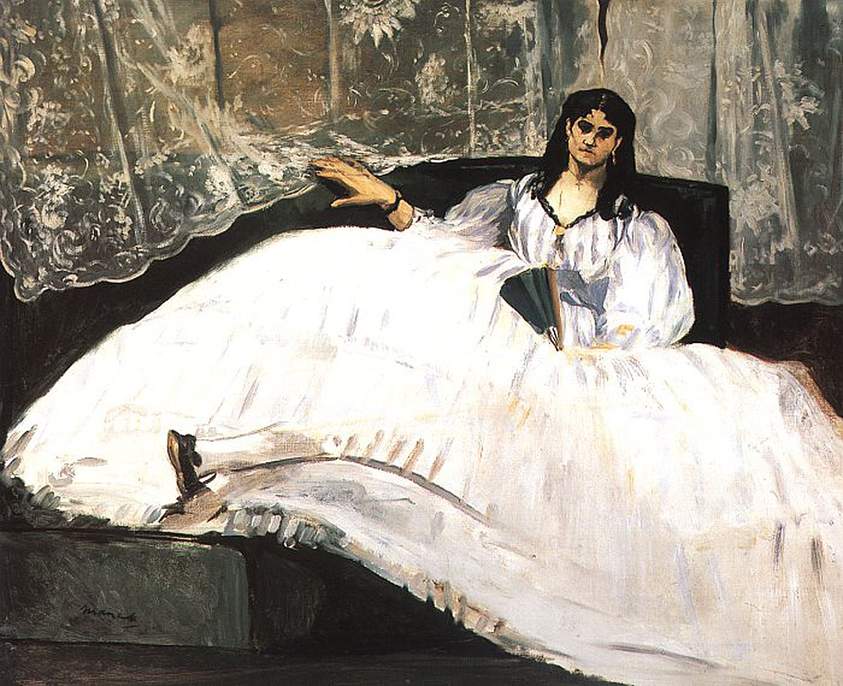
The dress comes first. Its white expanse takes up so much of the canvas that it largely sets the portrait's proportions. Only Jeanne Duval's dark head and one small exposed shoe break into it, and curtains crowd the background. For a portrait, surprisingly little of the emphasis gathers around the face. Much of her presence in the picture is carried by the fabric.
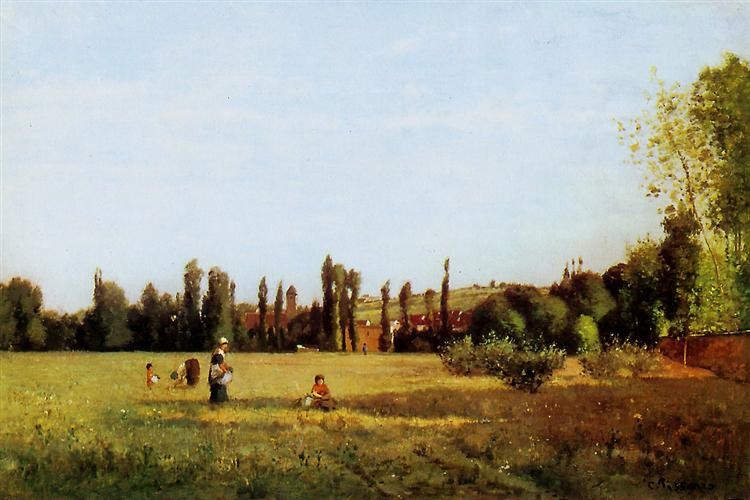
Small figures cross the field. There are enough of them to make it an inhabited place, but none becomes a main event. Pissarro gives the broad stretches of ground and sky space of their own, and lets trees and buildings mark the line where one meets the other.
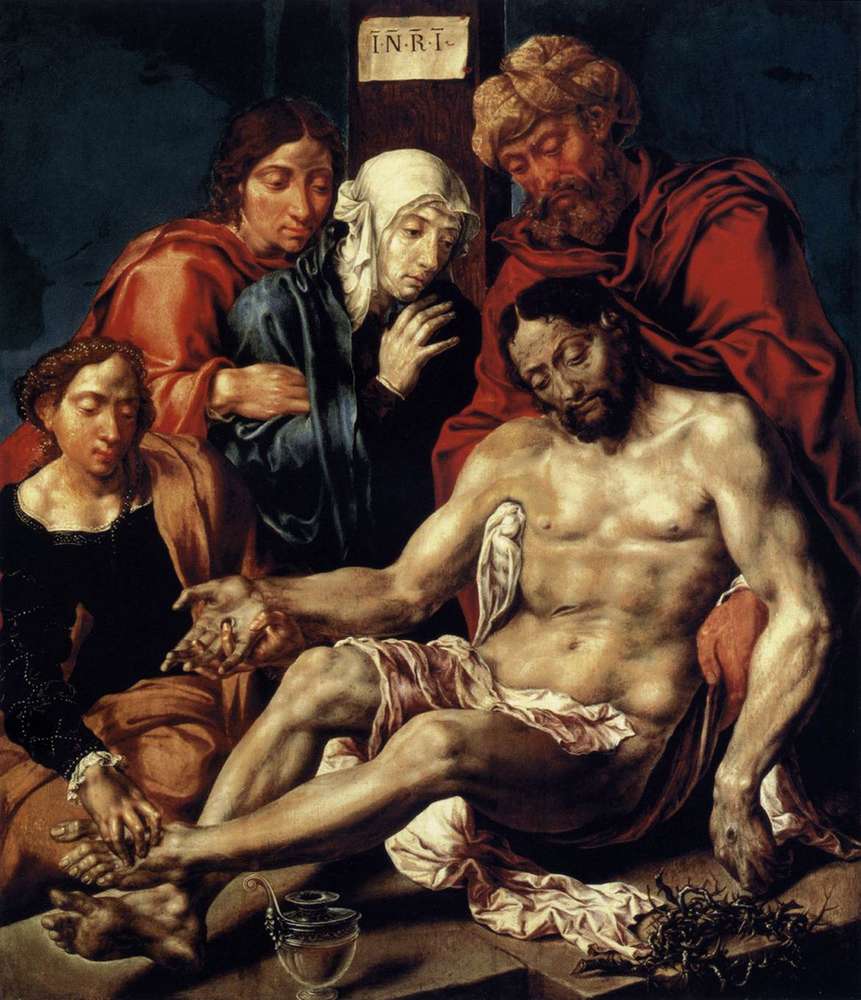
Christ's body, pale and muscular, cannot hold itself up, and it takes several hands and arms to support it. Heemskerck packs the mourners so tightly together that their grief becomes bound up with the practical difficulty of handling a dead man. The weight they share is what holds the group together.
Who he was is not settled. The name Antonio Broccardo is a traditional identification and should be read as one. The precision of the likeness does nothing to confirm it. What the picture does give us is a young man whose attention is hard to locate. His hand is spread and his face turned slightly away. The small objects resting on the ledge add information without explaining that inward turn.
Jewellery, fine clothing, pale skin, and a severed head on a platter. Cranach arranges the scene like a portrait and presents the head as calmly as the young woman's finery. Elegance and violence belong to the same moment of the story, and nothing in the narrow picture marks a change of tone between them.
This is the earlier of the two Cranachs here, and it is arranged quite differently from the Salome. Instead of drawing everything into one close space, the painter keeps his figures apart. The angel comes down from above, the kneeling Joachim looks up, and a marked difference in height separates them. Their gestures are directed across the gap, but sky and earth remain separate spaces. Sheep and rocky ground keep Joachim's part of the picture pastoral.
Pouring, receiving, reaching, eating: everything on the cloth is caught up in some action. Velázquez connects the men through what they do at the table and gives each a different pose. The bread, vessels and fruit belong to the company as much as the diners do.
On the ground, kneeling figures and armed men form several separate centres of action. Solimena uses bright drapery to keep them distinct across the wide, crowded canvas. Above them, a heavenly group occupies the air. The martyrdom below and heaven's response happen at different heights, and no single gesture or focal point gathers the whole subject together.
The sermon is in the title; the preacher takes some finding. Bruegel gives more of the panel to the crowd than to John the Baptist. He sets John inside a dense gathering of people who turn, stand and lean in many directions, some close to him and others at a distance.
Bronzino paints his figures smoothly and twists them around one another so thoroughly that the group is hard to untangle. Gestures, flowers and darker forms are fitted into a shallow, crowded space. The allegorical title is a starting point rather than a complete key. Venus, Cupid and Jealousy may be named, but the way the figures overlap and reach across one another complicates any simple reading of affection and desire.
Long fingers reach around the child and bind the close group together, even though El Greco has stretched the bodies into elongated proportions. Intense colours in the clothing keep one figure distinct from the next, while all of them share a single focus. Behind them, a turbulent sky stops the gathering from settling into an ordinary domestic scene.
Anyone hoping to follow the course of the engagement will be disappointed. Smoke and tilting masts block any overall view of the fighting. The viewpoint is low, which leaves the small boats and wreckage beneath the warships looking exposed. Volanakis offers none of the detached clarity of a battle plan. The immense vessels appear among the immediate damage, with ships and bodies in the same dangerous water.
There is no ceremonial setting here. Seybold shows himself as an older man in an open white shirt and a loose head covering, facing the viewer directly. He pays closest attention to the wrinkles of the face and to the small changes of light across it.
This is a muse on a throne. Michele Pannonio does not give Thalia a single attribute and leave her to stand alone. Instead he builds an elaborate seat of state around her, crowded with ornament, fruit and smaller decorative forms, and sets her narrow, pink-robed body within it. Much of her authority as a personification comes from that ceremonial structure.
The fear is not confined to the horse's eye. It runs through the whole animal: the forelegs are raised, the mane is blown about and the body turns, as the storm throws it off balance. Delacroix ties the lightning and the dark sky closely to that physical reaction.
The hammer is raised, and the fatal blow has not yet fallen. Artemisia Gentileschi sets Jael's coordinated hands and taut readiness against the outstretched body of Sisera, asleep in the foreground. One figure is prepared to act and the other is helpless, and the biblical episode is built on that imbalance.
Is the subject the seated woman or her room? Pictures, fabrics and polished objects crowd so thickly around her that the question is a fair one. Munkácsy shows wealth as a whole environment, not a few choice possessions. A dog in the foreground adds one more layer.
A dark oval inside an elaborate frame makes for a formal presentation. Warm light on the forehead and white beard gives the face enough weight to hold its own within them. Lievens differentiates the features sharply, and for all the ceremony of the format, the sitter remains a particular person.
Explore this selection in Artline
See the selected works alongside books and events from their period, or compare when the artists lived. The books and events provide context, not evidence of direct influence. Works without confirmed dates remain in this guide.
Starting with the hands
If a picture here is slow to open up, try looking at the hands. The man in Van Ostade's room is busy with his quill. The diners at Velázquez's table pour, receive and reach. The long fingers in El Greco's Holy Family close around the child, and the young man in the Giorgione portrait spreads his hand without explaining the gesture. What is being held, offered or supported, and what is about to be done? You can ask those questions of a painting before its title or its story comes into play.
Further reading
Leonardo da Vinci; translated by John Francis Rigaud · Read free · English
In John Francis Rigaud's English translation, Leonardo's notes on painting give a painter's precepts on gesture, expression and the arrangement of figures. That makes them a good companion for looking at the hands and poses in this selection. The advice is general, and none of these pictures is discussed.
 Art, literature & history