The Museum Boijmans Van Beuningen in Rotterdam collects everything from medieval painting to modern and contemporary art. This selection covers nearly five centuries of that range, from Bouts's devotional Head of Christ to Magritte's mirror portrait of Edward James. Bosch and Bruegel are among the museum's most famous names, and both appear more than once. Bosch is here with a saint, a wanderer and a pair of puzzling heads. Bruegel has the Little Tower of Babel and a chalk drawing of the Resurrection. Around them are Dutch landscapes and domestic scenes, Fragonard's chalk drawing of a château, a waterfall by Balke, Kandinsky's Lyrical, Gauguin's riverside at Port de Javel and Signac's view of the harbour in Rotterdam itself. The subjects vary as much as the periods: a severed head, a meal shared with angels, anglers on a bridge, a woman at her spinning, a cow's head. The entries are not in chronological order, which makes for some unexpected neighbours. Magritte, for one, comes straight after Bosch's Saint Christopher.
Artline chose these works from the museum's documented holdings, independently of the museum. Dates and attributions keep the qualifications given in the linked records.
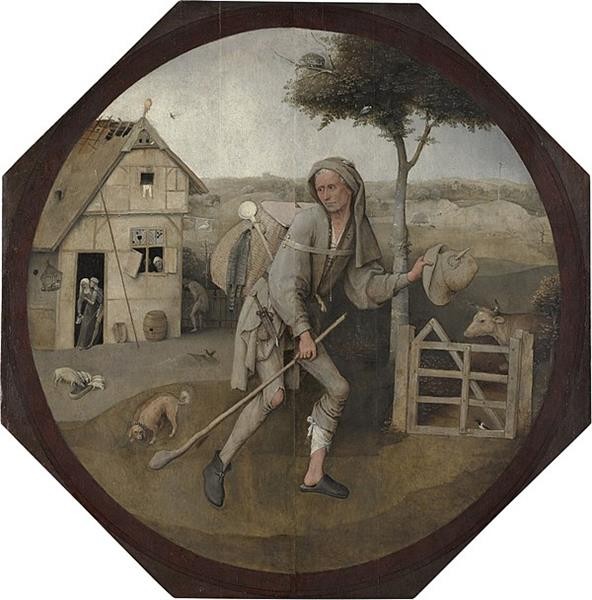
The objects and animals around Bosch's traveller have prompted moral readings, but scholars disagree about who he is meant to be and what the picture means. The gesture, at least, is plain. He walks forward with his head turned back, his body set on the way ahead while his eyes stay on what he is leaving behind.
1500 · Oil on panel · Museum Boijmans Van Beuningen
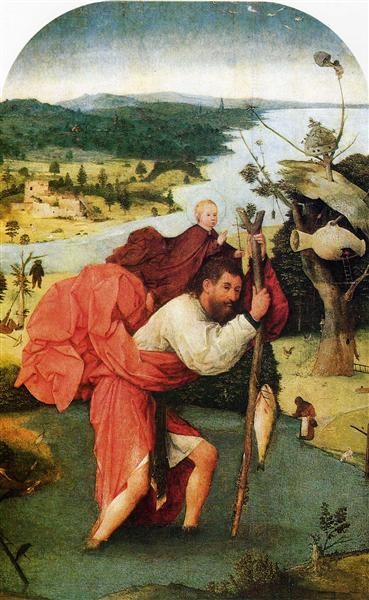
The wayfarer looks back at what he is leaving. Bosch's Christopher is weighed down by what he carries. The saint leans heavily on his staff, and the crossing clearly takes effort. The child takes up only a small part of the panel, yet he is the weight the saint bears. The landscape around them fills up with smaller incidents, and none of them gets in the way of the central action.
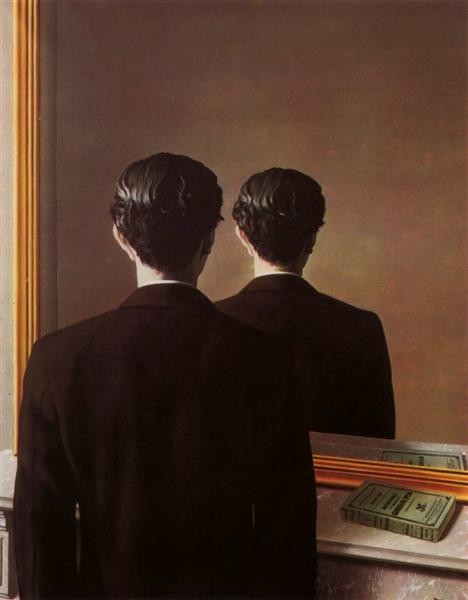
Edward James looks into a mirror, and the mirror shows the back of his head again. A book in the picture is reflected normally, so the impossibility is selective: the book behaves and the man does not. Magritte sets up the conditions for a portrait and then withholds the face, the one thing a portrait is expected to deliver. The title seems to join in, since reproducing is exactly what a mirror is for.
1891 · Oil on canvas · Museum Boijmans Van Beuningen
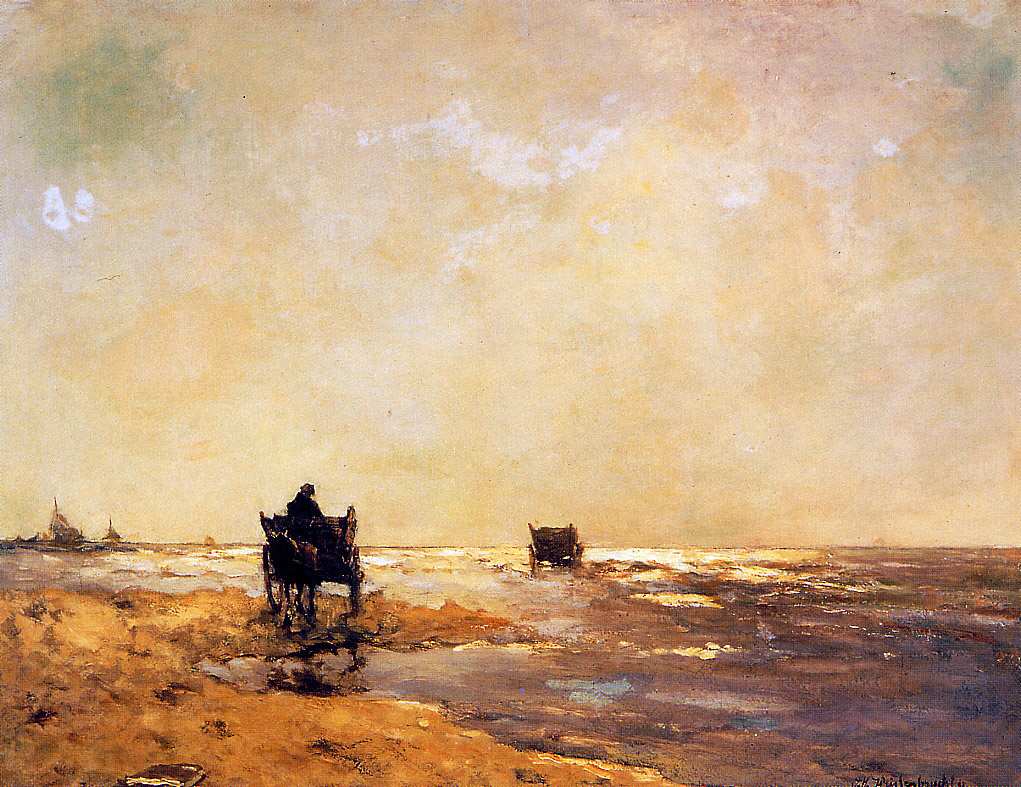
Much of this canvas goes to pale sky. Below it, a beach offers little to measure distance by, so a pair of carts does the job. One stands on the wet sand close by and the other is further off towards the water, and the stretch of sand between them tells you how wide the beach is.
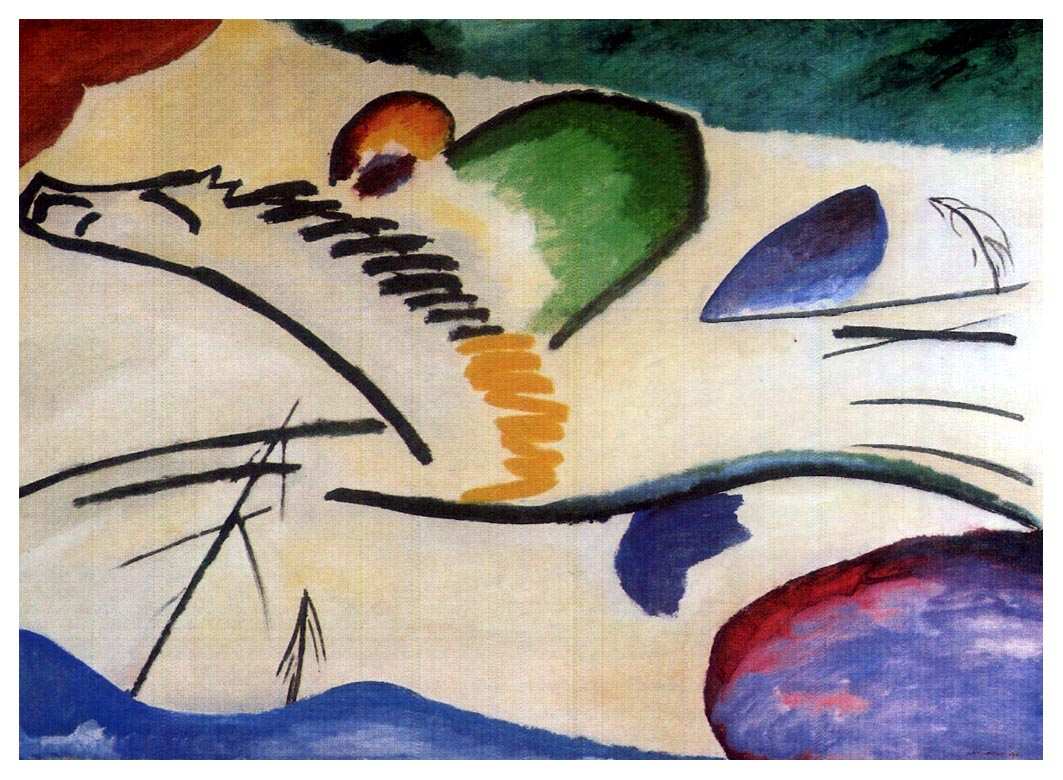
1911 · Oil on canvas · Museum Boijmans Van Beuningen
Kandinsky's title names a mood, but a subject survives, if only just. A horse and rider can still be made out, although most of the setting has fallen away into scattered patches of colour. The rider anchors the long lines that carry the action across the canvas. While he is in view, they read as movement through a place. Lose sight of him and they become movement within the painted surface. The picture seems to sit very close to the point where one reading gives way to the other.
1876 · Oil on canvas · Museum Boijmans Van Beuningen
This early Gauguin shows a working stretch of river at Port de Javel, with boats, low buildings and smoke. A wide spread of cloud takes up as much of the view as the waterfront does. Gauguin neither hides the industry nor sets it apart as an emblem of modern life, and the smoke rises into the sky almost as if it belonged to the weather.
1907 · Oil on canvas · Museum Boijmans Van Beuningen
No other title here names the museum's own city. The harbour has to be pieced together from small, separate touches of colour, and the cranes, sails and water gradually emerge from them. The harder feat is that Signac uses the same touch for machinery, sail and water without making them look like the same material. Distance softens the far bank, but the colour stays lively at the surface.
c. 1480 · Oil on panel · Museum Boijmans Van Beuningen
The earliest of the Bosch works here is also the most reticent. Two men in elaborate headgear are packed so tightly into a narrow panel that there is room for little else. With no story to explain them, the picture becomes a matter of comparison: glance against glance, expression against expression, with a further set of differences in their head coverings. Each face is individual, but the panel never says what the men are to each other.
Fragonard leaves much of the paper bare and lets it serve as light. His warm chalk picks out the towers and walls of the château without enclosing them in continuous outlines, and touches the surrounding ground only here and there. What surprises is how solid the building looks when so little of it is closed in by line.
c. 1560 · Chalk on paper · Museum Boijmans Van Beuningen
After Fragonard's château, where bare paper does much of the work, this is a far more crowded use of chalk. The lower part of the sheet is a scrum. Around the tomb the soldiers are knocked off balance, their bodies pointing in different directions. Above them Christ rises upright and stands clear. Put like that, the scheme sounds almost diagrammatic, but in a drawing this busy it is a strength, because the subject can be read at once through the tangle of bodies.
The title calls it little, but the tower is anything but. At first it reads as pattern, tier upon tier of repeated arches. Its size becomes clear only when you measure it against the small city and the river. The upper levels are unfinished, so the doomed project is caught while it is still going up.
De Gelder turns a divine visit into a meal. Abraham and his three guests meet over food, and the ordinary business of hospitality brings the encounter down to earth. The shared table holds the group together, though each figure responds differently. Light falls on faces and fabrics and leaves the setting subdued.
Fishing from a small wooden bridge is a modest pastime, and the title is just as modest, yet van der Hulst builds a broad view around it. The bridge supplies a firm set of angles against the softer landscape, and the anglers leaning from it show both what it is for and how big it is next to a person. With that nearby crossing as a fixed point, he can leave the water, the distant land and the sky open.
Brick walls hem in a small working space. Boursse gives his closest attention to what things are made of. Masonry, wood and cloth each take the light differently, and he tells them apart by texture and tone. The bent figure of a worker belongs to these practical surroundings rather than standing apart from them.
A woman spins in a dark interior, and ter Borch concentrates the work in the small space between her hands. Her pale collar and cuffs stand out against the gloom. The room is left vague, and the movement of the thread is described more closely than anything around her. Boursse's courtyard works almost the other way round: there the walls and materials get the closest scrutiny, and the worker blends into them.
A cow sits for its portrait. The head fills the picture, seen straight on and symmetrical in the format used for portraits of people, but the horns and curling forelock leave no doubt about the sitter. Uneven light keeps the symmetry from turning rigid. Govertsz gives the texture of the hair and the small asymmetries of the face the kind of attention usually reserved for human sitters.
The earliest work in the selection has no crowd or event to follow. Christ's face is shown frontally and almost symmetrically, the pale features framed by dark hair against a dark ground. In this devotional image Bouts includes little else that might compete with the face. Coming straight after Govertsz's cow, which is set out in much the same way, the arrangement may take a moment to recover its gravity.
Of the landscapes here this is the most dramatic, and Balke gets the drama from very little. He works in a narrow range of tones, setting pale falling water and spray against dark rock, and that contrast gives the falls their force without any build-up of detail. Even so, solid rock, mist and spray stay distinct.
A cluster of houses sits beneath a rocky height, and beyond them the valley runs out into pale distance. The houses do what the bridge and the carts do elsewhere in this selection: they give a measure on ground that would otherwise be hard to judge. The depth itself, though, comes from tone. The foreground is dark and the far ground faint, and the contrast is strong enough to carry the view well beyond the small settlement.
Sweelinck paints the aftermath, not the killing. Two women appear with the severed head of Holofernes between them. The head is held low, which leaves the upper part of the picture to the women's faces and the visible difference in their ages. Neither face settles into a single emotion. Judith looks neither plainly triumphant nor plainly distressed, and her companion is just as hard to read. Drapery and shadow keep attention on the pair, and the head between them is left as a blunt fact.
Explore this selection in Artline
See the selected works alongside books and events from their period, or compare when the artists lived. The books and events provide context, not evidence of direct influence. Works without confirmed dates remain in this guide.
Finding individual works
A work's place in the collection does not mean it is on view. The museum's holdings, its Depot presentations and its loans do not add up to a single permanent display, so check where each work you hope to see is at present.
Further reading
Walter Liedtke · Read online or download · English
Liedtke's catalogue of the Dutch paintings in the Metropolitan Museum of Art has detailed entries on seventeenth-century landscapes, portraits and genre scenes, and is particularly good on what the different genres set out to do. Its entries deal with the Met's own pictures, so it gives background and points of comparison rather than discussing the Rotterdam works. It is most useful for the seventeenth-century Dutch landscapes and domestic scenes in this selection.
 Art, literature & history