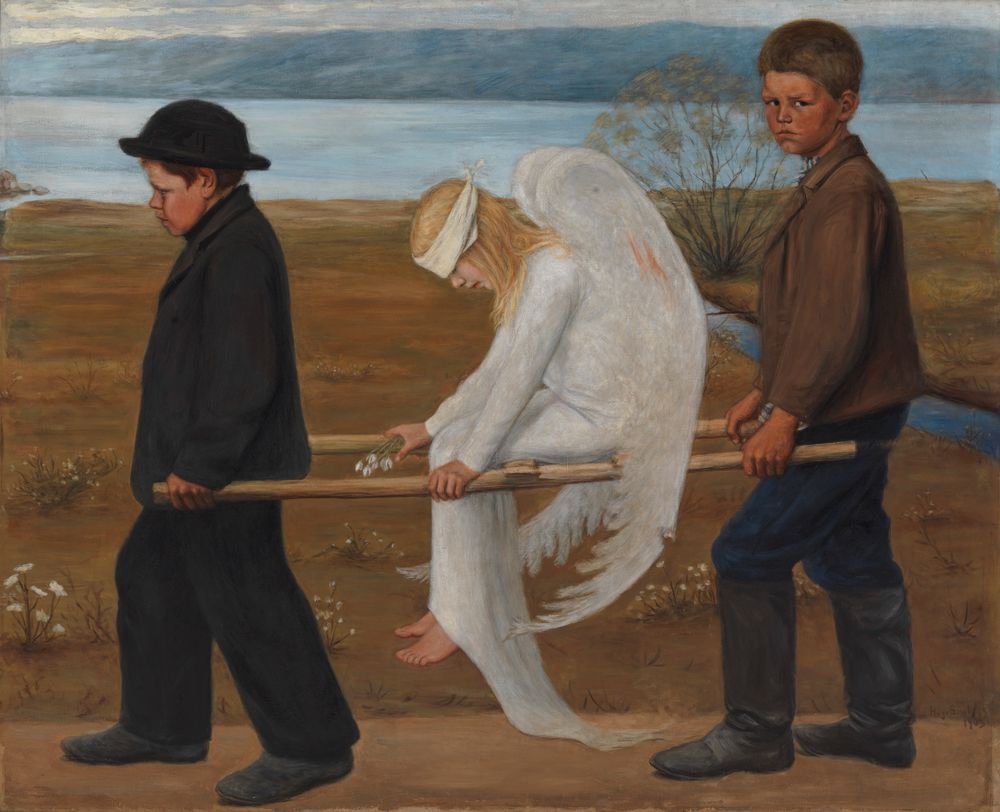
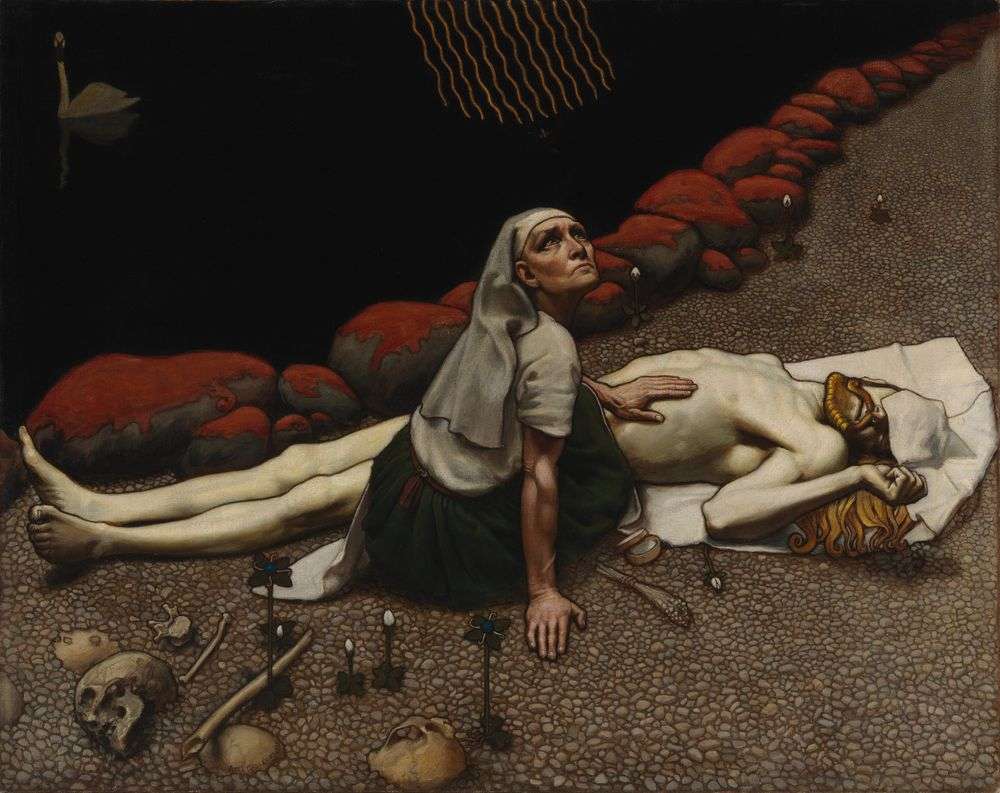
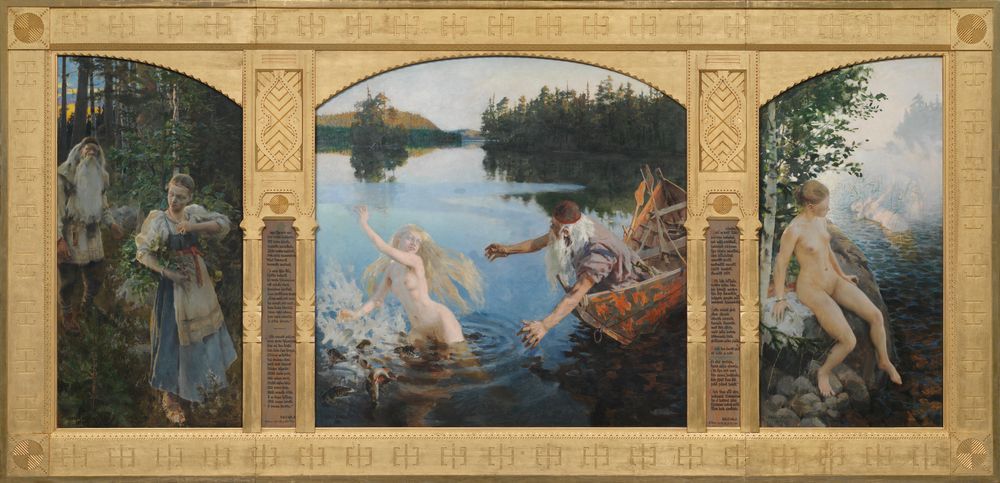
The Ateneum, part of the Finnish National Gallery, occupies a nineteenth-century building in Helsinki. Its collection matters above all for Finnish painting, and this selection follows that emphasis. Gallen-Kallela appears with scenes from the Kalevala, the Finnish epic poem, and Simberg with The Wounded Angel. Helene Schjerfbeck can be followed from a child's recovery to a self-portrait pared down to a few marks. The collection also holds pictures that rarely appear in international surveys, so there is room here for quieter subjects: a forest road in Häme, an empty summer room, snow at Kinahmi. From further afield come Van Gogh, Cézanne and Munch, and Gauguin, whose landscapes take the eye as far as Tahiti and Hiva Oa. The selection ends with less expected things: an invented landscape by Tove Jansson, Gallen-Kallela's study for the frescoes of the Jusélius Mausoleum and a stage design by Nicholas Roerich.
The selection is independent of the museum and drawn from its documented holdings. Dates and attributions follow the linked records, keeping any date ranges or qualifications they give.
Two boys carry an injured angel on a stretcher through a bleak landscape. Her wing is damaged and her eyes are bandaged, so she cannot see where she is being taken. Simberg tells us no more than she knows: neither how she was hurt nor where the boys are going. The picture's peculiar force comes from how matter-of-fact it is. In their plain clothes, the boys make the task look almost ordinary, just a load to be got from one place to another. Is that ordinariness a comfort, or the strangest thing in the painting?
Lemminkäinen's mother stays upright beside her son's pale body, which lies stretched out and cannot respond to her. Nothing in the setting eases her vigil: dark water, bones, red stones. The episode comes from the Kalevala, but you need no knowledge of the poem to understand a mother keeping watch over a son who cannot answer her.
Aino refuses the proposal of the old sage Väinämöinen. In the central panel he catches her in the form of a fish, and she escapes him again. Gallen-Kallela keeps the three scenes apart, and the landscape does not run on from one panel to the next. What joins them is his carved frame, inscribed with text from the Kalevala. The poem's words do the linking that the scenery leaves undone.
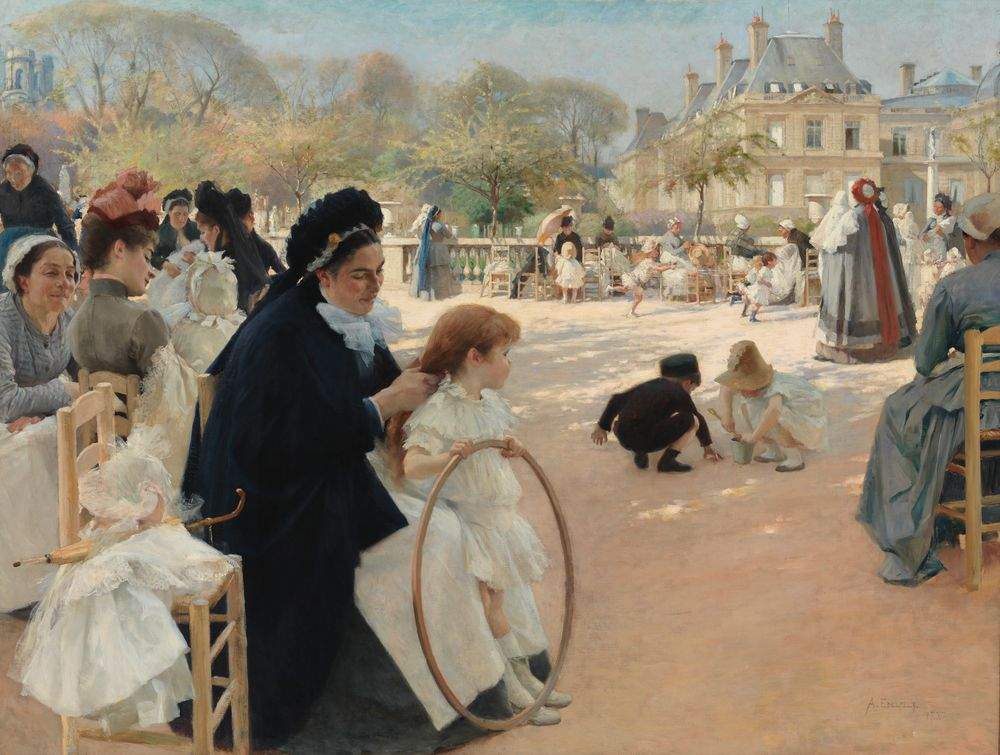
A hoop, chairs, groups of people beneath the trees: Edelfelt's Paris garden has several things going on at once and no single focus. Across the wide path, playing, watching and resting remain distinct. The real subject is the public garden itself, ground shared by people who are each busy with something different.
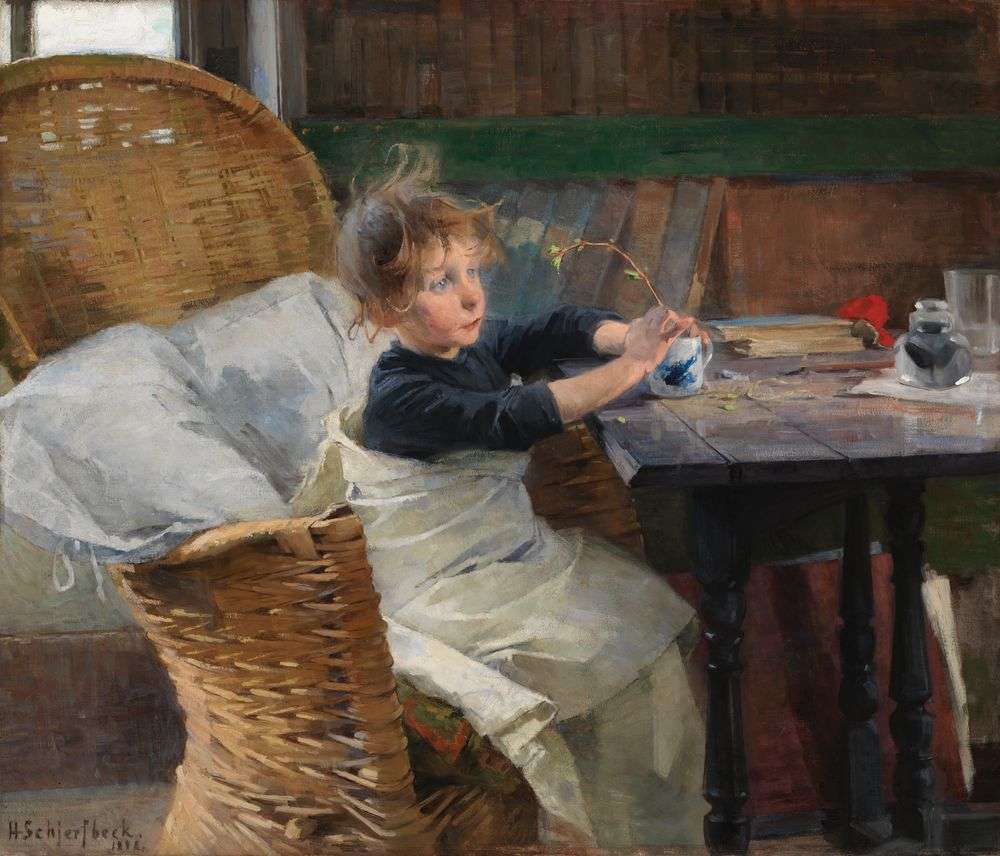
The child looks small in the large wicker chair, attention fixed on a branch held near the table. Schjerfbeck does not reconstruct the illness. Instead, recovery shows itself as renewed interest in an ordinary thing.
The face rises above a dark collar, set apart from broad areas of grey and yellow behind. Schjerfbeck does not give everything equal attention. Some passages are defined more fully than others, and she leaves the surface unevenly finished. Her frontal self-portrait, later in this selection, strips away still more descriptive detail.
A handful of marks separate eyes, nose and mouth, just enough for them to read as a face. The head is seen straight on, with no turn or profile to help, so everything depends on where those few marks fall.
The paint is busy across the whole canvas, yet the road can still be followed between the houses. Roofs, vegetation and sky each have their own rhythm of brushmarks, and that is what keeps the scene legible: however much is going on, buildings, plants and air never run into one another.
Van Gogh, in the street at Auvers, sorts his marks according to what they describe. Cézanne's short patches of colour join into planes without entirely losing their separateness. The bridge gives the trees and sloping ground a firm structure to be arranged around. The double character of the patches runs through the whole picture, so that the landscape reads both as space going back into the distance and as adjoining areas of paint that build that distance.
Seen in profile, head bent over the page, the girl gives little of her face away. What Schjerfbeck shows is her absorption, while the expression stays largely hidden. It is the opposite of the frontal self-portrait, where the face is all there is. The bars of her chair cut across her figure. You might expect them to get in the way, but their repeated divisions make the small turn of her body easier to see, and they hold her within a tightly organised space.
The violin is not set beside the sitter as an attribute. It is in use, held between chin, hand and shoulder, which makes this a picture of playing as much as of a player. With the upper body exposed, the contact and positioning that playing depends on are plain to see.
Halonen's other picture in this selection leaves the player behind for trees under snow. Snow covers much of their branching and turns them into rounded, pale masses. A subject like this could easily become one unbroken white field, but blue in the distance and shadows within the masses prevent it. The trees remain recognisable, even though the snow has hidden much of what usually identifies them.
A small cart on the road marks the way through the forest without taking it over. Between tall trunks, patches of sun alternate with enclosed shade, so the route is followed in stages. Depth comes from these changes of light and openness, and there is no single clear view of where the road leads. If the hot summer day of the title can be felt anywhere, it is in that alternation of sun and shelter.
With nobody in the room, the bright window and its plants become the main event. Light falls across pale chairs and a covered table. Danielson-Gambogi has the same difficulty indoors that Halonen has in the snow, and warmer touches in the furnishings keep the pale surfaces from merging into one white mass. The room shows signs of use without saying whose. The date of 1900–1919 is a broad catalogue range. The museum's current record gives a narrower one.
A small seated figure is surrounded by palms, buildings and strong areas of orange and green. Colour does as much as description to hold the view together. This is a constructed image of a place, built from what Gauguin chose to emphasise, and it is better looked at that way than as an account of Tahitian life.
A pig and a horse give scale to a clearing ringed by richly coloured trunks and foliage. Purple, red and green run through the landscape, with no attempt to match the usual colours of outdoor light. In the Tahiti landscape colour holds the view together. Here it goes further, and while the animals stay recognisable, much of the space around them turns into pattern.
There is no incident here. Munch's bathers are the whole subject. Some face us and others are turned at an angle, and those differences of position give the group its variety. Broad strokes run across bodies and shore alike, binding the men into the open setting.
c. 1930–1939 · Oil on plywood · Ateneum Art Museum
Jansson's invented terrain, painted on plywood, is closed in. Dark mountains and pale, drooping trees surround a small opening in the distance. Paths offer ways through without showing where they go. The title calls the landscape mysterious, yet there is nothing confused about how it is built. What stays unsettled is the story.
Spring may seem an unexpected subject for a mausoleum, but the study is full of upward movement. Raised arms beneath the branches echo the growth above them, and beyond the gathering, water opens out into a broad setting. Because this is a study for frescoes, it also works on a practical problem: how figures and gestures might organise a decorative wall and stay legible across a large space. That is a different task from the Kalevala paintings and their episodes from the poem.
1913 · Gouache, charcoal and pastel on paper · Ateneum Art Museum
This is architecture devised for the stage. Arches and columns form a series of openings, orange light marks out the space beyond, and the depth suggests where performers might appear or pass through. It proposes a setting rather than recording real buildings, and it does not illustrate any particular moment of the action.
Explore this selection in Artline
See the selected works alongside books and events from their period, or compare when the artists lived. The books and events provide context, not evidence of direct influence. Works without confirmed dates remain in this guide.
Sources and what pictures make of them
Several of these pictures answer to something outside their frames. Gallen-Kallela's Kalevala paintings draw on a poem that can be read beside them, though the poem does not dictate how he arranged them. The Jusélius study and Roerich's design were made for other settings, the walls of a mausoleum and a theatre stage, and here they are seen apart from the places they were meant to serve. Simberg and Jansson offer nothing beyond their titles, and their pictures are, if anything, stranger for having nothing else to lean on.
Further reading
Elias Lönnrot; English translation by John Martin Crawford (1888) · Free English text and ebook at Project Gutenberg.
The epic itself, in John Martin Crawford's nineteenth-century English translation. It contains the episodes behind Gallen-Kallela's Aino triptych and Lemminkäinen's Mother, so you can find there the parts of the story the pictures leave out. Crawford's language belongs to its period and reads quite differently from a modern translation.
 Art, literature & history