The Ashmolean in Oxford is one of the oldest public museums in Britain, and it is more than a picture gallery: its collections take in archaeology as well as art, from many places and periods. These twenty paintings and works on paper are one way into the pictures. They range from Uccello's forest hunt to Mark Gertler's portrait of Thomas Balston, and take in Sydney Carline's view of Kirkuk from the air along the way.
Some were made as finished pictures to hang. Others are studies, or were taken to very different degrees of finish, and some of the most rewarding works here are drawings: Raphael's possible self-portrait, Michelangelo's portrait of Andrea Quaratesi, Canaletto's ink view of the Grand Canal. Canaletto appears in paint as well, at Dolo on the Brenta. Shakespeare turns up twice, in Arthur Hughes's Ophelia and Robert Braithwaite Martineau's Katherine and Petruchio. Around them are nineteenth-century British pictures by Rossetti and Seddon, Anna Alma-Tadema's girl on a blue pillow, the double portrait of Hester Tradescant and her stepson, portraits by Manet and Gertler, and quieter landscapes by Levitan, Corbet and Maitland.
Artline made this selection independently of the Ashmolean, from works documented in its collection. Dates and attributions keep the qualifications given in the collection records.
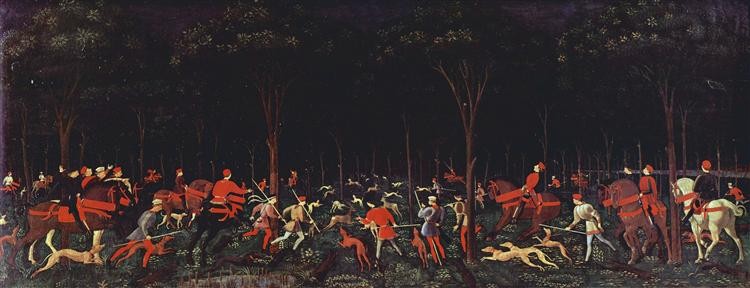
c. 1465–1470 · Tempera and oil on panel, with traces of gold · Ashmolean Museum
Riders and hounds run between rows of trees into a dark forest, growing smaller as they go, and they shrink with almost mathematical regularity. Uccello is remembered for his interest in perspective, and here the geometry has a job to do: it gives the hunt its direction, drawing it on into depth and darkness. What stops the panel from becoming a diagram is the hunt itself. The dogs run, the horses push into the wood, and the scene is busy, almost noisy.
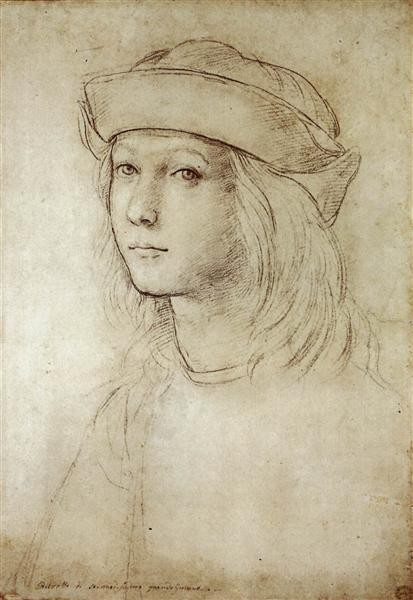
c. 1498–1499 · Black chalk with white heightening · Ashmolean Museum
Raphael puts his shadow where it matters most, gathering the black chalk around the youth's eyes and cheek; the hair and cap get by with far fewer marks. The title is careful to say "possibly". A self-portrait is an attractive idea, and the directness of the face may encourage it, but directness proves nothing and the identification is still open. What the drawing does secure is a particular face, recorded as a likeness and not as a type.
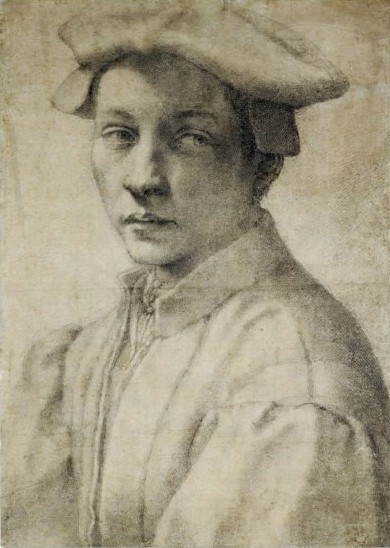
Andrea Quaratesi, unlike Raphael's youth, has a name. Michelangelo models his head with continuous shading, carrying the chalk through cheek and jaw without a break, where Raphael had gathered his shadow in a few places. The shoulders and clothing are drawn far more lightly and left unfinished, so a closely worked head rests on a body that is barely more than suggested.
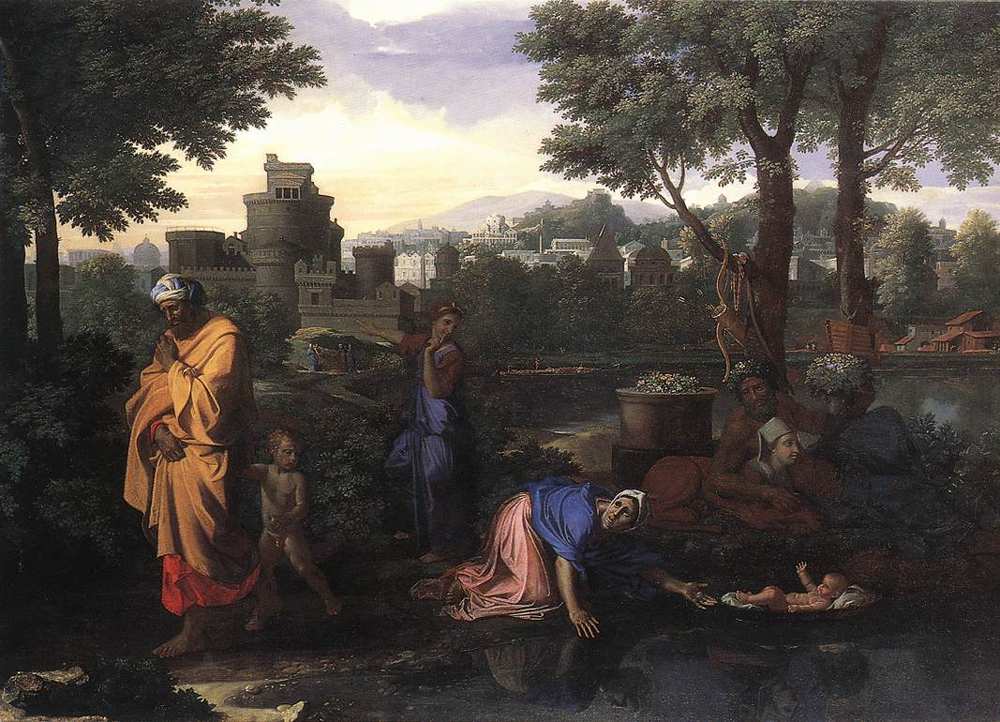
The subject is the biblical episode in which the infant Moses is left beside the water. Several figures react to the child, each with a gesture of their own, and Poussin does not draw them together into one shared action. The setting opens out in the same way, with trees and distant buildings carrying the eye well beyond the group. For an abandonment this is a measured treatment, and some viewers may find it a cool one: each figure has room to respond separately, and the child the story is about does not hold all the attention.
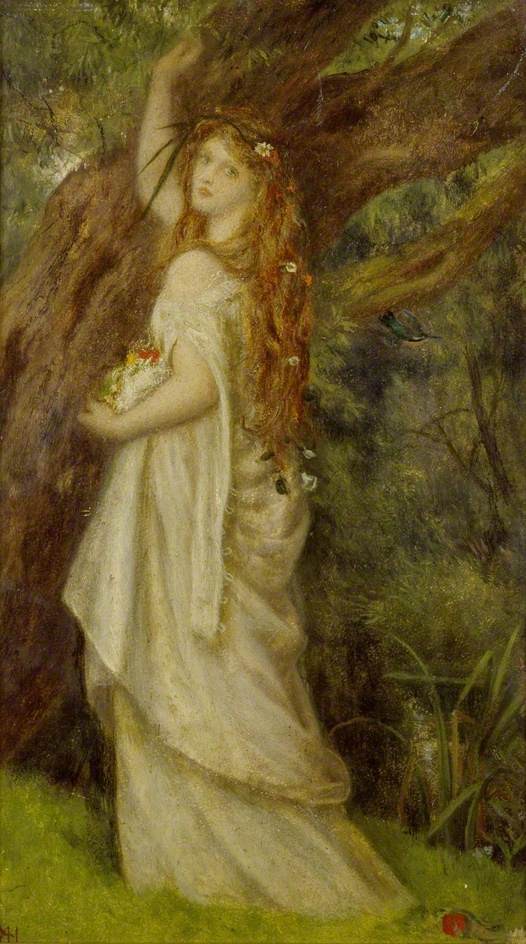
Hughes shows Ophelia standing upright beside a tree and holding flowers, her pale figure hemmed in by vegetation. She is neither floating, as in Millais's painting, nor seated, as in Hughes's own earlier version.
In Shakespeare's Hamlet, Ophelia drowns. Here that end is still only a threat, though anyone who knows the play may feel the crowding plants bringing it closer.
The book lies open, but the woman has stopped reading. A small branch is raised near her hands. Rossetti describes the setting only lightly, so the attention stays on her and on the pause. What the daydream is about, nothing in the picture says.
Even the title gives the pillow its colour. The girl's cheek rests against it, and that contact between face and fabric is the centre of the image, with the ruffles of her bonnet and other pale materials gathered round it. Against all that pallor, the blue is strong enough to give the pillow almost as much weight as the girl herself.
Corbet comes at Asolo the long way round, across fields and long stretches of ground that tie the town's buildings to the lived-in country around them, under a broad sky that leaves room for those open intervals. Asolo is reached by crossing its land and is not set apart as a monument or a picturesque sight.
Buildings line the Brenta at Dolo, with small figures and working structures along the banks, and a bell tower stands up clearly among the low roofs. Canaletto spaces his distances so that the small activities by the water register without crowding out the town, and the town does not swallow them either.
Canaletto goes over some edges again with repeated ink strokes and lets others stand open, sometimes leaving a single line to do the work. A few decisive lines set out the space, and detail gathers only in places. Boats, façades and the course of the canal are all recognisable, though the drawing has none of the continuous surfaces of a finished painting. Set beside the painted Dolo, it shows him building a view in line instead of paint.
This double portrait, attributed to Thomas de Critz, joins Hester Tradescant and her stepson John by the meeting of their hands in the foreground. Their different heights and clothing keep them distinct as two likenesses. The title is exact about the relationship, stepmother and stepson, a tie made by marriage, and the joined hands keep that tie in view.
A wing of the aircraft cuts across the land below, placing the view firmly in a particular machine in flight, and other aeroplanes share the air above the hills and fields. Carline keeps all of them in the picture, so the panorama is never quite clear. Few pictures in this selection are so frank about where the viewer has been put.
Poor, actress, Christmas: every word of the title carries weight, and the drawing itself says much less. Much of the woman's body is only lightly sketched around the act of eating, so the small dish draws more attention than its size would suggest. That modest dish, set against the word Christmas, is where the poverty named in the title becomes visible.
Martineau's other work here is a good deal louder. Katherine and Petruchio are the couple at the centre of Shakespeare's The Taming of the Shrew, and in Martineau's furnished room their postures are opposed and a vessel is raised, turning the scene into a confrontation. The gestures make the quarrel clear before anyone has identified the play; costume and setting then place it within the social roles the characters perform.
Gertler uses colour to separate Thomas Balston from his surroundings: a lilac jacket against a greenish ground, both laid in as broad areas. The head is described more precisely, and a bright tie below it adds a smaller, sharper accent. The difference in handling gives the face priority.
A low bank runs on through trees and reeds above their darker reflections. Nothing dramatic happens, and there is no landmark to find. Autumn shows itself in small changes of colour building up along an ordinary, unbroken stretch of lake.
Long bands of bank, water and evening sky dominate Seddon's view, and a pale sail cuts across them on a diagonal. Reflections link the river to the distant light. The boats are distinct objects, but the horizontal spread of the scene runs on past them, and the width of the view counts for more than anything that happens in it.
Maitland's beeches reverse the spread of Seddon's Nile. Their trunks stand at close, repeated intervals and shut off most of the distant view, and what depth there is comes from the small lit gaps between them. This part of Kensington Gardens becomes an enclosed space, made of verticals and the sunset light filtered through them.
Mademoiselle Claus's face is more resolved than her dress, and far more resolved than the partly developed figure beside her, whom the title does not name. A green railing helps hold this unevenly finished arrangement together. The painting is a likeness and, as it stands, also a record of Manet's decisions at different stages of completion.
An upper arm, and nothing else: no body, and no hint of the action it might eventually have served. Chalk and lighter passages are enough to model its curve, and Grünewald's contour and shading give this single part of a body real force.
Explore this selection in Artline
See the selected works alongside books and events from their period, or compare when the artists lived. The books and events provide context, not evidence of direct influence. Works without confirmed dates remain in this guide.
Studies and degrees of finish
Several works in this selection are unevenly finished, and that is part of their interest. The chalk drawings by Raphael, Michelangelo and Grünewald, Canaletto's Grand Canal, Martineau's poor actress and Manet's Mademoiselle Claus all set fully worked passages beside others cut short or barely begun. Taken together, they show where the effort was spent. In the portraits it goes mostly to the face, with caps, shoulders and clothing left to lighter marks. In Canaletto it goes to chosen edges. Grünewald takes this furthest, drawing a single part of a body with nothing around it. None of this says for certain what each artist meant to finish.
Harold Speed's guide to drawing practice discusses line and tone in working terms, and that vocabulary suits the drawings here by Raphael, Michelangelo, Canaletto and Grünewald. It helps in putting words to differences such as Canaletto's repeated ink strokes against his open edges, or Raphael's concentrated shading against Michelangelo's continuous modelling.
 Art, literature & history