 Art, literature & history
Michelangelo
1475–1564
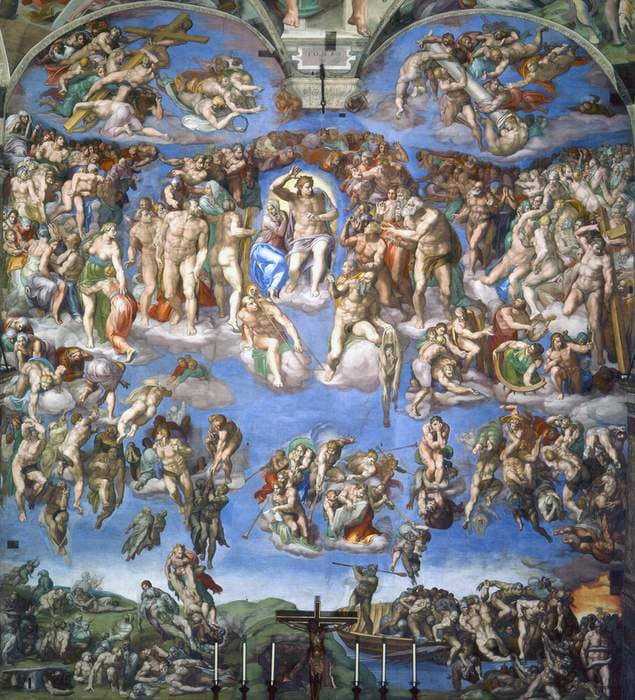
Selected artwork
The Last Judgment
1536–1541
Sistine Chapel
Other names (14)
Michael Agnolo, Michael Angel, Michaelangelo, Michael Angelo Bonalotti, Michael Angelo Bonnarotti, Michael Angelo Buonarota, Michael Angelo Buona Rota, Michael Angelo Buonaroti, Michael Angelo Buona Roti, Michael Angelo Buonarotti, Michael Angelo de Bonarotti, Michael Angelo di Buonarotti, Michael Anglelo, Micheangiolo Buonarroti
Biography
Michelangelo di Lodovico Buonarroti Simoni (6 March 1475 – 18 February 1564), known mononymously as Michelangelo, was an Italian sculptor, painter, architect, and poet of the High Renaissance. He was born in the Republic of Florence but was mostly active in Rome from his 30s onwards. His work was inspired by models from classical antiquity and had a lasting influence on Western art. Michelangelo's creative abilities and mastery in a range of artistic arenas define him as an archetypal Renaissance man, along with his rival and elder contemporary, Leonardo da Vinci. Given the sheer volume of surviving correspondence, sketches, and reminiscences, Michelangelo is one of the best-documented artists of the 16th century.
Michelangelo achieved fame early. Two of his best-known works, the Pietà and David, were sculpted before the age of 30. Although he did not consider himself a painter, Michelangelo created two of the most influential frescoes in the history of Western art: the scenes from Genesis on the ceiling of the Sistine Chapel in Rome, and The Last Judgment on its altar wall. His design of the Laurentian Library pioneered Mannerist architecture. At the age of 71, he succeeded Antonio da Sangallo the Younger as the architect of St. Peter's Basilica. Michelangelo transformed the plan so that the Western end was finished to his design, as was the dome, with some modification, after his death.
Michelangelo was the first Western artist whose biography was published during his lifetime. Giorgio Vasari's Lives (1550), in which he was the only living artist given a biography, presented his work as the culmination of the revival of the arts and called him divino, an honorific then extended to several celebrated writers and artists. Ascanio Condivi's Life (1553), prepared with Michelangelo's participation, corrected Vasari in places, and Vasari incorporated much of it into his expanded edition of 1568.
His contemporaries admired his terribilità—his ability to instill a sense of awe in viewers of his art. Attempts by subsequent artists to imitate the expressive physicality of Michelangelo's style contributed to the rise of Mannerism, a short-lived movement in Western art between the High Renaissance and the Baroque.
Wikipedia contributors. Opening excerpt, formatted for reading. CC BY-SA 4.0. Source revision.
Influenced by
- Masaccioeditorial inference
Evidence
Explicit secondary-source assertion; independent historical verification remains pending.
- Domenico Ghirlandaioeditorial inference
Evidence
Wikidata assertion retained for review; its references, if supplied, have not been independently verified. Teaching is recorded separately and does not itself establish artistic influence.
- Giotto di Bondoneeditorial inference
Evidence
Explicit secondary-source assertion; independent historical verification remains pending.
Later influence
- Titianeditorial inference
Evidence
Explicit secondary-source assertion; independent historical verification remains pending.
- John Singer Sargenteditorial inference
Evidence
Explicit secondary-source assertion; independent historical verification remains pending.
- Daniele da Volterraeditorial inference
Evidence
Explicit secondary-source assertion; independent historical verification remains pending.
- José Clemente Orozcoeditorial inference
Evidence
Explicit secondary-source assertion; independent historical verification remains pending.
- Guido Renieditorial inference
Evidence
Wikidata assertion retained for review; its references, if supplied, have not been independently verified.
- Henry Mooreeditorial inference
Evidence
Explicit secondary-source assertion; independent historical verification remains pending.
- Auguste Rodineditorial inference
Evidence
Explicit secondary-source assertion; independent historical verification remains pending.
- Tintorettodocumented
Evidence
The museum identifies Michelangelo’s figure construction as a model for Tintoretto. The cited museum text was read and supports this relationship.
- Théodore Géricaulteditorial inference
Evidence
Explicit secondary-source assertion; independent historical verification remains pending.
- Raphaeleditorial inference
Evidence
Explicit secondary-source assertion; independent historical verification remains pending.
- Edgar Degaseditorial inference
Evidence
Explicit secondary-source assertion; independent historical verification remains pending.
- Antoine Wiertzeditorial inference
Evidence
Reviewed the named influence and direction in the source passage. Explicit secondary-source assertion; independent historical verification remains pending.
- Johann Georg Pinzeleditorial inference
Evidence
Explicit secondary-source assertion; independent historical verification remains pending.
- Hendrik Goltziuseditorial inference
Evidence
Explicit secondary-source assertion; independent historical verification remains pending.
- Maerten de Voseditorial inference
Evidence
Explicit secondary-source assertion; independent historical verification remains pending.
- Jean-François Milleteditorial inference
Evidence
Explicit secondary-source assertion; independent historical verification remains pending.
- Andreas Friiseditorial inference
Evidence
The biography identifies Michelangelo as an artistic influence on Andreas Friis. The biography locates these inspirations during Friis's Paris study period. Explicit secondary-source assertion; independent historical verification remains pending.
- Sebastiano del Piombodocumented
Evidence
The National Gallery describes Michelangelo’s significant influence on Sebastiano, including designs for The Raising of Lazarus. The cited museum text was read and supports this relationship.
- Parmigianinodocumented
Evidence
The National Gallery identifies Parmigianino’s artistic debt to Michelangelo. The cited museum text was read and supports this relationship.
- Bronzinodocumented
Evidence
The National Gallery identifies Michelangelo’s influence on Bronzino’s Mannerist art. The cited museum text was read and supports this relationship.
- John Michael Wrighteditorial inference
Evidence
The biography identifies Michelangelo as an artistic influence on John Michael Wright. Wright is explicitly said to have adopted tone and style from Michelangelo, Raphael and Titian during his Italian period; the other named portraitists are comparisons or favoured rivals. Explicit secondary-source assertion; independent historical verification remains pending.
Artworks by year
Loading chronology…Museum / collectionAll collections
Finding recorded artworks…
Museums & collections
Documented holdings of works attributed to Michelangelo. Check the museum’s record for current display information.
- Sistine Chapel10 recorded works
- British Museum3 recorded works
- National Gallery of Art2 recorded works
- Pauline Chapel2 recorded works
- The Metropolitan Museum of Art2 recorded works
- Kimbell Art Museum, Fort Worth, TX, US1 recorded work
- National Gallery1 recorded work