Twenty works from the Van Gogh Museum, from a Borinage coal mine and The Potato Eaters to the colour of the French years, with pictures by Gauguin, Bernard, Pissarro, Angrand and Boulanger.
The Van Gogh Museum in Amsterdam holds a major collection of Vincent van Gogh's paintings, drawings and letters. His career was fairly short, and the pictures show how far he moved within it, from the sombre palette of his Dutch period to the intense colour and charged surfaces of the work he made in France. The letters, now available in a scholarly edition, record much of what he was trying to do.
Most of the works chosen here are Van Gogh's own. They run from an early watercolour of a coal mine in the Borinage and the lamplit table of The Potato Eaters to the blossom, irises and sunflowers of his later years, with a painting of worn shoes along the way and a chalk drawing of a woman picking up a stick among the late works. A few come with circumstances worth knowing: a painting identified as a gift for a newborn nephew, a legend the museum rejects, irises whose colour has shifted since they were painted. The other pictures are by painters who worked very differently: Gauguin's view of Van Gogh at work, a self-portrait by Émile Bernard that includes an image of Gauguin, Pissarro's haymakers at Éragny, Charles Angrand's view of the Seine and Gustave Boulanger's highly finished Phryne. They set Van Gogh's handling beside other approaches to colour and finish, and in Gauguin's case they show him as another painter saw him.
Artline chose these works from the museum's documented holdings, independently of the museum. Dates and attributions keep the qualifications given in the linked records.
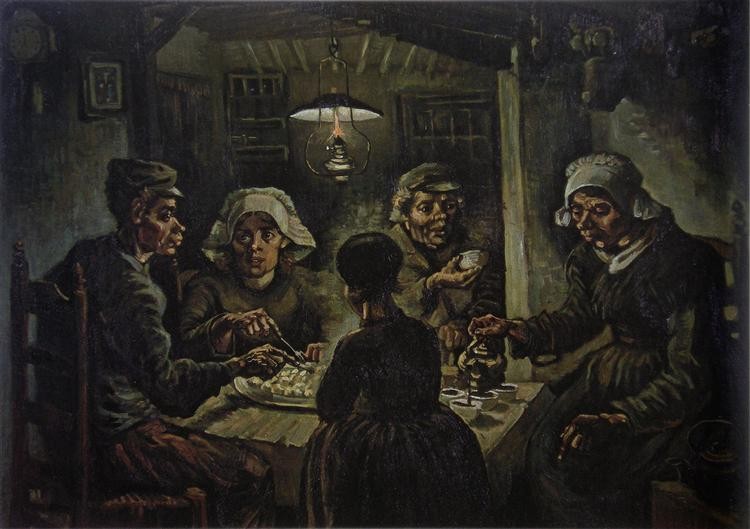
Five people sit round a table under a small lamp. The light is poor, the food is simple, and the hands and faces are angular to the point of clumsiness. The clumsiness is part of the point. Van Gogh meant this picture of rural labour to be taken seriously, and he wanted to show people whose lives had been shaped by work without borrowing the manners of polite portraiture.
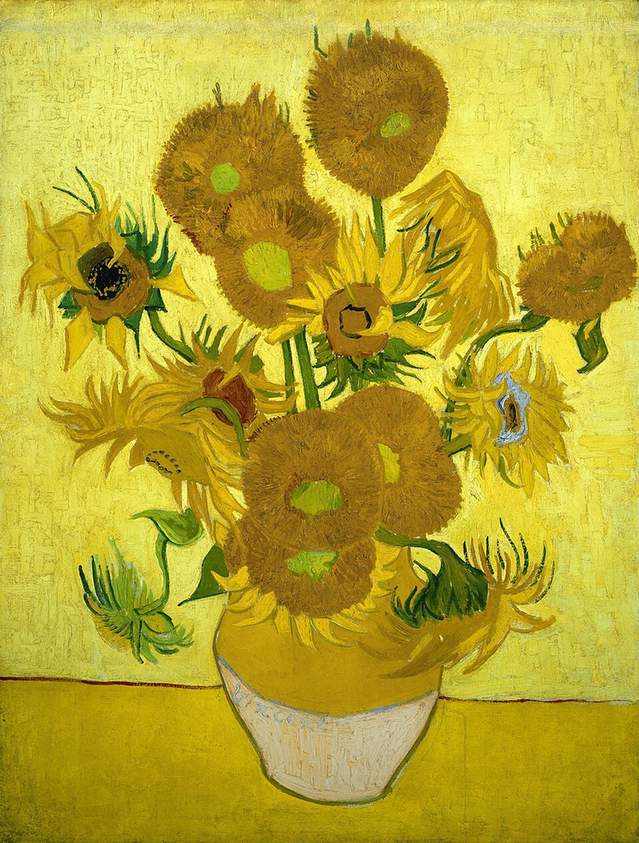
The difficulty is plain enough: a crowd of yellow flowers held within a narrow range of closely related tones, any of which might merge with its neighbours. Van Gogh keeps them apart by other means. Some stand upright and others droop. Each is at its own stage of growth and turns its own way, and the dark seed heads break up the yellow wherever it threatens to settle into a single mass.
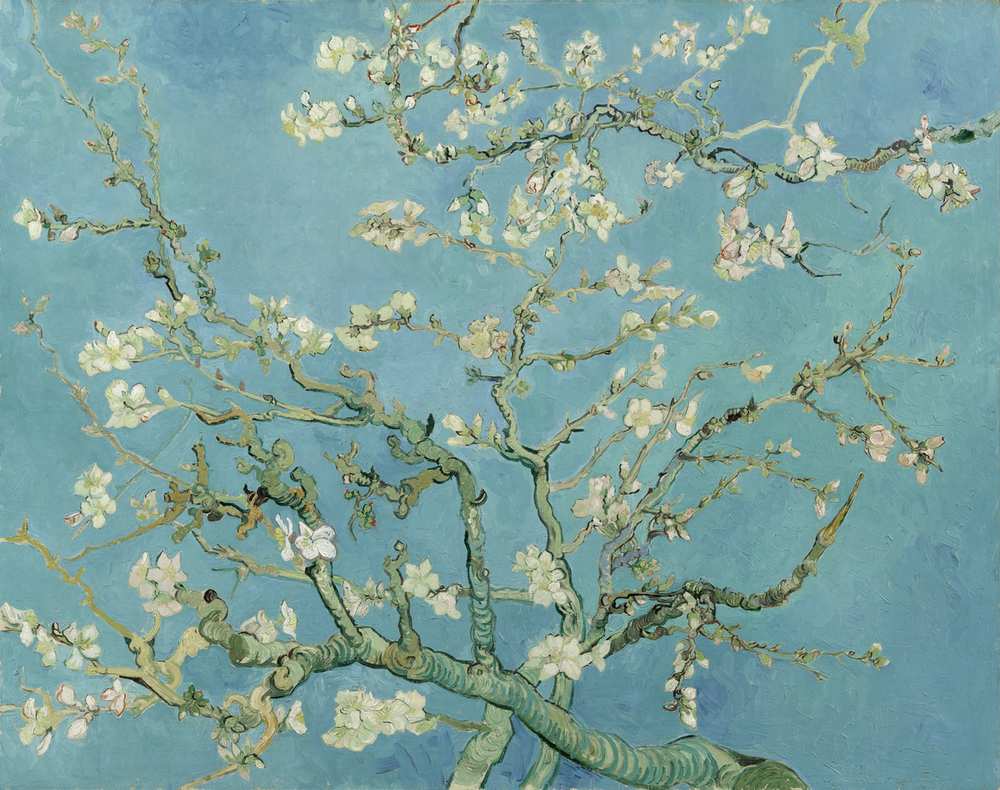
The museum identifies this painting as a gift for Van Gogh's newborn nephew. There is no trunk and no wider landscape, only branches and the intervals between them. The blue ground gives that intricate network room, and the pale flowers stay distinct against it, so the picture is organised as much by its gaps as by its blossom.
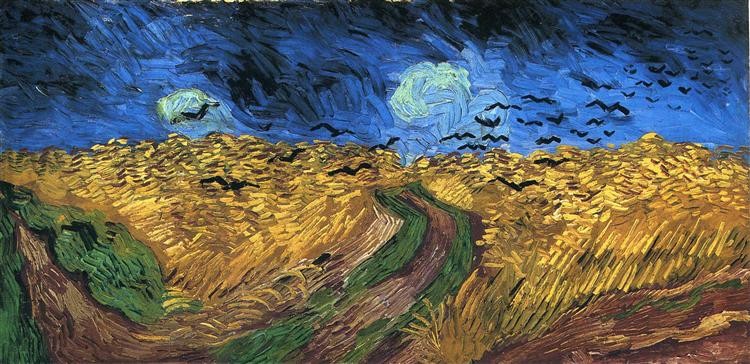
A persistent story makes this Van Gogh's final painting. The museum rejects it, and the canvas is unsettling enough without the story's help. Paths lead into the wheat in competing directions, so that none settles as the way in, dark birds cross the sky, and the brushwork stays forceful throughout.
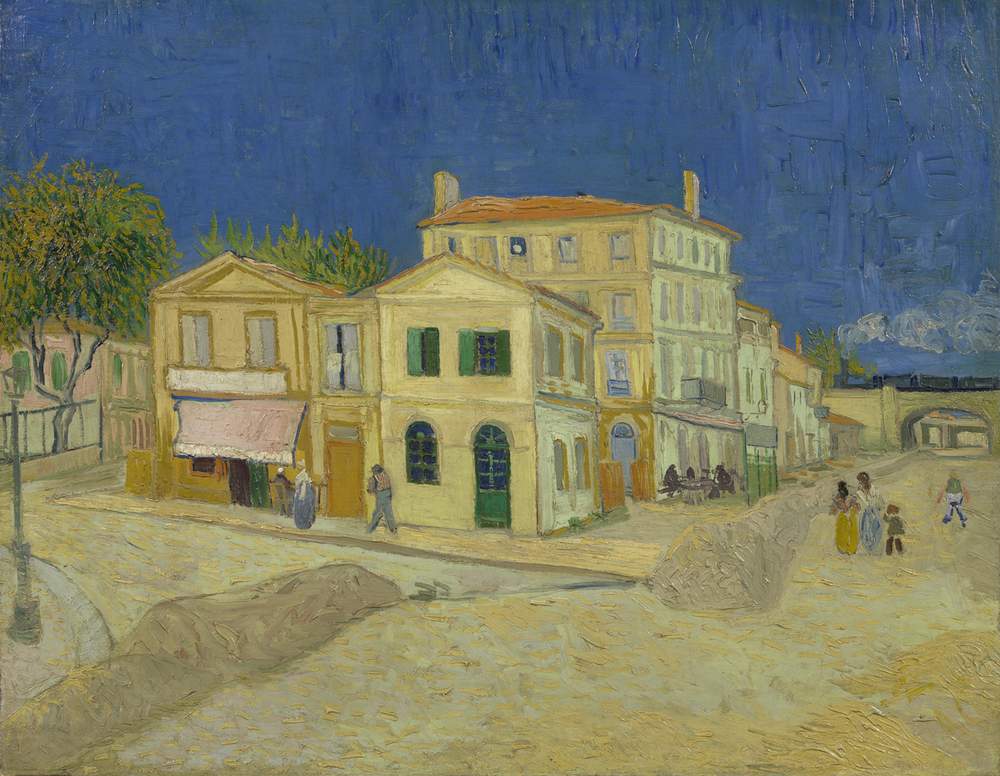
Title and colour both single out the house, yellow against a deep blue sky. Yet the painting does not isolate it. Neighbouring buildings, pedestrians and the open street keep it within a working town, and for all its strength the colour never pushes those ordinary surroundings out of the picture.
September–October 1887 · Oil on cotton · Van Gogh Museum
Short strokes change direction as they travel round the hat, the face and the clothing. Orange in the beard answers cooler passages nearby, and the space around the head plays its part in describing it too. The likeness is built from these contrasts as much as from the features themselves.
Gauguin shows Van Gogh absorbed in his work, the bent arm linking the painter to the sunflowers beside him. The method is Gauguin's own: broad areas of colour, far removed from the short, restless strokes of the Self-Portrait with Grey Felt Hat. It is one artist's interpretation of another, not a neutral record of Van Gogh at work.
Books and a burning candle rest on the empty seat. Gauguin himself is absent, and a few chosen objects stand in for him, while the curved chair, the green wall and the patterned floor carry the colour. Beside the previous picture it makes a curious pairing: Gauguin painted Van Gogh at work, and Van Gogh painted Gauguin's empty chair.
The blossom is scattered, never massed into one pale canopy, and the gaps keep the slim branches readable against the sky. Fencing and smaller trunks place the tree in an orchard. Almond Blossom, earlier in the selection, also depends on the spaces between branches but cuts away everything else. Here the setting stays.
A glass and a carafe stand before a window, one transparent thing set in front of another. Reflections and the street outside find their way into the objects on the table, so that the glass opens onto the space behind it and interrupts it at the same time.
Boulanger shades the skin with great care, sets the figure among cushions and brings everything to a precise finish. The raised hand and the reclining pose belong to a staged presentation. After the angular hands and faces of The Potato Eaters, this marks the far end of the range in the selection: a body arranged and polished to be looked at.
Almost nothing on this broad river catches the eye. Angrand works instead with small shifts within pale, closely related tones, enough to keep the water quiet without letting it go blank, while trees and buildings mark out a low distance. Sunflowers also keeps to a narrow band of related tones, but Van Gogh crowds it with competing forms. Angrand leaves his almost empty.
Bernard brings another artist into his self-portrait without pretending the two men share a room. His own face, cropped, sits beside a smaller image of Gauguin. The two likenesses keep to separate spaces, and pale blue links them across the gap. In Van Gogh's painting Gauguin appeared only as an empty chair; here he has a face, though still at one remove, as a picture within a picture.
Pissarro paints the haymakers with the same small coloured marks he uses for the ground. They remain recognisable as people, but they are made of the same stuff as the field, and their movements recur among the haystacks in a pattern of repeated labour. Van Gogh's chalk drawing of a woman picking up a stick, next in this selection, works the other way, setting the bending body apart from the trees around it.
The sharp bend of the body tells you what is happening before the foliage has been sorted out. The chalk then does the sorting, with strokes running in different directions for the clothing, the trunks and the leaves. Elsewhere the drawing is left open.
1879 · Pencil and watercolour on paper · Van Gogh Museum
Low buildings and smoking chimneys spread across a spare landscape, and small figures give the industrial structures a human scale. This pencil and watercolour sheet is the earliest of Van Gogh's works in the selection. It has none of the bright palette later associated with him, but it already takes a place of labour as its subject.
The large bed and two chairs leave little free space. Angled furniture and the pictures on the walls keep the simplified geometry conspicuous, and the room is built from strong boundaries and colour relationships. There is more than one Bedroom. The Amsterdam canvas is the version painted in October 1888. Van Gogh's later painted versions, like the sketches of the room in his letters, are separate works.
The flowers push out against a yellow ground, and pointed leaves and falling stems break past the edge of the bouquet. What survives, though, is not quite what Van Gogh painted. A red pigment has faded, and the irises have shifted from violet towards blue. The contrast with the yellow is still strong, but it is not the contrast he set down, and reproductions show the painting as it is now, not as it first looked.
The shoes face the viewer at different angles, and the paint lingers over worn leather, openings and laces. Van Gogh gives them room enough to stand as a subject in their own right and identifies no wearer, so the signs of use are left to speak for themselves. In The Potato Eaters work has shaped the people themselves. Here its marks appear without anyone present.
Here the irises serve as a foreground. They keep their busy pattern while the depth opens up behind them, with bands of cultivated land leading back to the distant town, where trees break the far line. Repeated areas of colour carry the eye from front to back. Beside the still life of Irises, the same flower has a quite different job to do.
Explore this selection in Artline
See the selected works alongside books and events from their period, or compare when the artists lived. The books and events provide context, not evidence of direct influence. Works without confirmed dates remain in this guide.
Following a thread
Some choices recur across these twenty works, and following one through several of them is a good way to use the selection. Yellow is an obvious candidate. It is kept to a narrow band of related tones in Sunflowers, set hard against a deep blue sky in The Yellow House, and laid down as the ground of Irises, behind flowers that no longer look as they once did. Labour is another, from the small figures at the Borinage mine and the people at the lamplit table in The Potato Eaters to the worn shoes and the woman bending for a stick. Biography can come in where it is documented, and the letters are the place to check it.
Further reading
Vincent van Gogh; edited by Leo Jansen, Hans Luijten and Nienke Bakker · Read free · English translations and original texts
Van Gogh's correspondence, edited for the Van Gogh Museum and the Huygens Institute, with the original texts alongside English translations, images and scholarly notes, all free to read. For a reader of this guide the most useful feature is that the edition can be searched by artwork, so what Van Gogh himself wrote about a painting can be set beside what has been written about it since.
 Art, literature & history