Statens Museum for Kunst, usually shortened to SMK, is Denmark's national gallery in Copenhagen. Its collection runs from older European painting through Danish art to modern work. Most of this selection is Danish.
Rome comes up again and again: Bloch's osteria, Marstrand's charlatan in Piazza Barberini, Eckersberg's view into the damaged Colosseum and Constantin Hansen's group portrait of Danish artists gathered in the city. Copenhagen supplies a corvette on the stocks and Købke's prospect towards Nørrebro. Eckersberg's name comes up more than anyone else's, and his pictures here move from an ancient ruin to open sky to a ship not yet afloat.
Several painters looked close to home. Hammershøi and Matisse each painted their wives, Haslund his children at the piano, and Bendz a fellow painter checking a sketch in a mirror. Hammershøi also painted his easel in a room without its painter. The remaining pictures come from elsewhere in Europe, from El Greco and Cornelis van Haarlem in the sixteenth century to Matisse, Derain and Modigliani in the early twentieth.
Artline chose these works from SMK's documented holdings, independently of the museum.
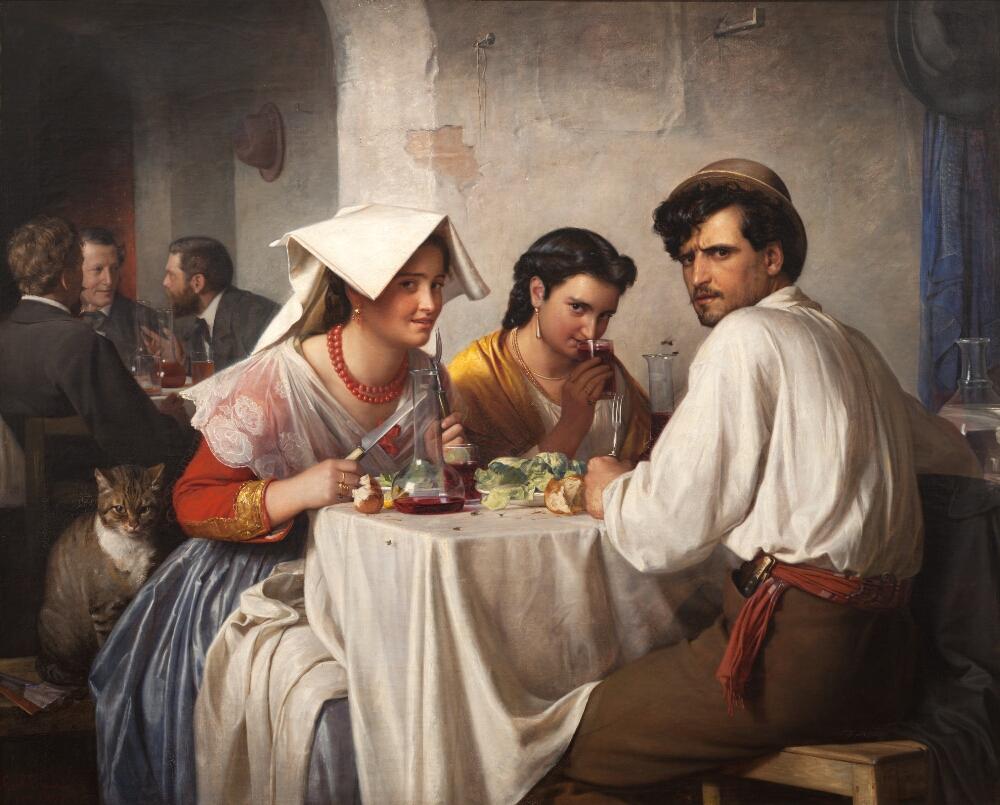
An osteria is a tavern, and Bloch's group sits round a table among cups, food and furniture in what seems an ordinary social scene. Then you notice that one figure has turned to look straight out of the picture. That direct look gives the gathering its awkward immediacy, as though the viewer had been caught watching.
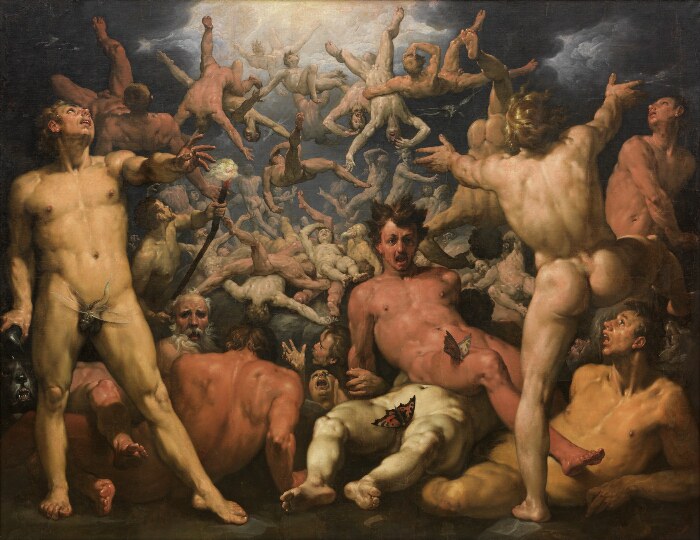
1588-1590 · Oil on canvas · Statens Museum for Kunst
Cornelis van Haarlem tells the Titans' defeat almost entirely through anatomy. The falling bodies twist in opposite directions, and the rocks give them points of contact but no stable position. The myth becomes an occasion for showing how far the human body can turn and stretch before it loses all purchase.
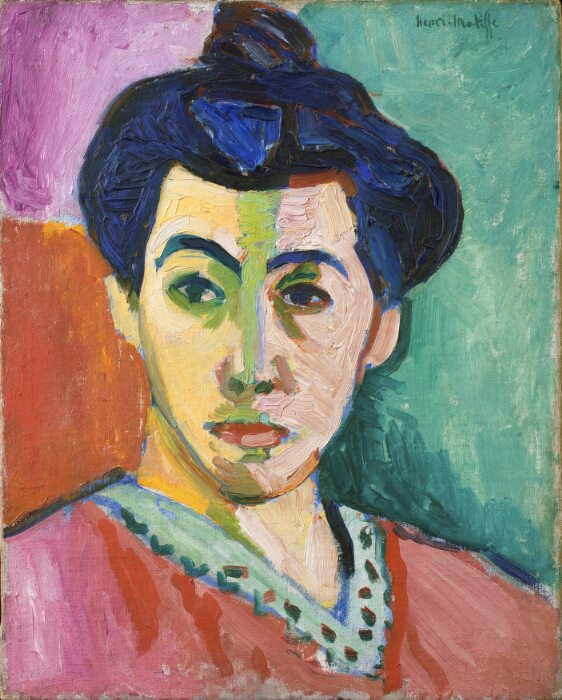
A green band divides Amélie Matisse's face into two halves of different colour, yet she remains recognisable. The painting makes no attempt at naturalistic flesh tones. Its force comes from colour contrast.
It is also small, about 40.5 by 32.5 centimetres, which is easy to forget given the strength of its colour.
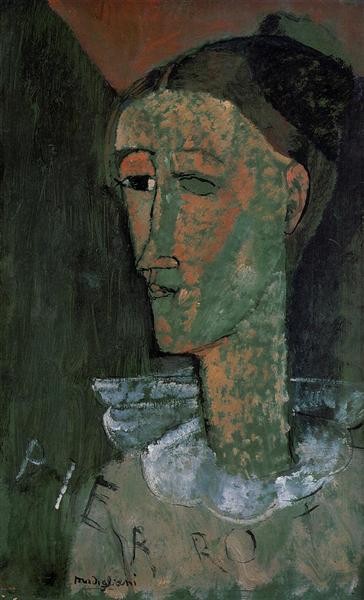
1915 · Oil on cardboard · Statens Museum for Kunst
The ruff and angular headwear mark the figure as Pierrot, a theatrical role. Modigliani builds the long face from narrow features and greenish patches. Mask-like as it is, it still reads as a person's face, so a picture of a stage character comes close to being a portrait. It is painted on cardboard.
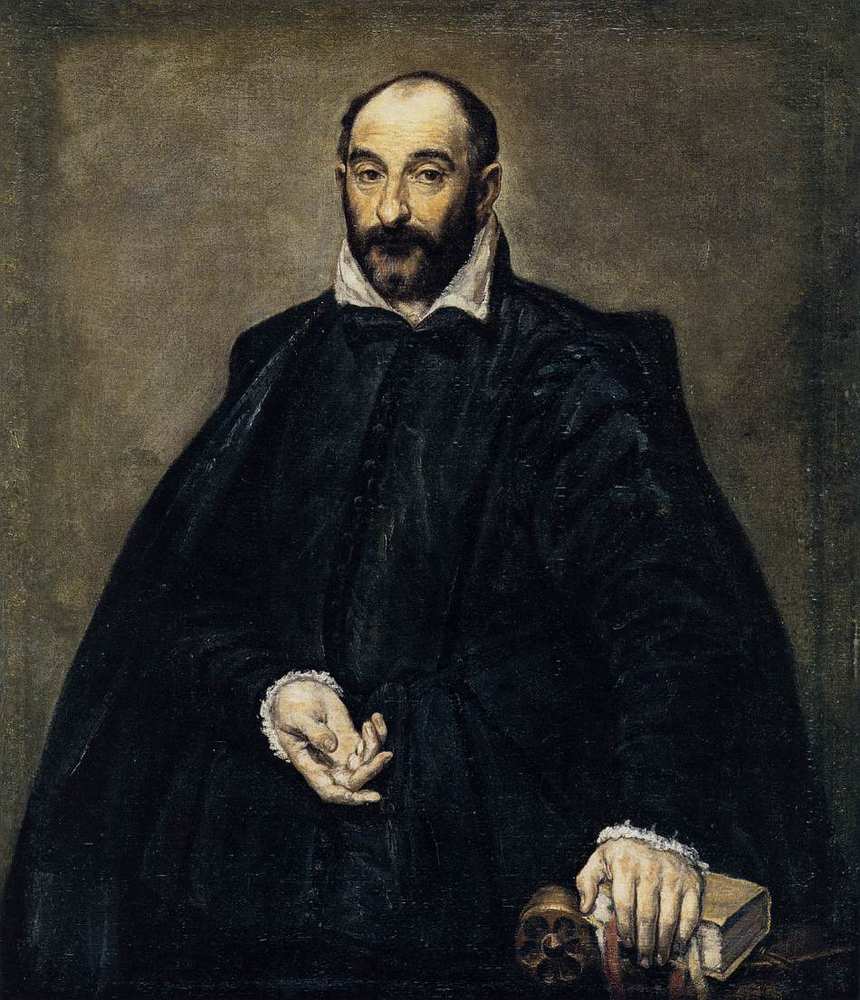
The sitter has sometimes been identified as Palladio, but that identification is disputed. Whoever he was, his dark clothing is compact and the setting subdued, so a few details carry the portrait. The cuffs and beard stand out clearly, and a pale hand reaches beyond the dark mass of the body, giving the picture some action outside the face.
Abildgaard puts the pain into the whole body. Both of Philoctetes' hands lead to his injured foot, and his back and limbs fold around it. He is shown alone, with no other figure to share the weight of the scene.
Hansen's fellow artists share a room but not an activity. Some sit, others stand, and they turn in different directions. Each is an individual likeness, and each seems busy with his own work. It is a group portrait without ceremony. An open view beyond keeps the room from closing in.
The damage does not make the Colosseum hard to read. Eckersberg builds the view from intervals and shifting planes, so the arches and broken walls still read as parts of one structure and the distances between them can be followed. Small figures give the human scale. Nothing much happens to them.
Købke sets a flagpole, the one firm vertical, against the long horizontals of water and sky. Two figures nearby and a boat in the distance take up only a small part of the view.
The title names the artist's wife, but her face is hidden. Hammershøi tells us far more about the room. Its limits are unusually clear, and in all that stillness a small grid of sunlight on the floor counts as an event.
An easel and a framed picture mark this as a place of work, but the artist is absent. An open doorway leads into a further room where nothing is happening either. The Strandgade interior at least has a figure in it, even if her face is hidden. Here painting is present only through its equipment and an empty setting.
The woman rests her chin on her hand, a familiar pose that keeps the body easy to read. That may be what leaves Derain free with colour. Pink, blue and green blur the usual distinctions between skin, fabric and shadow, and colour builds the figure as much as any outline does. Matisse's portrait of his wife, which also gives up naturalistic flesh tones, makes a natural companion.
c. 1793-1797 · Oil on canvas · Statens Museum for Kunst
Gestures link the seated older man with the two standing figures. The landscape, with its distant view, gives the family a wider social setting. Their position comes across through land and surroundings as well as through their likenesses.
Ditlev Blunck, himself a painter, looks at a sketch in a mirror, which shows it to him the other way round. Tools and canvases crowd the working room. Bendz paints the pause in which Blunck judges what the reversed view reveals.
Like the easel in Hammershøi's interior, the violin implies someone who is not there. It lies at rest, and there is no musician in sight. In Matisse's picture the absence counts for less. Open shutters connect the room to a brighter outside, dark frames separate the adjoining areas, and the instrument and furniture become parts of the colour arrangement without becoming the centre of a story.
The title says Concert, and some of Haslund's children and their playmates do concentrate on the piano. Others, including the youngest, spoil any idea of a perfectly coordinated performance. The scene is more particular because of them.
1840-1849 · Oil on canvas · Statens Museum for Kunst
The charlatan's demonstration has drawn an audience in Piazza Barberini. Persuasion is what joins the figures, and their varied responses matter as much as his gesture. The buildings and a fountain set the scene, but the sales pitch gives the picture its tighter structure: he has to win attention before he can sell anything.
A narrow band of ground lies under layers of cloud. Eckersberg divides the sky into heavier masses and paler openings, ordering something with no fixed structure much as he ordered the broken arches of the Colosseum. This is a study, and the clouds are its whole subject.
Eckersberg shows the corvette raised on wooden supports, before it is afloat. Out of the water, the hull shows surfaces that would normally be hidden. The timber framework shows how so large a structure rests on the ground.
c. 1881-1884 · Oil on panel · Statens Museum for Kunst
The man stands beside his house, head lowered and stance supported, while bright light spreads across the ground around him. The title tells us he is blind. Light falling around a man who cannot see it could easily have been made into a pointed contrast. Ancher studies his posture as closely as he might in a portrait and keeps him part of the landscape.
Explore this selection in Artline
See the selected works alongside books and events from their period, or compare when the artists lived. The books and events provide context, not evidence of direct influence. Works without confirmed dates remain in this guide.
Size and support
On a screen every picture appears at much the same size, which hides real differences in this selection. Matisse's portrait of his wife is small, while Cornelis van Haarlem's scene of tumbling bodies is large. The supports vary too. Most of these paintings are on canvas, but Modigliani's Pierrot is on cardboard and Ancher's blind man is on panel. SMK's catalogue has useful object records.
Further reading
Wassily Kandinsky; translated by Michael Sadleir · Read free · English
This is Kandinsky's argument about colour, in Michael Sadleir's English translation. It gives historical context for the Matisse and Derain paintings, where colour does much of the work.
 Art, literature & history