The Rijksmuseum in Amsterdam holds the Netherlands' national collection of art and history, and it is best known for its seventeenth-century paintings. Rembrandt's Night Watch is the picture everyone knows. Around it, the collection is rich in the other things Dutch painters of that period did well: large civic group portraits, domestic interiors, winter landscapes and still lifes.
This selection keeps almost entirely to that century. The one later work is Breitner's snowy Amsterdam street. Rembrandt is here in strength, from The Night Watch and the syndics to a self-portrait in the role of the apostle Paul. Vermeer and Jan Steen contribute three paintings each, and they could hardly be less alike. Vermeer gives a whole canvas to a woman pouring milk, a woman reading a letter or the front of a brick house, while every one of Steen's pictures here is crowded with children. Several entries are worth reading in pairs. The obvious ones are the militia companies of Rembrandt and of Hals and Codde, and the married couple Hals put on a single canvas beside the pair Rembrandt painted as separate portraits.
A few questions remain open. One couple is only probably identified and an elderly sitter only possibly, and her portrait is merely attributed to the painter whose name it carries.
All of these paintings are documented Rijksmuseum holdings, but the selection was made independently of the museum. Being in the collection does not mean a painting is on show. Dates and attributions keep the qualifications given in the museum's records.
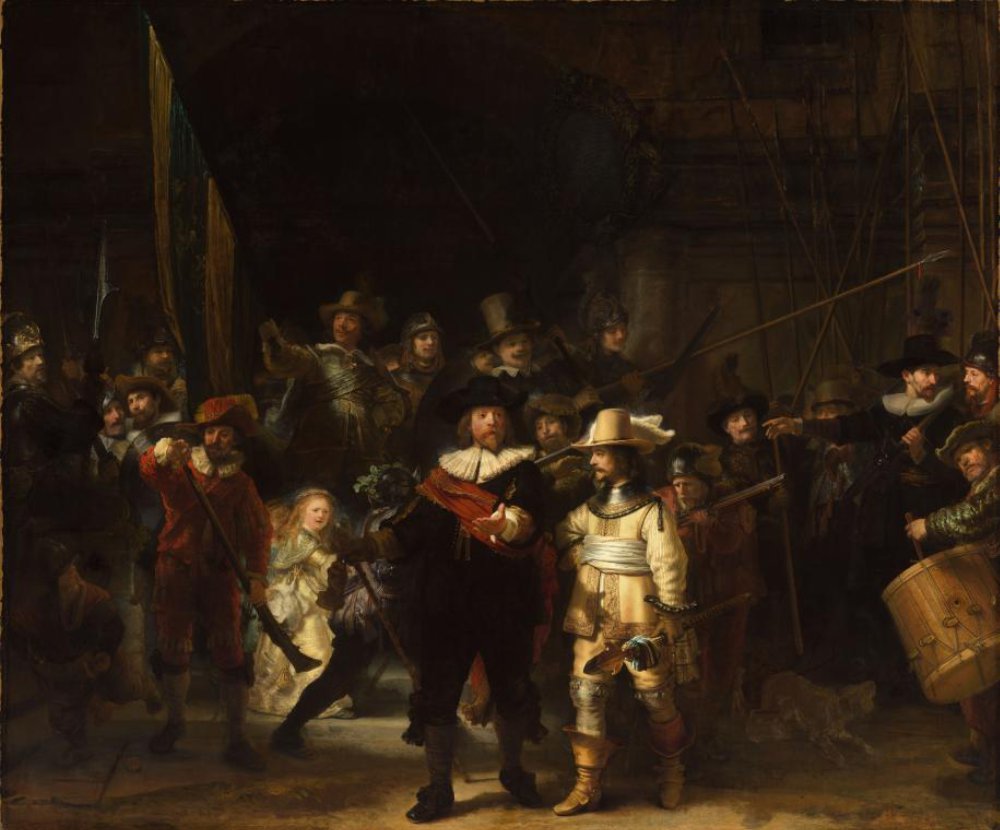
Despite its title, this is not a night scene. Much of the gloom that makes the familiar name seem apt comes from later changes in the painting's appearance.
What Rembrandt painted is a company of Amsterdam civic guards about to move off. Captain Frans Banninck Cocq and his lieutenant step forward while the men around them make ready, and hands, weapons, faces and flashes of light crowd the canvas. Rather than lining the men up in a neat row, Rembrandt turned the group portrait into an event in progress.
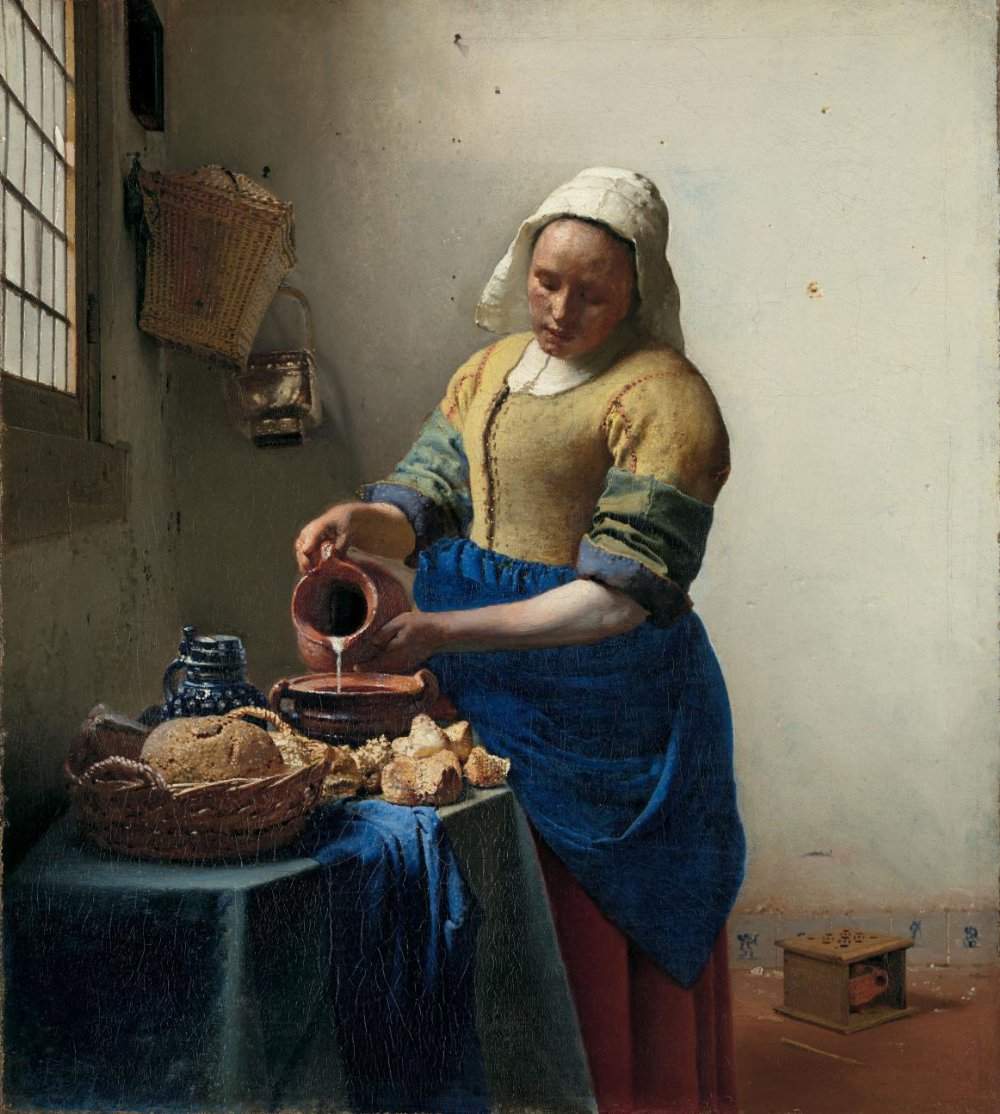
It is easy to look straight past the centre of this picture, which is a stream of milk thin enough to miss at a glance. The woman's whole pose is built around keeping it steady. Bread, a basket and the solid tabletop anchor the task. The wall behind her is left comparatively bare, so nothing competes with the pouring.
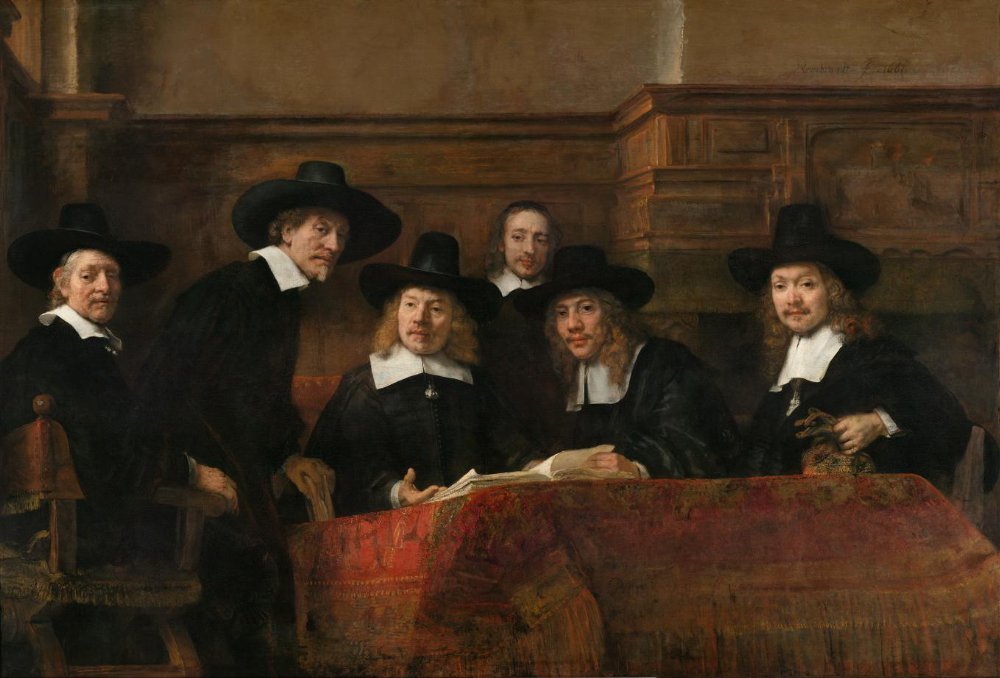
Several of the syndics look straight out, as if someone standing where we stand has just interrupted the business at the table. They do not react together. Their postures fall out of step and attention breaks unevenly across the group, so the viewer seems to have arrived a moment before everyone has quite looked up. The formality of an official portrait survives. Each man simply turns or pauses in his own time.
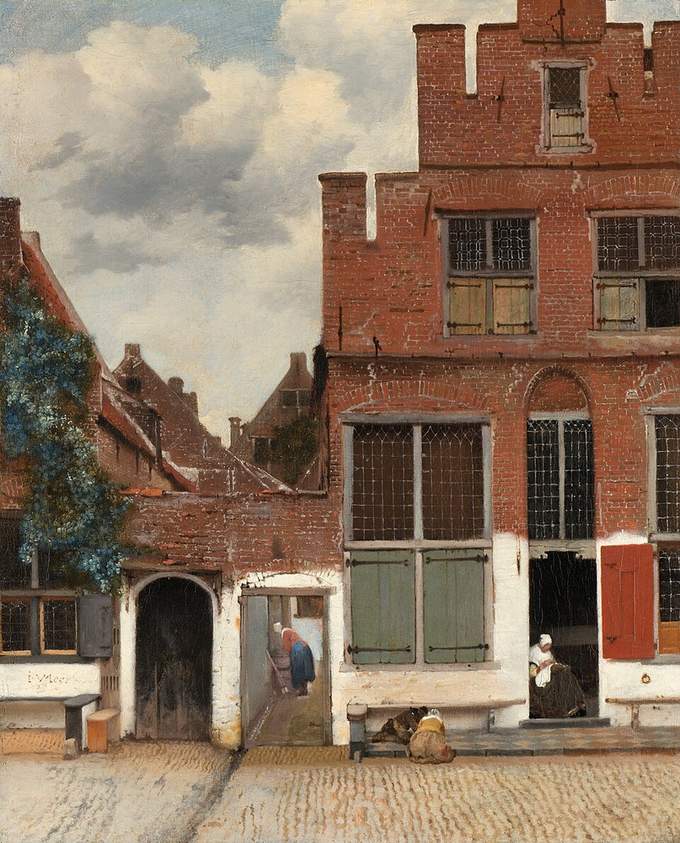
This is close to a portrait of a building. Most of the canvas goes to a brick house front and comparatively little to the people using its doors and passage. The figures are small enough to show that the place is lived in without drawing attention from the façade. Repairs interrupt the regular brickwork, so the house shows its age and wear, and Vermeer offers no story to account for them.
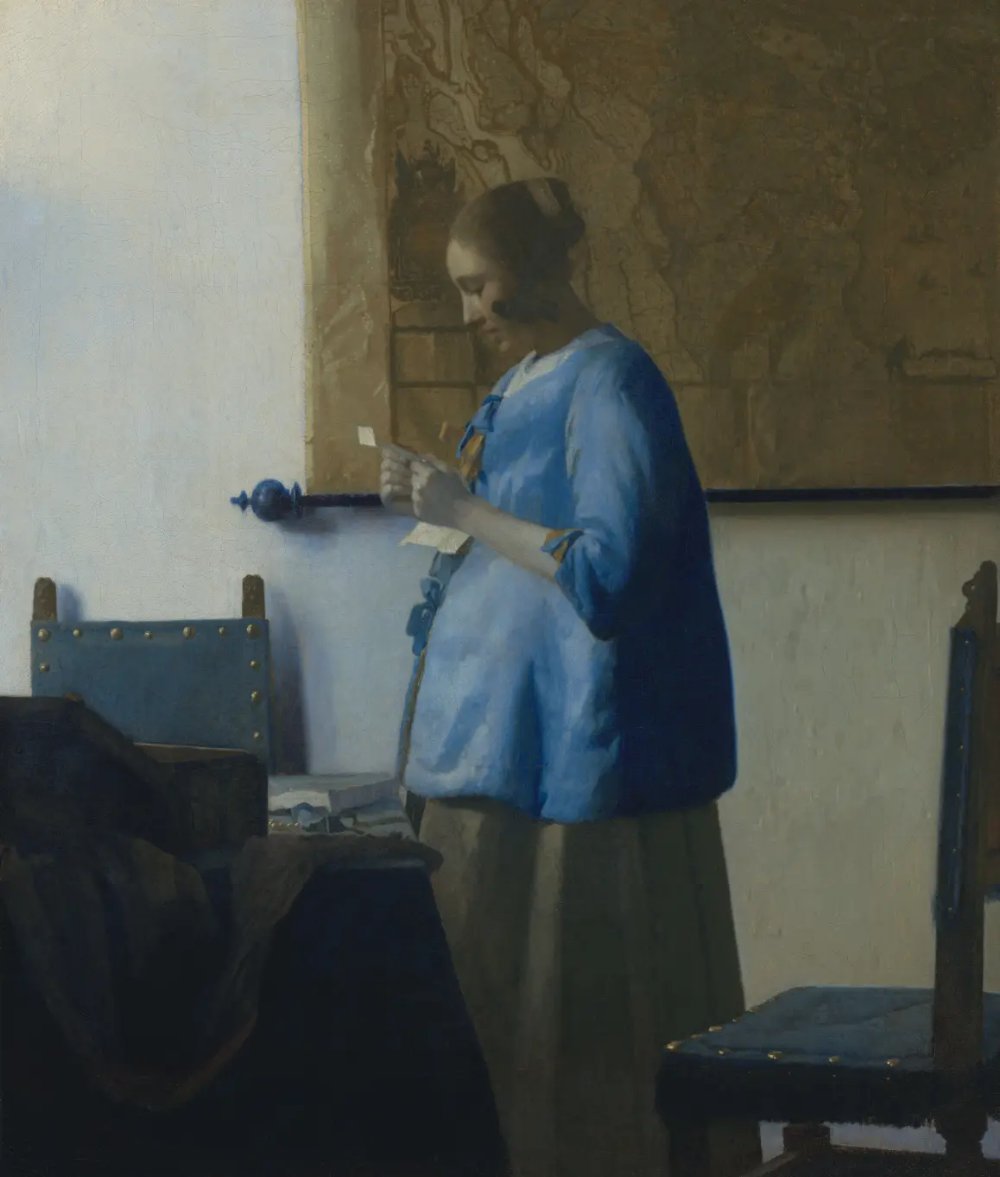
The letter is in plain sight, but we cannot read it. Vermeer shows the woman's absorption in full and withholds whatever has absorbed her. A map on the wall brings a wider world into the room and prompts an obvious question: has the letter come from somewhere out there? Nothing in the picture says so. The map tells us nothing about the message that holds her attention.
The title calls the swan threatened, but with its wings spread and neck outstretched it looks well able to do some threatening of its own. An approaching dog has provoked it. Against the dark water its bright body becomes a large, urgent shape, and the nest shows what is at stake.
The picture has invited symbolic readings. It does not need them. An intruder, a vulnerable nest and an animal fighting back make a complete drama without any allegory.
Objects lie scattered about and music and drink have taken over the table. The children are not left out of either. Steen gives the young their own versions of whatever the adults are doing, and it is hard not to read the household's merriment as a lesson in how children learn: by watching and copying.
Presents are the occasion, and not everyone is pleased with theirs. Some of the children are delighted and others are not, while the adults wait to see how things will turn out. Several small dramas run at once, and Steen lets none of them set the mood for the whole room. The Merry Family seems to point a lesson, but this feast is harder to sum up.
The dark costume is less plain than it looks. Collar and cuffs give it bright edges, and subtler shifts of light pick out costly materials, so the restraint is itself part of the display. The full-length format gives Oopjen Coppit room to stand as a complete figure.
Oopjen Coppit's display is held in, but Marten Soolmans's is pushed outward. A bent arm widens his outline, and pale stockings and elaborately ornamented shoes draw the eye down the full length of the figure. His clothes are doing public work. The two are painted at the same scale but not in the same pose, so the portraits read as a pair without either sitter simply mirroring the other.
As the title says, the subject is enjoyment of the ice. Frozen water gives Avercamp one continuous surface on which to spread a great many small activities. He tells the groups apart by posture and spacing, and they fade by degrees into the pale distance. No group becomes the centre, so the way into the picture is to pick out its incidents one at a time.
Rembrandt gave Marten and Oopjen a portrait each. Hals puts his couple together beneath the foliage, leaning close and both smiling out at the viewer. The marriage is shown through closeness, not through a matching pair of formal poses, and by comparison the picture feels relaxed. The sitters are probably Isaac Massa and Beatrix van der Laen, though the identification is not certain.
Frans Hals and Pieter Codde both worked on this company portrait, which had to present each civic guard as an individual and still hold the company together. Their answer is a wide formation. Sashes, weapons, the standard and shifts of stance keep the line from going rigid and give it a rhythm. A few years later, in The Night Watch, Rembrandt met the same demand by setting his company in motion.
The cat has clearly not volunteered. The children are enjoying their game, the animal is stuck in a predicament, and the comedy lies in the gap between the two. A dog below adds a reaction of its own.
Two things about this portrait are uncertain: who she is and who painted her. The Rijksmuseum names her as possibly Elisabeth Bas and attributes the picture to Ferdinand Bol, committing to neither.
The painting itself is spare. Her joined hands form a second focus below her face, and a white collar separates both from the expanse of dark clothing. She sits formally and very still.
The face is recognisably Rembrandt's own, while the book and the wrapped head covering belong to the apostle Paul. There is little else to go on. He is set alone against dark surroundings, with no scene or story around him, so the figure has to be read as self-portrait and role at once: the painter cast as the apostle.
In Vermeer's Little Street the figures stay small. Breitner brings one right to the front. The woman walking in the foreground is too close and too large to settle into the view. The frame crops her as she moves, and her figure cuts across the view back to the bridge and buildings. The snowy Amsterdam setting is still recognisable, but she takes over the space nearest the viewer, and the picture becomes a passing encounter with someone on the street.
The vase is packed tight, yet no flower is lost in the crowd and none dominates. Each holds on to its own colour, shape and direction. Curling stems and small insects push past the edges of the bouquet, so there is no clean line where the arrangement stops and the empty background begins.
Heavy cloud covers most of the sky, and the little light that breaks through falls on the snow. Everything else is kept subdued, which is why that narrow opening tells so strongly. Small figures give a sense of human scale. Avercamp's figures invite you to pick them out one by one, but these belong to the larger rhythm of light and weather.
Most of the interiors in this selection are domestic. Metsu's is a place of work. The workshop is dim and crowded, with tools, metal and equipment partly filling the room, and in the low light some objects are hard to tell from their neighbours. Two workers occupy different points in the space, and a small, hot glow marks where the work itself is being done.
Explore this selection in Artline
See the selected works alongside books and events from their period, or compare when the artists lived. The books and events provide context, not evidence of direct influence. Works without confirmed dates remain in this guide.
Holding a crowd together
The order of this guide is not a route through the galleries, and some of its most useful connections cut across the usual divisions by type. Many of these pictures face the same practical problem: how to fit a great many separate things into one image without letting any of them swallow the rest. In the militia companies this problem came with the task, because each guard had to be presented as an individual. Hals and Codde keep their guards in a long, varied line. Rembrandt puts his in motion, and in The Syndics he lets attention pass unevenly from one man to the next. Avercamp meets a version of the same problem on the ice, where he spreads his figures so evenly that nobody takes charge. Steen meets another at the Saint Nicholas feast, where the children's reactions pull in different directions. Even de Heem's crowded vase works on similar terms, with every flower allowed its own colour and direction.
Further reading
Walter Liedtke · Read online or download · English
Walter Liedtke's two-volume catalogue deals with the Metropolitan Museum's Dutch paintings, not the Rijksmuseum's, but its detailed entries cover many of the painters in this selection. Because it studies one work at a time, it is also a good guide to how group portraits, domestic interiors and still lifes differ as kinds of painting. It is in English and can be read online or downloaded.
 Art, literature & history