Nationalmuseum in Stockholm holds Sweden's national collections of painting, sculpture, drawing and decorative arts. Its older paintings reflect centuries of collecting by the Swedish court and other patrons. Its later ones show Swedish artists responding to developments elsewhere in Europe and to subjects closer to home.
The collection has royal roots, but none of the pictures chosen here is a formal royal portrait. Rembrandt appears three times, with a resting woman, a biblical encounter and a sworn conspiracy: The Kitchen Maid, Simeon in the Temple and The Conspiracy of the Batavians. There are also works by Zurbarán, Boucher, Renoir, Cézanne and Van Gogh, and Alexander Roslin's portraits of the botanist Linnaeus and of Marie Suzanne Roslin.
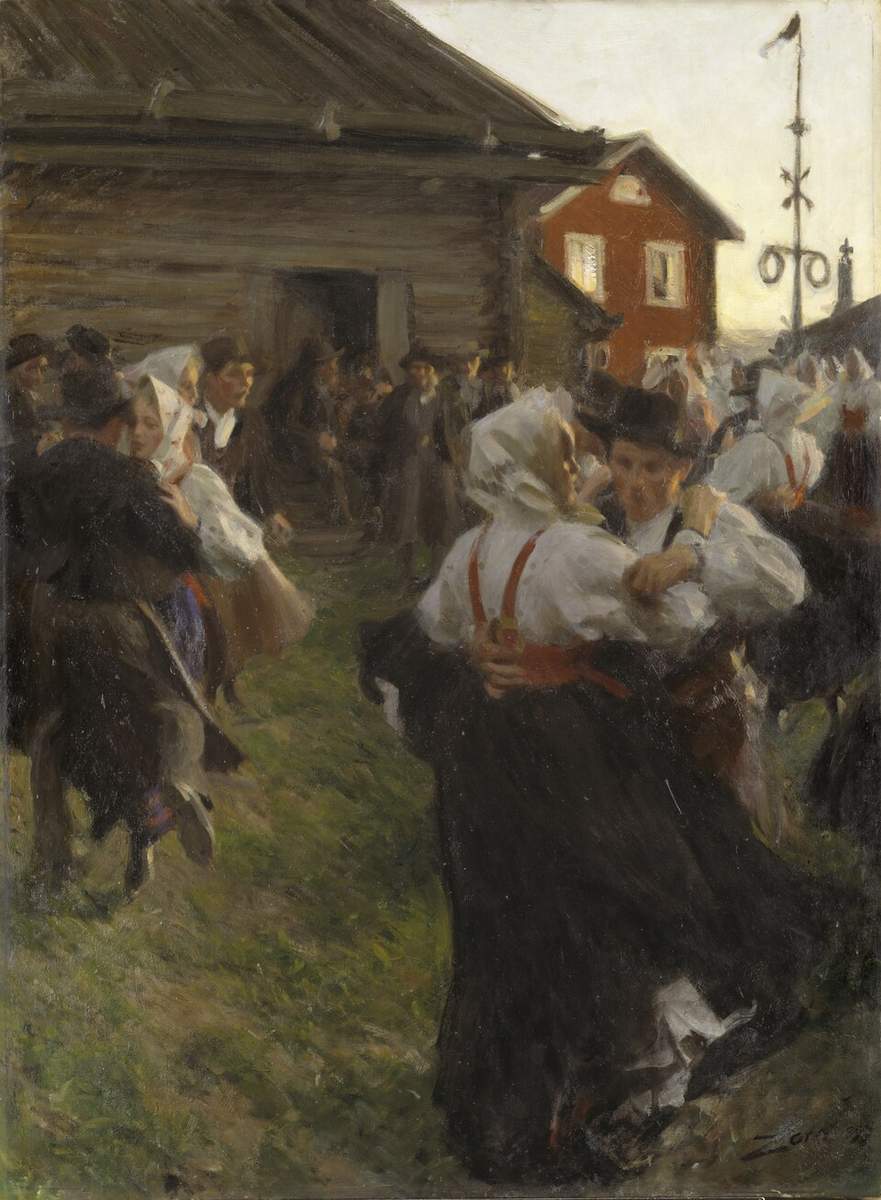
Each of the later Swedish painters appears more than once, so you can follow a single artist into different conditions. Anders Zorn goes from a midsummer dance to a meal beside the fields. Hanna Hirsch-Pauli paints a breakfast table by daylight and a group of friends by lamplight. Bruno Liljefors sets sea eagles against a pale sea and a fox among snow and branches. Carl Larsson moves from a snowy yard to interiors in watercolour: a celebration, a letter-writer, a child on a rocking horse.
Artline chose these works from Nationalmuseum's documented holdings, independently of the museum. Dates and attributions keep the qualifications given in the collection records.
Light is running out. Couples turn round the maypole, their white shirts and dresses catching what brightness is left, while the crowd behind them fades towards darkness. The pole is the fixed point: it names the occasion, and the dancers circling it supply all the movement.
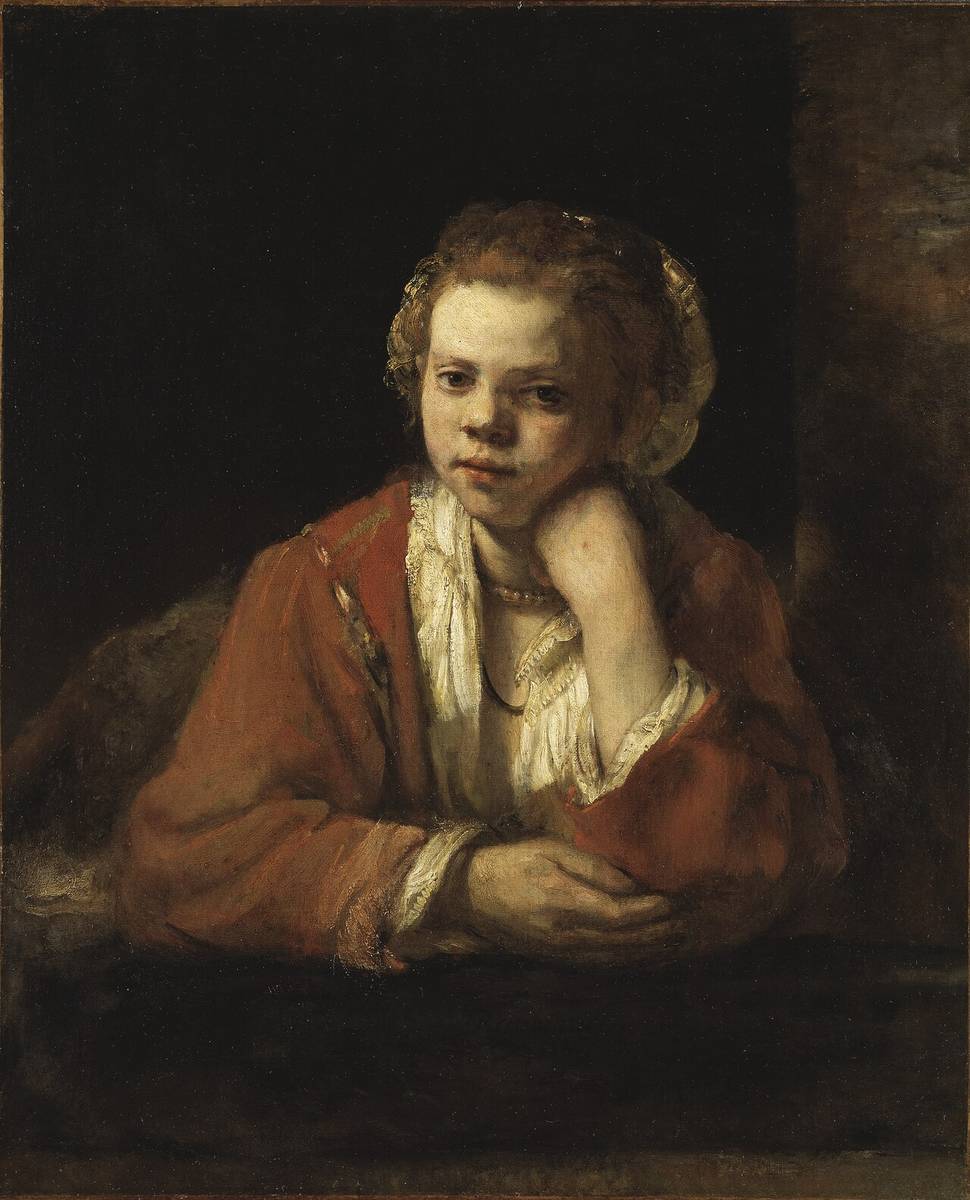
The title is traditional, and it names an occupation. What the painting shows is a woman who has stopped to rest. She leans her head against her hand, and that small contact gives her stillness a physical weight. Red clothing and pale linen emerge from the surrounding darkness, and the ledge in front of her keeps her close to the picture surface.
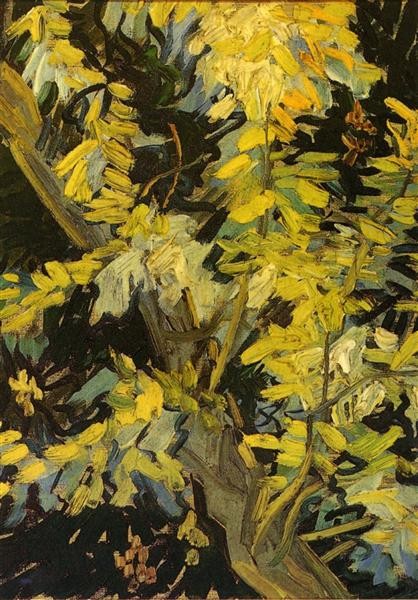
No sky, no ground, no distance to look into: yellow blossom and green leaves fill the whole canvas. Van Gogh builds each cluster and spray from directional strokes, so the brushwork itself shows which way each part runs. Some branches can be followed for a while before they lose themselves among the surrounding marks.
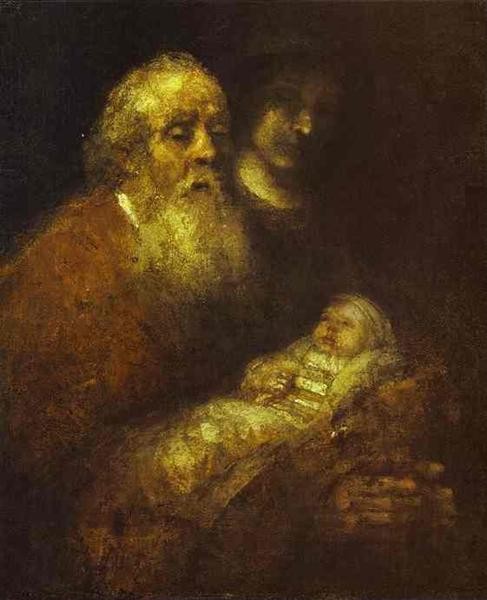
For a picture named after a temple, there is remarkably little temple to see. The interior falls away into indistinctness, leaving the faces, the wrappings and the old man's hands. Simeon holds the infant with evident care, and the biblical scene comes down to the difference in scale between the old man and the small body he receives.
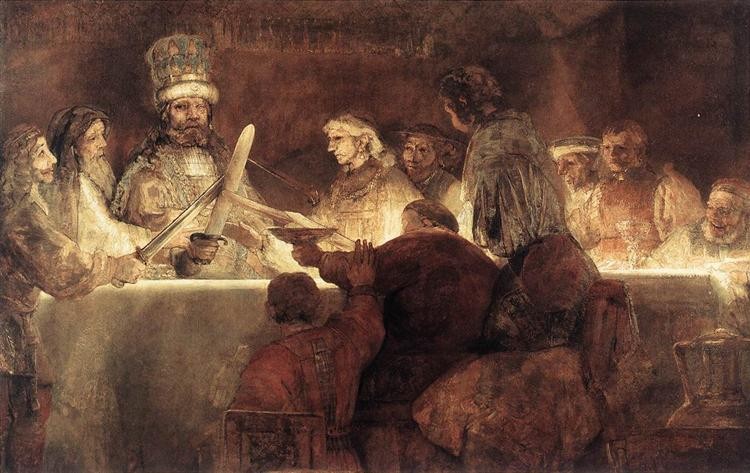
The oath is sworn with swords, brought together above a brightly lit table. Rembrandt gathers the conspirators round that single gesture and lets the light bind them, so they never settle into a row of separate portraits. Some faces recede until they are hard to make out; the meeting of the blades stays clear.
Books, a globe and a sheet of paper in his hand: Boucher gives Tessin the furniture of a cultivated public life, placed round him without crowding him. His face is turned, as though his attention has just been interrupted. The objects establish his role, and the casual turn of the head makes him look at home in it.
The cloth is the most solid thing in the picture. Zurbarán paints it with sharply defined folds and cast shadows, while the face it bears is faint and difficult to make out, closer to an impression than to a likeness. Shouldn't the sacred image get the firmest handling of all? Here it gets the faintest, and the result is as much a painting of the cloth as of the face upon it.
A white tablecloth gives Renoir's diners a common centre, and that is about as far as the arrangement goes. They take up different positions round it, nobody is set in a formal row, and the group stays loose. In the foreground below them is a dog.
The lamp decides who is seen. Some of the friends are close to it; others are left in the shadows of the room, their faces only partly visible. For a picture called Friends, attention is very unevenly shared.
In this earlier Hirsch-Pauli the light is daylight, and glass, silver and crockery break it into small bright points across the white cloth. The table is laid but not yet fully occupied, with a woman seen beyond it. Renoir's tablecloth is a centre for diners. This one is still a preparation, and the painting gives as much attention to what has been set out and made ready as to the people present.
Roslin sets a good deal of decoration round this likeness. The sitter turns, with flowers at her shoulder and in her hair, and gathered fabric carries the movement away from her face. None of it swamps her. The flowers and fabric follow the turn of her body and loosen the pose instead of competing with it.
Of the sitters Roslin paints here, it is not the botanist who wears the flowers. Linnaeus gets the sober dress of formal portraiture: dark coat, bright buttons, powdered wig. His work enters only as a small plant near his chest, easily missed, which points to his botany without disturbing the conventions.
Zorn's other picture here is a watercolour, and it shows an ordinary working day rather than a festival. A woman sits in the foreground with a steaming pot while work goes on in the field behind her. The meal is a pause within the day's labour, and Zorn keeps the rest of that labour in sight behind it.
The eagles are caught in motion above a rough shore, their outstretched wings set at competing angles. Against the pale sea you can see how far each wing reaches. The birds' movement organises the scene, yet they remain part of the shore and water around them; Liljefors never lifts them out as specimens.
Decades after Sea Eagles, Liljefors gives his animal nothing like the eagles' open background. The fox's warm coat stands out against the snow, but branches cross the view and break up its outline. How much of the fox you can see depends on its cover.
The red armchair closes round Cézanne's wife. She tilts her head towards her hands and does not look out at us. Broad planes of colour give her body and the chair a similar weight, so she seems as firmly built as the furniture that holds her.
Both halves of the title count. The snow-covered yard is the winter motif. The equipment in the foreground belongs to the open-air painter, and it puts the practical business of working outdoors in front of the view. The yard is what is being painted and also where the painter had to stand to see it. This is the earliest of the Larssons here and the only oil; the others are watercolour interiors.
Zorn's midsummer dancers have their maypole. Larsson's celebration has no single centre. Decorated beams, doors, rails and furniture divide the room into smaller episodes, and the figures are spread among them, linked from one to the next by repeated colours and by the edges of the architecture. The decorated room does as much as anyone in it to hold the occasion together.
We are not allowed to read over the writer's shoulder. Larsson gives us the figure bent over the task and the place where the writing happens: the desk, the window with its plants, the woodwork around them.
A rocking horse is made to move, but its rider, the small Casimir Laurin, is holding still to be painted. The horse's curved runners and the child's red coat give him a clear place among the heavier furniture.
Explore this selection in Artline
See the selected works alongside books and events from their period, or compare when the artists lived. The books and events provide context, not evidence of direct influence. Works without confirmed dates remain in this guide.
The watercolours
Zorn's Our Daily Bread and Larsson's A Day of Celebration, Letter-Writing and Murre are watercolours, and they are rotated for conservation. Any of the other works may also be on loan, at another site or in storage, so if a particular picture is the reason for your visit, look it up beforehand.
Harold Speed wrote this practical manual for students learning to draw. It deals with technique in general, not with Swedish art. Its chapters on tone and on the arrangement of a picture give you a working vocabulary for light and dark, useful in front of Hirsch-Pauli's lamplit friends and daylit breakfast table, Zorn's fading midsummer light or Liljefors's fox against the snow.
 Art, literature & history