The National Museum in Warsaw holds Polish art alongside paintings from other European traditions, and this selection leans heavily towards the Polish. History painting has a prominent place, on subjects that carry weight in Polish memory but may need explaining elsewhere. Only one picture, though, is a battle in the ordinary sense: Jan Matejko's The Battle of Grunwald. His court scene turns on a jester and a letter. Elsewhere, history is mostly a matter of waiting, whether for Maksymilian Gierymski's insurgent patrol, halted in open country, or for Jacek Malczewski's convicts on the road to Siberia.
Many of the other pictures hold back on incident in much the same way. There is no human observer in Józef Chełmoński's partridges in the snow, and no prominent building or traveller in Gierymski's marshes. The portraits run from Jacques-Louis David's grand equestrian display to women whom the titles describe but do not name. The self-portraits run from Anna Bilińska's, left unfinished, to Leon Wyczółkowski's costume piece in pastel. The other pictures from outside Poland are a literary subject attributed to Charles Alphonse Dufresnoy and an inn scene by Adriaen Brouwer.
The works were chosen from the museum's documented holdings, independently of the museum. Dates and attributions keep the qualifications given in the records. The order is not a route through the galleries, and a work's inclusion here does not mean it is on display.
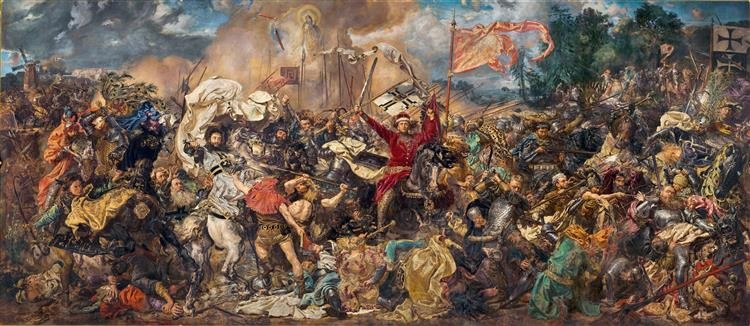
The victory commemorated here was won in 1410. Matejko painted it centuries later, when Polish history carried urgent political meaning, so what we see is a reconstruction shaped by that climate, not a record. Horses, banners, armour and bodies are packed so tightly that almost no clear ground shows between them. There is no single line of action to follow. The eye moves from one struggle to the next without settling, so the viewer has to piece the triumph together from fragments of combat.
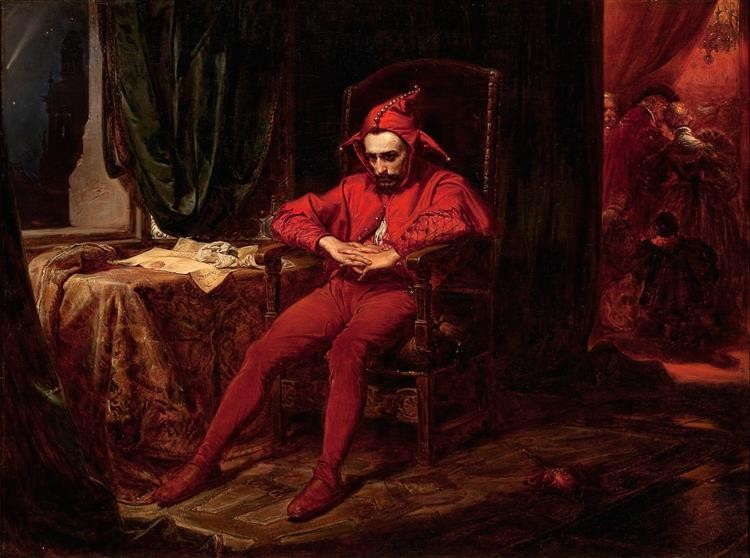
Through a doorway the ball carries on, bright and busy. On this side of it the jester sits alone and still, hands clasped, with a letter lying near him. The drama comes from a piece of news, not an action. Whatever the letter reports, he seems to be the only person present who has grasped what it means. Matejko leaves him in the red costume of an entertainer yet makes him the most serious figure in the picture. The courtiers enjoying themselves beyond the doorway sharpen the point.
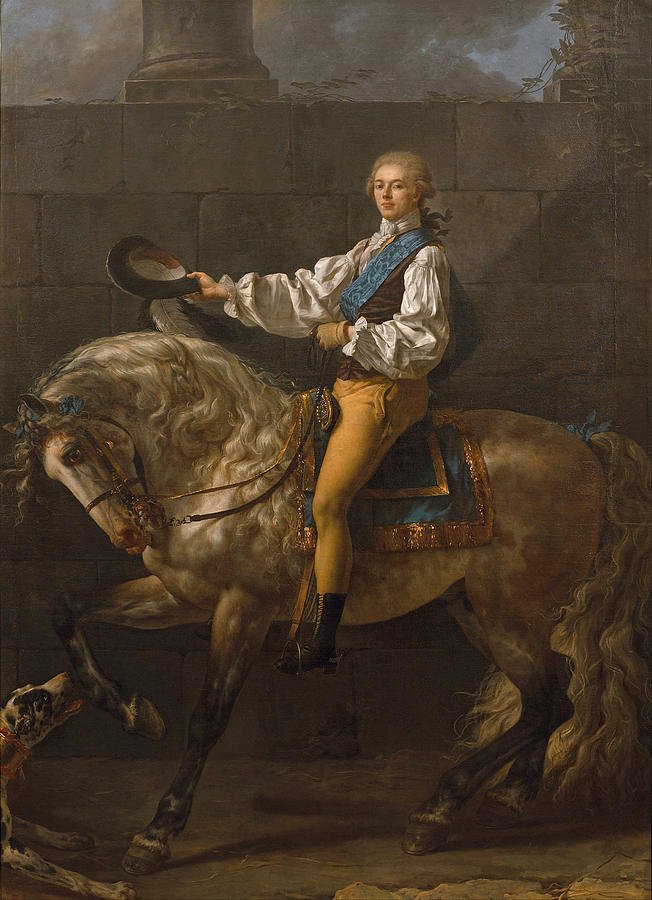
Stanisław Kostka Potocki lifts his hat as if to acknowledge an audience, and his horse raises a leg. Both movements have energy, but David holds it in check. Stone architecture frames horse and rider, and the formal arrangement turns a greeting into a display of authority: an arrival staged as a public event.
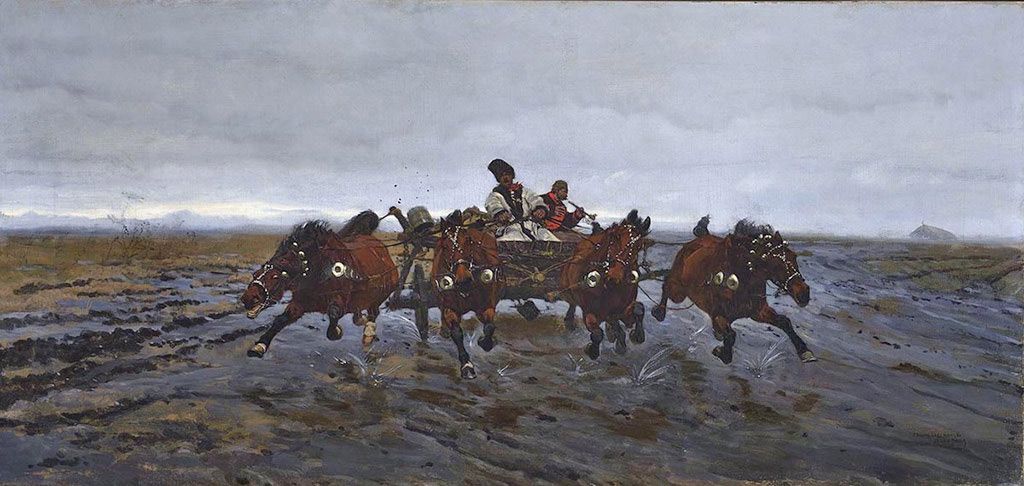
Four horses stretch across the low canvas as the carriage drives over wet ground beneath an open sky. Chełmoński shows their speed through the horses' legs and the uneven positions of the team, and the long horizontal format gives them room to run.
This is the smaller Warsaw version. The much larger Four-in-Hand in the National Museum in Kraków is a related but separate painting, and the translated titles make the two easy to confuse.
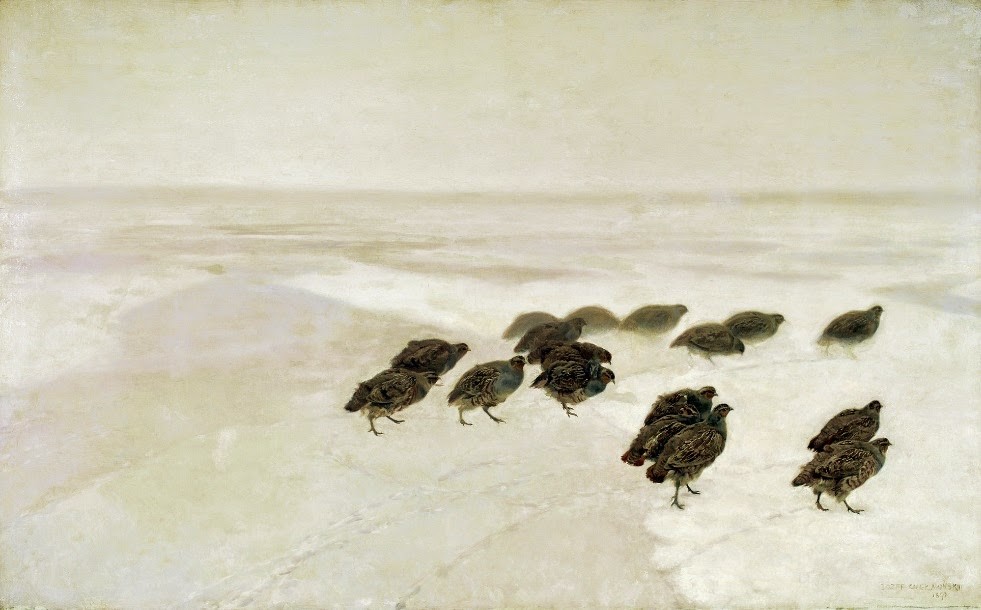
After the team in Four, Chełmoński's partridges are almost motionless. They huddle together on a field of snow that runs back to a faint, low horizon. He paints them small, which makes their exposure plain. Apart from the birds and the scattered traces they have left, the field is nearly empty, so each dark body stands out sharply against the pale ground. There is no human figure, and the open snow gives the flock no shelter.
c. 1880 - 1881 · Oil on canvas · National Museum in Warsaw
The catalogue identifies her only as a Jewish woman and records no name, yet Aleksander Gierymski gives her the attention a portrait sitter would receive. He brings her close and paints her from the front, so that she is the subject of the picture rather than an incidental figure in a street scene. Her baskets show how she makes her living. What holds the eye, though, is her face and the careful handling of her layered clothing.
A small blue coffin rests in an ordinary yard. The mourners sit apart from one another, and their grief shows in stillness, with no conspicuous gesture of lament. The gaps between them count for as much as their postures. Behind them are the house and a resting dog, everyday life carrying on in plain view. Nothing is heightened for effect, and that directness makes the picture hard to look at.
Like Aleksander Gierymski's orange seller, the woman in Boznańska's orangery holds a basket. The seller's baskets are her livelihood. This one is a practical object that sits a little oddly in a cultivated interior. Tall plants surround her, but her pale clothing and composed pose keep her distinct among them. Boznańska claims little for the scene. There is no story, only a figure in a glasshouse.
The title describes the sitter only by the colour of her skin, and the catalogue gives no name for her. Bilińska places her in a studio arrangement. Pale drapery and gold jewellery frame her face, and her dark skin is set against pale cloth. Within that arrangement, though, the pose keeps an individual character: she turns to look beyond the picture, not at us.
The face is resolved, but parts of the clothing and surroundings are not, and in places the preparation lies bare. This lets us see Bilińska's method quite openly: she was building the picture up section by section and had taken the head furthest. Her firm stance holds the image together across these unequal stages of finish, so it still works as a picture where it stops.
The title does much of the work. Calling Aleksander Wielopolski a Polish Hamlet invites us to see a man caught between alternatives, and the composition supports that reading. He is placed between two women who differ in age and dress, one bright, the other restrained. The picture does not say what they stand for. Where Wielopolski stands in the group matters as much as his likeness, which pushes the portrait towards allegory. The choice is left unmade.
Malczewski approaches Siberian exile from very close. Hands reach towards a bare foot, and the painting centres on this small act of care rather than on any wide view of hardship. In the dim interior only some faces and some cloth can be made out, which keeps the encounter intimate. The expressions vary: both weariness and tenderness register.
The title speaks of a journey, but the convicts have stopped, crowded into a room where waiting is part of the ordeal. Seated and reclining bodies show fatigue in several forms, and a standing figure breaks their low arrangement. Foot Washing narrows exile to a single gesture. This picture spreads it across a group and makes confinement on the road a subject in itself, without the drama of departure or arrival.
A woman stands beside a large framed picture, among other images and studio furnishings. The picture does not say who she is. Her presence makes the room a social setting as much as a workplace, a place where people come across art and stand near it.
Bilińska's unfinished self-portrait leaves its preparation bare. This pastel, by contrast, is densely worked, with no empty space around the figure. The patterned robe and the blue textile behind it are so busy that they nearly merge, and only contrast keeps the face at the centre. The Chinese robe is a costume, part of how Wyczółkowski chose to present himself.
After the crush of Grunwald, Maksymilian Gierymski's patrol has almost too much room. The riders have halted in open country with few landmarks, under a broad, pale sky, and the low terrain leaves them exposed. They watch and wait. Their watchfulness gives the empty ground a weight that no visible encounter has yet justified. Whatever they are watching for has not appeared.
Pools and dark grasses break the foreground into uneven patches, and the main opening is a narrow strip of distant light at the low horizon. Above it the clouds take over, so weather and failing light decide how much can be seen. No prominent building or traveller turns the marsh into a setting for some other subject.
This picture is dated to the same years as Marshes at Sunset, but it shows a drier, paler place. A sandy track curves through slender birches towards open fields, and the undergrowth is set down in small, specific marks. The track offers a way into the landscape, but nobody is on it.
The painting is attributed to Dufresnoy and dated only broadly. Figures in robes of distinct colours gather around a seated woman. Attendants, gestures and vessels give the meeting of Aeneas and Dido a ceremonial scale without hiding its centre. The painter organises the group through colour and placement and allows little dramatic incident, so the literary subject comes across more as a formal reception than a moment of high feeling. Even so, the gestures read as an exchange between individuals.
1627 - 1630 · Oil on copper · National Museum in Warsaw
Nobody here is arranged for show, which puts the picture about as far from David's Potocki as this selection goes. One man raises a pipe, and the others have settled around a small table in unequal poses, absorbed in what they are doing. Brouwer neither preaches about their leisure nor dignifies it. The picture is painted on copper. Warm light draws faces and clothing out of the dark room, though not every detail emerges with the same clarity.
Explore this selection in Artline
See the selected works alongside books and events from their period, or compare when the artists lived. The books and events provide context, not evidence of direct influence. Works without confirmed dates remain in this guide.
Names and roles
Some of the people in these pictures keep their names: Stanisław Kostka Potocki, the jester Stańczyk, Aleksander Wielopolski. Others are known only by description. One title calls a woman Jewish and another calls a woman Black, while the mourners in Aleksander Gierymski's yard and Malczewski's convicts appear as groups without names. Having a name does not settle how a person is shown, because almost every named figure here comes with a role attached. Wielopolski's name comes with Hamlet's. Stańczyk is identified by his office as jester as much as by his name. Potocki is named in full but appears mainly through the trappings of public display. Wyczółkowski, painting himself, takes on a role of his own choosing in the Chinese robe. The unnamed orange seller has no part to play beyond her trade, yet she receives some of the closest attention in the selection.
Harold Speed's drawing manual discusses mass, line and the construction of portraits, and sets exercises for the reader to work through. It provides useful terms for the faces in this selection and for crowded scenes such as Grunwald. Bilińska's Unfinished Self-Portrait, where the building-up of a portrait is partly left in view, is a good place to test what he says about construction.
 Art, literature & history