Norway's National Museum in Oslo brings together art, architecture, design and craft. Its paintings take in Norwegian work of the nineteenth and twentieth centuries, Edvard Munch's included, alongside pictures from elsewhere in Europe. Everybody knows The Scream, but these twenty paintings show far more of Norwegian art than that image alone might suggest. Munch has more pictures here than anyone else, and even his group runs from the dark restraint of Sister Inger to the uncertain figure of Madonna. Around him are Harriet Backer's interiors, Oda Krohg's portrait of a painter at work, Theodor Kittelsen's two fairy-tale subjects and a run of landscapes, from Hans Gude's fjord to Peder Balke's mountain in mist. The one painting from outside Norway is Lucas Cranach the Elder's The Golden Age.
Several of the pictures are built around an opening of some kind: a window letting spring into a sickroom, a church doorway, a room giving onto evening water, one balcony above a busy street and another facing winter.
Artline chose these works from the National Museum's documented holdings; the selection is independent of the museum. Dates and attributions follow the linked records, including any qualifications given there.
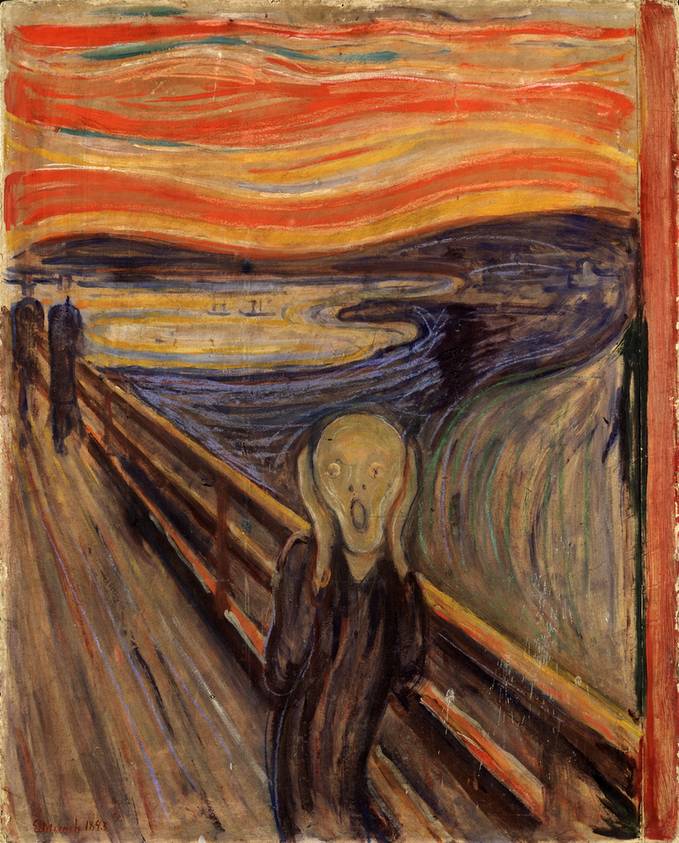
1893 · Tempera and wax crayon on cardboard · National Museum
For so famous a picture, the materials are modest: tempera and wax crayon on cardboard. Munch made several versions of the image, and this is one of them. A figure on a bridge presses its hands to its head, its face pared almost to a mask. Behind it, sky and water twist into bands of colour, as though the landscape were caught up in the same disturbance.
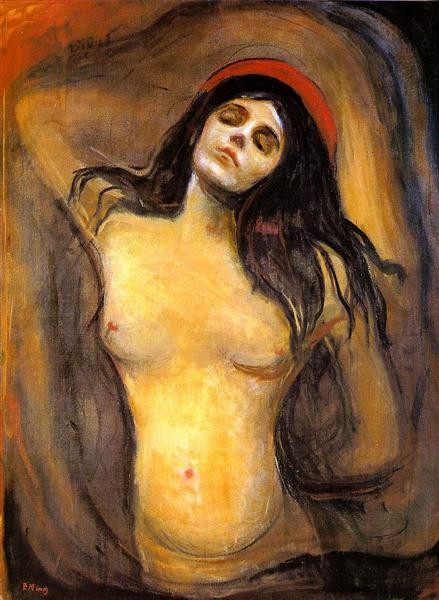
Is this a Madonna at all? The title says so, and a red form recalls a halo. But the woman is partly bare, enclosed by dark hair and deeper shadow, her head tilted and her pose suspended. She belongs to no familiar type, neither devotional image nor conventional nude.
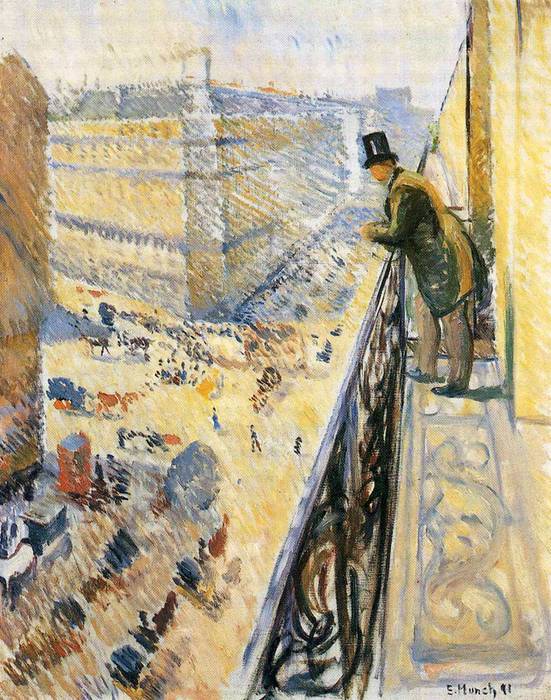
A man on a balcony looks down at the street far below. Munch paints the street in short, busy strokes of colour: there is movement everywhere, yet no passer-by is given a distinct form. The man is comparatively still, and the height of the balcony keeps him out of the life he is watching.
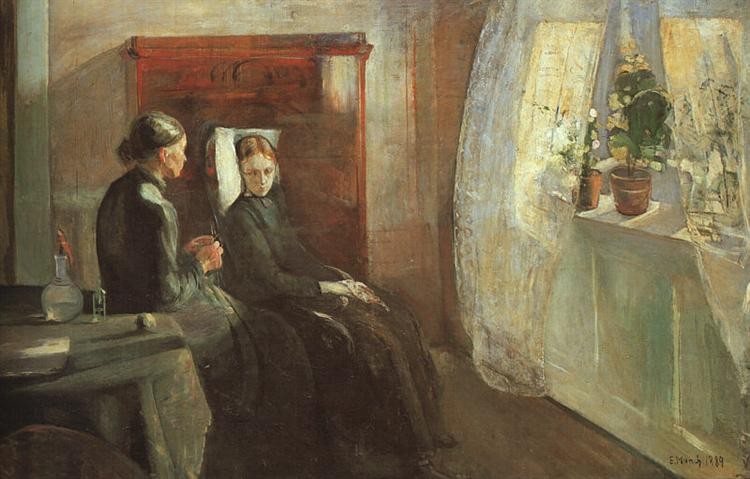
Spring enters this room only through the window, as bright light and a moving curtain. Inside are a pale young woman and her older companion, and Munch sets illness and care side by side with the season. The light reaches them, but it holds out no promise of recovery.
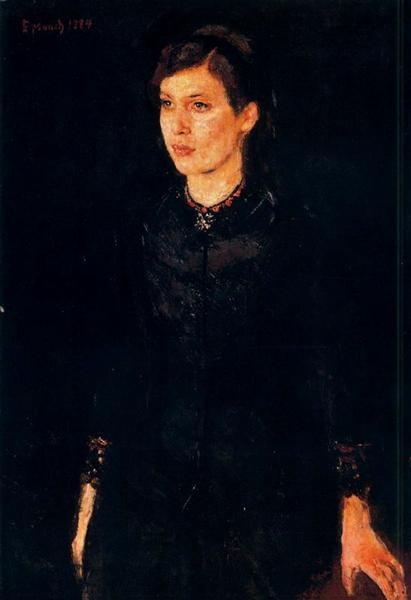
This is the earliest Munch in the selection, and a long way from the twisting colour of The Scream. Inger's dark dress all but merges with the background, so it is her face and hands that show where she is. Munch places those pale areas asymmetrically and builds the rest of a spare picture from small differences within the dark.
In a room of cool blues, the red writing desk is the loudest thing. Backer gives the desk, the pictures on the wall and the intervals of light the standing of subjects in their own right; they are not props for the seated woman. The colour binds her into the room instead of setting her apart from it.
A church doorway joins two groups: figures still outside in bright daylight and people already seated in the dim interior, with further openings leading deeper into the building. The christening itself is only one focus. Backer seems at least as interested in the approach and the waiting, the passage from daylight into shadow, as in the ceremony.
Lamplight falls on the woman's hands and the side of her face, enough to make her working posture clear, while much of the room stays in shadow. Munch's Sister Inger also picks out face and hands against the dark, but Backer's light has a job to do: it falls where the work is. The dark around her reads less as isolation than as space the task does not need.
Oda Krohg works with two kinds of light and keeps them carefully apart. The lantern hangs in front and gives the warmer; beyond the opening, a cooler evening light lies over water and trees. The seated woman is placed where the two meet.
One painter at work, painted by another. Christian Krohg is seen from the side, out of doors, his attention fixed on the canvas in front of him. Palette, chair and posture are enough to show what he is doing, and there is none of the formality of a staged studio portrait. Oda Krohg paints the surroundings loosely, so nothing competes with the man and his work.
Kittelsen paints the golden towers sharply, then takes away the ground. Mist hides whatever lies beneath them: no path, nothing to tie the palace to a place anyone could reach.
The boy and the fox face each other in a woodland clearing, both upright, and have paused, much as two people might when they meet on a path. Kittelsen needs very little to bring in the impossible part of the tale: a recognisable path, two figures and the gap between them. Everything stays at an everyday scale, apart from the small matter of a fox standing on its hind legs.
Sohlberg keeps the balcony in the picture. Its railing is close and clearly defined, while the water and ground beyond show little activity. He could have cleared it away for an open view; because he does not, the winter is seen from the edge of shelter, and the muted colour adds to the sense of separation. Munch's Rue Lafayette also looks out from a balcony, but down onto a street full of movement. Here almost nothing stirs.
Mist takes the detail out of the land and leaves Stetind as a single decisive outline, its pointed peak sharper than much of what lies beneath it. The dark shore, pushed forward against the pale distance, gives the scale.
A lighthouse exists to guide ships. Balke's is a thin, pale upright among broad movements of water and cloud. It is easy enough to pick out, but it commands nothing around it, and its smallness is what lets you gauge the turbulence of the coast. The conditions are plainly larger than its reach.
Kielland holds the summer evening in closely related tones. There is no single brilliant effect, and nothing happens. Such small differences as there are come at the water's edge, among reeds, lilies and reflections.
The title promises the sea, but Kielland spends her effort on the ground in front of it. Rounded rocks and shallow channels break up the near stretch, with low vegetation catching among the stones, before the open sea begins. The horizon is simple by comparison; it is the foreground that takes time to cross.
Small figures and buildings at the shore set a familiar scale, and the mountains suddenly enlarge it. Gude's fjord is huge, yet it never becomes shapeless: he separates the near rock, the water and the slopes beyond into clear distances, and uses light to pick out particular features. Of the Norwegian paintings in the selection, this is the earliest.
Trees crowd the foreground and block much of the view; only a gap in the distance and a pale band of cloud stop the picture closing in entirely. Hertervig puts the densest masses first and the brightness beyond them, and the picture's tension comes from that order, not from anything happening among the trees.
Painted in oil on wood, this is by far the oldest picture in the selection. Figures rest, dance and bathe among animals and fruit trees, and Cranach makes the imagined harmony of the Golden Age concrete through these untroubled activities. Then he encloses the whole garden with a wall. The ideal is visibly set apart, and makes no claim to describe life outside it.
Explore this selection in Artline
See the selected works alongside books and events from their period, or compare when the artists lived. The books and events provide context, not evidence of direct influence. Works without confirmed dates remain in this guide.
Walled garden, palace in mist
The widest gap in time within this selection lies between Cranach's The Golden Age and Kittelsen's Soria Moria Palace, yet they share a problem: how to paint a place that does not exist. Both show the imagined place plainly, and both keep it apart from the world, but by opposite means. Cranach builds a boundary. His wall says exactly where the Golden Age stops and leaves everything beyond it to ordinary life. Kittelsen subtracts. With mist where the ground should be, his palace is less enclosed than left with nowhere to stand, and the question it raises is not what lies outside but how anyone could get there. The Ash Lad and the Fox reverses the arrangement: the setting is the most ordinary thing in the picture, a path and a clearing, and the marvellous happens on solid ground.
Harold Speed wrote a drawing manual, but his chapters on tone, line and composition supply practical terms that carry over to painting. They are useful for describing how Backer handles light in her interiors, how Balke lets haze strip detail from a landscape, and how Munch simplifies form.
 Art, literature & history