The Smithsonian's National Museum of Asian Art in Washington brings together the Freer Gallery of Art and the Arthur M. Sackler Gallery. A painting there may be a hanging scroll, a handscroll, an album leaf, a fan or a folding screen. The format settles a good deal before brushwork comes into it at all: whether the image stands in angled panels, keeps a curved edge or fills only part of a larger mounting.
Most of the twenty works chosen here are Japanese. They run from Kanō Eitoku's gold-ground screens and Kanō Tan'yū's spare brushwork to Hokusai's breaking wave and Kunisada's courtesan under her net. Ogata Kōrin, Ogata Kenzan, Hiroshige, Hanabusa Itchō and Mori Sosen are among the others. Gold, silver and imitation gold all appear in their materials. The rest of the selection is a mixed group: a small Chinese fan landscape whose attribution is unresolved, Whistler's quietly tonal views of river and shore, and Fantin-Latour's portrait of him.
Artline chose these works from documented museum holdings, independently of the museum. Being in the collection does not mean a work is on view. Dates and attributions keep the qualifications given in the linked records.
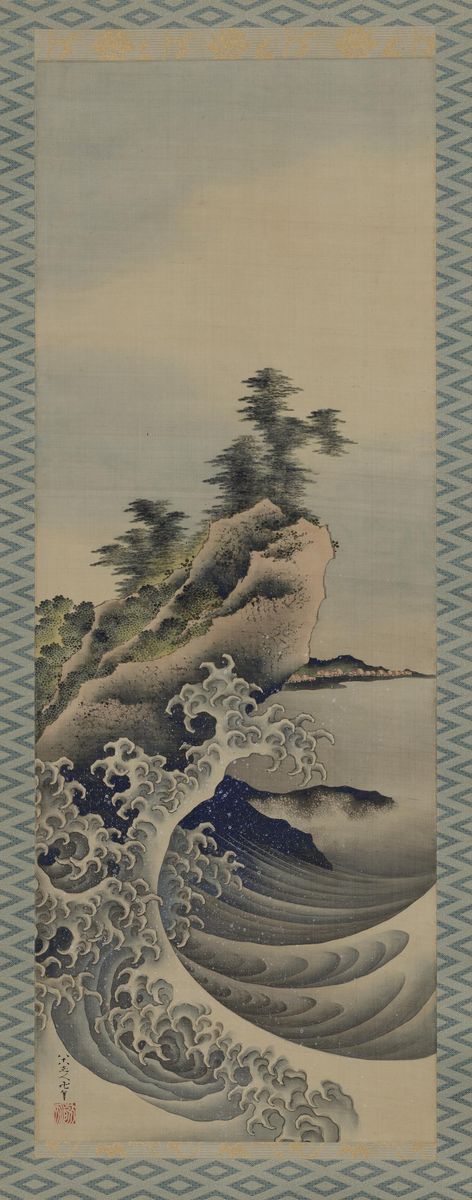
1847 · Ink and colour on silk · National Museum of Asian Art
Foam curls above dark water beside the rocks, its fine edges set against the heavier mass beneath. The scroll is narrow and more than a metre high. Hokusai has the wave rise and break inside that upright strip, so its movement climbs the picture instead of running across it. This is a single painting in ink and colour on silk, not a printed impression.
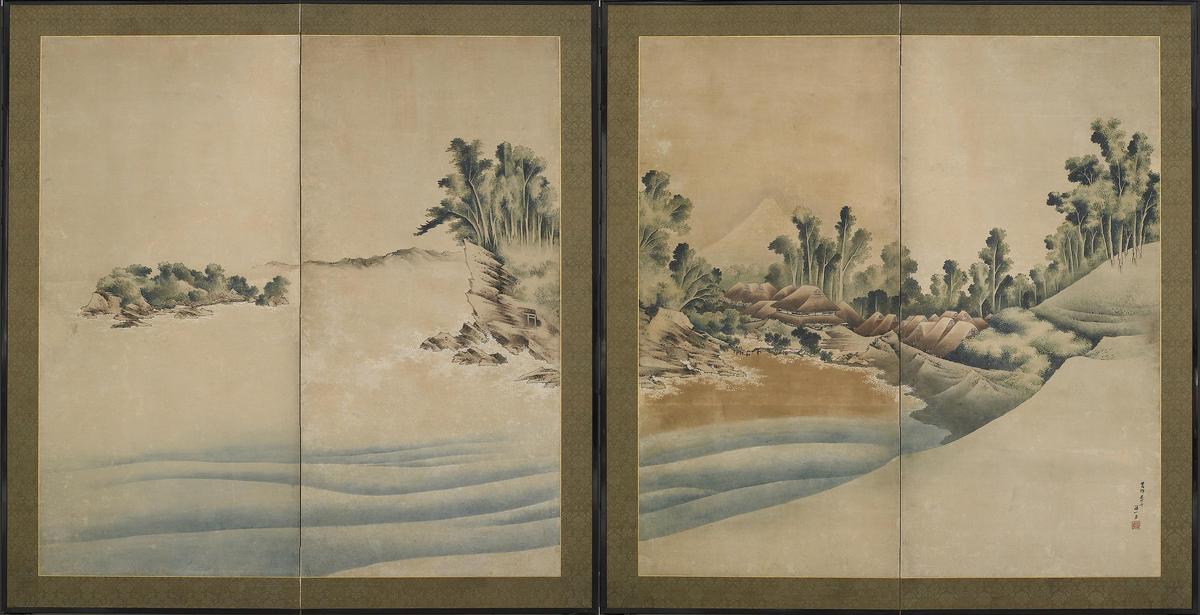
c. 1825-1831 · Ink and colour on paper · National Museum of Asian Art
Here Hokusai works on a folding screen. Low water and distant land stretch across its panels towards Fuji. When the screen stands, the panels meet at angles, so the long view to the mountain turns at every fold. A photograph that lays the screen out flat straightens all of that.
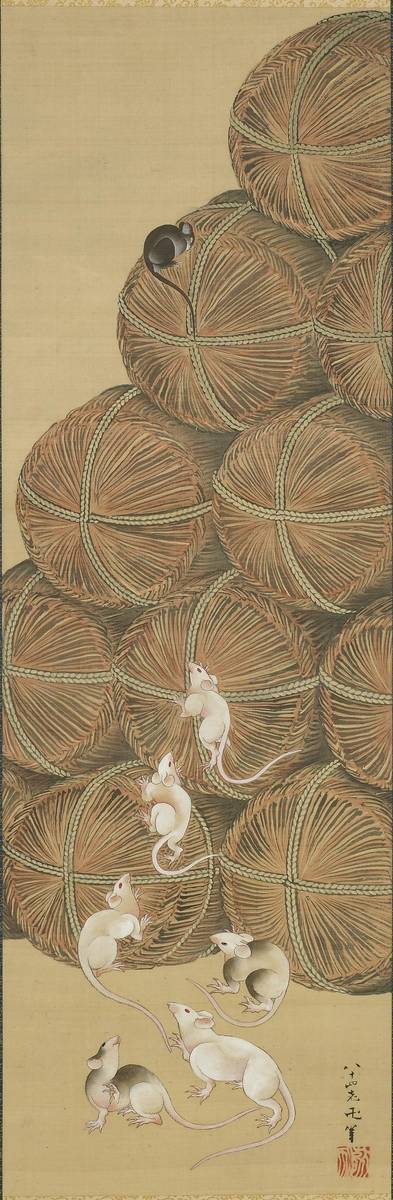
1843 · Ink and colour on silk · National Museum of Asian Art
Small rats scatter round heavy, stacked bales of rice. They break up the bulk of the straw but never stray far from it. Hokusai uses one kind of mark for straw and another for fur, and the painting depends on that difference: small, soft, scurrying bodies against a weight that does not move.
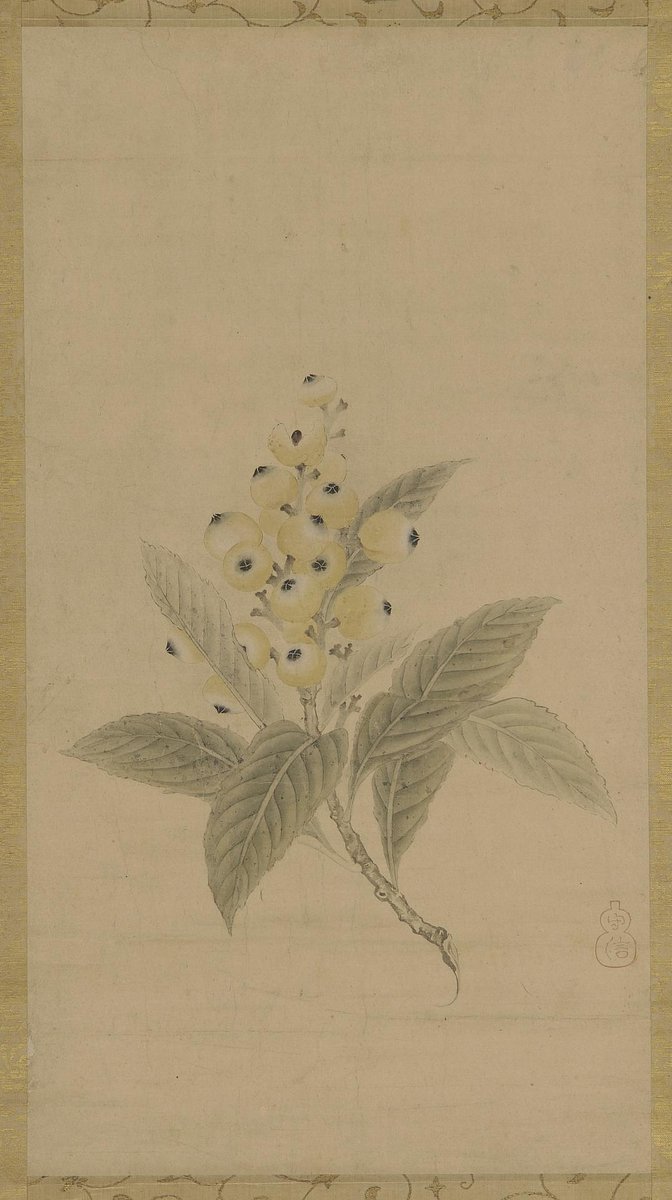
17th century · Ink and colour on paper · National Museum of Asian Art
Of Tan'yū's paintings here, this is the only one with colour. Stems, leaves and fruit all grow from one continuous curve of branch, and he tells the parts apart by varying the width and weight of his strokes. Each kind of stroke does a single job, so he needs very few. The unpainted paper leaves every difference exposed. A misjudged stroke would have nowhere to hide.
1615-1868 · Ink and colour on imitation gold · National Museum of Asian Art
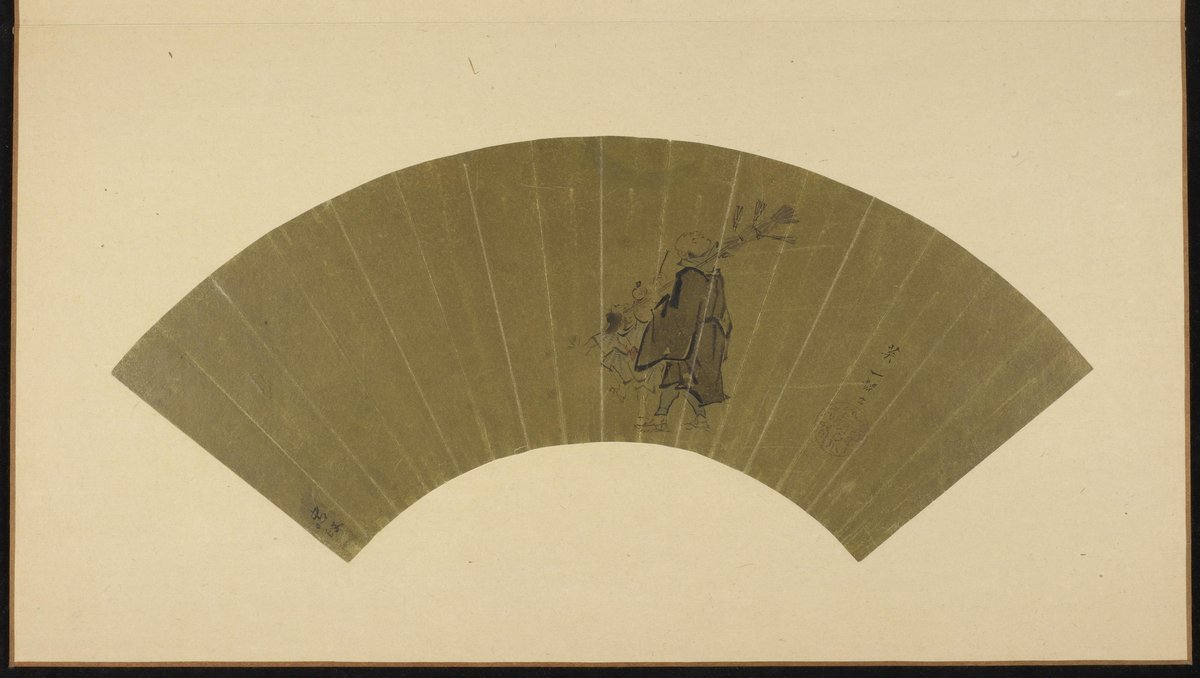
A peddler and a child look up together towards the moon of the title. Hanabusa Itchō gathers the two small figures into the curve of a fan and leaves a broad space open above them, which is where their gaze goes. They exchange no detailed expressions. Looking up together is what makes them companions. The record specifies imitation gold as the ground, not the gold of Eitoku's screens.
19th century · Ink and colour on silk · National Museum of Asian Art
Dark branches hold their shape against pale snow, and that contrast gives the winter landscape nearly all its structure. Hiroshige adds little else. His view on silk is compact and fills only part of a taller mounting, so the scroll as a whole is larger than the picture it carries.
17th century · Ink on paper · National Museum of Asian Art
Tan'yū leaves out colour here and works in ink alone. The bird takes up only a small part of a tall field, but with bare paper all round it, it is the first thing you notice. Bamboo stems and leaves give it a setting without crowding it.
17th century · Ink on paper · National Museum of Asian Art
Tan'yū gives a person the same economy he gave the medlar and the bird. Bodhidharma sits low in a long, pale field, and a handful of dark strokes sets down his head and robe. Most of the surface stays blank. Because the figure is placed so low, the empty space gathers above him, and that small, dense body holds the whole sheet.
1855 · Ink and colour on silk · National Museum of Asian Art
A hanging green net encloses the woman but leaves her visible. Kunisada fits the net, her patterned clothing and her bending pose into the length of the scroll, and keeps the writing to a separate area above. We see her partly through the mesh, so the net is more than furniture. It frames her, and it also stands between her and whoever is looking.
1568-1615 · Colour and gold on paper · National Museum of Asian Art
Dark stems carry scattered leaves and bunches of grapes across the gold ground. The vine bends easily enough to cross the joins between the screen's panels. Gold and dark paint respond differently to the light around them. As that light changes, the screen can look different even though its branches stay exactly where they are.
1615-1868 · Ink on paper · National Museum of Asian Art
Leaves and blossoms stand apart from one another, linked by the flowering stem and very little else. Kōrin leaves the gaps unfilled and lets each ink mark keep its own character against the paper. In Tan'yū's medlar branch everything grows from one continuous curve. This plant is held together much more loosely.
16th century · Ink on silk · National Museum of Asian Art
The qualification in the heading matters. The museum record names Ma Yuan but dates the painting to the sixteenth century, centuries after he was active. As they stand, the name and the date cannot both be right, and it remains open who painted the fan and when. What can be described is a small ink landscape on silk, a fan painting mounted as an album leaf. Dark branches and other foreground forms lead back towards pale water and distance, with the pavilions of the title. It is the only Chinese painting in the selection.
1786 · Colour and ink on silk · National Museum of Asian Art
Tan'yū's bird is a small presence in a tall field. Mori Sosen's peacock is the opposite: its long tail spreads through much of the lower part of the picture. Sosen changes the character of his small marks between feather and leaf, so the plumage separates from the plants nearby. Followed on its own, the tail turns into pattern. Sosen keeps it attached to a standing bird that bears its own weight.
1658-1868 · Colour, ink, and silver on paper · National Museum of Asian Art
Bands of water run across the broad screen, broken by autumn plants at unequal distances, so the current keeps moving and never settles into a fixed repeat. The materials are colour, ink and silver, a long way from the plain ink of Kōrin's Hollyhocks. Like the gold in Eitoku's Grape Vines, the silver depends on the light in the room. A reproduction can record its colour but cannot show that it is metal, or how it responds as the light changes.
1690-1868 · Ink and colour on paper · National Museum of Asian Art
Like Itchō's peddler and the landscape attributed to Ma Yuan, these are fan paintings, but here there is a pair. Two fan-shaped paintings are mounted together, each keeping its curved edges, and Kenzan arranges snow and dark foliage to follow those curves. They are catalogued as related parts of one object, and side by side they invite a comparison between the snow-covered grasses and the pine.
1883-1884 · Oil on wood panel · National Museum of Asian Art
With the tide out, exposed shore fills a broad area beneath boats and waterfront structures. The tide sets the picture's proportions: a wide, quiet stretch of ground in front and the busier band beyond. Whistler holds the two together with restrained blues and browns, so the working boats and buildings never break away into separate incidents. It is the only Whistler here painted on a wood panel and not on canvas.
1870-1875 · Oil on canvas · National Museum of Asian Art
Boats and shore forms have to be picked out from closely related green-blue tones. Few objects get a firm outline. Whistler gives just enough to place the scene on the river at Battersea, and spacing and slight changes of tone do the rest. The broad frame belongs to the object, not to the painted view.
1871-1876 · Oil on canvas · National Museum of Asian Art
Thin horizontal divisions separate shore, sea and sky, and the beach stays open. Small figures and boats give it scale, but they are kept modest, and nothing at the centre competes with the bands of space between them.
1865 · Oil on canvas mounted on aluminum panel · National Museum of Asian Art
The portrait is earlier than any of Whistler's own paintings in this selection, so the painter appears here first as a sitter. Fantin-Latour gives him few surroundings, and none of the brushes or palette that might announce his profession. Dark clothing and a dark background bring the turned face forward, and the face carries almost the whole picture. The canvas is mounted on an aluminium panel.
16th century · Ink, colour, and gold on paper · National Museum of Asian Art
These Japanese screens show the Chinese emperor Minghuang with Yang Guifei in an idealised palace. Across the gold ground, the architecture divides their company into a series of connected spaces. In Grape Vines Eitoku's gold carried a vine. Here it sets off buildings and a court. The story is Chinese, but the screens present it as it circulated and was reinterpreted in Japan, so the court they show is seen at one remove.
Explore this selection in Artline
See the selected works alongside books and events from their period, or compare when the artists lived. The books and events provide context, not evidence of direct influence. Works without confirmed dates remain in this guide.
Formats, dates and names
A reproduction may show a whole screen, the painted area alone or a scroll with its mounting, and each choice changes the apparent proportions. Several catalogue dates are broad period ranges, some spanning more than a century. They mark the period an object is assigned to, not an artist's lifetime, and are best read as outer limits. The headings sometimes drop the long vowel mark in Kanō, as in Kano Tan'yū. It is the same name.
Yoné Noguchi's essays introduce Japanese painters through the judgements and enthusiasms of an early twentieth-century writer. They tell you as much about how that period looked at Japanese art as they do about the painters.
Maxwell K. Hearn and Wen C. Fong (1999) · Free PDF and online reading from the Metropolitan Museum of Art.
A Metropolitan Museum catalogue of Chinese paintings from another collection, the C. C. Wang family's. Its detailed entries show how format, inscription and attribution are weighed when a painting is studied. That makes it useful background for the fan landscape attributed to Ma Yuan, whose attribution is unresolved and which is the one Chinese work in this selection.
 Art, literature & history