The National Gallery in Athens tells the history of modern Greek painting, and this selection of twenty works follows its emphasis on the nineteenth and twentieth centuries. Many of the painters trained at European academies and worked both in Greece and abroad. They brought what they had learned to local subjects: the War of Independence, everyday life and portraiture. Behind them lies a religious tradition that reaches back through post-Byzantine painting, and the selection includes earlier religious pictures by El Greco, Stephanos Tzangarolas and Nikolaos Doxaras.
The pictures range from commemorative compositions to modest studies of light on water, and one place covers that whole range. Messolonghi appears both as a battle with a heavenly gathering above it and as a quiet lagoon. Gyzis, Parthenis, Theophilos and Bouzianis each appear more than once, so you can compare pictures from the same career. Gyzis, for instance, makes his figures small in both of his paintings, but for quite different reasons.
Artline chose these works from the museum's documented holdings, independently of the museum. Inclusion does not mean that a picture is on view. Dates and attributions keep the qualifications given in the linked records.
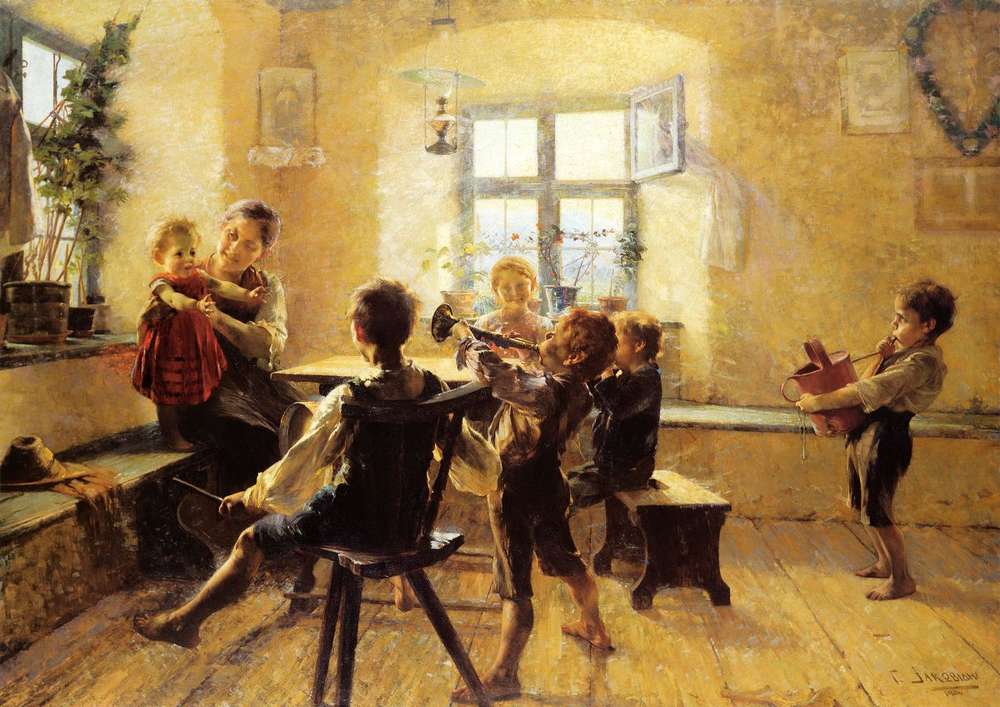
1900 · Oil on canvas · National Gallery — Alexandros Soutsos Museum
One of the young musicians has no proper instrument, so he blows into a red watering can. Any comedy is ours, because the children take their concert entirely seriously. Iakovidis does not give them a shared cheerful expression, and each face and pose shows its own kind of effort.
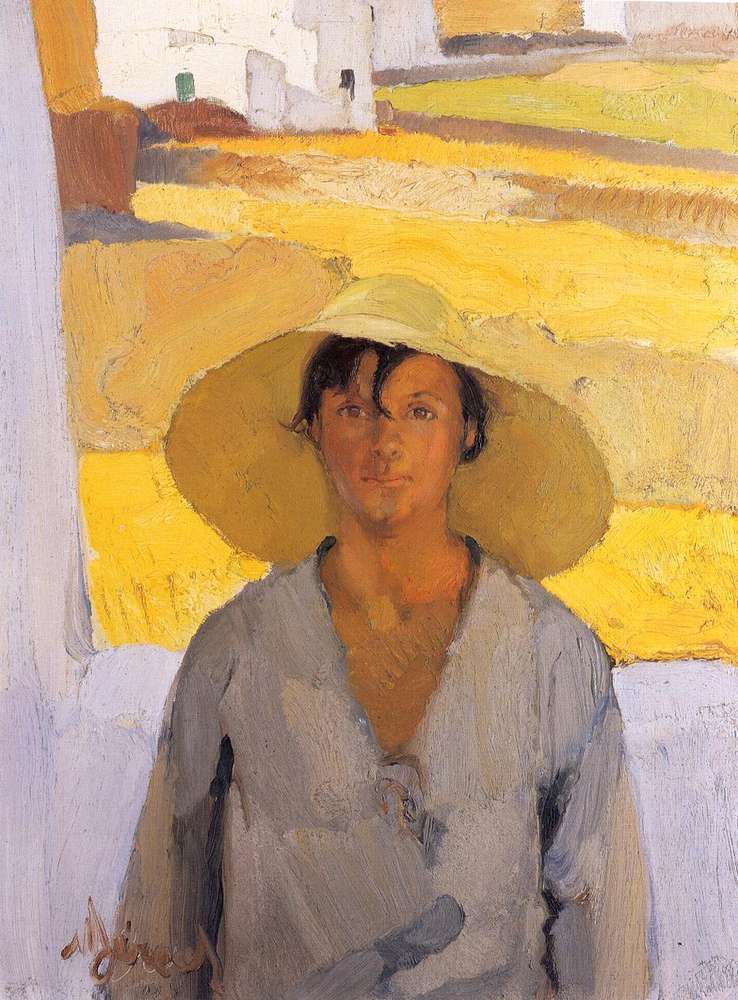
1925 · National Gallery — Alexandros Soutsos Museum
The yellow brim is the brightest shape in the portrait, and the sitter's face falls into shade beneath it. That seems fair in a picture named after the hat and not the person wearing it. Lytras renders the sunlight in broad areas of colour, setting warm ground and buildings against the cooler blue-grey of the clothes. He makes little use of fine shifts of tone and leaves some brushmarks unblended.
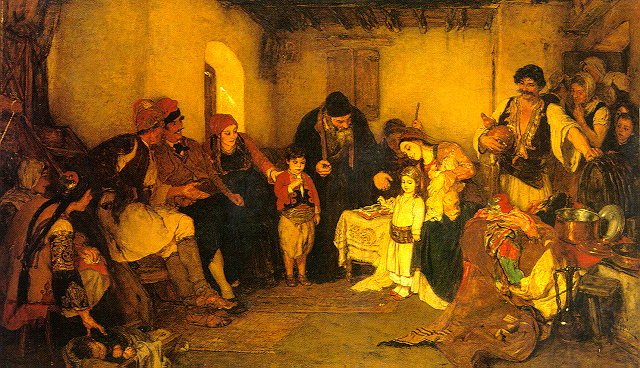
1877 · National Gallery — Alexandros Soutsos Museum
The ceremony is an adult one, and the children at its centre are very small. Costumes and seated figures show how formal the occasion is. The children are its principal participants, yet they can barely hold their own in the space. As Gyzis shows it, the whole custom has been organised around people too small to command the room.
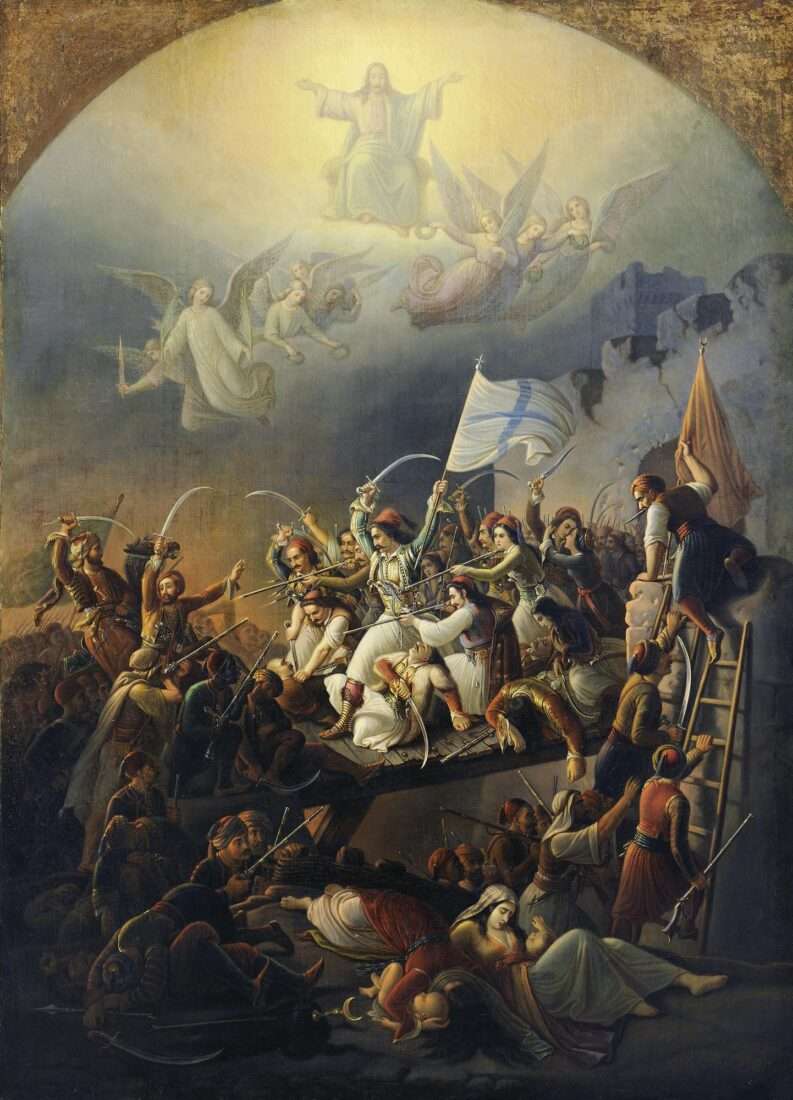
1853 · National Gallery — Alexandros Soutsos Museum
In 1826 the defenders of besieged Messolonghi tried to break out. Vryzakis painted their sortie nearly three decades later, so the picture is an act of remembrance and not a record. Crowded fighting fills the lower part. Above it, a radiant heavenly gathering presents the battle as a religious sacrifice. Nobody on the ground could have seen that upper half.
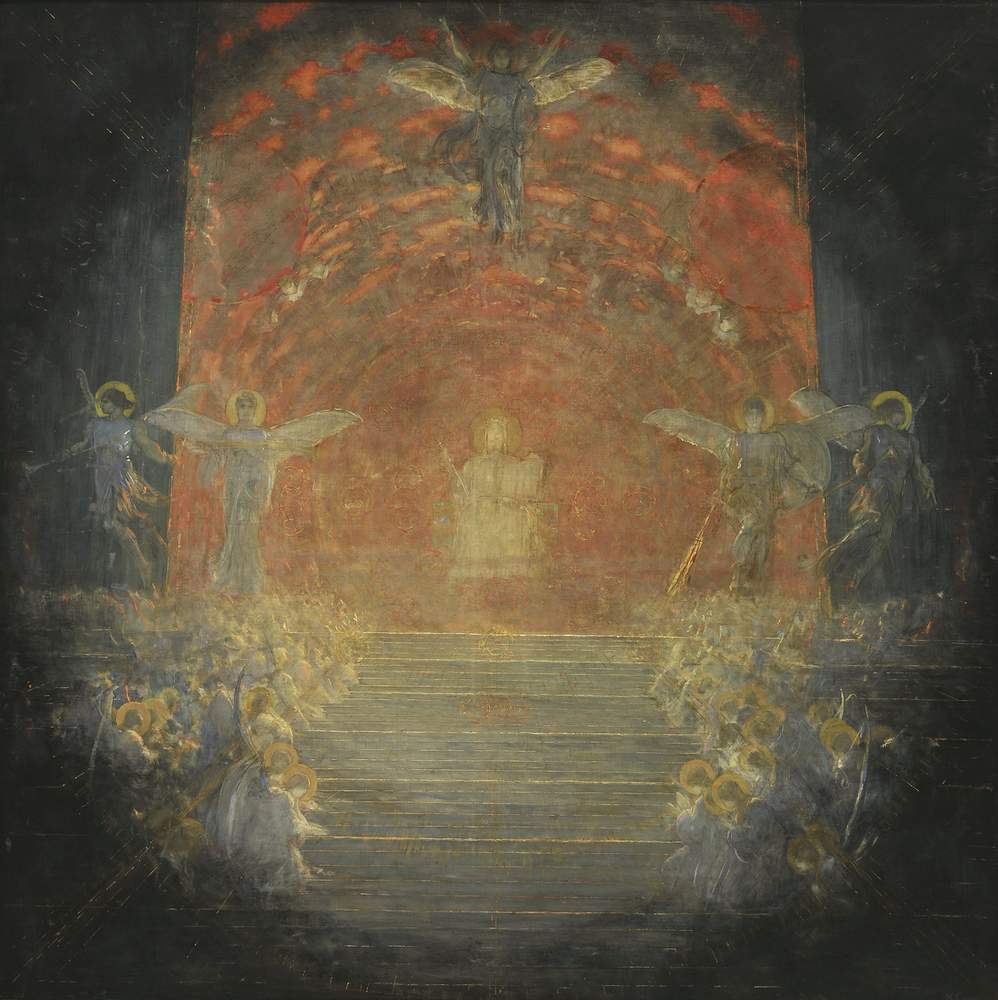
1899–1900 · National Gallery — Alexandros Soutsos Museum
Gyzis again makes his figures small, but this time it is light that dwarfs them. A glowing arch towers over the pale crowd in front of it, and the nearer the figures stand to it, the more their details dissolve. The title announces an arrival, yet the picture offers no clear sequence of events and no earthly place that could be fully described. Gyzis gives the sacred subject a vast, radiant setting instead.
1933 · National Gallery — Alexandros Soutsos Museum
An apotheosis raises its subject to an ideal or divine state, and Parthenis's methods suit that purpose. He draws bodies and architecture in light outline and keeps modelling to a minimum. As a result, Athanasios Diakos, a historical figure, appears in an invented ceremonial space, far from ordinary physical description. The pale, elongated figures seem almost weightless. They are not witnesses whose positions could be checked against an account of the event. They read as emblems in a formal tableau.
1910 - 1911 · Oil on canvas · National Gallery — Alexandros Soutsos Museum
This is the earlier of the two Parthenis paintings here, and it already has the paleness and economy of the Diakos. Another painter might have filled an Annunciation with furnishings and elaborate costume. Parthenis leaves open space between the two figures and sets them among pale architecture and tall green forms. In so quiet a picture, a small area of pink carries unexpected weight.
1945 · Oil on canvas mounted on pasteboard · National Gallery — Alexandros Soutsos Museum
Short, separate strokes of blue and ochre break up the pale slopes below a darker ridge, and Papaloukas leaves every one of them visible. He does not smooth one plane into the next or use conventional shading, yet the land still holds together as it recedes.
c. 1895 · National Gallery — Alexandros Soutsos Museum
The boats lie at anchor on pale, untroubled water under a wide sky. Volanakis softens their reflections, so the hulls lose their hard lower edges and seem to settle into the surface. One vessel sits close to the viewer, and the drop in size from it to the others is enough to show the distance across the water.
c. 1568-1570 · Oil and tempera on panel · National Gallery — Alexandros Soutsos Museum
Grief here is partly a matter of carrying. The men bearing Christ's body have linked arms to share its weight. As they crowd around the pale corpse beside the tomb, their sorrow shows as much in the effort of holding it up as in their gestures. In the crush of bodies, the bright robes help to tell one figure from the next.
1688–1700 · National Gallery — Alexandros Soutsos Museum
The close group around the infant is only one part of the picture. Tzangarolas sets earthly and heavenly scenes on separate levels, or registers, and joins them with gold instead of a single perspective. Moving from one register to another changes the size of the figures, but it never leads further back into an imagined room. The Adoration stays within a traditional devotional order.
1725–1775 · National Gallery — Alexandros Soutsos Museum
The Assumption shows Mary being taken up into heaven. Doxaras keeps the two worlds distinct by painting the earthly architecture as more solid than the heavenly cloud. The witnesses below make the connection between them. They raise their arms and look upwards, and their gestures lead the eye from the open tomb to the ascending figure.
1927 · Oil on pasteboard · National Gallery — Alexandros Soutsos Museum
People, animals and buildings crowd the scene, and every one of them can be picked out. Theophilos does not fit them to a single distant viewpoint. He varies their size so that useful details stay clear, and he builds his sense of the place from many separate activities, each shown at its own scale.
1930 · Thinned oil (?) on canvas · National Gallery — Alexandros Soutsos Museum
The title gives her a name, a city and an epithet, and Theophilos presents her in the same spirit: seated, facing us and holding her instrument, almost as an emblem. In Ayia Anna, clear detail keeps a crowded scene legible. Here the same care goes into a single figure. He takes trouble over her dress and her instrument, and he keeps the patterns and plants around her distinct. Everything stays close to the picture surface, and sharp detail does the work that modelling in depth might do elsewhere.
1924 · Oil and pencil on pasteboard · National Gallery — Alexandros Soutsos Museum
Maleas works with the same ochre and blue as Papaloukas at Delphi, but he lays them in broad areas, not broken strokes. He also leaves the distance open and does not fill it with incident. Low buildings and small figures beside the wide river give a human scale while staying modest within the larger setting, and nothing in the foreground claims attention.
1954 · Oil on canvas · National Gallery — Alexandros Soutsos Museum
Dark blue strokes press in around the woman, and only her warm-coloured clothes keep her apart from them. Bouzianis lets the paint disrupt her edges and proportions, though she can still be made out.
1936 · Oil on canvas · National Gallery — Alexandros Soutsos Museum
The two dancers' arms and bent legs are loosely outlined, and their faces are only sketched. The boundary between their bodies and the surrounding darkness is left unresolved, and these unsettled edges do as much as the poses to create the movement. Bouzianis also leaves outlines open in the later Actress, but there they suggest paint pressing in on the figure, not movement.
1905 · Oil on cardboard · National Gallery — Alexandros Soutsos Museum
The place name recalls Vryzakis's sortie, but Laskaridou shows nothing of the siege, only pale water, distant land and air. Nothing large stands in the foreground. She separates water, land and air through small shifts within a pale range of tones. Scattered reflections enliven the nearest stretch of water without breaking the long, quiet view across the lagoon.
c. 1906 · Oil on canvas · National Gallery — Alexandros Soutsos Museum
The title is not quite accurate: the boy has turned his head away from his open book. Flora-Karavia does not show what has caught his attention, and she builds no further story around the pause.
c. 1938 - 1939 · Egg tempera fresco · National Gallery — Alexandros Soutsos Museum
Kontoglou spends almost nothing on the body. The shoulders are barely indicated and other passages are left sketchy. The likeness lies in the profile, the dark hair and the firmly drawn eye, set in clear outline against a pale ground.
Explore this selection in Artline
See the selected works alongside books and events from their period, or compare when the artists lived. The books and events provide context, not evidence of direct influence. Works without confirmed dates remain in this guide.
Earth, heaven and commemoration
Neither of the commemorative pictures, by Vryzakis and Parthenis, reports events. Both are allegories. Within this selection, the older religious paintings are a better guide to reading them than the portraits and landscapes. Tzangarolas and Doxaras each keep an earthly zone apart from a heavenly one and then find a way to join them. In their pictures, though, heaven belongs to the subject. An Assumption is an ascent into heaven, and Tzangarolas's Adoration has a heavenly register as well as the group around the infant. Vryzakis uses a similar division for a battle, and the upper zone then does a different job. It is no longer part of the event shown below. It tells later viewers what the sortie meant. Parthenis, who also commemorates a hero, takes another route. He does not open heaven above a recognisable scene. He raises Diakos into a ceremonial setting that no ordinary description would fit.
Further reading
National Gallery–Alexandros Soutzos Museum; edited by Olga Mentzafou-Polyzou (3rd edition, 2013) · Free English PDF from the National Gallery. Historical catalogue; its floor plans and display information are not current.
The gallery's own illustrated catalogue traces Greek painting from post-Byzantine work to modern art. Its essays give much of the background on these artists that the short entries here leave out.
 Art, literature & history