Twenty works from the Musée national Picasso-Paris: Picasso from an early portrait to Jacqueline with Flowers, by way of bathers, children and a bull made of bicycle parts, with a drawing by Seurat and a goat by Courbet alongside.
The Musée national Picasso-Paris occupies the Hôtel Salé, a seventeenth-century mansion in the Marais. Its collection follows Picasso through many stages of his working life, in paintings, sculpture, drawings and archival material.
The Picassos chosen here run from The Barefoot Girl, an early portrait, to Jacqueline with Flowers. Between the two, certain subjects keep coming back: bathers on the beach, children with toys or doves, figures bent over books. Paul, Maya and Jacqueline are named in their titles, but most of the other figures are not. Two works break the run. The Bull's Head turns a bicycle saddle and handlebar into an animal. Massacre in Korea, far more gravely, sets armed figures against people who cannot defend themselves. From outside Picasso's own work come a crayon drawing of a seated woman by Seurat and a goat's head by Courbet, and each makes a useful foil for particular Picassos.
Artline selected these works from the museum's documented holdings, independently of the museum. Dates and attributions keep the qualifications given in the linked records.
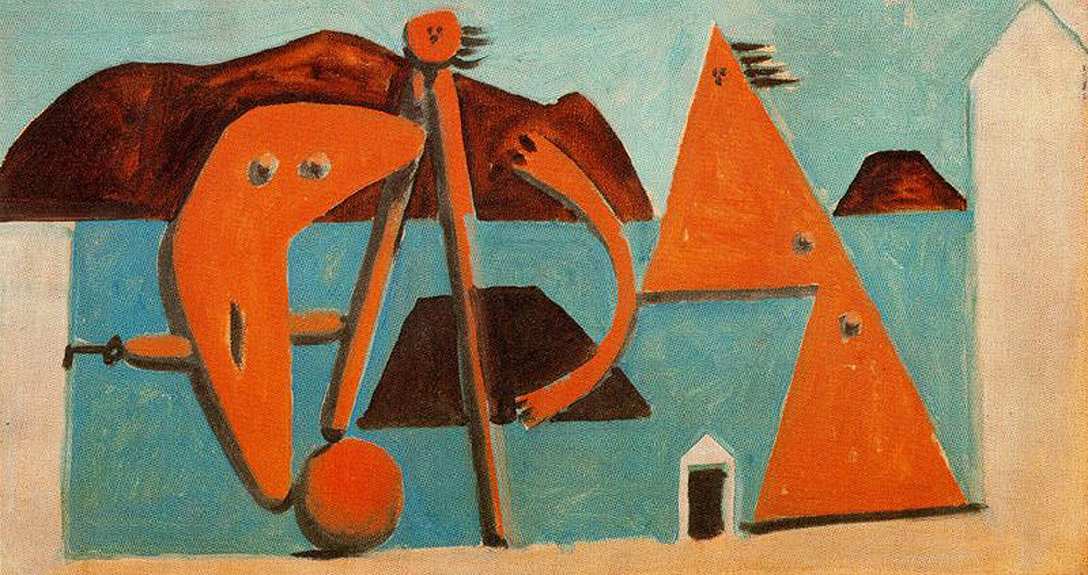
1928 · Oil on canvas · Musée national Picasso-Paris
Here the bathers are angular shapes against blue water. They can still be read as bodies, but their limbs and positions no longer add up to a naturalistic group. The sea does more to hold the picture together than any arrangement of the figures. This is the earliest of the beach pictures in the selection, and the later ones go the other way: in Two Nude Women on the Beach and Large Bather with a Book the bodies are rounded and heavy.
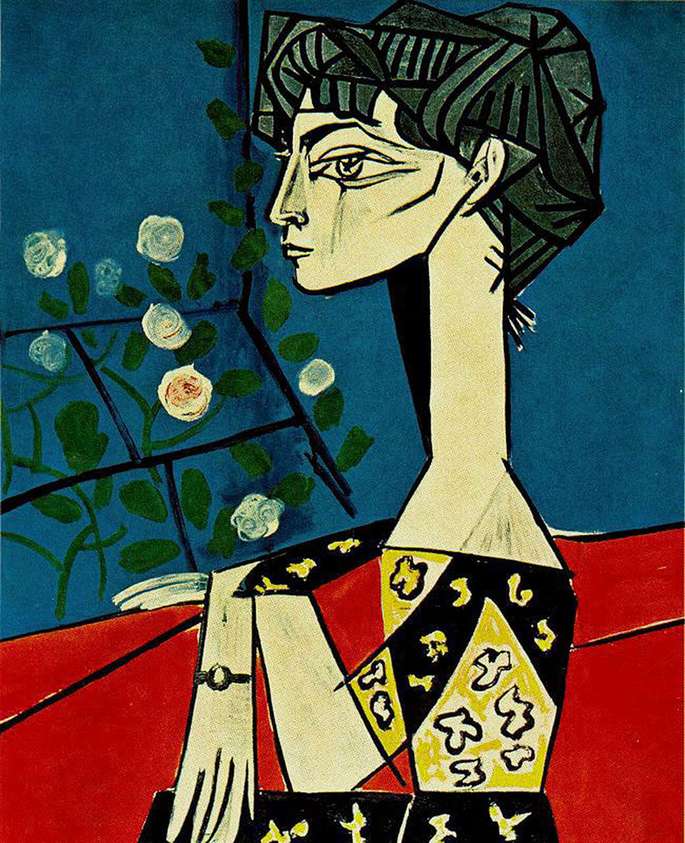
1954 · Oil on canvas · Musée national Picasso-Paris
In the latest picture in the selection, everything hangs on one clean edge: Jacqueline's profile against the blue ground. Flowering stems and her patterned clothing make smaller, more irregular movements around and below it, and her long neck lifts the head clear of all that activity. Straw Hat with Blue Foliage, from much earlier, has the opposite arrangement, with the busy foliage piled on top of a simple profile.
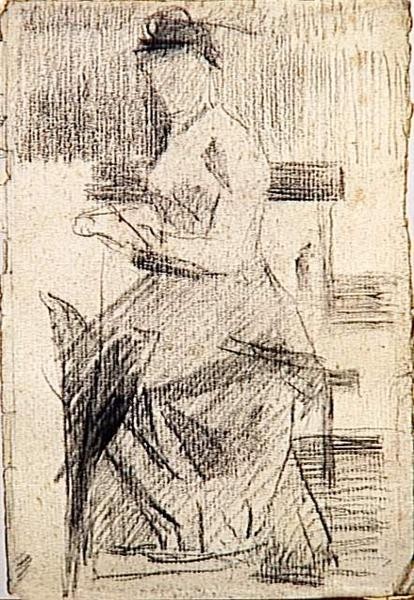
1881 · Crayon on paper · Musée national Picasso-Paris
No continuous line encloses this figure. Seurat built it up from layers of dark crayon, and where the marks thin out the body fades towards the pale paper. Its edges come from how densely the marks lie, not from an outline. That makes it the sharpest contrast in the selection with the Picassos that depend on a firm contour, among them the acrobat's loop and Jacqueline's profile.
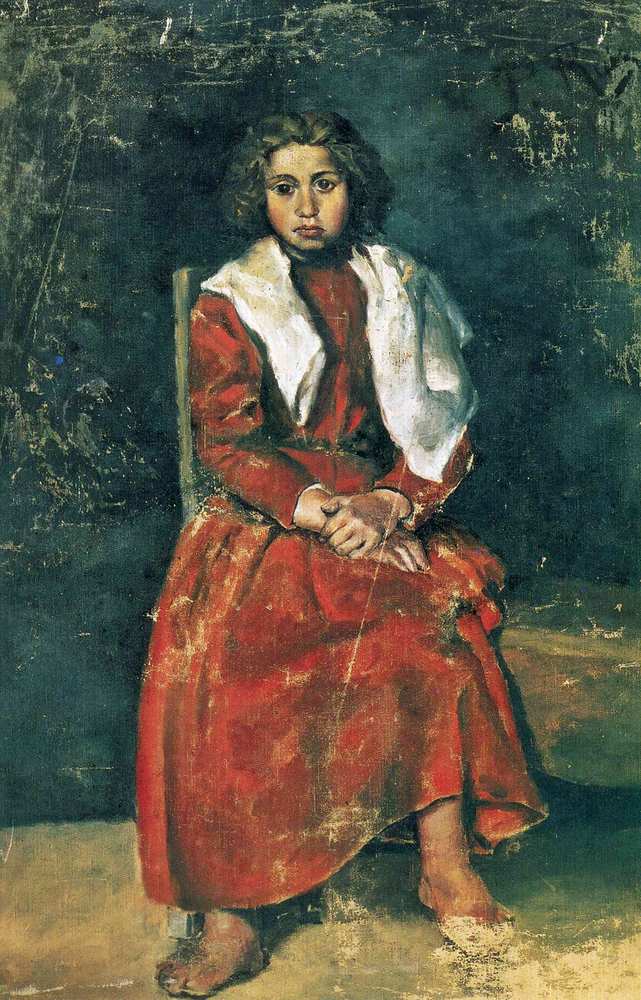
1895 · Oil on canvas · Musée national Picasso-Paris
This is the earliest of the Picassos here, and the closest to convention. The girl sits upright, and the bare feet of the title do practical work: together with her folded hands, they hold her firmly in the seat. Her red dress separates her from the dark foliage behind, and the pose is unshowy. Much of what follows in the selection unsettles what this picture takes for granted, a coherent figure in a stable space. The mismatched sizes in Women in an Interior and the many-eyed face of Figure and Profile are two examples.
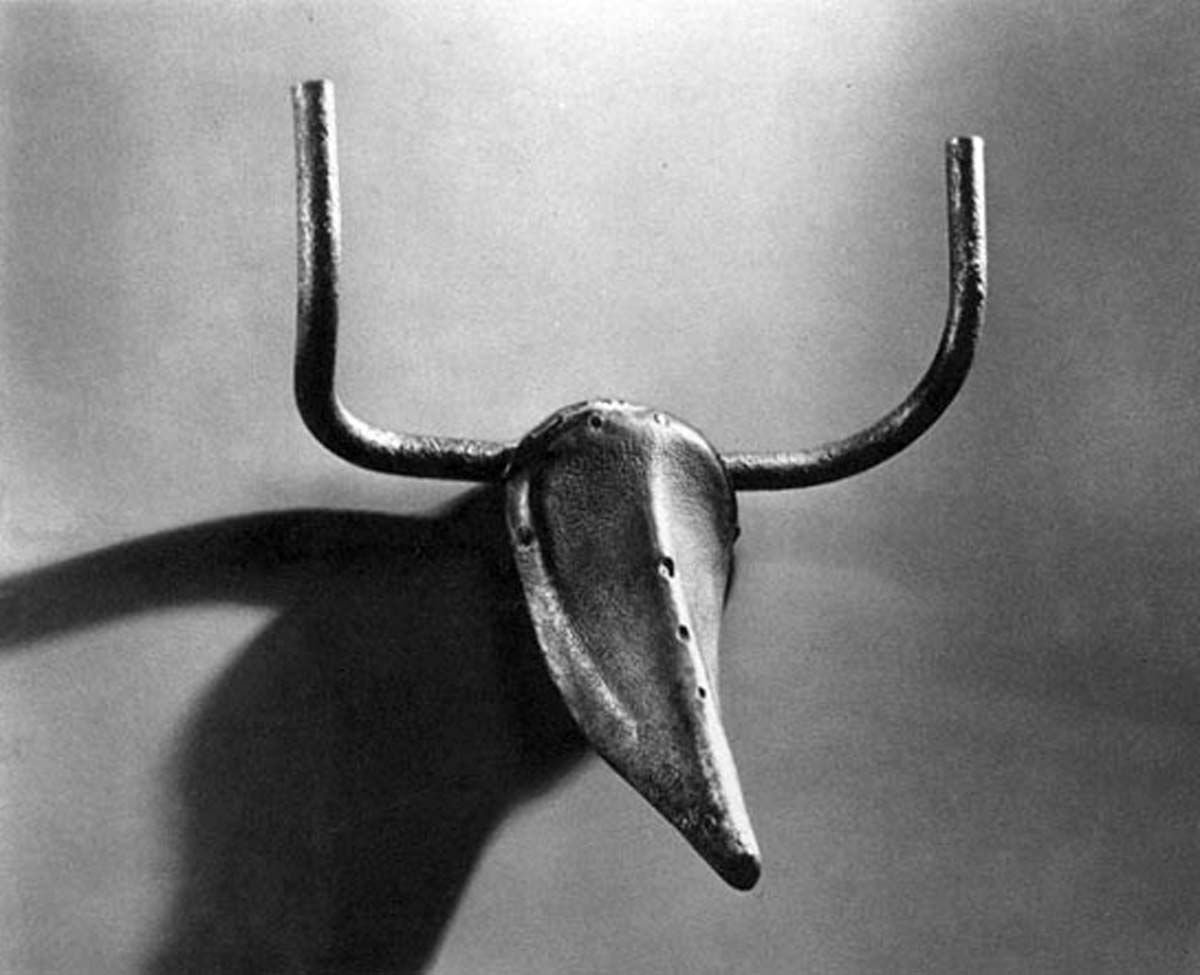
1942 · Assemblage , objet trouve · Musée national Picasso-Paris
The museum identifies the materials as a real leather saddle and a metal handlebar. They are found objects, joined as an assemblage, and neither is disguised. The narrow saddle becomes the bull's muzzle and the curving handlebar its horns. There is no fur and no modelled eye. The pun, if that is the word, works only because the parts remain recognisable as bits of a bicycle, so that bull and bicycle are seen at once.
This is the selection's other horned head, made in quite the opposite way. The saddle and handlebar give the bull a muzzle and horns and little else, while Courbet records the particular anatomy of the goat's head, its flesh and texture. Light catches the eye and the muzzle beneath the sweep of the horns, and mountain and sky give the animal a setting.
The title puts the stripes on the hat, but the picture does not keep them there. They cross from costume to person, dividing the woman's face as well as her clothes. The background takes up the same vertical rhythm, so one pattern runs through figure and setting alike. Her features can still be picked out, but they no longer lie on a single smooth surface.
Two women look downwards, absorbed in some modest activity they share. Their enlarged limbs fill the shallow space, and the rounded forms press against one another with little room left around them, which gives the pair a monumental weight. The title does not say what occupies them. Much of the picture's interest lies in the contrast between so much bulk and so modest an occupation.
Sleep comes down to a familiar gesture, a head resting on an arm. Head, arm and shoulder fold into a compact run of curves. Some of the anatomy is bent out of shape to fit, but the gesture itself is never in doubt. Behind the sleeper, the shutters of the title supply a more regular pattern of lines.
1953 · Oil on canvas · Musée national Picasso-Paris
The truck of the title takes up very little of the canvas. Branches and leaves crowd the picture, and restless marks surround the small, absorbed child. Only the child's posture, bent towards the toy, leads the eye to the truck at all.
1936 · Oil on canvas · Musée national Picasso-Paris
The women in this room are not painted to one consistent scale. One sits with a book. The larger, striped figure presses against angled furniture and walls, as though the room had been built for someone smaller. It is still recognisably a domestic interior, but its dimensions are hard to work out.
1928 · Oil on canvas · Musée national Picasso-Paris
The title names two things, a figure and a profile, and the central outline may hold both. It has several eyes, so it cannot be read as one face seen from one position. Is the profile part of the figure, or something separate from it? The picture leaves more than one reading open. The open window nearby is far easier to name.
Two Nude Women on the Beach was painted in the same year, but its title does not say what holds the women's attention. This one does. The book looks tiny beside the body bent around it. The bather's broad limbs are as compact as stone, yet they settle into the ordinary posture of reading, with the huge figure closing around a small patch of pages. In Women in an Interior the reader is the smaller figure. Here reading is given to a body of monumental bulk.
1931 · Oil on canvas · Musée national Picasso-Paris
In the selection's only still life, the objects on the pedestal table take up more room than any tidy view of a tabletop would allow. Curved outlines run across the areas of colour without following them. Sometimes they separate one vessel from the next and sometimes they join them, so the eye keeps re-sorting what belongs with what. Each shape can be recognised in turn, but no single viewpoint accounts for the whole.
1930 · Oil on canvas · Musée national Picasso-Paris
An acrobat's body can do what others cannot, and Picasso's goes further still. The pale body is stretched into a long loop that bends beyond anything real joints could manage, yet the hands and feet keep the turn readable as a human pose. Nothing on the grey ground competes with that outline.
1943 · Oil on canvas · Musée national Picasso-Paris
A child with doves sounds like a gentle subject, but the picture does not let it stay one. Angular furniture fills much of the room and closes in around the small child. The child's rounded body sits low in the crowded space, while the pale doves draw the eye upwards. The differences in scale stop the group from settling into an easy domestic scene.
1936 · Oil on canvas · Musée national Picasso-Paris
The title names the hat, not the person wearing it, and the painting shares that priority. Loops and blue leaves spread above a profile made from a few clearly outlined areas of black, cream and violet. The face is kept simple enough to give the extravagant hat the stage.
1924 · Oil on canvas · Musée national Picasso-Paris
Paul is dressed as Harlequin, and the diamond-patterned costume presents him as a performer. The pattern, though, stays on the costume. His face and hands are carefully described, which makes this a portrait of a particular child, not of a role. The furniture lower down is noticeably less finished.
1951 · Oil on plywood · Musée national Picasso-Paris
Children appear here too, but not with toys or doves. They are grouped with women among the exposed, and a strip of open ground separates them from the armed figures facing them. Only the armed figures have any means of acting, and their weapons look mechanical. The scene is not composed like a photograph of a particular moment. Its protest lies less in any single incident than in the imbalance between force and vulnerability.
1938 · Oil on canvas · Musée national Picasso-Paris
Maya's head is large and her features point in different directions, yet the doll she holds close makes the scene familiar at once. Repeated colours connect the toy with her dress and with Maya herself, binding sitter and doll together in a compact picture. Paul as Harlequin keeps its most careful description for the face. Here the face is where the distortion goes.
Explore this selection in Artline
See the selected works alongside books and events from their period, or compare when the artists lived. The books and events provide context, not evidence of direct influence. Works without confirmed dates remain in this guide.
Room to move
A question runs through much of this selection: who, or what, has room? Sometimes the pressure comes from within, when bodies and objects outgrow their settings. Examples are the striped woman pressing against the furniture of Women in an Interior, the beach pair filling their shallow space and the vessels crowding the pedestal table. The children are more often hemmed in from outside, by furniture in Child with Doves and by foliage in Child Playing with a Truck. Massacre in Korea turns the question round, because there the open ground leaves the people facing the weapons so exposed. Not everything fits. The acrobat has the grey ground to itself, however hard its joints are strained. The girl in The Barefoot Girl never has to contest her space. Seurat's woman has no boundary to push against at all, and at her margins she gives way to the paper.
Further reading
Edited by William Rubin · Digitized catalogue under Publications · English
MoMA offers a digitised copy of William Rubin's 1980 retrospective catalogue in English, under Publications. Its long chronological survey is the place to go for setting the Picasso works in this selection within his wider output. It records an exhibition, not the Paris collection.
 Art, literature & history