The Musée d'Orsay is housed in a former railway station on the Seine, and its collection concentrates on the period from the middle of the nineteenth century to the beginning of the twentieth. French painters of those decades disagreed fiercely about what a picture should look like, and some works in this selection were first received as provocations: Manet's Olympia caused a scandal at the Salon, and the Salon jury would not have his Luncheon on the Grass at all.
The twenty paintings here follow those disagreements through particular subjects rather than through a sequence of movements. One strand runs through a village funeral, women gleaning, two field workers stopped for prayer, men on their knees scraping a floor, a crowded dance and a dance lesson. Portraits make up another: by Manet, Morisot and Whistler, by Renoir of a fellow painter at work, and by Regnault of a rider on a restless horse. Then come Cézanne, Van Gogh and Gauguin, in whose pictures a tabletop, a church or a Tahitian scene can no longer be taken on trust. Manet, Millet, Renoir, Van Gogh, Cézanne and Gauguin each appear more than once, so pictures by the same hand can be set beside one another as well as against the rest.
This selection was made independently of the museum. Inclusion here does not mean that a painting is on display, since works may be on loan or off view. Dates and attributions keep the qualifications given in the collection records.
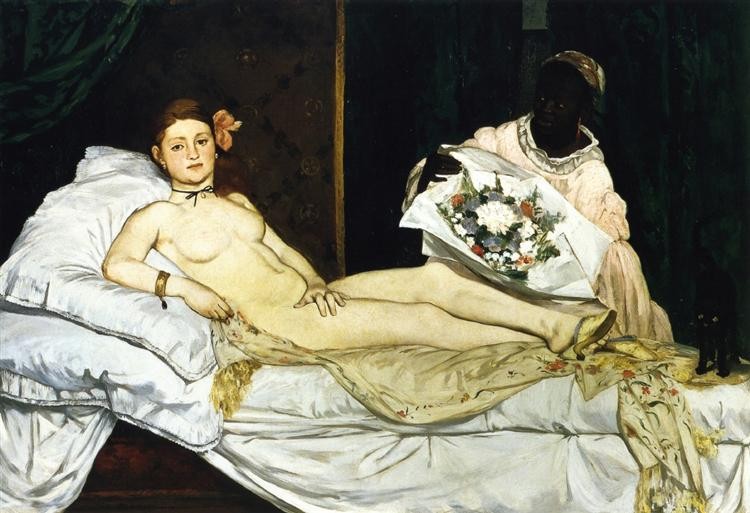
Olympia is dated 1863, but the scandal came when it was shown at the Salon of 1865. Official painting had accepted the nude as long as mythology kept her at a safe distance. Manet does without that distance. The reclining woman looks straight at the viewer, and nothing in the picture explains her away: a servant brings flowers and a black cat stands near the foot of the bed, details that place the scene in contemporary Paris rather than in some mythological elsewhere. Nor was it only the subject that gave offence. The way Manet painted it was taken as a provocation too.
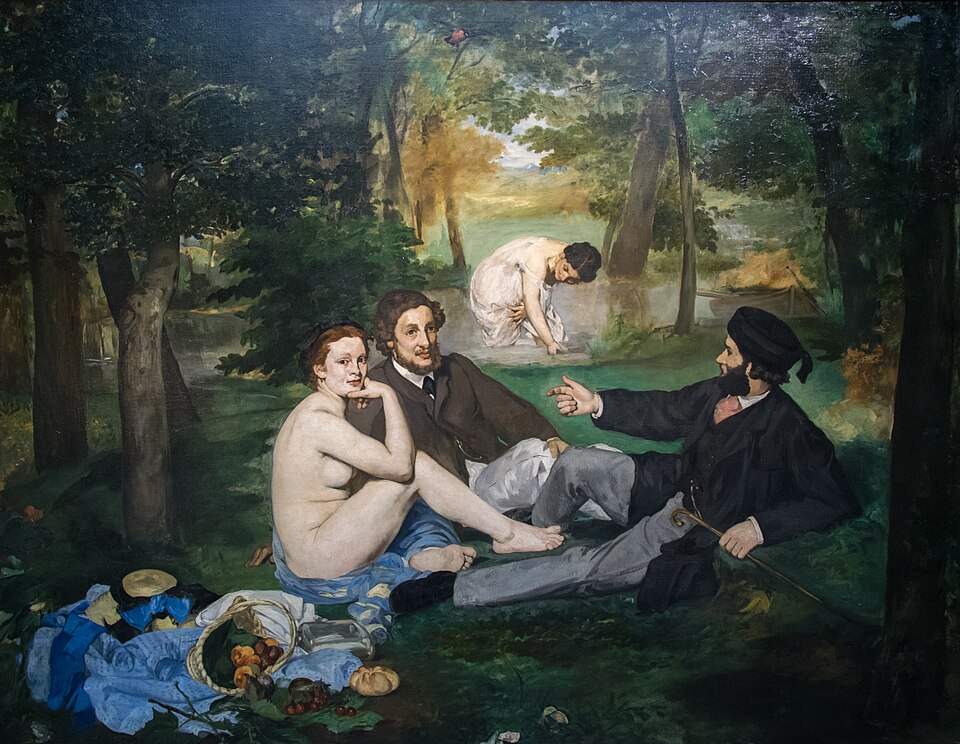
A nude woman and two clothed men share the picture, but they do not seem to belong to the same occasion, and, as in Olympia, Manet offers no mythology to account for her. The composition is more traditional than the subject: one group of figures derives, by way of an engraving, from Raphael. That pedigree did not save it. The Salon jury rejected the painting, and in 1863 it was shown instead at the Salon des Refusés, an exhibition of rejected works.
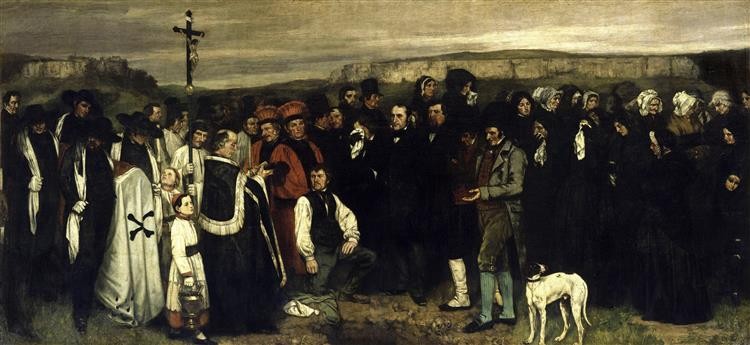
At 6.68 metres wide, the canvas gives a village funeral the kind of space usually reserved for elevated historical or religious subjects. Courbet does not spend that space on a hero. He shares it among the mourners and paints them life-size without idealising any of them, so the dignity of the format goes to people who have not been improved to earn it. The open grave lies in the foreground, at the edge nearest the viewer.
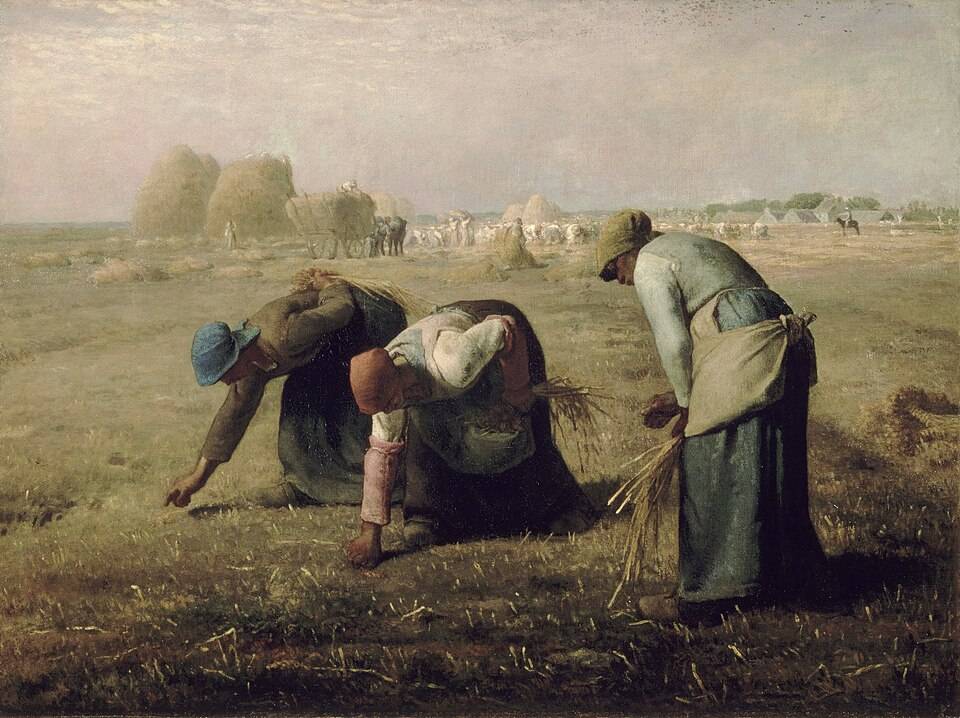
Gleaning meant gathering what was left in the fields after the harvest, and Millet builds the picture on that division. The harvest itself, the abundance, is pushed into the distance. The foreground belongs to the women and their handfuls, to work that is exhausting and small in scale, so those left with only the remains get the most room. They bend in similar ways, which links them, though Millet does not make them interchangeable.
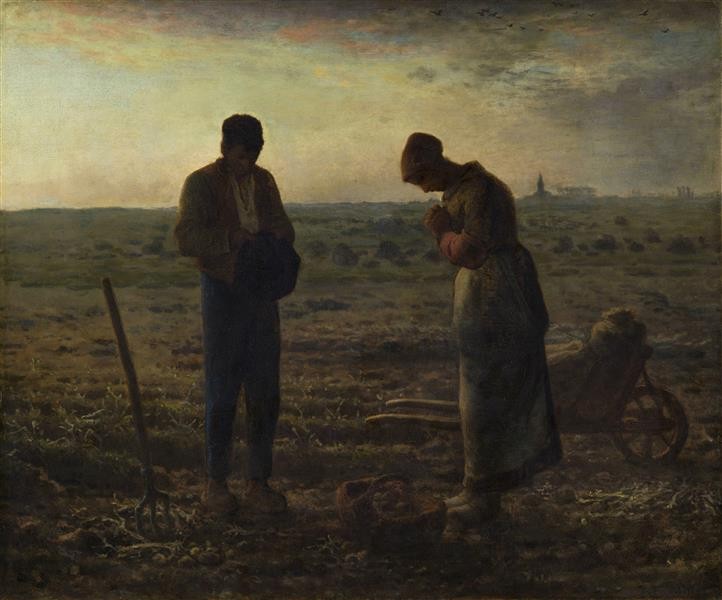
A man and a woman have stopped work to pray. Their tools and basket are still beside them, so the prayer reads as a pause in the day's labour rather than a separate ceremony; as in The Gleaners, Millet keeps the work in view. With both heads lowered, neither looks at the other, and the gap between them becomes all the more noticeable. A church in the distance ties this private moment to the wider landscape.
Courbet's funeral has no hero, and neither does Renoir's dance. But where the mourners at Ornans have gathered for one occasion, this crowd is many small occasions happening at once. Patches of light fall on faces, clothing and the ground, passing from group to group without settling on any main event, and it is the light, more than any action, that binds the separate conversations and dancing couples into one scene. The seated figures in the foreground offer a way in; farther back, nobody dominates.
Here the floor is as much the subject as the men. Millet's gleaners bend over a field; these men kneel indoors on the very surface they are working, and its boards run back into the room in long strips that set the direction of the picture. The men work their way across them, each at a different stage of the same job. Light from the window picks out the scraped wood and their bare backs. Caillebotte gives the labour an orderly, even handsome setting, without disguising the awkward positions it demands.
Whistler's title puts the arrangement in grey and black first and the sitter second, and the painting seems to work in the same order. Large areas of the two colours establish the picture; only afterwards do the smaller pale accents of face, cap and hands come forward. A framed picture and a patterned curtain divide the wall, and the artist's mother sits in quiet profile within that firm structure. Is this a portrait, then, or an arrangement that happens to include the painter's mother? The title, at least, is clear about which comes first.
On this evidence, much of a dance lesson is spent not dancing. Only some of Degas's dancers are practising; others wait, rest or adjust their clothes. Where light ties Renoir's crowd together, here the small activities stay separate on the open floor, and only the instructor and the lesson in progress hold the group loosely together.
Two kinds of light share the night: stars scattered overhead and the long reflections of the city stretched across the river. The difference keeps sky and water apart, even where their colours come close. A couple near the bank gives a measure of the river's breadth.
1890 (painted 4–8 June 1890) · Oil on canvas · Musée d’Orsay
Paths divide to pass around the church, and its walls seem to bend beneath the deep blue sky. The outlines are less stable than masonry has any right to be. In Starry Night over the Rhône Van Gogh kept sky and water distinct; at Auvers even a building's solidity is drawn into the movement of the landscape, though it remains recognisably a church. A small walking figure adds movement on an entirely different scale.
Weariness, perhaps melancholy, is the reading this pose invites, and the picture gives it plenty of support. Gachet's hand props up his head rather than gesturing towards anyone, and his sloping shoulders and the diagonal of his body repeat that downward pressure. The flowers beside him stand more upright, almost in contradiction.
A bottle marks a vertical division between the two men, but they are not mirror images: they sit in different postures on either side of the narrow table. Each looks at his cards, neither at the viewer nor at the other man. Very little happens. Cézanne makes their concentration the subject, and a game of cards takes on a stillness close to the monumental.
The fruit looks solid. Try to piece the table together as one consistent surface, though, and it will not quite fit: the plates, the folds of cloth and the raised dish are each seen from a different angle. These shifts need not be read as faulty perspective; they can as easily be seen as letting each object show more of itself. With no single fixed viewpoint, Cézanne holds the arrangement together through the relations between neighbouring objects.
The red dog settles it: this is not a neutral record of what Gauguin saw. Bands of colour organise the ground around the seated women, smaller figures occupy a separate zone behind them, and the simplification that holds the scene together makes no secret of the painter's intervention. The picture is better taken as Gauguin's construction than as an account of Tahitian life.
1891 (November–December) · Oil on canvas · Musée d’Orsay
Where Arearea, from the following year, spreads its figures across separate zones, this picture pulls everything in around two women. They sit close together but look in different directions, one turned sideways and the other facing out, so they never become a matched pair. Broad outlines and shallow space give their bodies weight, and their hands and patterned clothing add smaller differences within a compact, stable arrangement.
Dark clothing could have turned the seated figure into a single block. Morisot prevents that with small changes of light that separate hands, face and dress. The head turns slightly while the hands rest together, and pale, patterned furnishings surround her. Whistler's portrait of his mother, from the same year, also sets pale accents of face and hands against dark tones, but there the large areas come first. Morisot's picture lives inside the dark, in the small distinctions that keep it from going flat.
An open book and pictures on the wall make reading and looking part of the portrait's subject. Manet surrounds Zola with these things, yet the sharply drawn profile stays distinct and is never lost among them.
Bazille is at work, not posing: the title tells us he is painting a heron. Renoir shows his colleague from the side and lets the leaning body, the brush and the materials nearby define the portrait. It is one painter's record of another, busy with a picture of his own.
The equestrian portrait was a traditional format for displaying public authority, and Regnault takes it up directly. Prim's horse lifts a foreleg and is plainly restless, which makes the rider's composure all the more noticeable. Around horse and rider, other figures and flags carry the scene outwards. The title ties the picture to a single day, so it reads as the record of an occasion as well as a portrait, and the figures and flags seem to belong to that event as much as to the man at its centre.
Explore this selection in Artline
See the selected works alongside books and events from their period, or compare when the artists lived. The books and events provide context, not evidence of direct influence. Works without confirmed dates remain in this guide.
Kinds of attention
A surprising number of these pictures turn on where people's attention goes. Cézanne's card players have eyes only for their game, and the couple in The Angelus have lowered their heads to pray. Bazille is absorbed in his canvas, and Gachet seems turned in on himself. Whistler's mother and Manet's Zola are both seen in profile. In Degas's class and at Renoir's dance, attention scatters among small concerns. Olympia stands apart from all of these. She returns the gaze of whoever is looking at her, and that may have been part of what made her a scandal.
Further reading
Anne Dayez, Michel Hoog and Charles S. Moffett · Read online or download · English
An exhibition catalogue placing works by Monet, Renoir, Degas and their contemporaries in the context of the early Impressionist exhibitions. It deals with Impressionism, not with the Musée d'Orsay's collection as a whole, so it bears most directly on the Renoir and Degas paintings in this selection.
 Art, literature & history