Twenty paintings from the seventeenth century to the twentieth, from Georges de La Tour's candlelit Saint Peter and Courbet's grain sifters to abstraction by Kandinsky, Manessier and Bryen.
The Musée d'arts de Nantes has a wide collection of European painting, with older works in its historic palace and modern art nearby. The twenty pictures chosen here draw on both. They run from Georges de La Tour's Denial of Saint Peter, a still life by Pieter Claesz and Charles de La Fosse's Venus at Vulcan's forge, by way of Watteau's stage emperor, Courbet's grain sifters and landscapes by Corot and Maufra, to abstraction by Kandinsky, Manessier and Camille Bryen.
Several threads run through the selection. Religious subjects take very different forms: La Tour sets a gospel scene among people who are not all paying attention, Marie Laurencin's Judith keeps the violence of its story out of view, and Manessier's Salve Regina is devotional in its title and abstract on the canvas. Jean-Léon Gérôme appears twice, once with a captive in a river boat and once with a head crowned by ram's horns. Adolphe Yvon's companion portraits of Monsieur and Madame Cossé ask to be seen as a pair. Some pictures depend on a story, such as Jean-Paul Laurens's posthumous trial or Léon Comerre's flood; others are more concerned with how a face is lit or how much of a canvas is left open.
The paintings come from the museum's documented holdings, but the choice was made independently of the museum. Where the records qualify a date or an attribution, as with the dating of La Fosse's Venus, the qualification is kept.
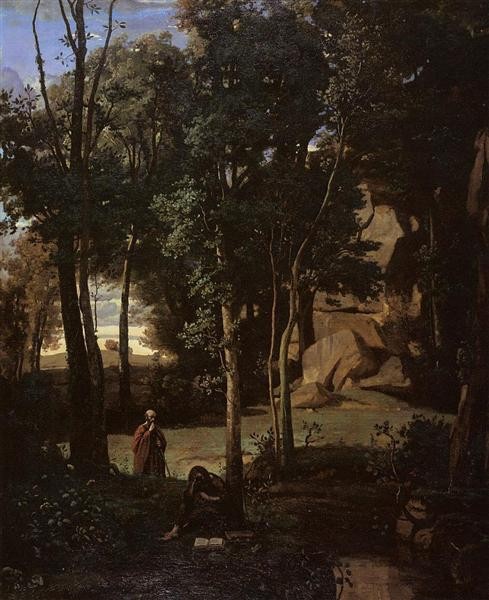
The philosopher named in the title occupies only a small part of Corot's canvas. Trees and uneven ground take up most of it, and the picture is not arranged around Democritus: Corot seems at least as interested in the stand of trees as in the figure who gives the scene its name. Anyone who arrives wanting the story will find the landscape doing most of the talking.
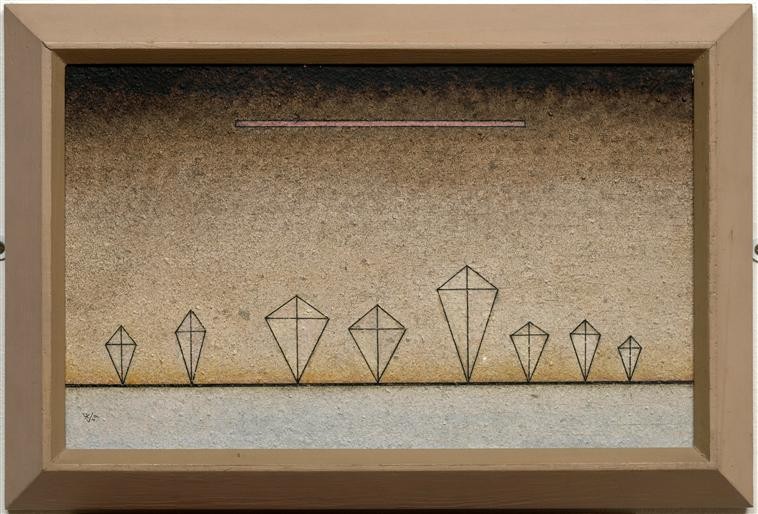
Eight upright forms stand in a row, joined by a horizontal line; the number, at least, matches the title. Reading the row as a sequence is harder. The forms differ in height and have angular profiles, and they never settle into a regular beat. A pale bar above them sets a second level against which each variation can be measured, and Kandinsky leaves so little else on the cardboard that a small shift in position or height carries real weight.
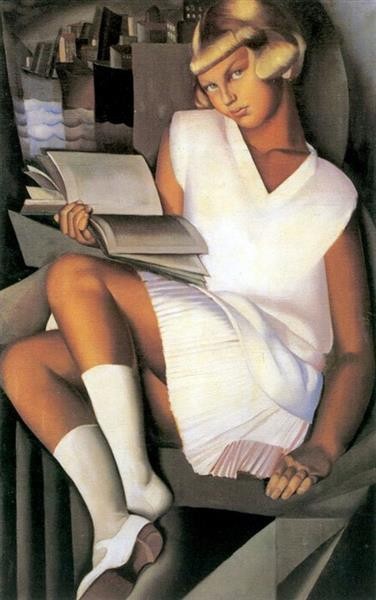
An open book gives the child something to do besides hold still. Around that absorbed activity Lempicka builds a body of unusual solidity: folded fabric, strongly lit limbs, a bent leg pressed into the narrow seat. Kizette's rounded volumes are set against the angles of her surroundings, until a reading child takes on something of the weight of sculpture. It is a curious amount of force to bring to so quiet a moment, and much of the picture's interest lies in that mismatch.
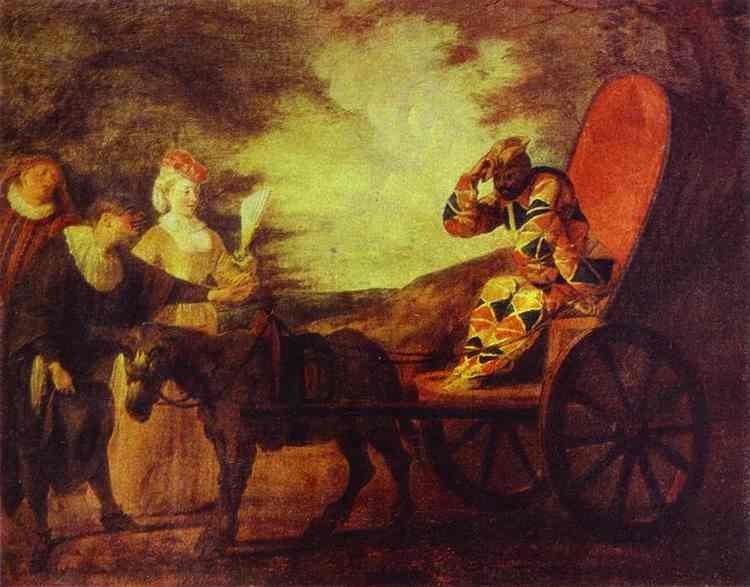
Harlequin's authority comes entirely from the people gathered round him. A costume, a raised seat and the placing of the other performers are enough, for the moment, to make an emperor of this commedia figure, and Watteau leaves the machinery of the transformation in plain view. The title is fanciful, and the picture is frank about it: what we see is a makeshift hierarchy put together by players.
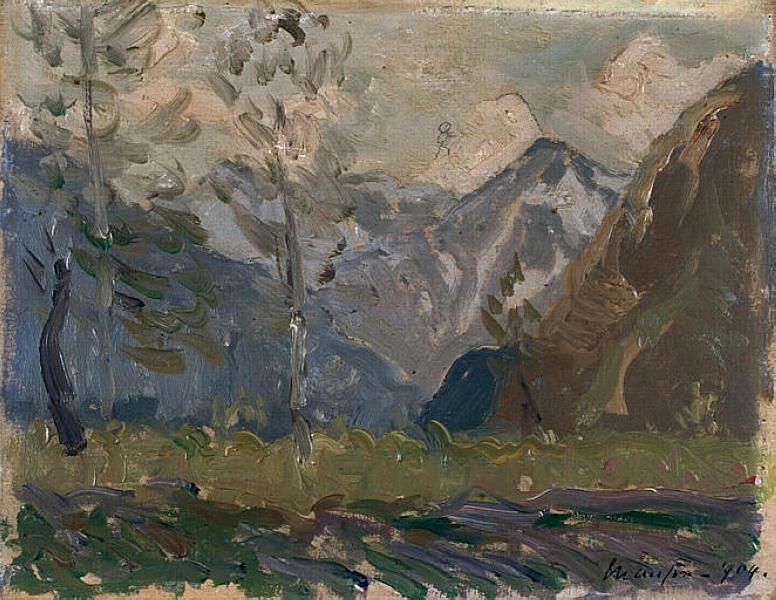
The title calls this a study, and Maufra does not give every leaf or rock a finished edge. He still keeps the near vegetation distinct from the distant peaks. The brushwork changes direction and density between the rough growth in the foreground and the mountain faces above, so distance registers in the handling as well as in scale, and the pale summits keep their mass even where their outlines soften into the sky.
Judith's story is a violent one, and other painters have given it muscular force. Laurencin's pale figures and pink drapery have little of that. A raised arm hints at action, but the elaborate headdress draws as much attention as the gesture, and the violent climax is nowhere shown. Is the restraint a way of rethinking the story, or is the biblical title simply an occasion for decoration?
Candlelight connects faces and hands around the table, yet only part of this gathering is caught up in Peter's confrontation. The others attend to the table or to their own concerns. A decisive moment in the gospel happens in company and still seems almost private, passed over by people who share its light. La Tour manages the division without breaking the group apart, and the effect is quieter, and more unsettling, than a crowd turning to stare would have been.
The accused in this posthumous trial cannot answer. Laurens sets a rigid corpse in ceremonial vestments opposite the gestures of living accusers, so that movement confronts complete stillness, and the severe interior offers little to distract from the imbalance. The robes carry authority. They cannot disguise the absurdity of demanding a defence from a body incapable of speech.
Masts give Dufy's harbour a row of uprights, and his orange boats are vivid enough to hold their place among the buildings and rigging. In the water that order breaks up. Reflected colour falls into shorter, less stable marks, and the same boats loosen into arrangements of colour without ever quite disappearing.
Several people share Gérôme's boat, but not the same freedom. The captive is held low and hemmed in within the vessel, while the river spreads wide towards a distant bank. All that open water might have offered some relief; instead it makes the confinement plainer.
Raising the sieve takes the whole body. Courbet gives the kneeling woman's broad back and lifted arms the kind of prominence a more ceremonial painting might reserve for a mythological or military subject, while a seated companion and a child form other centres of activity around her. Sifting grain is the subject, and Courbet treats it as reason enough for a large figure composition.
For a picture named after a glass of beer, this is a sober affair. Claesz works within a narrow, subdued range of colour and still keeps each object distinct. Small shifts in reflected light separate the glass from the earthenware jug and the metal utensils, and on the partly covered table hard rims and smooth surfaces sit beside softer food and cloth.
Yvon concentrates on the head. The dark coat around it is kept quiet, warm light carefully models the forehead, cheeks and beard, and the white shirt marks the passage from face to body. This is the later of the two Cossé portraits: Madame Cossé was painted the previous year in the same format, and the two sitters do not hold themselves alike.
A high collar and a small brooch give Madame Cossé's head a firm base. Above them, the turn of her face sets up a different relation to the surrounding space from Monsieur Cossé's in the companion portrait. Yvon keeps background and clothing subdued, and differences of posture and glance between the pair register all the more clearly for it.
Narrow areas of colour climb and interlock up the tall canvas, and the dark divisions between them act as boundaries in some places and as connections in others. No saint or biblical episode appears. The religious association rests on the title, and perhaps on the upward movement of the forms, since Manessier offers no recognisable imagery to pin it down.
Bryen distributes the activity unevenly. Dark, white and violet marks gather in a cluster, then give way to a relatively open field of pale blue. That quieter area is part of the composition, not space left over: it gives the cluster something to press against and makes its density legible.
Comerre crowds people and animals onto a mound above rising water, and there is too little refuge for the number of bodies seeking it. Each separate struggle adds to the instability of the whole, and the dark sky offers no relief from the congestion below.
Where The Prisoner places a figure in a wide river landscape, this Gérôme concentrates on a single head. He describes the lowered face with a portraitist's attention to structure and light, but the curved horns rising from the head keep the picture from becoming an ordinary likeness. Braided hair connects the improbable headdress to the body beneath. The face itself is not distorted; the strangeness comes from believable flesh crowned with an ornament that seems to belong elsewhere, perhaps to ritual or allegory. The title only tells us what we can see.
Venus appears above the seated smith, so her request has to cross a difference in level. Forge equipment and attending figures keep the encounter rooted in the workshop, and La Fosse brings the bodies forward with warm light and fabric. The story turns on a practical matter: the armour has to be made, and Venus must persuade the one who can make it. A goddess's request ends up looking very like a commission.
Ethnicity and region are all the historical title offers, and the catalogue gives only that category, with no account of who this young woman was or what her circumstances were. The painting is more forthcoming than its label. Landelle gives the standing figure a clear outline and sets her reddish clothing against a pale background that places her nowhere in particular. The face is individual, and her direct gaze makes the missing name hard to overlook.
Explore this selection in Artline
See the selected works alongside books and events from their period, or compare when the artists lived. The books and events provide context, not evidence of direct influence. Works without confirmed dates remain in this guide.
Before visiting
This selection is not a route through the museum, and its paintings are not necessarily hung together. Some may be on loan or off display, so the comparisons suggested here, between La Tour and Manessier or between Gérôme's two pictures, may not be possible in the galleries at all. Check the museum's current display information before planning a visit around a particular painting.
Further reading
Wassily Kandinsky; translated by Michael Sadleir · Read free · English
Kandinsky's Concerning the Spiritual in Art, in Michael Sadleir's English translation, sets out the painter's case for treating colour and form as subjects in their own right, independent of representation. It is a personal argument rather than a survey of abstraction, and of the pictures here it bears most directly on Eight Times; Manessier and Bryen took abstraction in other directions.
 Art, literature & history