The Minneapolis Institute of Art, usually known as Mia, holds art from many parts of the world, and its paintings vary widely in scale, subject and technique. The twenty chosen here include Poussin's Germanicus on his deathbed, Rembrandt's Lucretia, wounded by her own hand, a late Monet in which the Japanese bridge all but vanishes, and Reinhardt's nearly black abstraction.
Most are oil on canvas, though not all. Degas painted Hortense Valpinçon on mattress ticking, and Shunshō's actor is a hanging scroll in ink and colour on silk. Elsewhere there are landscapes by Inness, Daubigny, Moran and Lewis, Van Gogh's olive trees, O'Keeffe's city at night, Gauguin's Tahitian setting and Roesen's crowded fruit. The portraits range from Stettheimer's Margaret Burgess to the feathered hat of Matisse's White Plumes. Self-portraits by Goya, Bazille and Mancini are compared at the end.
Artline chose these works from documented museum holdings, independently of the museum. Dates and attributions keep the qualifications given in the linked records.
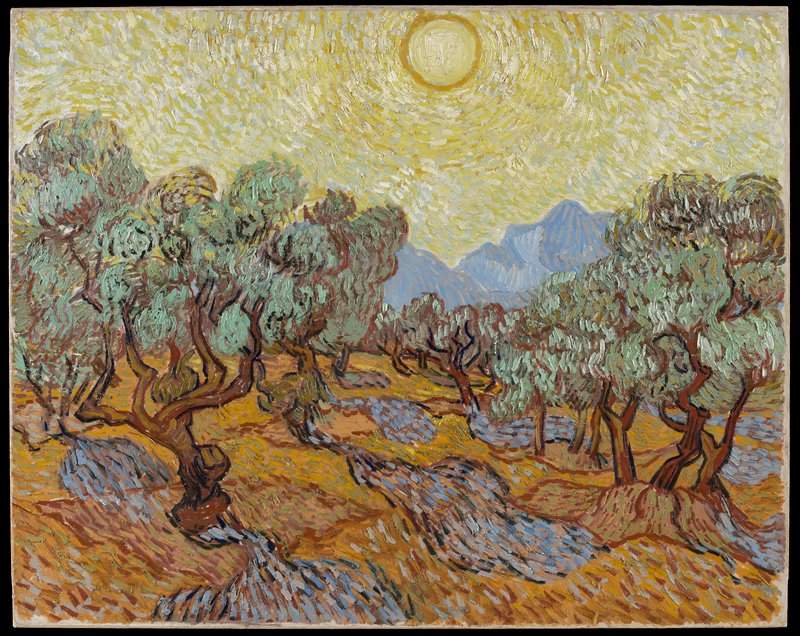
1889 · Oil on canvas · Minneapolis Institute of Art
Van Gogh painted olive groves again and again during his stay at Saint-Rémy. In this one the trees twist against an ochre field, and the same strokes run through trunks and ground alike. No neat outlines set the trees apart, yet they never sink into the earth around them.
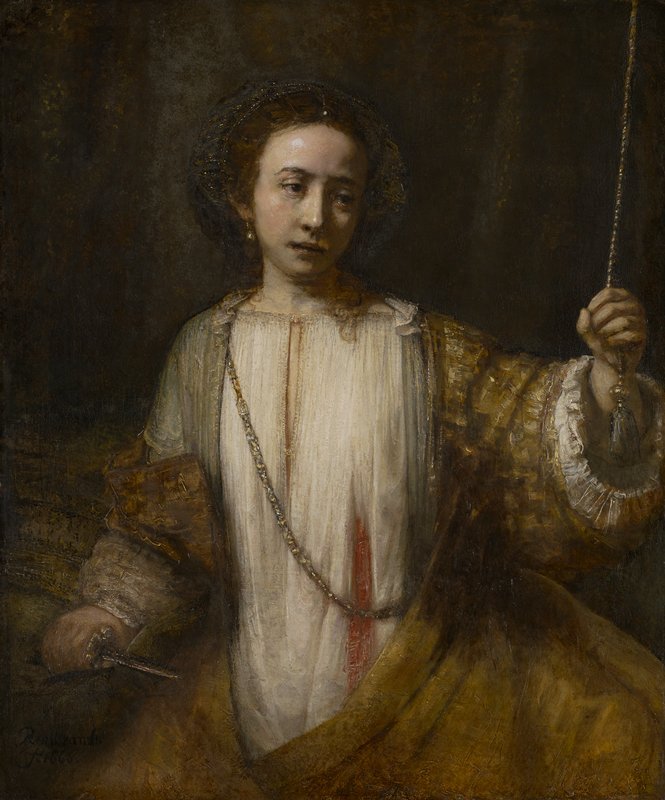
1666 · Oil on canvas · Minneapolis Institute of Art
A dark stain on her undergarment shows that Lucretia has already wounded herself. Rembrandt gives her no triumphant gesture: her gaze is lowered, and one hand is raised towards a cord. The ancient story has often been made to serve public ideas of honour. Here the attention stays on her vulnerable body, the blood on the cloth and the effort of staying upright.
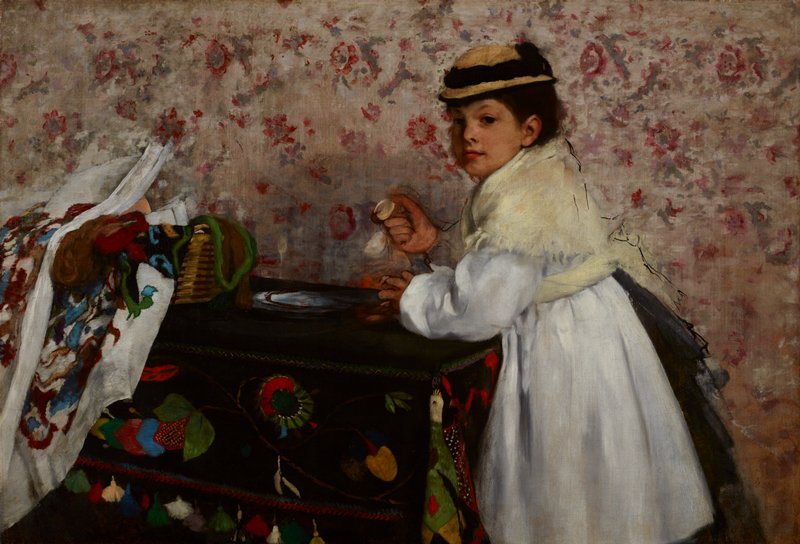
c. 1871 · Oil on mattress ticking · Minneapolis Institute of Art
Flowers and furnishings are packed around a small figure, and the room's busy patterns could easily have swallowed her. Instead the girl's leaning pose cuts across them, and her hands, shoulders and face stand out. She seems at ease in her own surroundings, yet her head turns to present her face for the portrait. Degas painted all this on mattress ticking, not canvas.
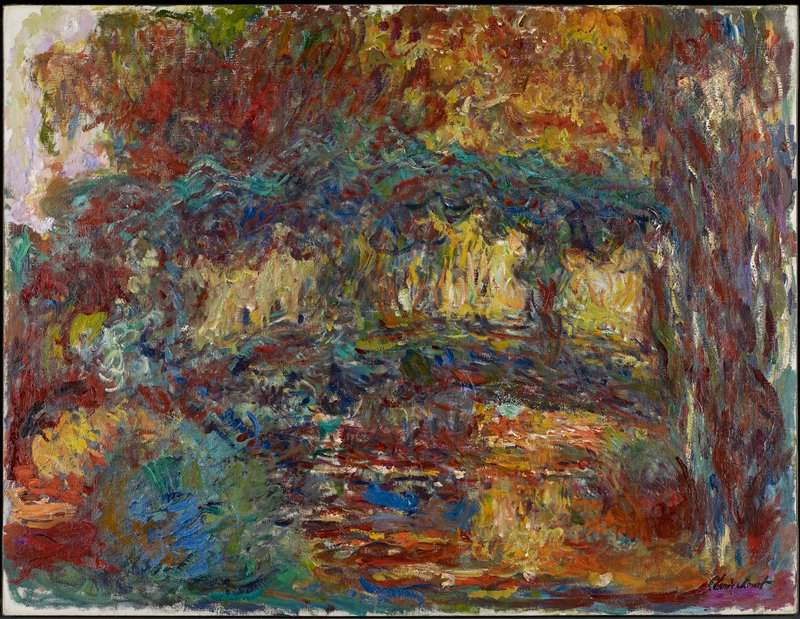
c. 1923–25 · Oil on canvas · Minneapolis Institute of Art
The bridge takes some finding. In this late picture from Monet's garden it is buried in dense marks of red, blue, yellow and green, and its familiar shape no longer gives the colour a clean outline to gather around. A few surviving relationships between forms keep it recognisable, though only just.
c. 1888 · Oil on canvas · Minneapolis Institute of Art
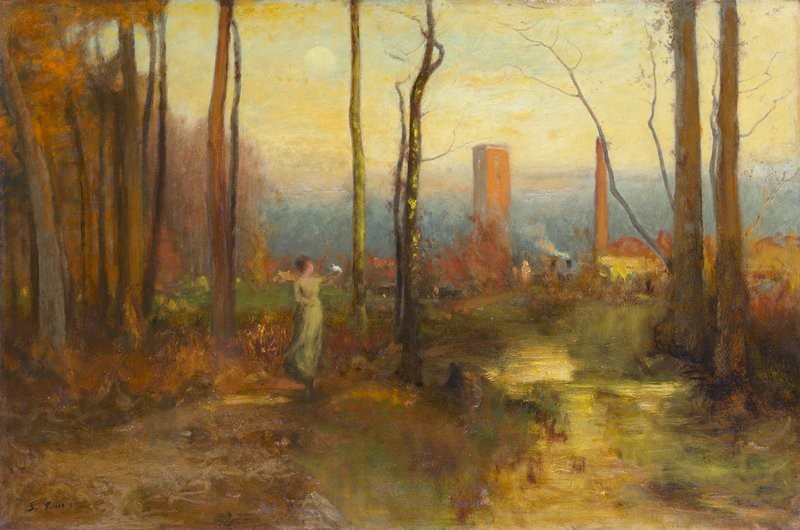
Roofs and chimneys show through the thin trees. Inness leaves these signs of industry in the view, which seems fair in a picture named after a mill stream, and lets warm light and blurred reflections draw buildings and landscape into a shared atmosphere. The blending is uneven, though. Some edges stay firm while others soften and give way.
1627 · Oil on canvas · Minneapolis Institute of Art
Germanicus lies dying, and the mourners are divided around him. Outstretched arms link his bed to the soldiers, while his family occupies another part of the gathering. Poussin varies the grief from face to face, so that each figure's response can be read on its own. Above them all, deep blue drapery spans the scene.
1926 · Oil on canvas · Minneapolis Institute of Art
Looking up from below, O'Keeffe lets the buildings close in until only a narrow strip of sky remains between them. They stand as broad dark masses, unbroken by windows or street life, and a small light near the lower edge is enough to make their scale felt.
1929 · Oil on canvas · Minneapolis Institute of Art
The title works in both directions. 'Our Nurse' records Margaret Burgess's place in the household, and her full name identifies her as an individual. Stettheimer sets her at the centre, an elongated figure among smaller objects and figures. Sizes here follow the decorative arrangement, not a consistently measured room, so her elongated form is perhaps best read as a matter of emphasis.
1820 · Oil on canvas · Minneapolis Institute of Art
Goya paints himself unable to hold the composed, self-contained pose that a portrait usually asks of its sitter. Dr Arrieta supports him and brings a glass towards his mouth, and the whole picture is built around that practical act of care. Shadowy figures are visible behind them.
1891 · Oil on canvas · Minneapolis Institute of Art
The ground is purple, the foliage patterned and the colour unnaturalistic. Together they give Gauguin's setting a decorative order of its own, and within it he places the women and a dark animal. That order is persuasive enough to pass for a transparent account of Tahitian life. It is better seen as, among other things, a European artist deciding how a place and its people should appear.
1919 · Oil on canvas · Minneapolis Institute of Art
The title goes to the feathers rather than the sitter, and so does a striking share of the picture. The plumes spread well beyond the sitter's head, set against a red background, dark hair and pale clothing, and the face has to hold its own among these shapes.
1865–67 · Oil on canvas · Minneapolis Institute of Art
Bright accents are few, so the narrow white collar of the title does a good deal of work, separating Bazille's head from the darker jacket and background. The slightly turned face is built from careful modulations of tone. There is no studio, palette or other prop to announce his profession.
1910 · Oil on canvas · Minneapolis Institute of Art
Rough highlights break across Mancini's face, catching some features and leaving others in shadow. The handling of the paint is conspicuous: it does not give every feature the same clarity, yet the face is still recognisable.
1855 · Oil on canvas · Minneapolis Institute of Art
Lewis painted this in 1855, but his title dates the view to 1848. Falls, islands, trees and low buildings are offered as a record of the site at that earlier moment, while the arrangement follows the conventions of a composed landscape. How far can a picture made on those terms, years after the moment it names, serve as a document?
1869 · Oil on canvas · Minneapolis Institute of Art
Nothing in particular happens at the centre of Daubigny's view. There is water, and there are dense trees, held together by closely related tones. Broad divisions give the picture its structure: a dark foreground, the reflective surface of the pond and warmer light beyond.
1868 · Oil on canvas · Minneapolis Institute of Art
The title promises autumn, and the foliage is warm, but the picture depends more on the water than on the season. Moran's creek opens a passage through trees that would otherwise close into a continuous wall. Small falls and lighter stretches of water lead the eye back towards a brighter distance.
c. 1726–27 · Oil on canvas · Minneapolis Institute of Art
Lemoyne brings the scene close, so that the woman's face and hands carry it. The flame she tends marks her ritual duty, and it is also the light by which she is seen.
1960–66 · Oil on canvas · Minneapolis Institute of Art
Reinhardt's nearly black rectangles barely separate from the dark ground, and the slight differences between them take time to emerge. The strong contrasts that usually make a composition quick to read have been taken out. A screen can suppress those fine distinctions or exaggerate them, so reproductions are a particularly poor guide to this picture.
1858 · Oil on canvas · Minneapolis Institute of Art
The title is, if anything, modest. Roesen piles up more fruit than any casual arrangement would hold, and whole skins, cut interiors, leaves and tendrils all compete for attention. Darkness between the crowded forms keeps each kind of fruit distinct, so the abundance never collapses into a heap.
c. 1788 · Hanging scroll (nikuhitsu), ink and colour on silk · Minneapolis Institute of Art
This is a nikuhitsu work, painted by hand as a hanging scroll on silk, not a woodblock print. Shunshō leaves the ground empty around the actor, Ichikawa Danjūrō V, with no elaborate stage setting, so that his silhouette reads clearly. The red costume, kneeling pose and long sword are enough to establish the Shibaraku role.
Explore this selection in Artline
See the selected works alongside books and events from their period, or compare when the artists lived. The books and events provide context, not evidence of direct influence. Works without confirmed dates remain in this guide.
Three self-portraits
The self-portraits by Goya, Bazille and Mancini are scattered through the selection, and their titles are a good place to start comparing them. Two name a companion. Goya's is Dr Arrieta, and Goya is the only one of the three to bring another person into the picture, and the only one to show himself in need. Bazille's companion is an item of dress, and he leaves his trade out of the picture altogether. Mancini's title names nothing but himself, yet his is the picture in which the trade is most in evidence, laid across his own face in rough, broken paint.
Harold Speed's practical handbook deals with tone, composition and the way light falls across observed forms. It was written about drawing, but it gives you a working vocabulary for several of the paintings here: the graded tones that model Bazille's face, the closely matched tones of Daubigny's pond and the broken light on Mancini's features.
 Art, literature & history