The Leopold Museum in Vienna holds one of the principal collections of Austrian art from around 1900. It is closely associated with Egon Schiele, and it also has important paintings and works on paper by Gustav Klimt and their contemporaries, artists who shared a cultural world but not a single style.
Schiele has the largest share of the twenty works chosen here: portraits, self-portraits, mothers with children, trees and a riverside town. Klimt is represented by Death and Life and a pond landscape. Alongside them are portraits and landscapes by Richard Gerstl and Lovis Corinth, a laid table by Anton Faistauer, a dance of death by Albin Egger-Lienz and a farmyard by Max Liebermann. Some subjects turn up in very different hands. Death appears in both Klimt and Egger-Lienz, and Schiele's portraits look quite different beside those of Gerstl and Corinth. Several of the Schiele pictures also carry two titles, and the second does not always agree with the first.
Artline chose these works from the Leopold Museum's documented holdings, independently of the museum. Dates and attributions follow the linked records, qualifications included.
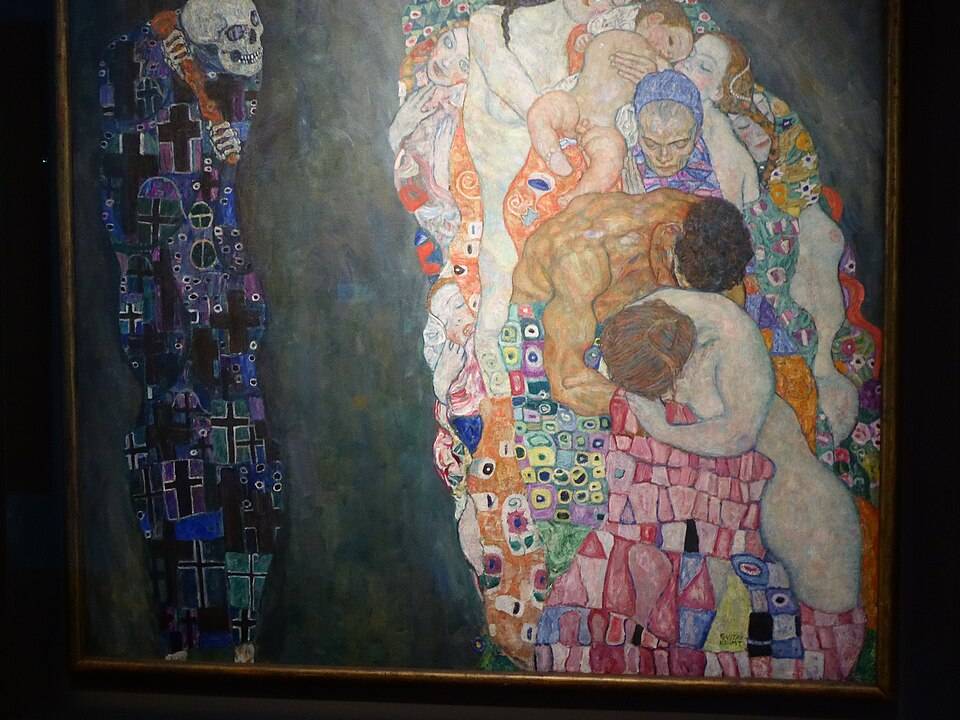
1910/11, reworked in 1912/13 and 1915/16 · Leopold Museum
Klimt did not leave this picture alone. After first painting it, he came back to it twice. Death stands apart at one side, a dark figure whose surface is marked with crosses, watching a tight cluster of people at different stages of life. Their patterned clothes run together into a bright, nearly continuous mass, so the living read almost as one crowded body set against a solitary watcher. The theme, the fragility of life, is familiar enough that the picture hardly needs an elaborate symbolic key. Nor does Klimt supply a story to connect watcher and watched. He puts them side by side and leaves the contrast blunt.
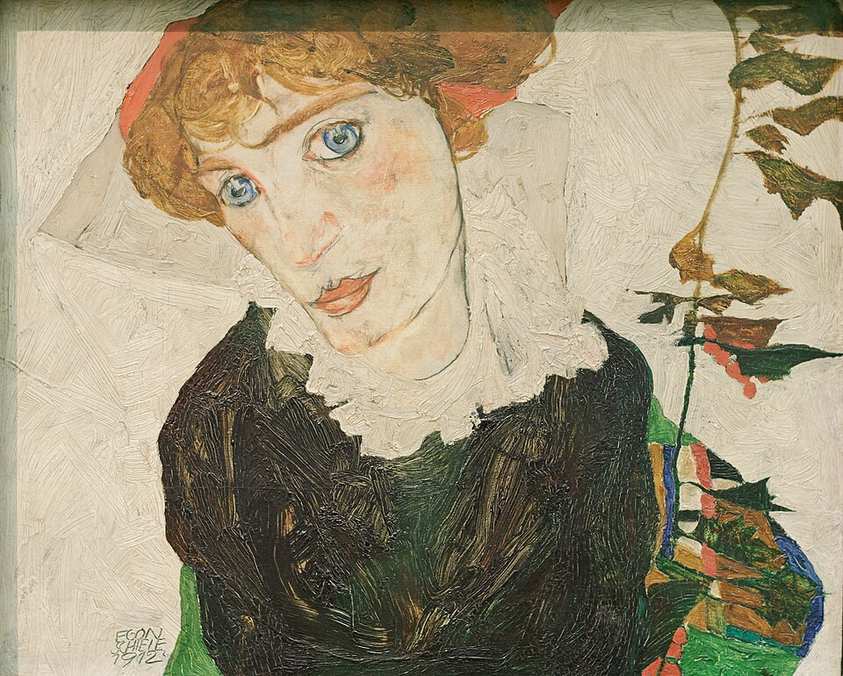
Schiele saves his detail for the head: red hair, blue eyes, a pale collar. The garment and surroundings are only lightly worked, plain enough to make a sharp frame around the face. The head tilts but the gaze stays direct, so the encounter is less square than it would be in a formal frontal portrait.
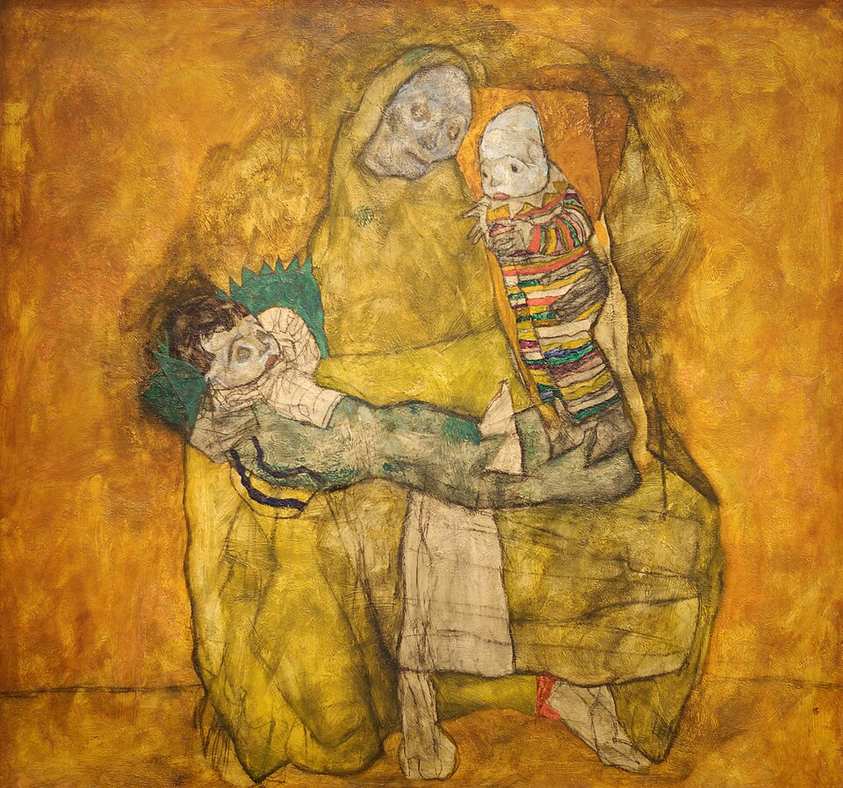
The mother and her two children overlap in a narrow group, yet each face turns its own way. You might expect a group like this to settle into one softened shape, but Schiele's angular boundaries prevent it. However closely the figures are pressed together, none of them gives up its own outline.
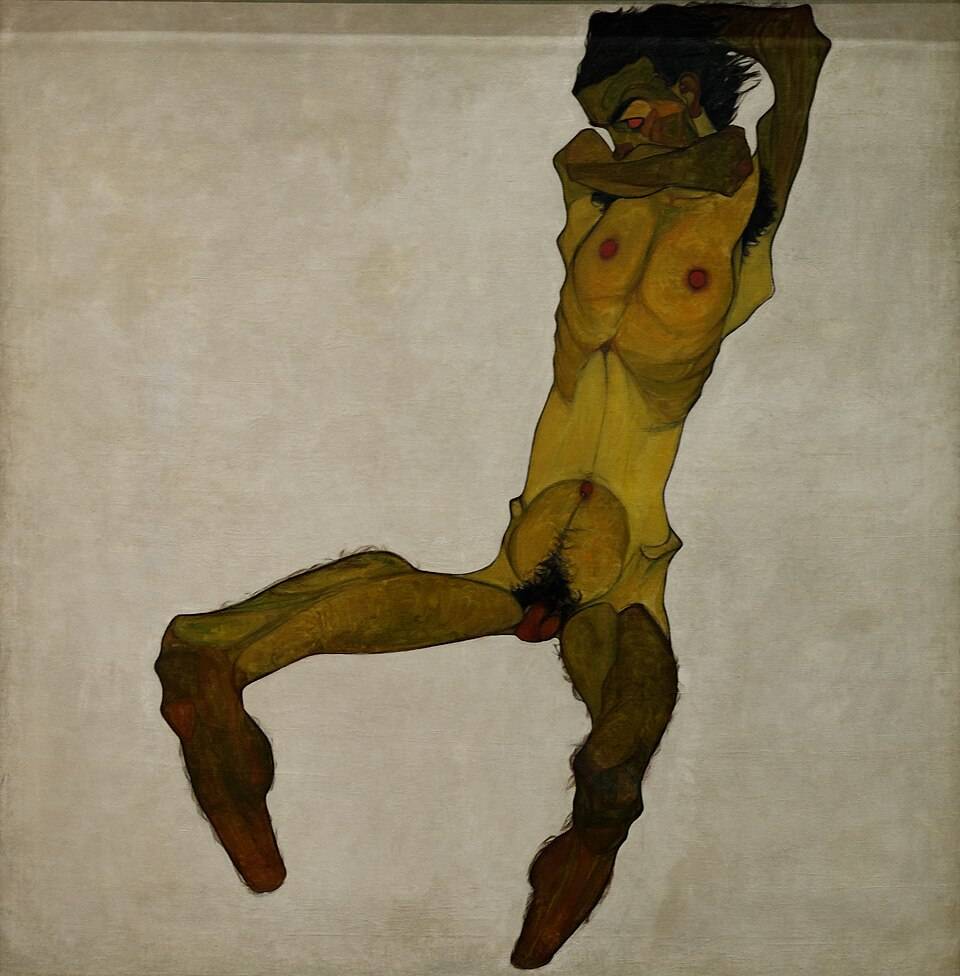
Schiele shows himself naked, arms raised and legs extended, against an almost empty ground. The first half of the title could label any study from the model. The second admits that the model is the painter himself. The title also says he is seated, but there is little furniture or room to explain the pose or take its weight, so every turn at a joint stands out. The strain is plain to see, and no setting or story of suffering accounts for it.
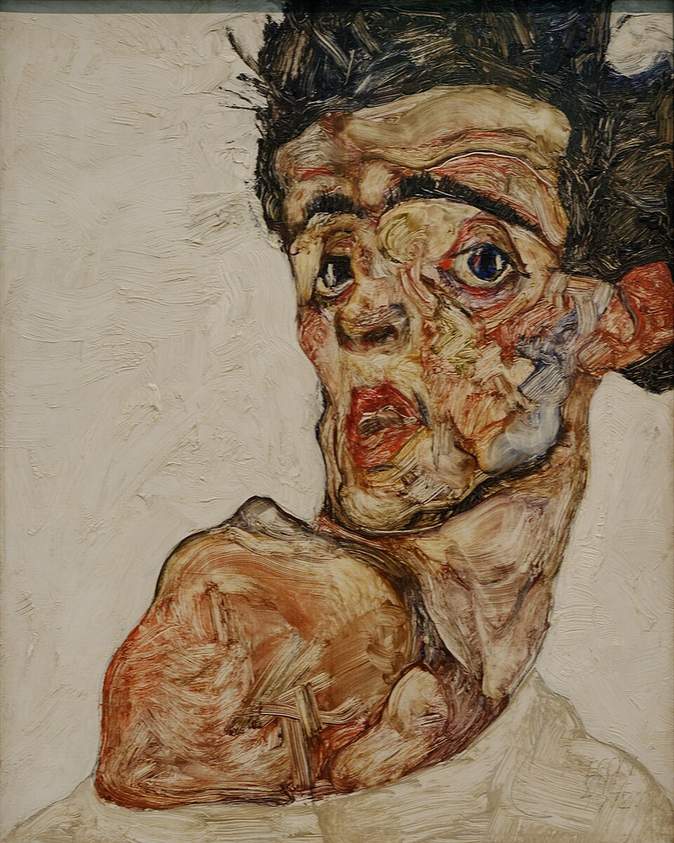
Here the body is reduced to a single shoulder, and even that refuses to play a supporting role. The title singles it out, and so does the painting: beneath the turned face, its pale mass competes with the features for attention. Dark hair and emphatic outlines break up the skin, leaving no smooth passage anywhere around the head. It shows far less than the seated nude and is hardly calmer for it.
There is no prominent figure here and no event. Klimt builds the picture instead from forms that repeat with varying degrees of clarity. The reflection follows the arrangement of the vegetation above it but softens its texture, so the same shapes come back, sharper above the water and softer in it. Beyond the dark bank, a lighter distance adds another horizontal band.
Pale faces and hands emerge from a steep mass of red and dark robes. The clothing is stiff, and its shapes make the embrace look awkward, almost as if the costumes were physically in the way. They are also the point. Without the religious dress this would be an embrace like any other. With it, the contact carries a charge that the gesture alone could not. The double title keeps both in play, one half naming the roles and the other the act.
Roofs, windows and narrow passages are packed into a steeply tilted view. Adjoining angles hold the image together and also make its compression obvious. Little human activity is visible. Beneath the crowded forms, the Vltava of the first title runs as a dark band and makes a firm lower edge. The second title drops the name altogether and calls the place simply The Small Town, and the numeral suggests one of a series.
Faistauer's is the only still life in the selection. The tabletop tips towards the viewer, pushing dishes and fruit forward against the darker room. He gives the objects weight with broad areas of colour, and the white cloth gathers them into a single sloping field. Chairs mark places for people who are not shown.
Klimt's Death watches the living from its own side of the picture. Egger-Lienz allows no such distance. His skeleton keeps step with the men carrying tools, as if it were one more walker in the procession. Bent limbs repeat from figure to figure in earth colours, and the shared rhythm counts for more than any one man's identity.
The earliest picture in the selection is a farmyard: low buildings under a steep roof, uneven ground worked through many changes of tone, and geese scattered across the foreground. Without the geese this would be a view of buildings. Dotted about in different positions, they make it a yard in use and keep the foreground from going still. Schiele's Krumau, with hardly any visible activity, has to leave its houses to suggest the people who live there.
Autumn or winter? The titles disagree, and the picture hardly settles the matter. Little foliage is left to soften the branches, so they show every change of direction. A dark strip of ground anchors the trunk against a pale, broken setting, perhaps the stirred air of the first title. The tree has something of the articulation of a drawn body, with support below, repeated joints above and pressure carried through an uneven contour, though nothing makes it literally human.
The mountain is called the Sleeping Greek Woman, but nothing in Gerstl's paint is at rest. Curling strokes run across mountain and sky alike, giving rock and air the same restless surface. Even so, the blue-green slopes above the narrow lake keep their mass as their description loosens, and the place stays recognisable.
Hillside, buildings and lake still form the main divisions of the view, but slanting strokes keep breaking their edges, and Corinth never smooths the handling into a seamless prospect. Even in the upper distance, where the view ought to recede, darker marks hold the eye at the surface.
Sunset colour fills the whole view and might have melted everything together. It does not. Thin trunks and dark branches cut across bands of land, water and warm sky, and the upright trees stay sharply apart from the horizontal distance, with drawn edges marking where each part ends and the next begins.
Corinth painted this portrait in the same year as the Walchensee landscape, and it has the same diagonal strokes. Here they run on from the sitter's clothes into the background, so the brushwork does nothing to separate the man from his surroundings. That job falls to the light, through the tonal contrast that brings out his turned face. The figure has substance, yet Corinth leaves some of its outer edges open.
The hands lead. Spread fingers carry the gesture out beyond the tilted head, and pale skin, crossed by coloured marks and broken edges, sets the hands apart from the darker body. They give the portrait a direction the face alone would not. The title names a role rather than a person, and the figure does seem to be performing rather than sitting for a settled likeness.
In Schiele's Portrait of Wally the background stays plain, a frame for the face. Gerstl's interior takes a more active part. Cool blues and violets pass between the sitter, who is turned sideways, and the patterned room, so that figure and surroundings lose some of their separation, though the pose stays clear. The pale dress belongs both to a recognisable body and to the colour that spreads through the room.
Only one of its titles calls the mother blind. The other is content with The Mother. A woman bends over a child in a dark, tightly enclosed setting. Heavy contours bind bodies, clothes and furniture into a single structure that is protective but also cramped and awkward. In Mother with Two Children II, angular boundaries keep each figure apart even where they overlap. Here contour does the reverse. The figures have to fit around one another, and hold one another up, in the little space they are given.
The title promises sun, and patches of light do break in, but they never clear the dense green field into a polished view. Gerstl builds that field from repeated strokes around the trunks and spreading branches. His handling is forceful, and the paint is as insistent as the foliage.
Explore this selection in Artline
See the selected works alongside books and events from their period, or compare when the artists lived. The books and events provide context, not evidence of direct influence. Works without confirmed dates remain in this guide.
Contour and brushstroke
Side by side, these works show contrasting ways of holding an image together. Schiele relies on contour whatever the subject. It shapes his own body in the self-portraits, separates one mother from her children and binds another to her child, locks the roofs of Krumau together and divides up even the warm colour of a sunset. Gerstl and Corinth work the other way, letting their strokes run across the edges a contour would fix and carrying a mountain into its sky or a sitter into the surrounding room. Klimt stands somewhat apart from both, building his surfaces from pattern and repetition, whether in the clothes of the living in Death and Life or in the reflections of the pond. Two pictures fall outside this rough division altogether: Faistauer's table rests on broad fields of colour, and Liebermann's farmyard on modulations of tone.
Speed's manual approaches drawing through line and mass, and it offers a practical vocabulary for contour that applies readily to Schiele. His own examples are more conventional, and that is useful too: they make it easier to say exactly where these pictures depart from them.
 Art, literature & history