Twenty Old Master paintings from Vienna's Kunsthistorisches Museum, with Bruegel at the centre and Vermeer, Titian, Velázquez, Dürer and Caravaggio close by.
The Kunsthistorisches Museum was created to house the Habsburg collections, and its picture gallery is especially rich in Italian, German and Netherlandish painting. It also holds an important group of works by Pieter Bruegel the Elder. He appears here more often than any other painter, filling a city, a valley, a town square and a barn with people at work and at play.
Many of the paintings were made for rulers or wealthy collectors, an audience quite unlike today's museum visitors, and rank and possession keep returning as subjects: a queen's jewellery, the spreading dress of a child infanta, a collector handling a small sculpture. Around them, from Mantegna to Bellotto, are biblical subjects that may now be unfamiliar, a mythological scene in which hero and woman exchange roles, a self-portrait in a distorting mirror and a head made of sea creatures.
The works come from the museum's documented holdings, but the selection is independent of the museum. Dates and attributions follow the linked records, qualifications included.
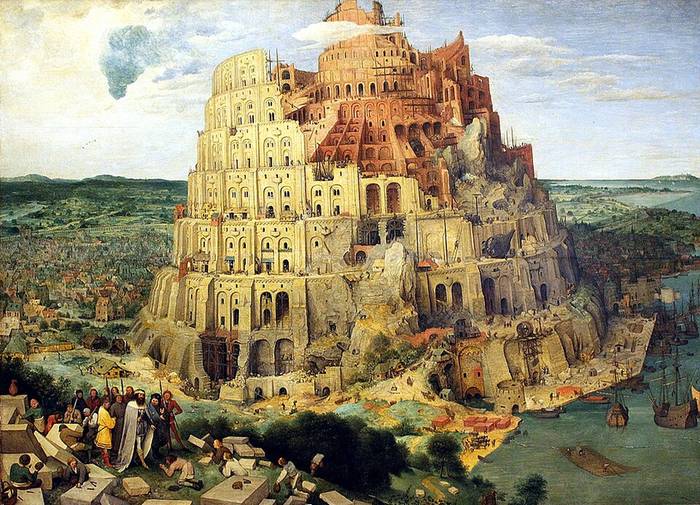
In the biblical story the tower is never finished: its builders' languages are confused and the work comes to an end. Bruegel shows it still going up, an uneven structure climbing above the surrounding city, impressive and plainly impractical. Its size almost swallows the people building it, yet he follows them closely across ramps and scaffolding and through the different stages of the work, as though the builders interested him as much as the tower's fantastic scale. Anyone who knows how the story turns out will watch all this industry with some irony.
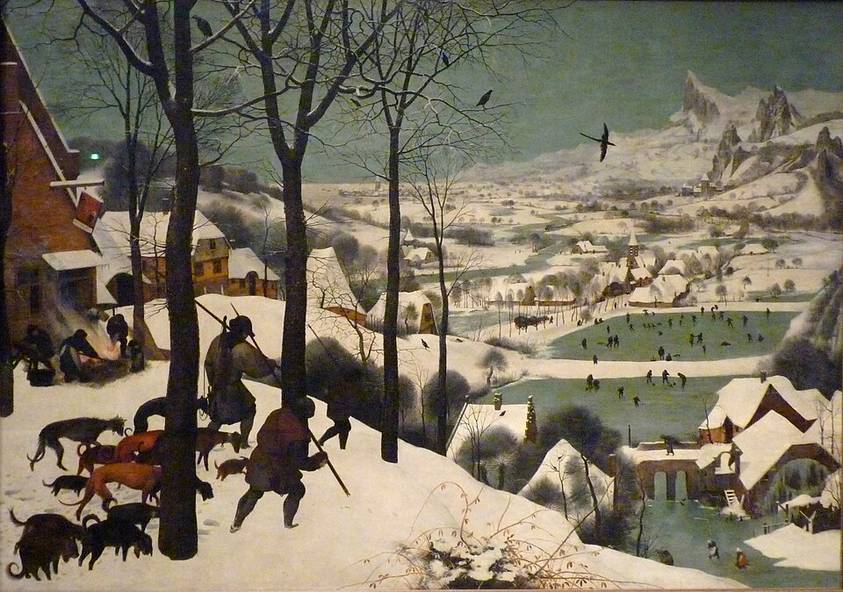
The hunters of the title trudge downhill with their dogs past dark, closely spaced trees, but the viewpoint is set high enough to carry the eye straight over them into the valley, which is busy with skaters. Their return is only one part of the winter scene, and even the farthest reaches of the valley have incidents of their own.
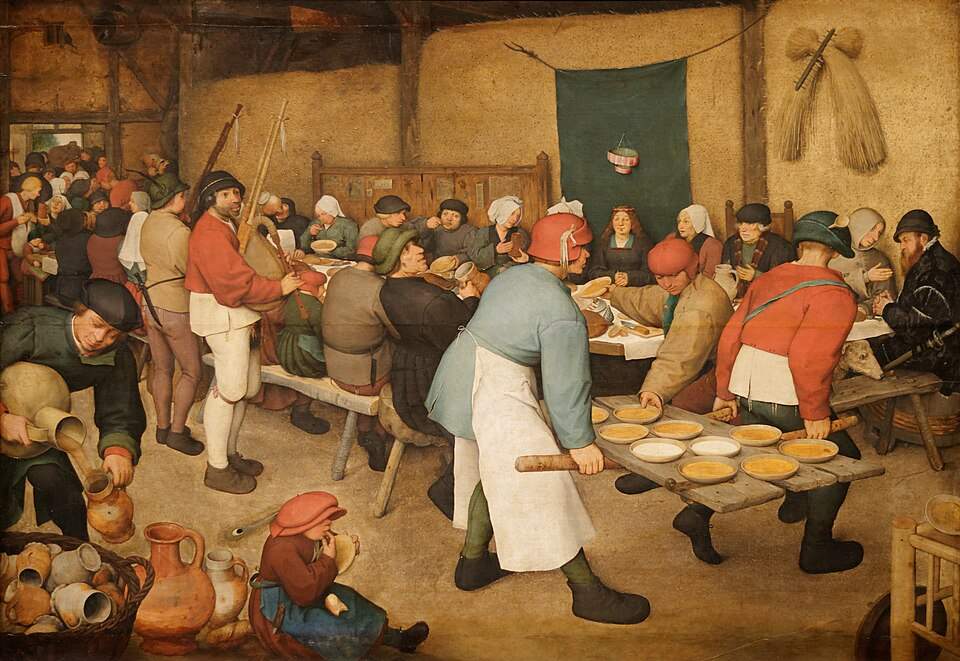
The bride sits comparatively still, the one fixed point in a barn where nothing else stops. Servers bring bowls through the crowd, hands carry and receive, guests bend over their food. Bowls and working hands recur so often that they set the rhythm of the whole picture. The ceremony centres on her, but the energy of the scene comes from the practical coordination that keeps a feast going.
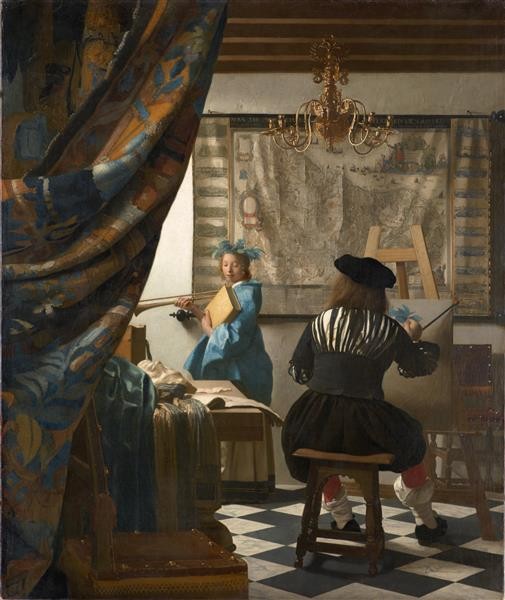
We look past a pulled-back curtain into a painter's carefully arranged room. He sits with his back to us, his face hidden. His model, the tiled floor, the chandelier and the map on the wall are set at measured, deliberate intervals.
The subject is painting itself, yet Vermeer withholds the view that subject seems to call for: we watch a painter looking at his model, but never from where he sits.
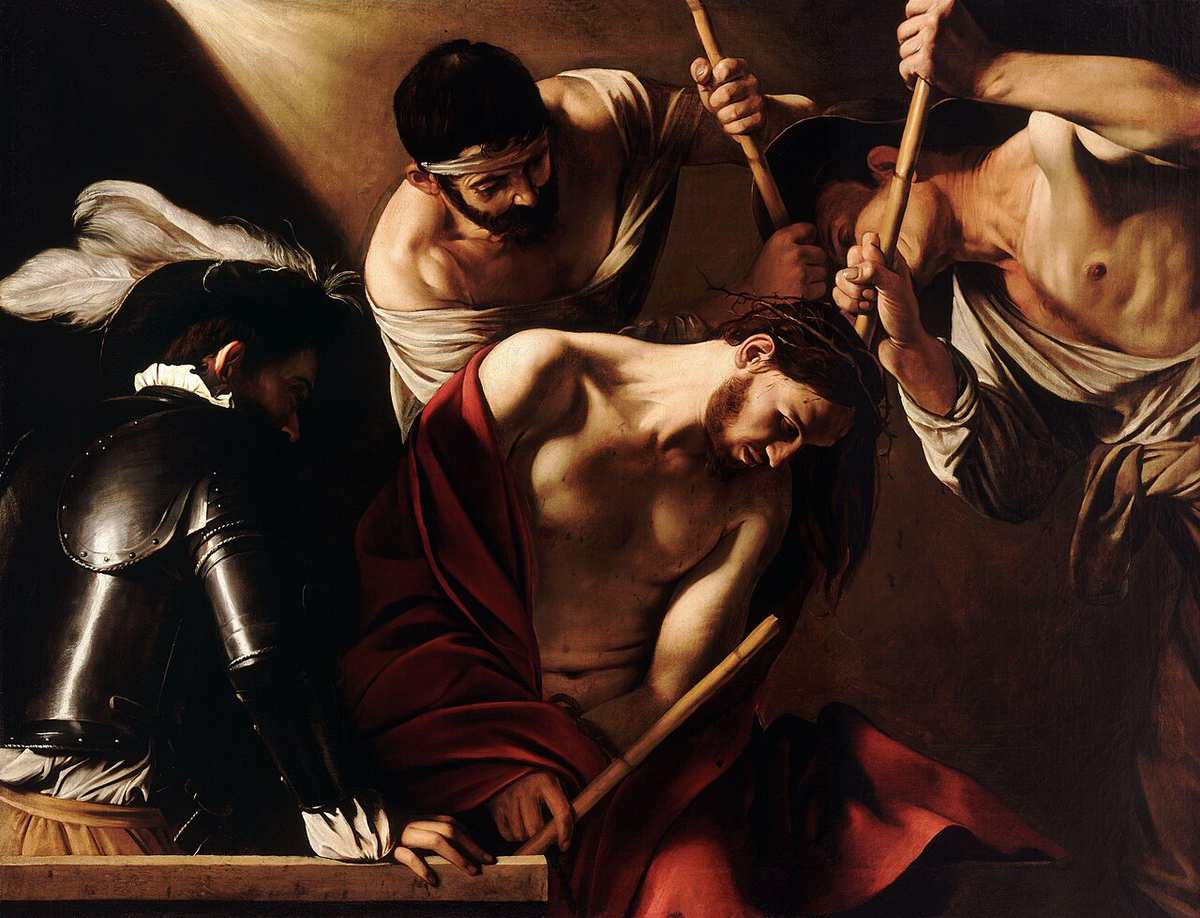
Caravaggio packs the figures so tightly around Christ that there is almost no room around the act itself: rods press the crown of thorns down onto his bowed head. Beside the group an armoured figure looks on and takes no part. The sharpest contrast in the picture is between exposed skin and metal, between the body that receives the violence and the one that armour keeps out of it. That onlooker's detachment may be the most unsettling thing here.
Another homecoming, this time with cattle. The herd moves across the foreground in one warm, heavy mass. Beyond it the land opens out to distant hills and water under a changing sky, and the colder tones of the distance set off the animals' warmth. Bringing a herd home is seasonal work, and Bruegel gives a large share of the picture to the sky and open country that set its conditions.
Carnival stands for indulgence, Lent for abstinence, and the title promises a contest between them. The foreground delivers one where the opposing groups meet. But Bruegel sets these rival customs in a town square already crowded with food, games and smaller encounters, and with so much else going on, the tidy opposition becomes one event among many.
Parmigianino kept the convex mirror's distortion rather than correcting it into an ordinary likeness. The face stays recognisable, but the hand in the foreground swells to an impossible size and the room behind bends towards the circular edge. Of all things, it is the painter's own hand that the mirror inflates.
The title calls them philosophers, but the three men are doing nothing that would explain them. They are told apart by their clothes and positions; the seated one turns towards a dark rock, while beyond the group the view opens out. Giorgione gives unusual weight to the intervals, between one figure and the next and between the figures and their setting, and their relationship never settles into any one obvious action.
Who are they, and what holds them together? The painting does not say.
Children fill the town one patch after another, each group busy with a different game: they run, balance and wrestle. Nobody stops to explain the rules, which show plainly enough in what the children do together. The scene can be read group by group or across the whole surface, and taken all together, play acquires the scale of a social world.
Sebastian is bound beside hard classical stone, arrows piercing his pale body, and the repeated verticals around him hold him upright. Mantegna keeps the soft skin and the sharply drawn stone distinct. The stone is a ruin, though, and the broken architecture may suggest an analogy with the wounded body: stone, too, can be damaged and keep its form. Beyond the ruins a landscape opens in the distance.
Titian catches Strada in the act of handling a small sculpture, leaning forward among books and other collected objects. Such things could have been set out beside him as attributes. Instead his learning and possessions show in what he is doing with them, and that handling becomes part of his public identity. His forward lean also gives the crowded setting its direction.
Dürer stacks a large assembly in distinct tiers: the heavenly figures at the top as the focus, worshippers gathered below and, further off, a narrow strip of earthly landscape, the smallest share of all. The order is strict, rank above rank, yet nobody in the crowd is reduced to a type, and the faces stay individual.
Jane Seymour hardly moves: her hands are joined and her face is restrained. With so little happening, small things do the work: the jewellery, the fabrics, the headdress, each change of texture. Through them Holbein gives the queen's rank a precise material form.
c. 1585 · Oil on copper · Kunsthistorisches Museum
The expected relationship between the hero and Omphale is reversed. Attributes have passed between them, Hercules sits, and it is she who twists and acts. Spranger, painting in oil on copper, shows the exchange through both objects and pose. For all the overlapping bodies and heavy drapery, the limbs stay readable, so the swap of roles comes through clearly enough to unsettle the familiar heroic hierarchy.
Seen from the garden, the long, regular façade of Schönbrunn runs as one steady horizontal, set down with the architectural precision of a topographical view. The visitors walking the paths are small enough to give the building its scale without challenging its authority. Still, Bellotto puts them there, and with them the grounds become a place in use.
Holbein keeps Jane Seymour and her costume in balance; Velázquez does not. Far more of this picture goes to the dress than to the child's bare head and hands, and its broad, spreading geometry turns royal display into something the five-year-old has to inhabit physically, not simply wear. Bright trim and a flower lead the eye across it, but her small face keeps its own scale: inside all that rank, she is still child-sized.
Bruegel brings the dancers right up to the front, close enough for their effort to show in raised feet and swinging arms. After the tiny skaters far below in The Hunters in the Snow, these are heavy, active bodies, caught mid-movement as they fill the street beside the bagpiper.
Fish, shells and other sea creatures make up a head in profile, yet each one stays distinct and identifiable. The picture works on two incompatible scales: attend to a single creature and the head falls apart; step back and it comes together again. The trick depends on precision, since every part has to be painted carefully enough to hold its own.
The name Laura is conventional, not a confirmed identification, so here, as with The Three Philosophers, much about the figure remains unresolved. The things around her can be described more securely than the sitter can be identified: the laurel, the fur-lined clothing, the pale cloth. As she turns and holds the garment, bare skin, cloth and fur come close together.
Explore this selection in Artline
See the selected works alongside books and events from their period, or compare when the artists lived. The books and events provide context, not evidence of direct influence. Works without confirmed dates remain in this guide.
Where Bruegel puts the centre
One way to tell Bruegel's crowded pictures apart is by how much of a centre they allow. The Fight Between Carnival and Lent gives its crowd a contest to gather round, and The Peasant Wedding has its bride. Children's Games has neither contest nor ceremony, only one game after another, until the town itself becomes the subject. Even where there is a centre, it rarely keeps the picture to itself: the tower shares Bruegel's attention with its builders, and the returning hunters share it with the skaters in the valley below.
Further reading
Leonardo da Vinci; translated by John Francis Rigaud · Read free · English
Leonardo's notes on painting in John Francis Rigaud's English translation, with observations on bodies, light, perspective and the arrangement of figures. It sets out Leonardo's own principles and does not discuss these pictures, but it offers a working vocabulary for how they are put together, especially the portraits and the invented architecture.
 Art, literature & history