The Kröller-Müller Museum stands in the Hoge Veluwe National Park in the Netherlands. Its collection grew out of Helene Kröller-Müller's collecting and is especially rich in paintings by Van Gogh. The museum is also known for its modern holdings and its sculpture garden.
Van Gogh is at the centre of these twenty works as well. They run from a woman mending stockings to the café terrace at night, the Langlois bridge and an old man with his face in his hands. Around him, the selection follows several lines through the collection. Jan Toorop's entangled figures, Odilon Redon's charcoal head, pastel figure and legendary rescue, and the withdrawn houses of William Degouve de Nuncques all hold something back. Maurice Denis's April turns figures in a landscape into pattern. Two contrasting paintings by Georges Seurat, one of a dance scene and one of a quiet channel, can be compared with Henri-Edmond Cross's fishermen, painted in separate touches of colour. Piet Mondrian, Theo van Doesburg and Georges Valmier take the selection into geometry. Some works answer each other across the years: Seurat's dancers and Van Doesburg's, or Valmier's broken-up still life and the one by Jan Treck, the oldest work here.
These works were chosen from the museum's documented holdings, independently of the museum. Dates and attributions keep the qualifications given in the collection records.
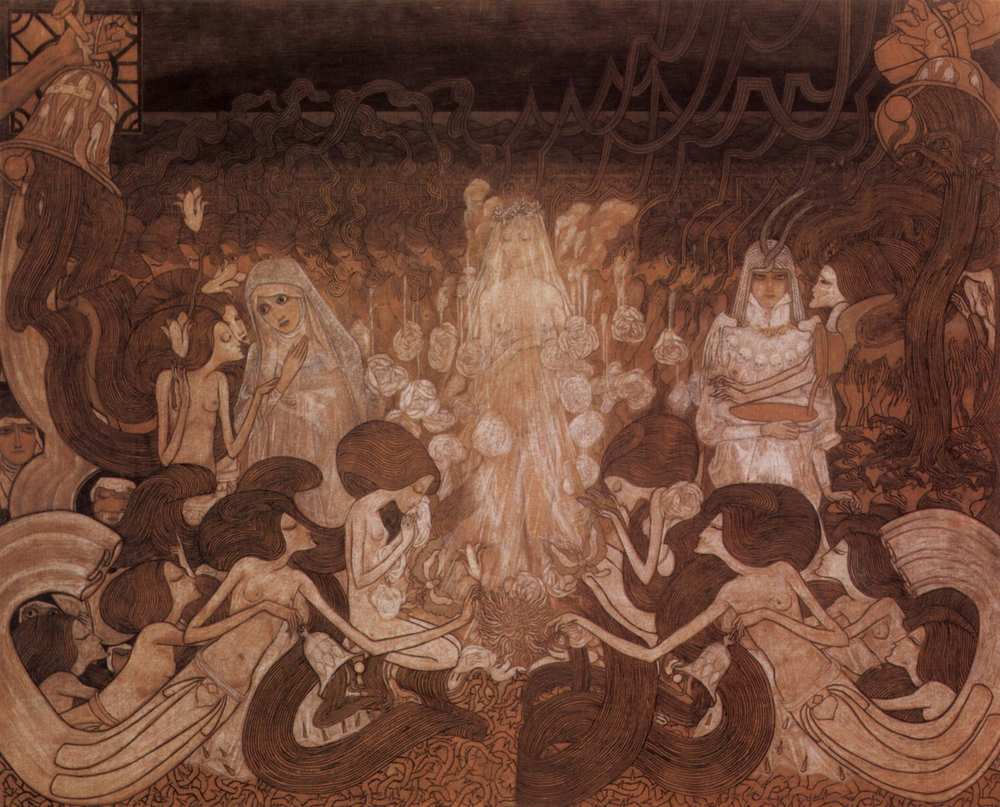
The title promises three brides, so it is natural to look for them as characters with parts to play. That turns out to be hard. Curling, rhythmic lines fill the canvas and draw the figures into one overall pattern, and the eye follows the line from body to body without ever picking out a cast. The atmosphere comes from those repeated curves. How far any single motif should be read as a symbol is uncertain.
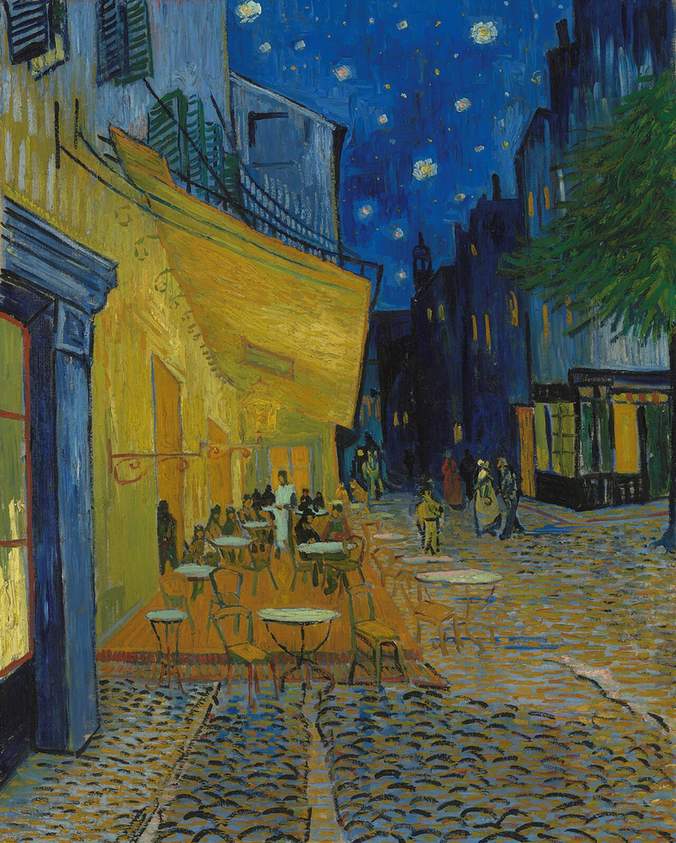
c. 16 September 1888 · Oil on canvas · Kröller-Müller Museum
According to the museum's account, Van Gogh painted this gas-lit café terrace outdoors, after dark, so the colours were judged by night as well as being of it. The yellow of the terrace and the blue of the night sharpen each other, and the street draws the eye back past them into depth.
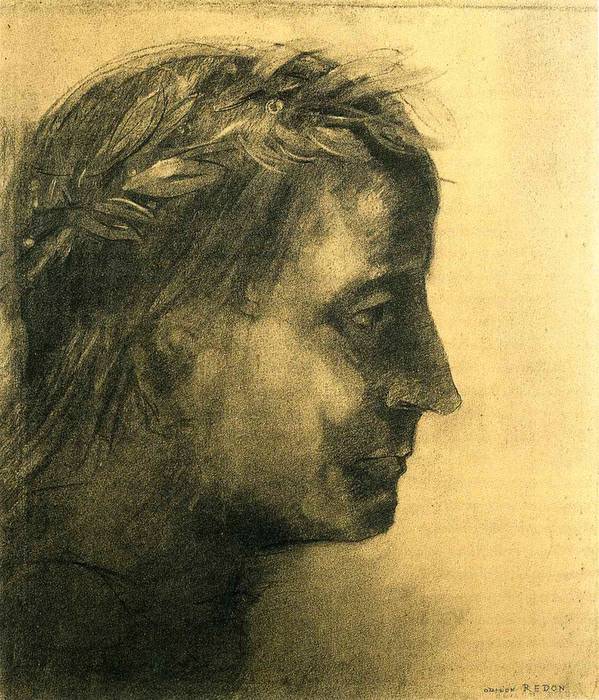
c. 1875 · Charcoal and pencil on paper · Kröller-Müller Museum
Charcoal and pencil, and no colour. The earliest of the Redons here is a laurel-crowned head in profile, worked to very different degrees of finish. Redon gives it weight and solidity only in places. He leaves the neck and lower edge uncertain, so the image never closes into a complete portrait. One moment it looks like a carved head, the next like an apparition.
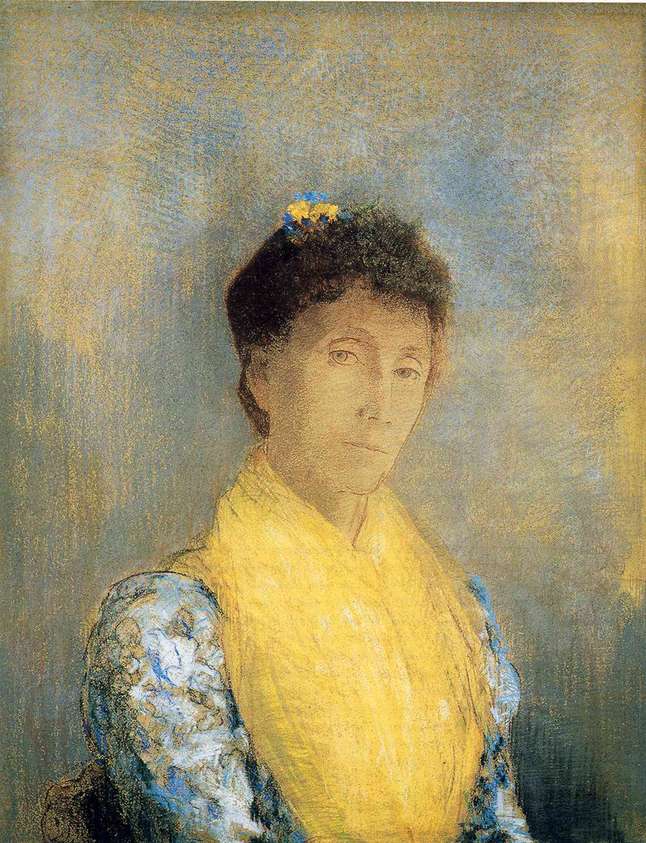
Redon turns the usual order of a portrait round. The face is softly handled, almost withdrawn, and the yellow bodice is what takes the eye, helped by the cool colours around the sitter. The charcoal Laureate Head has no colour at all. By contrast, this pastel puts nearly all its force into colour, and into the clothes rather than the features.
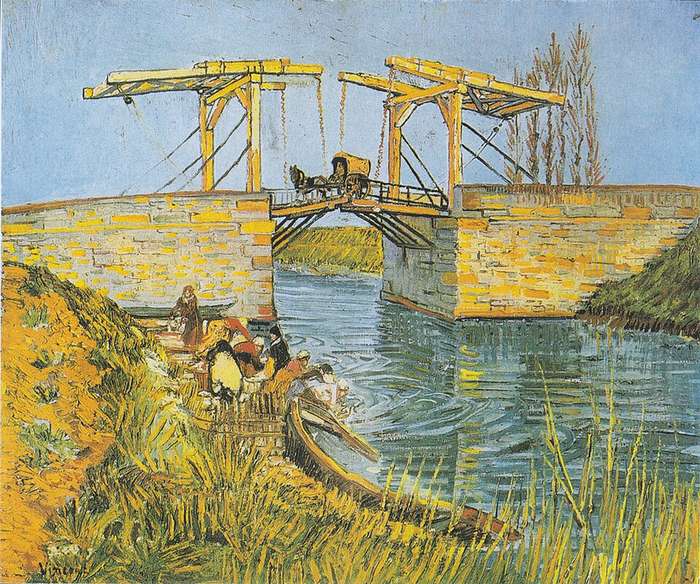
mid-March 1888 · Oil on canvas · Kröller-Müller Museum
The drawbridge is painted as the piece of engineering it is. Its raised mechanism gives the picture a clear framework of beams and angles. Below it, the water and its reflections break into looser, livelier marks, so the geometry of the structure does not govern the whole scene. Figures on the bank show activity around the crossing.
There are upright and horizontal strokes and nothing else, set within a pale oval. Out of that narrow vocabulary Mondrian gets a surprising range. The strokes vary in length, spacing and density, so they never settle into a regular grid. In places they crowd together, and towards the edges they thin out, as though the pattern were dispersing.
A still life taken apart. Vessels and the edge of a table surface among flattened geometric shapes, but no single viewpoint takes in the whole arrangement. The objects have to be pieced together from the relations between the parts.
Nothing here is out of place in an ordinary winter landscape: a dark stream, bare trees, low houses. The unease comes from how they are arranged. The stream curves through a screen of repeated trunks, and the houses lie behind it, easy to recognise and harder to reach. There is no hidden figure among the trees, yet the scene feels watchful and withdrawn, as if the trunks themselves were keeping guard.
Across the harvested field Van Gogh's strokes keep changing direction, so the ground looks worked and reworked, which suits a field that has been harvested. The sheaves stand in that restless surface. Above it, the orange moon keeps to a simple, steady circle, a calm shape rising over all that movement.
Cross paints the bent fishermen in exactly the same separate, visible touches of colour as the shore and the bright sky. Their postures set them apart, but the technique binds them back into their surroundings. In that field of scattered marks, the sail is the clearest shape to hold on to.
With the face buried in both hands, the expression that might explain this man's grief is withheld. The body has to do all the work: the bent back, the bowed head, and the planted feet that anchor the seated figure. The distress is unmistakable, but its cause is not given. The title pulls in different directions. Sorrowing Old Man describes what is in front of you. Its second part, At Eternity's Gate, reaches for something larger that the painting never shows. It stays with a single seated man, overcome.
Small highlights pick the dark vessels out from one another, and a white cloth runs between them, linking and separating them at once. Where the cloth falls over the edge of the table, the arrangement gains its depth. Valmier's Geometrical Still Life breaks vessels and a table edge into fragments. Here, a few points of light and a length of cloth are enough to hold them together.
The earliest of the Van Goghs here is a picture of small-scale work. Attention gathers on the hands and the dark stocking. Below them, the long skirt gives the body its bulk, firmly seated, a steady base for the repeated movement of the mending. It is worth setting beside the Sorrowing Old Man, the latest Van Gogh in the selection. Each is a single seated figure whose hands hold the eye. Here they are busy. There they cover a face.
Against the dark trees, the orange wall makes the house hard to miss. Getting any further is another matter. The windows seem to give nothing back, and the interior stays out of view. The title supplies the word for it: this is a house that cannot return a look. Degouve de Nuncques keeps his houses at a similar distance in Hamlet in the Snow, painted much later.
Are the pale figures repeated across the green ground separate people, or a recurring shape of colour? Denis lets them be both. A winding path leads into the landscape, but flattened areas keep pulling attention back to the surface. There is distance here, but it never overrides the decorative pattern.
This is a dance scene full of raised legs, with no loose handling anywhere. Seurat gets the exuberance from order. Legs, upward curves and the dancers' gestures repeat across the picture, each answered by another, like the parts of a design.
This is a second dance after Seurat's, and a far sparer one. Seurat's dancers were already built from repeated parts, and Van Doesburg's are made of little else: geometric pieces with almost no anatomy left. Yet the two figures do not merge. The position of an arm or the tilt of a shape is enough to tell one gesture from the other.
This comes from the same year as The Three Brides and is bound by the same kind of line. But that title names characters, while this one names an idea. Flowing hair and enclosing lines leave hardly any open space around the central figures, and fatality takes visible form as entanglement. The bodies are caught in a pattern that reaches beyond any of their individual gestures, and they seem unable to get free of it.
Seurat's other picture here comes from much the same moment and is as calm as Le Chahut is busy. Masts rise from pale water, and the long bank lays the composition out in stable horizontal bands. The calm belongs to the arrangement, though, not to the paint. Like that of Cross's fishermen, the surface is made up of many separate, active touches.
The latest of the Redons here is the only one with a story to tell: the legendary rescue of Angelica by Roger. He tells it sparingly. A mounted figure and a winged creature emerge only partly from the surrounding colour. The blue, orange and gold seem to lead a life of their own, apart from anything they describe, and the scene looks as if it were still taking shape. Between the charcoal Laureate Head and this, Redon's work here moves from a drawing without colour to colour that has nearly come loose from its subject.
Explore this selection in Artline
See the selected works alongside books and events from their period, or compare when the artists lived. The books and events provide context, not evidence of direct influence. Works without confirmed dates remain in this guide.
Before visiting
Being included here is no promise that a work will be on the wall. If you are travelling to see one picture in particular, check the museum's object record for it before you set out.
Further reading
Vincent van Gogh; edited by Leo Jansen, Hans Luijten and Nienke Bakker · Read free · English translations and original texts
Van Gogh's letters describe in close detail how he worked and what he thought of other artists. This scholarly edition is free to read online and gives the original texts alongside English translations. It can be searched by subject, including the café terrace and the Langlois bridge. It goes with the Van Gogh entries here rather than with the selection as a whole.
 Art, literature & history